Nematodes: a natural solution against fungus gnats

You water and care for your plants, yet tiny black flies take off from the potting soil at the slightest movement. They’re fungus gnats, or sciarid flies, and the real problem isn’t the adult flitting around: it’s the larvae hiding in the growing medium and nibbling at the roots.
The good news: there’s a natural, targeted and safe solution: Felti nematodes (Steinernema feltiae). Here’s how to identify the pest, apply the treatment at the right time, and make sure you never see these gnats again.
🐛 Fungus gnat or passing gnat: identify the pest
Before treating, make sure you’ve identified the right pest. Fungus gnats are often confused with fruit flies, which hover around the fruit bowl: the former live in your pots, the latter near food. Sciarid flies are smaller (2 to 4 mm), matte black, and fly in zigzags close to the soil, especially after watering.
What makes this insect so troublesome is its life cycle. A female lays up to 200 eggs in moist potting soil. The adult lives for just 5 to 10 days, but the larvae spend nearly two weeks in the soil feeding on organic matter and fine roots. The result: by the time you see the adults flying around, a new generation is already growing beneath the surface. That’s why it’s important to act quickly and target the larvae.
| Sign observed | What you see | What it means |
|---|---|---|
| Tiny black flies | 2 to 4 mm long, they fly close to the pots after watering | Adult sciarid flies, ready to lay eggs |
| Moist potting soil at the surface | The growing medium stays wet for several days | Ideal conditions for egg-laying and larvae |
| Plant growth has stalled | Dull foliage, wilting young shoots | Larvae are devouring the fine roots |
| Tiny translucent worms | White threads with black heads in the top 2 cm of soil | Sciarid larvae: these are the ones to target |
🎯 Steinernema feltiae, the nematode that targets larvae
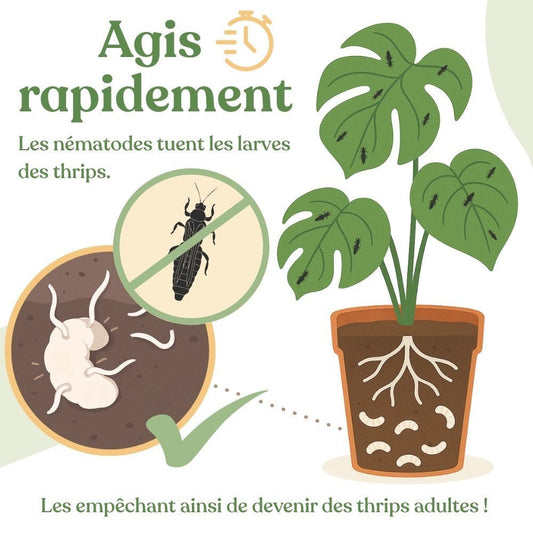
Nematodes are neither a chemical product nor a laboratory invention: they’re microscopic worms found naturally in moist soils around the world. Of the thousands of species, some are harmful to crops, while others are valuable allies: entomopathogenic nematodes, which parasitize insects. Steinernema feltiae is the recognized specialist in sciarid flies.
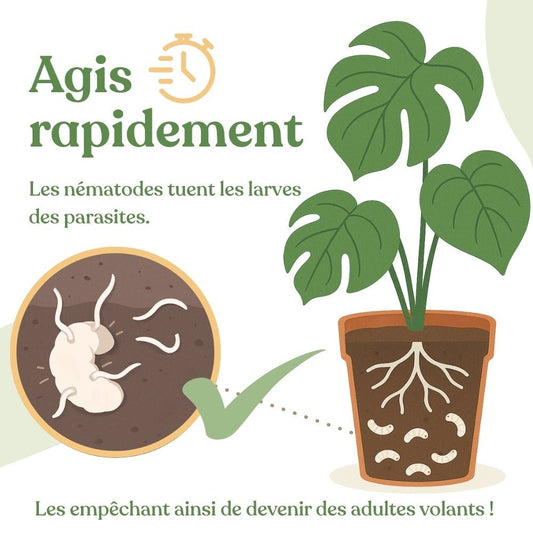
In practice, it finds the larvae in the potting soil, enters through their natural openings, and releases a symbiotic bacterium that kills them in less than 72 hours. The nematode then multiplies inside the larva, and a new generation sets off in search of prey, so the effect continues for several days after application. No odor, no residue, and no risk to your plants, hands, children, or pets.
This is the very principle of biological pest control: using a living organism to restore balance, instead of a pesticide that would affect everything. It also explains why nematodes succeed where surface sprays fail: they go after the problem at the heart of the growing medium.
🔬 Felti nematode fact sheet
| Characteristic | Steinernema feltiae |
|---|---|
| 🌳 Type of organism | Entomopathogenic nematode, a microscopic soil worm |
| 🔎 Target | Fungus gnat (sciarid fly) larvae |
| 🔎 How it works | Enters the larva and releases a bacterium that neutralizes it from within |
| ⏳ Time to take effect | About 72 hours |
| 🌡️ Ideal temperature | Soil between 10 and 25 °C |
| 🚨 Safe for | Plants, people, animals, and pollinators |
| 🔎 Storage | Refrigerate and use promptly |
| 🔎 Application | Dilute in watering water, preferably in the evening |
🚿 How to apply nematodes, step by step
Application requires no special equipment: a watering can is all you need. The key is to follow these four steps.
| Step | What to do |
|---|---|
| 1. Dilute | Empty the sachet into clean, room-temperature water, using the amount you’d normally use for watering |
| 2. Mix | Stir for 1 to 2 minutes to distribute the nematodes evenly |
| 3. Water | Pour directly onto the potting soil of the affected plants, as you would when watering normally |
| 4. Don’t rinse | Leave the treatment to work: keep the potting soil moist for 10 to 15 days |
One thing that often comes as a surprise: never rinse after application. The nematodes need to stay in the potting soil and come into contact with the larvae. That’s also why you should keep the growing medium moist in the days that follow, giving them time to explore the root ball. Allow one to two weeks for the treatment to run its course, even though you’ll notice the first effects within 72 hours.
columns: 4
columns_mobile: 2
-
Felti Nematodes (SF) - Soil fly control - Fungus gnat control - Sciarid control
Regular price From 12,99 €Regular price19,50 €Sale price From 12,99 €Sale -

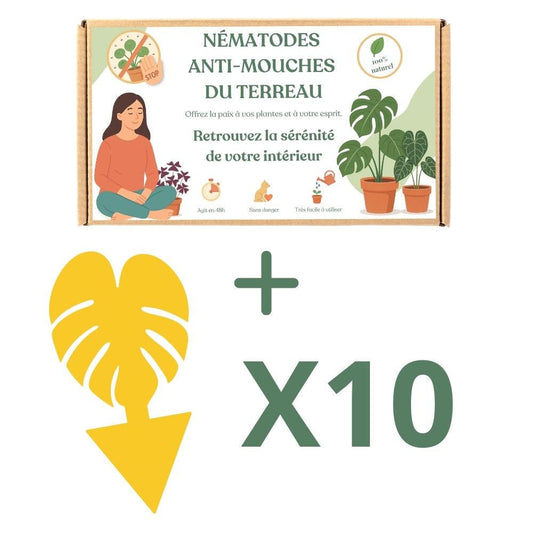
Nematode Duo for Gnat and Thrip Control + 20 Free Sticky Traps - 10 Million Nematode Pack for Each
Regular price 45,00 €Regular price62,96 €Sale price 45,00 €Sale -
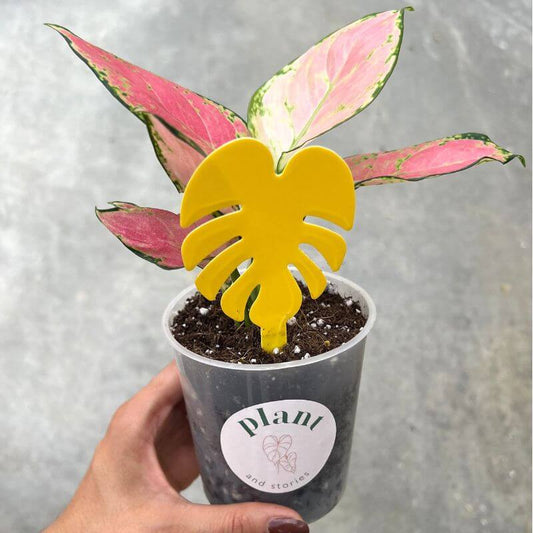
Yellow Sticky Traps for Fungus Gnats - Fungus Gnats - Double-Sided
Regular price From 7,50 €Regular price7,50 €Sale price From 7,50 € -
DUO OFFER - Blue Thrips Traps + Yellow Fungus Gnat Traps - Chromatic Sticky Traps
Regular price 14,00 €Regular price15,00 €Sale price 14,00 €Sale





🌡️ Conditions for guaranteed success
Nematodes are living organisms: a few simple adjustments can make the difference between an average result and complete eradication. Each of these factors has a specific biological reason, and overlooking them explains almost all treatment failures.
| Factor | Ideal conditions |
|---|---|
| 💧 Moisture | Keep the potting soil moist for 10 to 15 days, never waterlogged |
| 🌙 Light | Apply in the evening: UV rays weaken nematodes |
| 🌡️ Temperature | Soil between 10 and 25 °C |
| 🧪 Compatibility | Don’t use insecticides or fungicides within 7 days |
| ⏱️ Freshness | Use the sachet soon after delivery and keep it cool |
📅 A season-by-season gnat control calendar
Sciarid flies thrive when potting soil stays moist and warm. Here’s what to do in each season.
📅 Seasonal care calendar
| Season | Key action |
|---|---|
| 🌸 Spring | Apply for the first time as soon as adults appear, once the soil temperature rises above 10 °C. |
| ☀️ Summer | Keep a close eye on things: warmth and frequent watering speed up the life cycle, so reapply if needed. |
| 🍂 Fall | Treat plants brought indoors, as they often carry larvae. |
| ❄️ Winter | Water less often and let the surface dry out: this is the best way to prevent them in winter. |
⚖️ Nematodes, traps, or chemicals: a comparison
To break the gnat life cycle for good, tackle both stages: larvae in the soil and flying adults. A single method always leaves one stage untouched, while combining nematodes and traps attacks both stages of the life cycle at once. Here’s how each option measures up.
| Method | What it does | Verdict |
|---|---|---|
| S. feltiae nematodes | Eliminate larvae at the source, in the potting soil | The lasting, long-term solution |
| Yellow sticky traps | Catch adults and stop them laying eggs | Essential backup at the surface |
| Chemical insecticide | Kills visible adults but leaves larvae unharmed | Short-lived effect, disrupts the soil |
| Letting the potting soil dry out | Slows egg-laying | Useful as a preventive measure, but not enough on its own |
🛠️ Why a treatment fails (and how to prevent it)
When nematodes seem ineffective, it’s almost always a matter of conditions, not the product.
| Symptom | Likely cause | Solution |
|---|---|---|
| Gnats still present on day 7 | ⚠️ Adults haven’t been trapped, so egg-laying continues | Add yellow sticky traps to every pot |
| No visible effect | ☀️ Sachet is too old or was stored in a warm place | Use a fresh batch stored in the refrigerator |
| Nematodes ineffective | 💧 Potting soil is too dry or has been treated with chemicals | Moisten it again and wait 7 days after using any insecticide |
| Reinfestation after 3 weeks | ⚠️ The life cycle hasn’t been broken | Repeat the application once |
✅ Key takeaways
To get rid of fungus gnats, target the larvae, not the adults. Steinernema feltiae nematodes do this naturally within 72 hours, with no risk to your home—especially when combined with yellow sticky traps.
Remember the three-step approach: identify the sciarid fly so you don’t treat blindly, apply nematodes in the evening to moist potting soil, then maintain that moisture for two weeks to let these living organisms do their work. This is a long-term solution, not a quick fix—and that’s precisely what makes it reliable over time.
In ten years of caring for indoor plants, I’ve never found anything more reliable than nematodes against sciarid flies. The only real secret is keeping the soil consistently moist for the first two weeks: that’s when it all happens.

Laura Bruneau
Jardinière & autrice