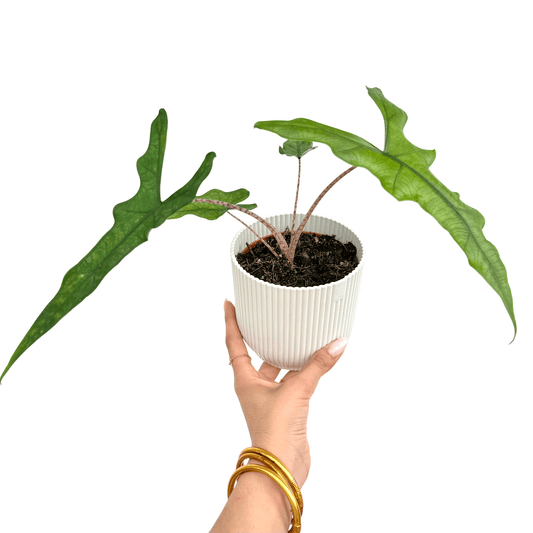
How to care for an Alocasia? A complete guide

How to Care for an Alocasia: A Complete Guide

The Alocasia family includes more than 70 species , all renowned for their spectacular leaves , often heart- or arrow-shaped , with prominent veins that create a striking contrast.
Originating from the tropical forests of Southeast Asia and Australia , these plants bring an irresistible touch of exoticism.
Alocasia plants are distinguished by their unique appearance , with leaves that vary in size , shape and color depending on the species, ranging from deep green to silvery or purple tones.
Although prized for their beauty, these plants can be slightly demanding in terms of care, requiring special attention to humidity, light, and temperature.
This article will guide you through the essential steps to keep your Alocasia healthy.
1. Light exposure: Where should you place your Alocasia?
Alocasia prefers bright but indirect light .
Too much direct light can burn its delicate leaves, while too little light can slow its growth.
Place your plant near an east- or west-facing window , where it can receive soft light in the morning or late afternoon.
If your space is darker, consider using a grow light to supplement natural light.
2. Watering: Finding the right balance
Watering is crucial to maintaining a healthy Alocasia .
It does not tolerate excess water.
Ensure the substrate is completely dry before watering.
When is the right time to water?
Insert your finger into the soil to check the moisture. If the substrate is dry beneath the top layer of potting soil, it's time to water. Use room-temperature water and avoid leaving the plant in a saucer full of water to prevent root rot .
3. Temperature and humidity: Creating an optimal environment
Alocasia originates from tropical regions, so it prefers warm and humid conditions.
Maintain an ambient temperature between 18°C and 25°C for optimal growth. It will thrive in high humidity, ideally 60% or more .
To increase humidity, especially in summer, place your plant on a tray of pebbles with water , use a humidifier, or mist its leaves regularly.
4. Fertilization: Feeding your Alocasia
To encourage healthy growth and robust leaves, fertilize your Alocasia once a month during the growing season ( spring and summer ).
Use a balanced liquid fertilizer , diluted to half the recommended dose. In autumn and winter, reduce fertilization, as the plant enters a period of dormancy.
We recommend our Green Plant Fertilizer . It is easy to use , practical , and very effective .
5. Repotting: When and how to do it?

Alocasia needs repotting every 1 to 2 years, depending on its growth.
If you notice that the roots are starting to come out of the drainage holes or if the plant looks crowded, it's time to repot it.
Choose a pot with drainage holes, preferably transparent , slightly larger than the previous one, and use well-draining potting soil .
The transparent pot will allow you to observe the development of the root system and easily monitor the moisture of the substrate, thus helping to avoid overwatering or, conversely, excessively long periods of drought.
For repotting, we recommend a mixture of potting soil enriched with essential elements, coconut chips , and perlite , to retain moisture while allowing good drainage.
Our " Araceae Substrate " perfectly meets the requirements of Alocasia. Make life easier and enjoy a custom-made mix that promotes healthy and sustainable growth.
6. Size and care : Keeping your plant in shape
Alocasia requires little pruning, but it is important to remove yellowed or damaged leaves to encourage new growth.
Cut off unwanted leaves at the base of the stem with clean scissors to prevent infection.
How to propagate an Alocasia: A step-by-step guide to successful cuttings.

Alocasia can be propagated by division ( bulbulb ) rather than by traditional stem cuttings. The classic stem cutting method does not work for Alocasia.
Choose a mature plant and gently remove it from the pot.
Gently detach the bulbils , ensuring that each division has healthy roots and, ideally, a leaf.
If some bulbils do not yet have leaves, separate them anyway and plant them in a transparent pot filled with sphagnum moss, where they will develop quickly.
Note that the sphagnum moss must remain moist but definitely not waterlogged.
Then replant the bulbils after several weeks of development in a suitable substrate such as our Araceae Substrate .
7. Common problems and solutions
Like any plant, Alocasia can encounter some problems.
If you notice yellowing leaves , this could be due to overwatering or insufficient light. Brown leaves , on the other hand, may indicate low humidity or insufficient watering.
Make sure you follow the watering and lighting advice mentioned above to avoid these problems.
Expert tip: Alocasia is a plant susceptible to pests such as mealybugs, spider mites and thrips.
Inspect regularly to prevent any signs of infestation.
In case of infestation, treat with natural and biological methods such as black soap.
Find our organic recipe for fighting pests on the product page of our black soap for plants .
For greater effectiveness, we recommend applying the solution with our pair of microfiber plant cleaning gloves .
It will allow you to gently eliminate unwanted elements.
Conclusion
The Alocasia is a spectacular plant which, with careful attention, can become the focal point of any room.
By following these simple tips , you can ensure that your plant remains healthy and continues to impress you with its majestic leaves .
Remember that each Alocasia has unique needs, so monitor it regularly and adjust your care accordingly.
HERE ARE OUR EXPERT ADVICE:
-
Choose a location near a window , avoiding direct sunlight for optimal growth.
-
Water when the soil is dry throughout. Does not tolerate overwatering.
-
Maintain a comfortable room temperature, without exposure to drafts.
-
Increase the humidity around the plant if possible, especially during the summer.
-
Use a well-draining potting mix to avoid excess water.
-
Propagate by dividing the rhizomes to multiply your collection or share with friends.
-
Inspect the leaves regularly for any signs of pests.
-
Clean the leaves to promote good photosynthesis.

Laura B.