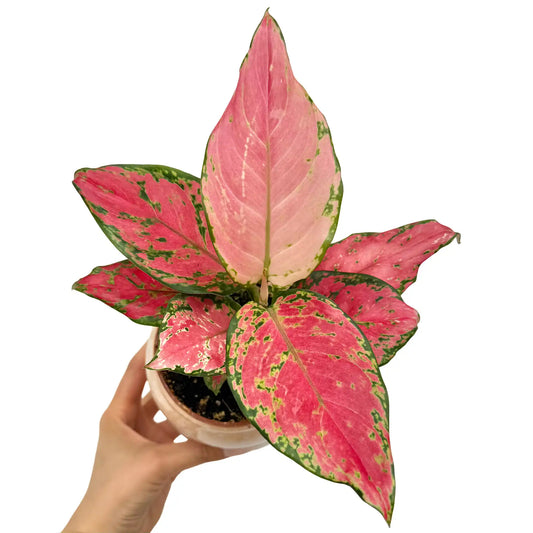
Aglaonema, a touch of the tropics to enhance your interior
Aglaonema : la plante d’intérieur facile et colorée qui ne demande (presque) rien
Vous cherchez une plante d’intérieur décorative, résistante et facile à vivre ? L’Aglaonema est un choix idéal. Avec son feuillage panaché aux nuances de vert, d’argent ou de rose, il apporte une touche tropicale sans contrainte. Peu exigeant en lumière, tolérant aux oublis d’arrosage et parfait pour les intérieurs, il s’adapte à tous les niveaux. Dans ce guide, découvrez comment entretenir votre Aglaonema et le mettre en valeur chez vous.

With its variegated leaves and slightly retro look, the Aglaonema has everything going for it. It's a tropical plant, but without any fuss. It thrives indoors, grows slowly, and is undemanding. In short, it's perfect for those who want greenery without the hassle .
What makes the Aglaonema so unique?

The Aglaonema originates from the forests of Southeast Asia , where it thrives in the shade, in warm, humid air. Indoors, this makes it a plant that is comfortable away from windows, not too sensitive to missed waterings, and quite hardy.
What we like about her:
- its thick and decorative leaves (green, silver, pink…),
- its compact size which doesn't take up too much space,
- its tolerance to average light ,
- and its simple daily maintenance .
Aglaonema pink and silver: two reliable choices
- Aglaonema Pink offers vibrant shades of pink or salmon. Ideal for brightening up a dull corner.
- The Silver Queen , on the other hand, is softer, with green leaves marbled with silver. Perfect in a simple or plant-filled decor.
There are also smaller sizes available, perfect for shelves or desks.
What are the ideal conditions for growing an Aglaonema?
The Aglaonema isn't particularly fussy, but if you really want to see it thrive, it's best to provide an environment that somewhat resembles its native jungle. Warmth, humidity, and indirect light: three essential elements .

Light: no need for full sunlight
There's no need to place it in full sun. The Aglaonema prefers soft light , or even slightly shaded spots. It will thrive near a window, provided that direct sunlight doesn't hit its leaves.
If it receives too much light:
- Its foliage may turn pale or burn,
- Growth may slow down.
In winter, feel free to move it a little closer to a source of natural light, without exposing it to cold drafts.
Temperature and humidity: tropical, but temperate.
This tropical plant thrives in stable conditions. A temperature between 18 and 24°C is ideal. Avoid sudden temperature changes and rooms that are too cold (not below 15°C).
Regarding humidity:
- If the air is too dry, the tips of the leaves may turn brown.
- Lightly misting or placing the pot on a bed of clay pebbles with a little water underneath can make all the difference.
The Aglaonema doesn't like dry environments . If you heat your home a lot in winter, consider slightly humidifying the air around it.
How to properly care for an Aglaonema?
The Aglaonema isn't fussy, but like any tropical plant, it has its preferences. Good care isn't necessarily about overdoing it, but rather understanding what the plant truly needs throughout the seasons.
Controlled watering: neither dry nor soggy
Watering is often the key. Contrary to popular belief, it's not a matter of a fixed frequency , but of observation. The soil should be slightly moist , never soggy. Before watering , simply run a finger through the soil: if the top two centimeters are dry, it's the right time.
Indicative frequency:
- Spring/summer : about once a week , or even twice in case of high heat or very dry air.
- Autumn/winter : reduce watering to every 10 to 15 days . The cooler the room, the less the plant needs.
And be careful about the water you use : opt for room temperature, soft water . If your tap water is very hard, let it sit for 24 hours or use filtered water.
Sign of proper watering:
- green, taut leaves ,
- a pot that remains stable, without stagnant water in the saucer.
To avoid:
- Excess water : this causes yellowing of the foliage and root rot.
- watering too lightly, where the water runs directly to the bottom without moistening the root ball.
Repotting to stimulate growth
Repotting is necessary every 2 to 3 years . If you see roots growing out of the drainage holes in the pot , it's a clear sign. Choose a pot that's slightly larger in diameter and has drainage holes.
Key steps:
- Carefully remove the plant from its pot.
- Remove some of the old topsoil (without breaking the roots).
- Place in a fresh mix: 2/3 potting soil for houseplants + 1/3 perlite or sand to improve aeration .
- Pack down firmly without compressing too much, then water lightly .
Repotting in spring is ideal: recovery will be faster thanks to the rise in temperature and the resumption of growth .
Bonus: a small application of fertilizer
A balanced liquid fertilizer , applied every 3 to 4 weeks from spring to summer, promotes dense and colorful foliage . Avoid fertilizing in winter: the plant is dormant.
How to incorporate an Aglaonema into your interior decoration?

The Aglaonema is not just an easy-care plant. With its variegated leaves and shades of green , pink , or silver , it has real decorative potential . Simply position it correctly and maintain a few visual balances, and it will transform any corner of your home.
A touch of greenery that changes the atmosphere
Certain varieties , such as Aglaonema pink or Aglaonema silver queen, bring a touch of tropical freshness , even to an urban studio. With their glossy, colorful foliage, they attract attention without stealing the show. They are plants that soften the space while adding structure and depth .
It can be installed:
- on a low piece of furniture or a shelf, to emphasize its bushy shape .
- in a hanging pot in a bright bathroom (the humidity is often ideal there),
- paired with plants with finer foliage (like ferns or a calathea), to play on textures.
And if you like collections ? Aglaonema offer a beautiful range of compact (mini) varieties , perfect for creating a tropical corner.
Which style for which aglaonema?
- For a modern interior , opt for a simple pot in white or grey ceramic and let the graphic foliage speak for itself.
- In a more bohemian or jungle-themed decor , dare to use natural fiber baskets and hanging decorations.
- In a minimalist space , a single well-displayed plant can be enough to liven up a somewhat empty corner.
The key is to choose a bright location without direct sunlight , such as near an east or north-facing window , to enhance the colours without risking burning the leaves .
Some decorating and wellness tips
- Combine Aglaonema with other air-purifying plants to create a true wellness corner (such as spathiphyllum or pothos).
- Vary the pitches to add rhythm to your composition.
- Rotate the pot regularly for even growth and to prevent the plant from leaning too far towards the light.
Conclusion
The Aglaonema ticks all the boxes: easy to care for , attractive , and well-suited to indoor life . Whether you're a beginner or a seasoned gardener, this tropical plant will find its place in any setting without requiring constant attention. Proper watering, suitable potting soil , and a little indirect light will reward you with vibrant foliage all year round.
FAQ
What is the best light conditions for an aglaonema indoors?
The aglaonema prefers indirect light . It tolerates partial shade well, but its colours will be more vibrant if it is placed near a well-lit window, without direct sunlight.
Does an aglaonema need a lot of watering?
No, this plant doesn't like too much water . It's best to wait until the top of the soil is dry before watering again. In winter, watering should be spaced out even further.
What is the ideal temperature for an aglaonema?
This tropical plant likes mild temperatures , around 18 to 24°C . It dislikes the cold: below 15°C, it begins to suffer.
Is it easy to repot an aglaonema?
Yes, every 2 to 3 years , when the roots fill the pot. Use a light, well-draining potting mix , and choose a slightly larger pot with drainage holes.
Is the aglaonema toxic to animals?
Yes, like many houseplants, the aglaonema can be toxic if ingested . It's best to keep it out of reach of cats, dogs, or rabbits .

Laura B.