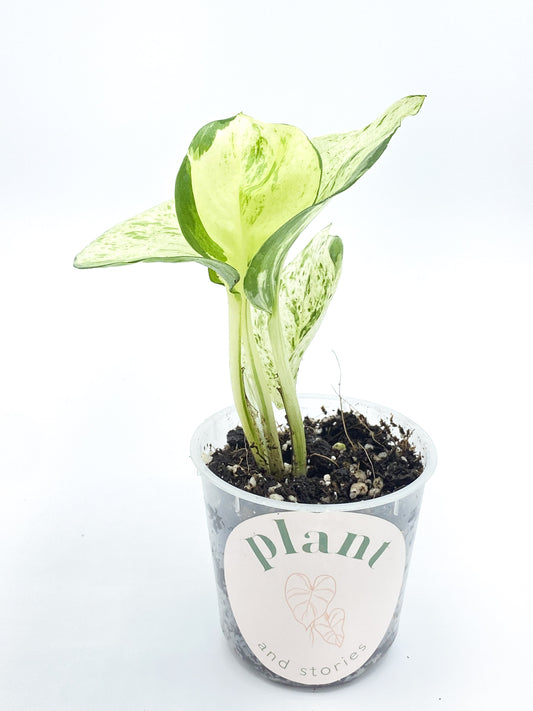
Marble Queen Pothos (Epipremnum aureum): care and variegation

To care for a Marble Queen pothos, give it bright, indirect light, water when the potting mix has dried out on the surface, and keep it warm and away from drafts: light is what preserves its white variegation. The Marble Queen plant, also called Epipremnum Marble Queen or variegated pothos, is a cultivar of Epipremnum aureum, the pothos in the Araceae family.
It is still sold under labels such as Scindapsus Marble Queen, Epipremnum pinnatum 'Marble Queen' or the translated name “Marble Queen.” This guide covers what’s different about this variegated cultivar: light, browning white areas, growth, propagation, and how it differs from N'Joy, Pearls and Jade, or Snow Queen.
For the basics that apply to all pothos, see our complete pothos guide.
🌿 Why choose a Marble Queen pothos?
Because it offers the brightest variegation of the classic pothos varieties while retaining their easygoing nature.
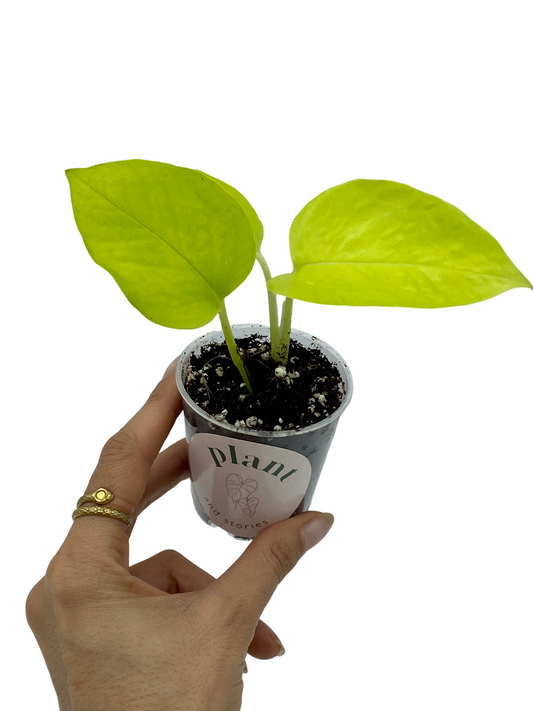
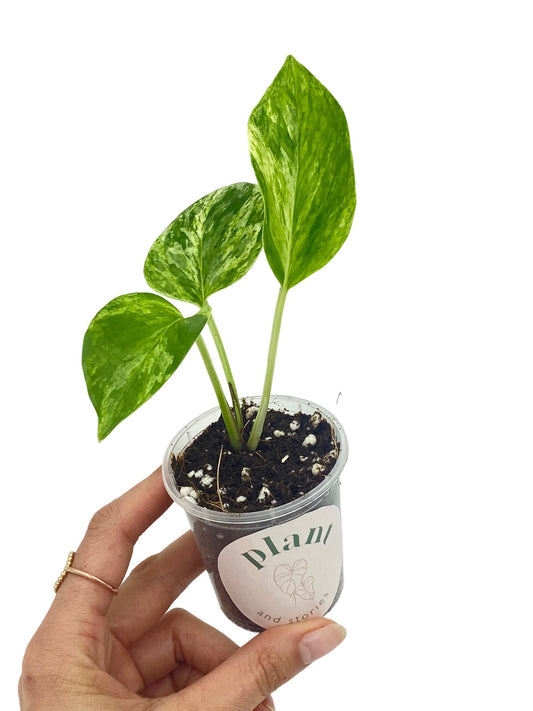
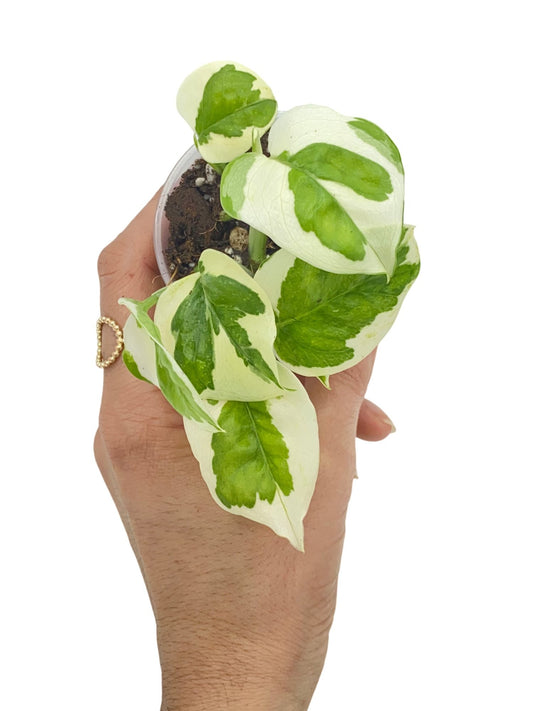
According to NC State Extension (North Carolina State University's outreach service), its green leaves and stems are marbled with white, while golden pothos is variegated yellow and green and Neon has yellow leaves.
It climbs or trails: the RHS describes it as an evergreen vine that attaches itself with its roots, which can be trained up a moss pole or allowed to trail. Its only real quirk is its light requirement.
According to Clemson University's extension pothos guide, it needs more light than other varieties, and UF/IFAS notes that variegated cultivars lose their color in low light. In the right spot, it grows easily and is very easy to propagate.
| Advantage | What it means for you |
|---|---|
| White marbling on leaves and stems | A bright touch, different on every leaf |
| Climbing or trailing growth habit | On a moss pole, a high shelf, or in a hanging planter |
| Easy to propagate in water | One stem cutting with a node is all it takes to propagate the plant |
| Tolerates missed watering | It prefers to be kept a little on the dry side rather than waterlogged |
🔎 Marble Queen pothos at a glance: Epipremnum, not Scindapsus or Philodendron
According to POWO (Plants of the World Online, the Royal Botanic Gardens, Kew database), the accepted name of the species is Epipremnum aureum (Linden & André) G.S.Bunting, a vine in the Araceae family native to Mo'orea in the Society Islands.
Scindapsus aureus and Pothos aureus are synonyms, which is why you may still see it labeled Scindapsus Marble Queen, even though true Scindapsus belong to another genus, described in our Scindapsus guide. It is not a Philodendron either, despite the “Marble Queen philodendron” label you may occasionally come across.
In the RHS profile for 'Marble Queen', it is listed as Epipremnum pinnatum 'Marble Queen' and E. aureum 'Marble Queen' is cited as a synonym; NC State notes that pothos was once treated as E. pinnatum 'Aureum' and is now recognized as a distinct species.
The two labels therefore refer to the same plant: the name used by POWO and NC State is Epipremnum aureum, while the RHS still retains the former classification under E. pinnatum.
| Feature | Verified details |
|---|---|
| 🏷️ Botanical name | Epipremnum aureum 'Marble Queen'; also listed as Epipremnum pinnatum 'Marble Queen' (RHS) |
| 🧬 Family | Araceae |
| 🌳 Type | Evergreen vine that attaches itself with its roots; climbing or trailing |
| 🌍 Origin | Species native to Mo'orea, Society Islands (POWO); horticultural cultivar |
| 🍃 Foliage | Green leaves and stems marbled with white (NC State), about 12 × 8 cm (UF/IFAS) |
| 🌸 Flowers | Very rare: pothos rarely flowers, according to UF/IFAS |
| 📏 Size | 2.5 to 4 m long, 0.5 to 1 m wide, over 5 to 10 years (RHS) |
| ⚠️ Toxicity | Toxic to dogs and cats; contains calcium oxalate (ASPCA) |
📋 Quick care facts
Essential growing guidelines, all in one glance.
| Requirement | Guideline |
|---|---|
| Light | Bright and indirect; more light than green pothos |
| Watering | When the top 2 cm has dried out; water less in winter |
| Potting mix | Well-draining potting mix for houseplants, in a pot with drainage holes |
| Humidity | Average household humidity; no misting |
| Temperature | 21 to 27 °C; minimum 10 to 15 °C |
| Repotting | In spring, when the roots fill the pot |
| Fertilizer | Balanced liquid fertilizer once a month during the growing season |
| Toxicity | Toxic to dogs and cats (ASPCA) |
| Difficulty | Easy, as long as it gets enough light |
📍 Where should you place a Marble Queen pothos to preserve its white variegation?
Place your Marble Queen near a bright window facing east or west, or behind a sheer curtain on a south-facing window. According to the RHS Epipremnum growing guide, it needs bright, indirect light and protection from direct summer sun, which scorches the foliage; the RHS also notes that deep shade results in poor growth and less variegation.
According to the University of Florida's Epipremnum growing guide (UF/IFAS), the plant can survive at 50 foot-candles (about 540 lux), but variegated cultivars lose their color at that level, while at least 150 foot-candles (about 1,600 lux) preserves leaf color and size.
For warmth, UF/IFAS recommends around 21 to 27 °C (70 to 80 °F) indoors, and the RHS rates Marble Queen H1B, with a minimum of 10 to 15 °C.
If your room is dark, our guide to plants for dark rooms can help you choose more tolerant plants; otherwise, add a grow light.
☀️ Light: East- or west-facing window, or a south-facing window with a sheer curtain; never expose the white areas to direct summer sun
🌡️ Warmth: 21 to 27 °C, away from cold drafts and radiators; keep above 10 to 15 °C
🧗 Support: Moss pole for climbing, or a hanging planter and high shelf for trailing
🪴 Repotting a Marble Queen pothos: when and how
Repot in spring, when the roots fill the pot or grow out through the drainage hole. The RHS recommends standard houseplant potting mix; the key is good drainage in a pot with holes, as NC State links excess water to root rot and browning leaf edges. A pot just slightly larger is enough.
If you’ve just bought it, first read our guide to repotting a plant after purchase: there’s no rush unless the root ball is cramped.
| Step | What to do |
|---|---|
| 1. Choose the right time | In spring, when growth starts again |
| 2. Choose a pot | Just one size larger, with drainage holes in the bottom |
| 3. Prepare the potting mix | Well-draining houseplant potting mix, such as our universal potting mix enriched with biostimulants |
| 4. Remove the plant and inspect it | Loosen the root ball and cut off any soft or black roots |
| 5. Repot and water | Add a support if needed, water, then empty the saucer |
columns: 4
columns_mobile: 2
-
-
-
-
Pothos Mysteries Box - Surprise Pothos Pack - Trailing Plants
Regular price From 19,95 €Regular price23,85 €Sale price From 19,95 €Sale -

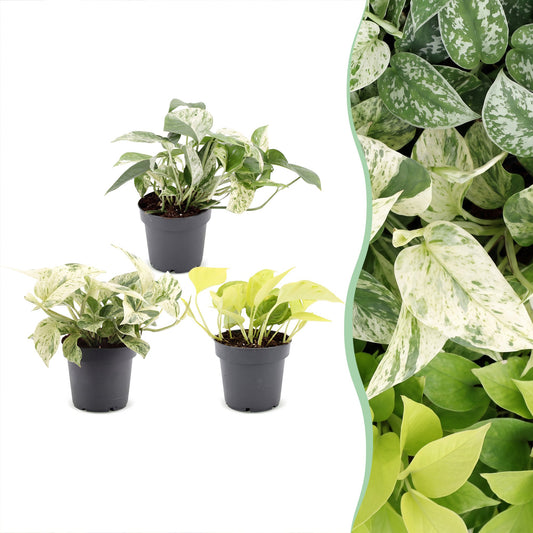
Set of 3 baby Pothos plants: Champs Élysées, Snow Leopard and Marble Variegata – 6 cm pot
Regular price From 69,95 €Regular price -

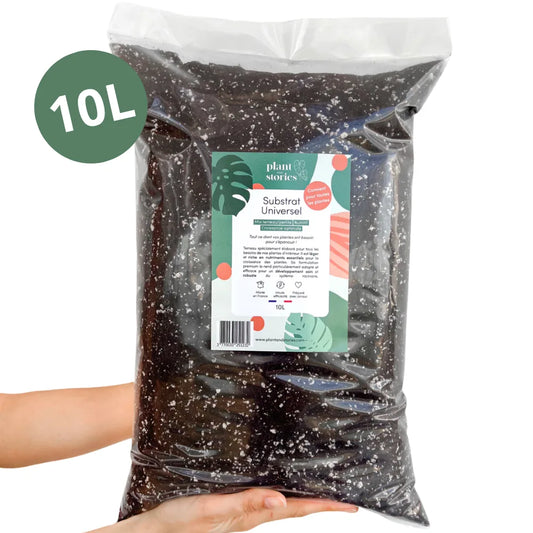
Universal Substrate enriched with Mycorrhizae and Bacillus - Premium Quality - Universal potting mix
Regular price From 9,50 €Regular price8,50 €Sale price From 9,50 €







✂️ Marble Queen pothos care: watering, fertilizing, and pruning
Marble Queen is grown like other pothos, but has a narrower margin when it comes to light. UF/IFAS notes that it does better indoors when kept “a little on the dry side”: a missed watering is better than a waterlogged pot.
💧 Watering: Let the top 2 cm of potting mix dry out before watering (RHS); water thoroughly during the growing season, moderately in winter, and always empty the saucer.
🌱 Fertilizer: The RHS recommends a balanced liquid fertilizer once a month during the growing season; we don't fertilize in winter. See when to fertilize houseplants for a schedule.
✂️ Pruning: Pinch the tips of the stems in spring to encourage branching (RHS): the plant will grow bushier, and you'll have cuttings to propagate.
💧 Humidity: Average household humidity is fine; our article on misting explains why misting doesn't really help.
🪢 Support: For larger leaves, train the stems up a moss pole; see our guide to supporting climbing plants.
🍂 Marble Queen pothos through the seasons
Marble Queen responds to light. From spring to late summer, it produces its marbled leaves: this is the time to repot, fertilize monthly, and take cuttings. In fall, space out watering.
In winter, move it closer to the window, keep the potting mix drier, stop fertilizing, and protect it from the cold: UF/IFAS reports that a few hours at around 1 to 4 °C (33 to 40 °F), or a sudden temperature change, can cause brown spots in the center of the leaves.
Keep this in mind when transporting the plant in winter, and read our guide to temperature shock before moving it.
📅 Seasonal care calendar
| Season | Key task |
|---|---|
| 🌸 Spring | Repot if needed, pinch back stems, resume monthly fertilizing |
| ☀️ Summer | Active growth: bright, indirect light, water when the potting mix dries out, take cuttings |
| 🍂 Fall | Water less often, give the last feeding, move the plant closer to the window |
| ❄️ Winter | Rest: keep the potting mix drier, don't fertilize, keep above 10 to 15 °C and away from drafts |
🌱 How to propagate a Marble Queen pothos
Cut a stem with at least one node, preferably one with good variegation, and place it in water or moist potting mix. NC State says stems root easily in water, and Clemson emphasizes that a node is essential for roots to form. The RHS recommends taking stem-tip cuttings in summer or layering a stem by laying it on the surface of a nearby pot.
In commercial production, UF/IFAS observes buds emerging within 2 to 3 weeks and roots within 3 to 4 weeks. We prefer to take a section with a good balance of white and green. To choose between water and potting mix, see our guide to propagating in water or potting mix.
🐛 Marble Queen problems: brown or yellow leaves, or leaves turning green
For Marble Queen, most problems stem from light or water. The UF/IFAS troubleshooting chart clearly distinguishes the causes: scorched, necrotic patches limited to the variegated areas result from too much light or heat, and these leaves will not recover.
As for pests, the RHS lists mealybugs, scale insects, and red spider mites; for mealybugs, see how to treat mealybugs.
| Symptom | Likely cause | Solution |
|---|---|---|
| Scorched patches on white areas | 💧 Too much light or heat (UF/IFAS) | Move to bright, indirect light; cut off damaged leaves, as they will not turn green again |
| Brown spots in the center of leaves | ❄️ Cold, around 1 to 4 °C (UF/IFAS), or a sudden temperature change | Move away from cold windows and doors, and avoid sudden temperature changes |
| New leaves are greener and smaller | ☀️ Not enough light (UF/IFAS) | Move closer to the window or add a grow light |
| Older leaves turning yellow | 💧 Potting mix too dry or too wet (UF/IFAS) | Check the moisture with your finger and adjust your watering |
| Blackened leaf edges, soft stems | 🍄 Overwatering and root rot (NC State) | Let it dry out, repot in well-draining potting mix, cut off black roots |
| Cottony clusters, stippled leaves | 🐛 Mealybugs or spider mites (RHS) | Isolate the plant, clean the leaves, treat at the first signs |


🌸 Similar varieties: Marble Queen, N'Joy, Pearls and Jade, Snow Queen
These cultivars look alike on the label, but differ in how they grow. Sources: NC State Extension, Clemson Extension, and the UF/IFAS fact sheet on pothos 'Pearls and Jade'.
| Variety | What makes it special |
|---|---|
| Epipremnum Marble Queen | Green leaves and stems marbled with white (NC State); more green and faster growth than Snow Queen (Clemson) |
| Epipremnum N'Joy | Smaller, thinner leaves, green with cream variegation (NC State); see its dedicated care guide |
| Pearls and Jade | Selected by UF/IFAS from Marble Queen plants; leaves are 7 to 8 cm long, compared with 12 cm on its parent |
| Snow Queen | More pronounced white variegation, without large green areas; requires plenty of bright indirect light (Clemson) |
| Manjula | Grows more slowly and trails less than the other cultivars (Clemson) |
| Epipremnum Global Green | Another variegated pothos in our collection, without the white marbling; its care is covered in our Epipremnum Global Green guide |
🎨 Where to place Marble Queen and what plants to pair it with
Marble Queen’s marbling stands out when it hangs near a window or sits atop a bright bookshelf; our guide to trailing houseplants compares other trailing vines.
Pair it with solid-colored foliage to bring out its white markings, such as Epipremnum Neon, whose leaves are yellow according to NC State. To make an informed choice between cultivars, read the Epipremnum N'Joy guide.
To discover several pothos at once, the mystery pothos box and the set of 3 baby pothos bring together different cultivars; all our pothos are featured in our pothos collection.
A note for anyone who searched for “Marble Queen” in connection with an Aglaonema, Begonia, or Monstera: check the label—this guide is about pothos.
⚠️ Is Marble Queen pothos toxic to cats and dogs?
Yes. In the ASPCA (American Society for the Prevention of Cruelty to Animals) “Marble Queen” listing, Marble Queen, also known as Golden Pothos (scientific name given: Scindapsus aureus), is classified as “Toxic to Dogs, Toxic to Cats,” with calcium oxalate crystals listed as its toxic principle.
NC State describes possible symptoms: irritation and swelling of the mouth and lips, drooling, difficulty swallowing, vomiting, diarrhea, and skin irritation; all parts of the plant are affected. The RHS considers it harmful if ingested and irritating to the skin and eyes: wear gloves when pruning or propagating it.
Hang it out of reach of pets and children, and don’t let the stems trail on the floor. For a home with pets, see our list of non-toxic plants for cats and our non-toxic plants for dogs.
✅ Our expert tips for success
In short, Marble Queen pothos is an easy-care Epipremnum aureum, provided it gets enough light. Place it in bright indirect light, away from direct summer sun; water when the top 2 cm of potting mix have dried out; keep it between 21 and 27 °C, and never below 10 to 15 °C.
Prune in spring, propagate a well-marbled stem cutting with a node, and keep an eye on the white areas: they tell you everything about the light it receives. And keep it out of reach of cats and dogs.
Marble Queen is the pothos I recommend to anyone with a bright window. When its new leaves turn greener, my first instinct is never to fertilize: I move the pot closer to the window and wait for the next growth. I let it dry out a little between waterings and propagate the most beautifully marbled stems in spring to keep the plant dense and bright.

Laura Bruneau
Jardinière & autrice