More than 100,00 € missing translation: "t:settings_schema.cart_progress_bar.settings.text_motivation_last.default" is not present in any of the ["en"] schema locale files
0 €
100,00 €
9.9/10 OVER 3121 REVIEWS ⭐⭐⭐⭐⭐
10% OFF YOUR FIRST ORDER WITH CODE "WELCOME10"
FREE DELIVERY TO A PICK-UP POINT ON ORDERS OVER €100
188K ON INSTAGRAM @plantandstories.shop - JOIN US ! :)
Daily care and tips for Boxwood (Buxus) & Babylon Beauty disease-resistant boxwood
How can you combat box tree moths?
Monitor the foliage from spring onward, remove caterpillars and cocoons by hand, and use a biological treatment based on Bacillus thuringiensis if needed. The most sustainable solution is to plant a resistant variety such as Babylon Beauty or an alternative to boxwood (Japanese holly).
When and how should you prune boxwood?
Prune once or twice a year, in spring and possibly again in late summer, on an overcast day to prevent the sun from scorching freshly cut leaves. Sharp shears or a hedge trimmer will give you clean lines.
Can boxwood be grown in a pot?
Yes, boxwood grows very well in pots and can be used to frame an entrance or add structure to a patio, shaped into a ball or cone. Use a well-drained container, water regularly but sparingly, and repot every 2 to 3 years. Applying fertilizer in spring helps keep the foliage dense.
When should boxwood be planted?
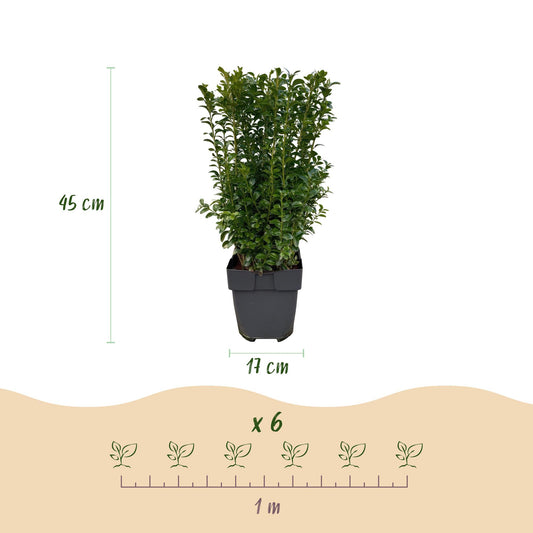
Boxwood can be planted almost any time of year, except during frost or extreme heat, though autumn and spring are preferable. For a crisp border, plant closely (5 to 8 plants per metre) and water well during the first year while the roots establish.
What’s a boxwood alternative that’s resistant to box tree moth?
Two options to avoid box tree moth damage and dieback: plant a resistant boxwood variety such as Babylon Beauty (BetterBuxus®), or choose Japanese holly (Ilex crenata), which perfectly mimics boxwood in borders and topiary without being attacked by box tree moths. Both can be clipped as precisely as traditional boxwood.
Everything you need to know about Boxwood (Buxus) & Babylon Beauty disease-resistant boxwood
What is the difference between common boxwood and Babylon Beauty boxwood?
Babylon Beauty boxwood (BetterBuxus®) is a hybrid selection developed to resist boxwood blight and better tolerate box tree moth, to which common boxwood (Buxus sempervirens) is susceptible. For a new planting with fewer health concerns, Babylon Beauty is the safest choice.
How far apart should you plant boxwood for a border?
For a dense border or low hedge, plant closely: 5 to 8 plants per linear metre, depending on the size of the plants. The faster you want the border to fill in, the closer together you should plant them.
Does boxwood grow quickly?
No, boxwood is slow-growing (about 10 to 15 cm per year). That’s precisely what makes it the ideal plant for topiary and neat borders: it retains its clipped shape for a long time. For a quick effect, start with established plants.
Is boxwood toxic?
Yes, all parts of boxwood (leaves and bark) are toxic if ingested because they contain alkaloids. Simply touching the plant is not dangerous, but it’s best to keep this in mind around young children and pets, and to wear gloves when pruning.
Is boxwood resistant to cold and drought?
Boxwood is very hardy: common boxwood can withstand temperatures of around -20°C, and Babylon Beauty down to -25°C. Once well established, it also tolerates drought. For the first two years, regular watering is still necessary, especially in pots, where the growing medium dries out quickly.
The boxwood (Buxus sempervirens) is a timeless classic for low hedges, borders and topiary: dense evergreen foliage, a compact habit and excellent response to pruning. To avoid disease and box tree moth, discover Babylon Beauty boxwood (BetterBuxus®), a hybrid selection resistant to boxwood decline and hardy down to −25 °C.
The essentials at a glance:
🍃 Foliage: evergreen, very dense, small and glossy
✂️ Uses: borders, low hedges, topiary, spheres
🛡️ Babylon Beauty: resistant to boxwood decline
❄️ Hardiness: very hardy, down to −25 °C
🌓 Position: full sun to partial shade, any well-drained soil
Classic boxwood or disease-resistant Babylon Beauty boxwood?
Common boxwood (Buxus sempervirens) is still perfect for structured borders and topiary on a budget. Babylon Beauty boxwood (BetterBuxus®) is a hybrid selection resistant to boxwood decline and more tolerant of box tree moth: the smart choice for replanting without the health problems associated with traditional boxwood. Available in several pot sizes and in multipacks for borders and low hedges.
Planting, pruning and protecting your boxwood
Boxwood can be planted year-round, as long as the ground is not frozen, in well-drained soil in full sun or partial shade. Plant close together (5 to 8 plants/m) for a neat border. Prune once or twice a year to keep the shape immaculate. Watch out for box tree moth and boxwood decline, or choose a resistant variety from the outset. Find advice on controlling box tree moth and alternatives in our complete boxwood guide.
Buy your boxwood from Plant and Stories
Our boxwood is supplied by Everspring and delivered in pots, individually or in multipacks for borders and low hedges. Fast, secure delivery. Also discover our evergreen foliage and our Privacy Screens & Hedges.