How to Water an Alocasia: A Guide to Getting It Right Every Time

If there’s one thing that determines whether an Alocasia lives or dies, it’s watering. Too much water, and the rhizome quietly rots; too little, and the plant goes dormant. Between the two lies a narrow comfort zone that’s easy to hit once you know what to look for.
This step-by-step guide shows you how to read your plant and its potting mix rather than follow a calendar, based on verified horticultural recommendations.
🌿 Why watering is vital for Alocasia
Alocasia grows from a fleshy rhizome packed with stored reserves. This organ is both its strength and its Achilles’ heel: in waterlogged potting mix, it quickly rots beyond recovery. By contrast, the plant tolerates slight drying out better, even if it has to shed leaves as it goes dormant. Watering is therefore not a routine, but a matter of observation: reading the actual moisture level of the potting mix.
Done well, it keeps the plant thriving; done poorly, it accounts for almost every failure.
| Benefit | What it means for you |
|---|---|
| Better chance of survival | Proper watering prevents rot, the leading cause of Alocasia death |
| Healthy foliage | Soft water and regular watering prevent brown tips and stress |
| Dormancy under control | Understanding winter dormancy prevents you from drowning a sleeping plant |
| Simple routine | A finger test and the weight of the pot are all you need to decide |
🔎 Alocasia at a glance
Before getting into the details, here are a few key facts about the plant. Alocasia is a rhizomatous aroid native to tropical Asia, with roots that hate being deprived of oxygen. Its water needs vary greatly depending on the season and temperature, as explained by the Royal Horticultural Society (RHS). That’s why no fixed watering schedule works: the condition of the potting mix is what matters.
| Feature | Verified details |
|---|---|
| 🌱 Sensitive part | Fleshy rhizome, prone to rot if waterlogged |
| 📏 Watering rule | When the top 2 inches are dry |
| 🚱 Recommended water | Rainwater or filtered water, lukewarm (sensitive to limescale) |
| 🚿 Drainage | Pot with drainage holes; always empty the saucer |
| ❄️ Winter | Minimal watering; dormancy is common |
| 🚨 No. 1 risk | Overwatering and root rot |
| 💦 Humidity | Moderate to high; keep away from dry air from radiators |
| ⚠️ Toxicity | Calcium oxalates: wear gloves |
📋 Quick care facts
Essential growing guidelines, all at a glance.
| Parameter | Guideline |
|---|---|
| When to water | When the top 2 inches of potting mix are dry |
| General frequency | More often in summer, much less in winter, always guided by the potting mix |
| Water | Rainwater or filtered water, at room temperature |
| Method | Water thoroughly, let drain, and empty the saucer |
| Potting mix | Very well-draining aroid mix (potting soil + perlite or gravel) |
| Humidity | Moderate to high; keep away from dry air from radiators |
| Temperature | Above 16°C (61°F) while growing; minimum 10–15°C (50–59°F) |
| Winter | Minimal watering; dormancy is possible |
| Toxicity | Calcium oxalates; gloves recommended |
📍 What to check before watering
There’s no need to water on a fixed schedule. Read your Alocasia: the potting mix, the weight of the pot, and the season tell you everything. Three simple checks will help you avoid drowning your plant.
👆 The finger test: Push a finger into the potting mix; water only if the top 2 inches are dry.
⚖️ The weight of the pot: Lift it: if it’s light, it’s time to water; if it’s still heavy, wait.
📅 The season: Water more regularly in spring and summer, and minimally in winter.
🪴 How to water an Alocasia, step by step
Water thoroughly, then let the potting mix dry out considerably before watering again. The goal is to moisten the entire root ball without ever letting water collect at the bottom of the pot. Follow these steps year-round, simply adjusting how often you water.
| Step | What to do |
|---|---|
| 1. Check the potting mix | Test 2 inches down; water only if it’s dry |
| 2. Water thoroughly | Pour until water runs out of the drainage holes, using lukewarm, soft water |
| 3. Let it drain | Wait 5 to 10 minutes for excess water to drain away |
| 4. Empty the saucer | Never let the pot sit in water |
| 5. Leave time between waterings | Wait until the potting mix has dried out 2 inches down before watering again |
columns: 4
columns_mobile: 2
-

 Livraison offerte
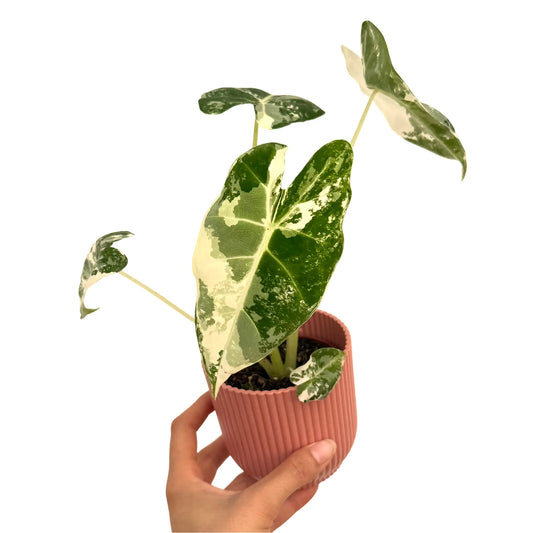
Alocasia Zebrina - 21cm Pot - Height 70-75cm
Regular price From 59,95 €Regular price -

 Livraison offerte
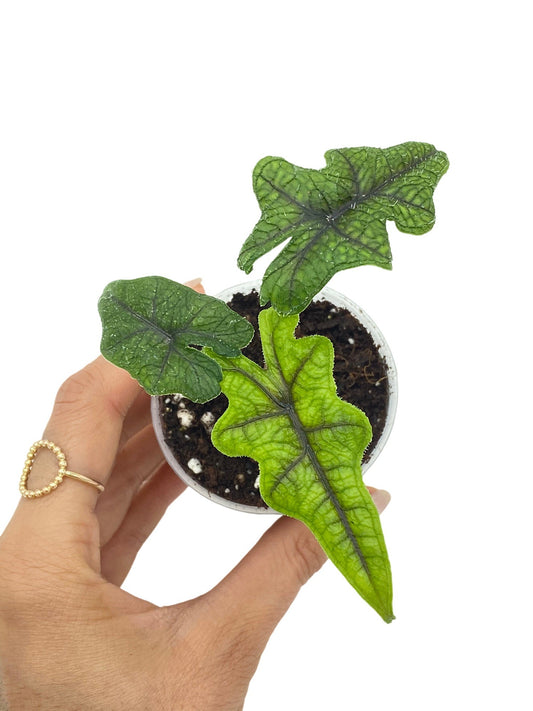
Alocasia Cucullata - Buddha's Hand
Regular price From 49,95 €Regular price -
-


✂️ Adjust watering based on your plant’s signs
Your plant will tell you if you’re watering too much or too little. Learn to read its leaves and adjust accordingly.
💧 Watering: Always water according to the potting mix, never the calendar; water thoroughly, let it dry, and empty the saucer.
💧 Water: Use lukewarm rainwater or filtered water to avoid limescale and temperature shock.
💧 Too much water: Yellow, soft leaves and a softened base: reduce watering immediately and check the rhizome.
💧 Not enough water: Drooping leaves and potting mix pulling away from the pot: rehydrate thoroughly.
🧣 Winter: Reduce watering to the bare minimum; a dormant plant barely drinks at all.
🍂 Adjust watering through the seasons
Watering frequency follows the plant’s growth. In spring and summer, Alocasia drinks regularly: water as soon as the top 2 inches dry out. In fall, space out waterings considerably. In winter, the plant slows down or goes dormant and needs very little water: overwatering at this time of year is a classic cause of rot.
At this point, keep the potting mix barely moist and the plant warm.
📅 Seasonal care calendar
| Season | Key action |
|---|---|
| 🌸 Spring | Gradually resume watering as the rhizome wakes up. |
| ☀️ Summer | Water regularly as soon as the top 2 inches dry out; use soft water. |
| 🍂 Fall | Space out waterings considerably; watch for excess moisture. |
| ❄️ Winter | Minimal watering: keep the potting mix barely moist; dormancy is common. |
🌱 Watering after repotting or division
After repotting or dividing the rhizome, Alocasia is fragile: water sparingly and give it time to settle in. Potting mix that’s too wet around freshly cut roots invites rot. Instead, keep it gently warm at 18–24°C (64–75°F) with good humidity, and wait until the plant shows signs of new growth before returning to a normal watering routine. Wear gloves while handling it, as the sap is irritating.
🐛 Common problems: causes and solutions
Almost every Alocasia problem can be traced back to watering. Here’s how to match symptoms with the right fix.
| Symptom | Likely cause | Solution |
|---|---|---|
| Yellow, soft leaves | 🍄 Too much water, early signs of rot | Reduce watering immediately, check the rhizome, and make the potting mix lighter |
| Soft base, unpleasant smell | 🍄 Rhizome rot (overwatering) | Remove the plant from its pot, cut away the soft parts, then repot in dry, well-draining potting mix |
| Drooping leaves, dry potting mix | 💧 Temporary lack of water | Rehydrate thoroughly, then return to a regular watering routine |
| Brown tips and edges | 🌱 Hard water or dry air | Switch to rainwater or filtered water and increase humidity |
| Leaves dropping in winter | ⚠️ Normal dormancy | Reduce watering to a minimum, keep the plant warm, and be patient |
| Water pooling at the bottom | ⚠️ Poor drainage | Repot in well-draining potting mix, make drainage holes in the pot, and empty the saucer |


🌿 Our picks for further reading
To learn more about Alocasia, explore these dedicated resources, each linking to its own guide.
| Our pick | Why choose it |
|---|---|
| Complete Alocasia care guide | Brings together lighting, potting mix, dormancy, and toxicity |
| Alocasia zebrina | A profile of the star with striped petioles |
| Alocasia Polly | One of the easiest varieties for beginners to grow |
| Large-leaf Alocasia | To understand the space and scale of the genus |
🎨 Watering and placement: an inseparable pair
Watering shouldn’t be considered in isolation: it depends on where the plant is placed. An Alocasia in bright, warm light will drink faster than one in a cool room. Place it somewhere bright and stable, away from drafts, and adjust your watering frequency to suit its surroundings. For a complete overview of its care, our complete Alocasia care guide covers more than just watering.
⚠️ Precautions: handle irritating sap with care
Watering, repotting, or dividing an Alocasia means handling the plant and its sap. Alocasia is highly toxic: its tissues contain needle-shaped calcium oxalate crystals that irritate the skin and eyes (NC State Extension) and are dangerous if ingested by people or animals. The ASPCA classifies it as toxic to dogs, cats, and horses.
Wear gloves when handling the plant, wash your hands afterward, and keep it out of reach of children and pets, as recommended by the RHS.
✅ Our expert tips for success
In short, watering an Alocasia comes down to a simple routine: water only when the top 2 inches are dry, use soft, lukewarm water, always empty the saucer, and cut back drastically in winter. Go by the potting mix and the weight of the pot, never the calendar. Follow this routine to avoid rot—the leading cause of death—and keep your Alocasia thriving for years to come.
My rule boils down to one sentence: when in doubt, don’t water. Alocasia is far more likely to forgive a brief dry spell than too much water. Lift the pot, wait until it feels light, and you’ll almost never get it wrong.

Laura Bruneau
Jardinière & autrice