Alocasia zebrina: care, yellow leaves, repotting, and toxicity

To care for an Alocasia zebrina, place it in bright but indirect light, water only when the top 2 inches of soil are dry, keep it above 15°C (59°F) year-round, and repot it in spring about every two years into a pot that is only slightly larger.
These guidelines come from the RHS (Royal Horticultural Society) Alocasia zebrina profile and its Alocasia growing guide. Its striped stems are hard to miss: it's the zebra-stemmed plant you're looking for when you've forgotten its name.
This guide also answers the questions that cause the most concern: a yellow or drooping leaf, leaf loss in winter, staking, repotting, and toxicity to cats and dogs. For the genus as a whole, see our complete Alocasia guide.
🌿 Why does Alocasia zebrina have zebra-striped stems?
The name zebrina comes from its petioles, the long stalks that support each leaf: according to the RHS, they are striped black and white; NC State describes them as white and green, evoking a zebra's coat.
The accepted name is Alocasia zebrina G.W.Johnson & R.Hogg, published in 1862, according to Plants of the World Online (POWO) from the Royal Botanic Gardens, Kew. POWO lists it as native to the Philippines, where it grows in the humid tropics, and classifies it as a subshrub.
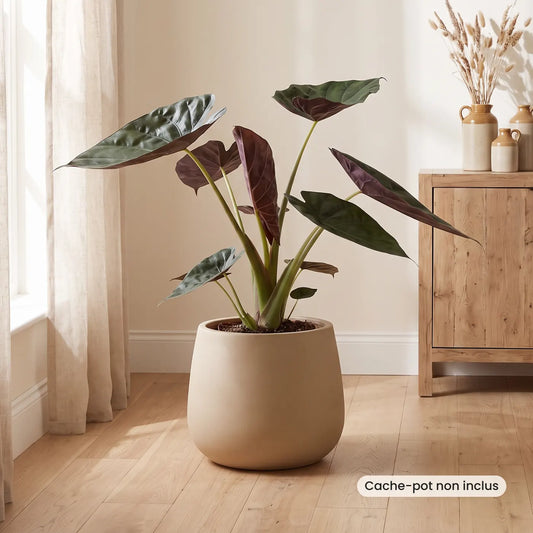
The RHS describes it as an evergreen, rhizomatous, bushy perennial with glossy, dark green, arrow-shaped leaves. Like other Alocasia, it is nicknamed elephant ear. Not to be confused with Tradescantia zebrina and Calathea zebrina, which are different plants; searches for “monstera zebrina” actually refer to this Alocasia, since Monstera is another genus in the Araceae family.
| Benefit | What it means for your home |
|---|---|
| Graphic form | Striped stems that make all the impact, displayed on a low piece of furniture or on the floor |
| Manageable size | 0.5 to 1 m tall and wide indoors, according to the RHS |
| Easy-to-read growth | A new leaf often replaces an old one: the plant shows you what is and isn't working |
| Easy propagation | Offsets that appear at the base can be potted up in spring (RHS) |
🔎 Alocasia zebrina at a glance
Here is the verified profile of Alocasia zebrina. Its name, authors, and origin come from POWO; size, hardiness, and foliage from the RHS; and flowers and genus dimensions from NC State Extension (North Carolina State University). The RHS rates zebrina H1A: it must be kept under cover year-round, above 15°C (59°F).
NC State says it can reach up to 3 feet (about 90 cm) tall and wide, and that it was used as a parent for the hybrid 'Sarian'.
| Characteristic | Verified details |
|---|---|
| 🏷️ Botanical name | Alocasia zebrina G.W.Johnson & R.Hogg (1862); synonym Alocasia wenzelii Merr. (POWO) |
| 🧬 Family | Araceae, like Monstera, Philodendron, and Caladium |
| 🌳 Type | Evergreen rhizomatous perennial, grown as a houseplant (hardiness rating H1A, RHS) |
| 🌍 Origin | Philippines, humid tropics (POWO) |
| 🍃 Foliage | Glossy, dark green, arrow-shaped leaves on long, zebra-striped petioles (RHS) |
| 🌸 Flowers | Rarely seen: small flowers on a cream-white spadix surrounded by a greenish spathe (NC State) |
| 📏 Size | 0.5 to 1 m tall and wide, reached in 2 to 5 years (RHS) |
| ⚠️ Toxicity | Toxic to cats, dogs, and horses: insoluble calcium oxalates (ASPCA) |
📋 Quick care facts
Essential growing guidelines, all in one place.
| Factor | Guideline |
|---|---|
| Light | Bright but indirect; east- or west-facing window; strong sun scorches the leaves (RHS) |
| Watering | Water thoroughly when the top 2 inches of soil are dry, from April to October; water minimally in winter (RHS) |
| Potting mix | Peat-free houseplant potting mix amended with horticultural grit; acidic to neutral pH (RHS) |
| Humidity | Moderate to high (RHS): use a tray of moist pebbles, group plants together, or use a humidifier |
| Temperature | Above 15°C (59°F) year-round, including in winter (RHS species profile) |
| Repotting | In spring, about every two years, into a pot 5 cm wider (RHS) |
| Fertilizer | Liquid fertilizer every 2 to 3 weeks from spring to fall (RHS) |
| Toxicity | Toxic if ingested by pets; sap is irritating, so gloves are recommended |
| Difficulty | Moderate: success depends on watering and warmth in winter |
📍 Where to place Alocasia zebrina: light, exposure, and outdoors
Place your Alocasia zebrina near an east- or west-facing window in a bright room, protected from strong midday sun. The RHS guide is clear: Alocasia grow best in bright, indirect light; strong sun scorches the foliage, while in lower light the plant survives but grows more slowly.
Turn the pot each time you water so it doesn't lean toward the window, advises the RHS. As for warmth, keep it above 15°C (59°F), away from cold drafts and radiators that dry out the air.
☀️ Ideal exposure: An east- or west-facing window, or set back from a south-facing window behind a sheer curtain
🌡️ Warmth: Above 15°C (59°F) even in winter, according to the RHS species profile; above 16°C (61°F) during active growth, according to the genus growing guide
🌳 Alocasia zebrina outdoors: The RHS rates it H1A and recommends growing it under cover year-round above 15°C (59°F): keep it indoors in France; you can try putting it outside in the height of summer, in light shade and sheltered from the wind, only if night temperatures stay above 15°C (59°F)
🪴 Repotting Alocasia zebrina: when and how
Repot Alocasia zebrina in spring, about every two years, when its roots fill the pot. The RHS says an Alocasia can stay in its original pot for about a year, then be repotted in spring if the roots are cramped, into a pot just 5 cm wider each time to avoid excess soil staying wet.
According to Penn State Extension, signs to watch for include roots growing out of the drainage holes, soil drying out very quickly even in cool weather, slowed or halted growth, and roots circling around the root ball.
For potting mix, the RHS recommends a peat-free mix amended with horticultural grit, at a ratio of about three parts potting mix to one part grit; our Aroid potting mix enriched with biostimulants follows the same free-draining approach. To compare mixes, read our Aroid potting mix guide.
| Step | What to do |
|---|---|
| 1. Choose the right time | In spring, when growth resumes; never during winter dormancy |
| 2. Prepare the pot | Use a pot with drainage holes, 5 cm wider than the old one (RHS); don't add a layer of clay pebbles at the bottom—the potting mix is what provides drainage |
| 3. Remove the plant | Ease out the root ball without pulling on the stems; wear gloves, as the sap irritates skin (RHS) |
| 4. Repot | Keep the rhizome at the same level as before and gently firm free-draining potting mix around it; separate any well-rooted offsets while you're at it |
| 5. Water | Water thoroughly, then let it drain well (Penn State); empty the saucer |
columns: 4
columns_mobile: 2
-

 Sold out
-

 Livraison offerte
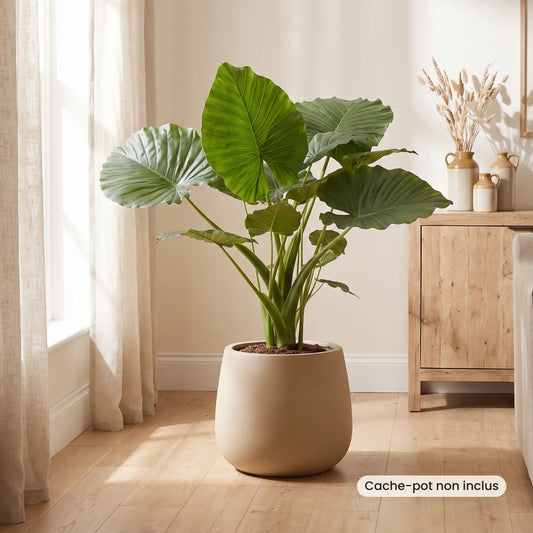
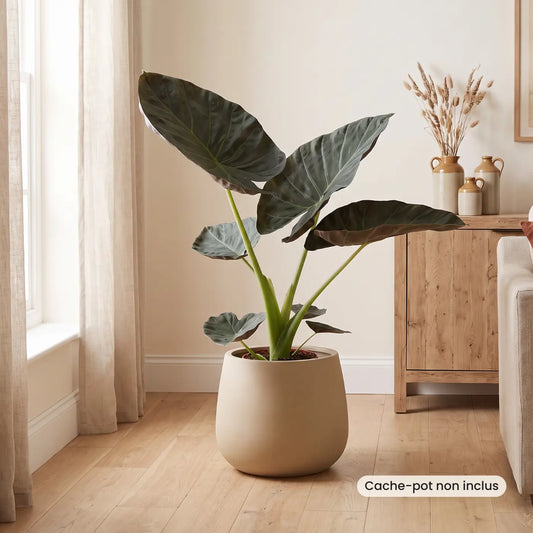
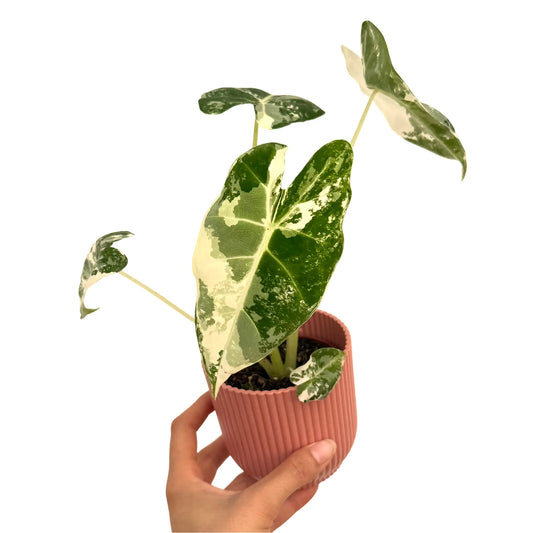
Alocasia Zebrina - 21cm Pot - Height 70-75cm
Regular price From 59,95 €Regular price -

 Livraison offerte Sale
Alocasia Zebrina - Set of 2 plants - 21cm pot - Height 70 - 75cm
Regular price 84,95 €Regular price94,95 €Sale price 84,95 €Livraison offerte Sale -
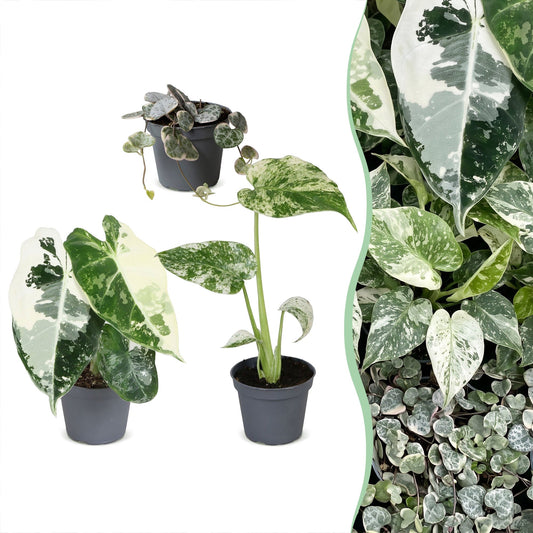
Alocasia Mystery Box - Alocasia Surprises Pack
Regular price From 29,95 €Regular price39,45 €Sale price From 29,95 €Sale -
-
-
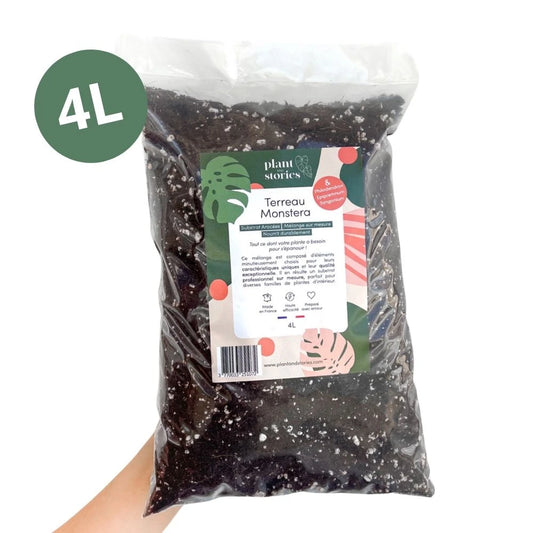
Monstera Soil - Enriched with Mycorrhiza and Bacillus - Araceae Substrate
Regular price From 9,50 €Regular price23,75 €Sale price From 9,50 €Sale -
Transparent climbing plant support - Pack of 3 + free velcro (Monstera, Pothos)
Regular price From 9,99 €Regular price13,89 €Sale price From 9,99 €Sale








✂️ Alocasia zebrina care: watering, humidity, fertilizer, and staking
Alocasia zebrina care is all about balance: keep the soil moist during active growth, but never waterlogged. The RHS guide recommends watering from April to October when the top 2 inches of soil are dry, then watering minimally in winter, as too much water during dormancy can rot the roots.
For step-by-step instructions, see our guide to watering an Alocasia. The air should be moderately to highly humid: dry air encourages spider mites, warns the RHS. Use a tray of moist pebbles or group plants together instead; our article on mist spraying explains why misting the leaves isn't enough.
💧 Watering Alocasia zebrina: Check with your finger: water thoroughly when the top 2 inches are dry, then empty the saucer; in winter, water just enough to stop the root ball from drying out
💧 Humidity: Place the pot on a tray of moist pebbles (RHS), group plants together, or use a humidifier; see our solutions without misting
🌱 Fertilizer: Apply liquid fertilizer every 2 to 3 weeks from spring to fall (RHS), such as our liquid fertilizer for houseplants; don't fertilize in winter
🪢 Alocasia zebrina and staking: No stake is needed as long as the plant gets enough light; for a large plant that leans, use a clear plant stake placed away from the rhizome, tying the stem loosely
🧹 Cleaning: Wipe the leaves with a damp cloth and cut fully dry leaves off at the base
🍂 Alocasia zebrina dormancy in winter: normal or a problem?
In fall and winter, it's normal for your Alocasia zebrina to slow down and lose a few leaves. The RHS notes that Alocasia may lose some of their foliage during winter dormancy, that this is “nothing to worry about,” and that new leaves appear when growth resumes in spring.
The species profile adds that it's normal for it to drop leaves as new ones form. During this dormant period, water minimally, stop fertilizing, and keep the plant above 15°C (59°F). What isn't normal: stems that are soft at the base, a soft rhizome, or a rotten smell.
In that case, it's not dormancy but root rot: remove the plant from its pot, cut off the soft parts, and repot it in dry, free-draining mix. If the rhizome is healthy but leafless, be patient: it often grows again in spring.
📅 Seasonal care calendar
| Season | Key task |
|---|---|
| 🌸 Spring | Growth resumes: repot if the roots are cramped, separate offsets, and start fertilizing again |
| ☀️ Summer | Active growth: water when the top 2 inches of soil are dry, fertilize every 2 to 3 weeks, and provide bright light without midday sun |
| 🍂 Fall | Growth slows: water less often, apply the last dose of fertilizer, and bring the plant indoors if it spent the summer outside |
| ❄️ Winter | Dormancy: water minimally, don't fertilize, and keep it above 15°C (59°F); a few leaves may drop |
🌱 Propagating Alocasia zebrina: offsets and rhizome division
The easiest method, according to the RHS guide, is to remove the offsets that form at the base in spring, keeping as many roots as possible, and pot each one in a small container.
The RHS also suggests dividing the fleshy rhizome in late spring or early summer, then potting up each section; NC State confirms that offsets can be divided for propagation. NC State also mentions corms for the genus, which can be started in pots indoors.
The species profile also mentions sowing seeds at 23°C (73°F) as soon as they ripen, though this is rarely done indoors. Wear gloves for all of these tasks.
🐛 Yellow leaves: causes and solutions
A yellow leaf on an Alocasia zebrina isn't always a problem: it depends on how many leaves are turning yellow and which ones. If only the oldest leaf is yellowing while a new one unfurls, this is the normal renewal described by the RHS.
If several leaves turn yellow or drop at the same time, look at the growing conditions: Iowa State University Extension lists the environment first, followed by overwatering or underwatering, lack of fertilizer, dry air, too much or too little light, a sudden change in exposure, and drafts.
This applies to any yellow Alocasia leaf (whether you're searching for “Alocasia yellow leaf” or “Alocasia zebrina yellow leaves,” the reasoning is the same); for other plants, also see our article on lower leaves turning yellow. Yellow leaves and other symptoms are ranked in the table below, from most common to least common.
| Symptom | Likely cause | Solution |
|---|---|---|
| One yellow leaf, the oldest one | ⚠️ Normal renewal: the plant drops a leaf as a new one forms (RHS) | Let it dry out, then cut it off at the base |
| Yellow, limp leaves, wet soil | 🍄 Too much water: NC State links root rot to overwatering | Let the top 5 cm dry out, empty the saucer, check the rhizome |
| Drooping yellow leaf, stem falling over | ❄️ Not enough light, soil too dry, or cold (Iowa State) | Move it closer to the light, water if the root ball is dry, keep it away from drafts |
| Several yellow leaves in autumn and winter | ⚠️ Normal winter dormancy (RHS) | Minimal watering, no fertilizer, above 15 °C |
| Brown, dry leaf edges | ⚠️ Air too dry: leaves turn brown and then drop (Iowa State) | Tray of damp pebbles, group plants together |
| Pale spots, fine webs under the leaves | ⚠️ Spider mites, encouraged by dry air (RHS, NC State) | Shower the foliage, isolate the plant, increase humidity |


🌸 Our Alocasia zebrina varieties and relatives
There are many trade names associated with zebrina, and not all are described by a botanical source. We sell Alocasia zebrina in several formats: individually, in a set of 2, or direct from the grower, as well as a mystery Alocasia box and other Alocasia plants in our Alocasia collection. Where there is no reference description for a name, we say so.
| Variety | What makes it special |
|---|---|
| Alocasia zebrina | The standard form: zebra-striped petioles, dark green arrow-shaped leaves, 0.5 to 1 m tall (RHS); available from us individually, in a set of 2, or direct from the grower |
| Alocasia zebrina 'Variegata' | Trade name for plants with variegated foliage; rare. None of the botanical sources consulted describes this cultivar, so judge by the actual plant |
| Alocasia 'Black Zebrina', 'Tiger', 'Reticulata' | Trade names associated with zebrina; their identity is not established by POWO, the RHS, or NC State, so we do not attribute any characteristics to them |
| Alocasia 'Sarian' | A. zebrina × A. micholitziana hybrid, 5 to 10 feet (about 1.5 to 3 m) tall, with white veins and wavy edges (NC State) |
| Alocasia Frydek | Alocasia micholitziana with velvety green leaves and white veins, the other parent of 'Sarian': see our Alocasia Frydek profile; also available as Alocasia Frydek Variegata |
| Alocasia Black Velvet | Another Alocasia in our collection, with dark foliage: a way to vary the shapes alongside the zebra-striped stems |
🎨 Which plants pair well with Alocasia zebrina?
Alocasia zebrina shares its needs with other tropical Araceae: warmth, filtered light, and consistently moist soil. It makes a lovely pairing with an Alocasia Frydek with velvety green leaves, which also goes dormant in winter.
A Calathea or a Maranta adds patterns at pot level, and grouping these plants helps keep the air humid. To learn more about the genus, see our Alocasia guide: care, light, and watering.
⚠️ Is Alocasia zebrina toxic to cats and dogs?
Yes. The ASPCA’s “Alocasia” page, which covers the entire Alocasia genus under the common name “Elephant’s Ear,” classifies it as toxic to dogs, cats, and horses because of its insoluble calcium oxalates.
Reported signs include oral irritation, pain and swelling of the mouth, tongue, and lips, excessive drooling, vomiting (except in horses), and difficulty swallowing. The RHS also notes that zebrina is toxic if eaten and can irritate the skin and eyes; NC State rates the genus as moderately toxic.
Keep it out of reach of pets and children, wear gloves when handling it, and call your veterinarian if it is ingested. If you have a cat, see our list of non-toxic plants for cats.
✅ Our expert tips for success
Keep four tips in mind to grow Alocasia zebrina successfully. Give it bright light without midday sun, turning the pot with each watering. Water when the top 5 cm of soil is dry and keep it above 15 °C, especially in winter. Read its leaves: one yellow leaf is normal; several at once mean you should reassess watering, light, or warmth.
Finally, repot it in spring about every two years into a pot only slightly larger, and accept that it goes dormant in winter.
Alocasia zebrina is the plant that gets us the most photos of yellow leaves, especially in November. I always start with the same question: how many leaves are turning yellow? If it’s just one and a new one is emerging in the center, everything is fine. My advice is to water it less when it slows down rather than more, and to keep it near the window even in winter. Its zebra-striped stems are well worth that little bit of extra care.

Laura Bruneau
Jardinière & autrice