More than 100,00 € missing translation: "t:settings_schema.cart_progress_bar.settings.text_motivation_last.default" is not present in any of the ["en"] schema locale files
0 €
100,00 €
🚨 2026 Advent Calendar - Limited Edition!
9.9/10 OVER 3121 REVIEWS ⭐⭐⭐⭐⭐
FREE DELIVERY TO A PICK-UP POINT ON ORDERS OVER €100
188K ON INSTAGRAM @plantandstories.shop - JOIN US ! :)
👉 Mix & Match Offer: buy 2 eligible plants and automatically get 10% off
In stock
Direct from the grower - Delivered within 3–5 days
Secure packaging
30-day plant guarantee
You’re subscribed to alerts for this variant.
Back in stock alert
Get notified first
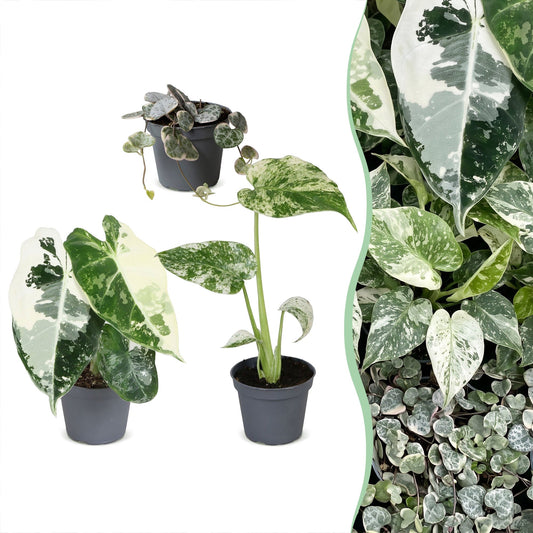
Set of 3 rare Alocasia baby plants: Frydek, Macrorrhizos and Ninja Variegata – 6 cm pot
Une question ?Nos experts vous répondent01 89 48 03 62
About
Set of 3 variegated Alocasia babies: three collector rarities
This set brings together three young variegated Alocasias, rare forms that are slow to produce: a Frydek Variegata with dark green velvet leaves splashed with creamy white, a variegated Macrorrhizos (Aurea Variegata form with golden-yellow touches, or Variegata depending on availability), and a Ninja Variegata with almost-black foliage brightened by pale sectors. Each leaf has unique variegation.
Foliage: cream, golden or light variegation, different on every leaf.
Light: brighter than for a green Alocasia, always indirect.
Watering: sparingly, when the surface is dry.
Pets: toxic to cats and dogs (calcium oxalates, ASPCA).
Placement: near a bright window, in a warm room.
Packaging: 3 plants in 6 cm pots, 5 to 15 cm tall upon delivery, with a ceramic cachepot (blue-gray, olive green, honey, copper and turquoise) or without a cachepot, depending on the option selected.
A rare trio, grown and shipped by our partner grower.
Description
Care instructions
Warranty
Commandez en toute sérénité 💚
Nos plantes d'intérieur, nos plantes d'extérieur et nos bulbes sont garantis 30 jours à compter de la réception.
Nos plantes sont rigoureusement sélectionnées, en pleine santé, acclimatées et expédiées dans un emballage pensé pour leur protection. Si un aléa survient pendant le transport, notre équipe est là pour vous accompagner.
💌 Comment bénéficier de la garantie ? 1. À la réception, sous 48 h : envoyez une photo de votre plante entière à sav@plantandstories.com, avec votre numéro de commande. Même si elle est en parfait état, cette photo est obligatoire : elle active votre garantie de 30 jours et nous permet de vous conseiller dès l'arrivée. Si la plante est abîmée, ajoutez une photo du dégât.
2. Pendant 30 jours : si votre plante dépérit, écrivez-nous à la même adresse avec des photos et votre numéro de commande.
3. Nous étudions votre situation et convenons avec vous d'une solution : plante équivalente, avoir, remboursement partiel ou total 💚
Conditions : la plante n'a pas été rempotée et se trouve dans son pot d'origine ; son exposition et son arrosage ont respecté sa fiche d'entretien. Les plantes livrées dans une consigne ou un casier automatique ne sont pas couvertes.
Plantes d'extérieur et bulbes : la garantie s'applique jusqu'à leur plantation. Une fois plantés en pleine terre ou dans un autre contenant, ils ne sont plus couverts. Envoyez-nous votre photo de réception avant de planter.
🧺 Un accessoire défectueux ou non conforme ?
Envoyez une photo et votre numéro de commande à la même adresse. Vous choisissez le remplacement ou la réparation ; si ce n'est pas possible, nous vous remboursons. Tous les frais sont à notre charge.
Cette garantie s'ajoute aux garanties légales. Tous les détails sont dans notre politique « Garantie, retours et remboursements ».
Shipping
Vos plantes et accessoires livrés avec soin 🌿
📦 Quand votre commande part-elle ?
Plantes : expédiées du lundi au mercredi, pour ne pas rester bloquées en transit le week-end.
Accessoires : expédiés du lundi au vendredi.
Plantes et accessoires commandés ensemble : un seul colis, expédié du lundi au mercredi.
Par grand froid ou forte chaleur, nous pouvons décaler l'envoi des plantes de quelques jours pour les protéger. Nous vous prévenons alors par e-mail.
🚚 Qui livre votre colis ?
Commandes préparées par notre équipe : UPS.
Produits « direct producteur » : DPD, puis livraison chez vous par Chronopost, qui vous propose la veille plusieurs options (dont le point relais). Pour une plante, évitez les consignes automatiques (Pickup Station), où notre garantie de 30 jours ne s'applique pas.
Votre numéro de suivi vous est envoyé par e-mail. Vous le retrouvez aussi dans votre espace client, sur la page de votre commande.
⏱ En combien de temps ?
Une fois le colis remis au transporteur :
France continentale : 1 à 2 jours ouvrés
Corse : 3 à 5 jours ouvrés
Union européenne : 24 à 48 h à domicile, 24 à 72 h en point relais
Suisse : 3 à 5 jours ouvrés
💶 Combien ça coûte ?
France continentale : point relais 7,50 €, offert dès 100 € d'achat ; domicile 9,99 €.
Produits « direct producteur » : livraison offerte, à domicile, en France continentale (hors Corse), en Belgique, en Allemagne et aux Pays-Bas.
Autres destinations : tous les tarifs sont dans notre politique d'expédition. Le montant exact s'affiche au moment du paiement.
📸 À la réception
Envoyez sous 48 h une photo de votre plante à sav@plantandstories.com, avec votre numéro de commande : elle active votre garantie.
🌱 Plantes calées sur mesure, emballages recyclables.
🤝 Une question ?
sav@plantandstories.com ou 01 89 48 03 62, du lundi au vendredi de 9 h à 17 h.
Philippines (micholitziana), Malaysia to New Guinea and Queensland (macrorrhizos), Borneo (reginula)
Port
Erected
Couleur du feuillage
Shandy
Couleur de floraison
(non-ornamental flowering)
Feuillage
Persistent, mixed
Parfumé
No
Dépolluante
No
Your satisfaction is our priority
If you have any questions about the delivery of your package, or if something is wrong upon its arrival, our team is here for you.
Feel free to contact us Monday through Friday, from 9 a.m. to 5 p.m., by phone at 01 89 48 03 62 or by email at sav@plantandstories.com.
We will do our utmost to find a solution quickly. 🌱
🌿 Direct from the Grower: Fresher Plants at the Best Price
No middleman between our growers and you. Superior quality, fairer prices, and a reduced carbon footprint thanks to a shorter supply chain.
💚 Your benefits
🌱 2 plants = -10%
🌱 3 plants = -15%
🌱 6 plants =-20%
The discount is automatically applied at checkout to eligible plants.
🚚 Please note
If your cart contains products shipped from multiple locations, your order may be sent in multiple packages. You will receive tracking for each shipment.
Everything you need to know about Set of 3 rare Alocasia baby plants: Frydek, Macrorrhizos and Ninja Variegata – 6 cm pot
Which variegated Alocasia make up this set of 3?
This set of 3 variegated Alocasia contains three young plants: an Alocasia Frydek Variegata, a variegated Alocasia Macrorrhizos and an Alocasia Ninja Variegata. The Frydek, a form of Alocasia micholitziana native to the Philippines, has velvety arrow-shaped leaves, dark green striped with white. The variegated Macrorrhizos arrives in Aurea Variegata form with golden yellow touches, or in Variegata form with white marbling, depending on the shipments. The Ninja Variegata brightens its dark foliage with light areas.
Why are variegated plants rarer and more expensive?
Variegated plants are rarer and more expensive because their variegation is an unstable mutation that is difficult to propagate. Some of the cells do not produce chlorophyll: the plant grows more slowly, produces fewer offsets, and some of the young plants revert to green. Growers often use in vitro culture and sort through many plants to keep the ones with the best variegation. This low yield explains the higher price compared to a green Alocasia of the same size. This is the case for the three Alocasias in this lot.
A variegated Alocasia leaf emerges completely green: what should I do?
A completely green leaf on a variegated Alocasia is not necessarily permanent: in a chimera, the distribution of variegated cells changes from one leaf to the next. Keep this leaf, as it strengthens the tuber, and make sure the plant receives bright, indirect light, or even a grow light in winter. If several green leaves appear in a row, or if a completely green pup appears at the base, the variegation may have been lost on that growth: separate the green pup at the next repotting to preserve the variegated plant. This is especially common with the Frydek in the batch.
The white areas of the Alocasia Frydek Variegata are turning brown: is it serious?
No, brown patches on the white areas of the Alocasia Frydek Variegata are common and rarely serious. These chlorophyll-free tissues are more fragile and dry out first when the air is dry, when the water is hard, or after a sunburn. Increase the humidity to around 60%, water with rainwater or filtered water, and move the pot away from direct sunlight. If a leaf turns largely brown, cut out only the dry part and leave the rest to nourish the plant. It is the plant in the lot most exposed to this issue.
Are variegated plants toxic to cats and dogs?
Variegation does not change the toxicity: a variegated plant is just as toxic as its green form. For the three Alocasia in this set, variegated Frydek, Macrorrhizos and Ninja, the verdict is the same: toxic to cats and dogs because of the insoluble calcium oxalate crystals identified by the ASPCA. Chewing a leaf causes severe mouth irritation, drooling and sometimes vomiting. Keep the entire set out of reach and consult a veterinarian if ingested.
Why do baby variegated plants have different sizes?
Variegated baby plants delivered together are not all the same size because each variety grows at its own pace, and this batch ranges from 5 to 15 cm. The Macrorrhizos, derived from a giant species, quickly gains height, while the variegated Frydek and Ninja grow more slowly, as variegation reduces their photosynthesis. A 5 cm baby is no weaker than a 15 cm plant: what matters is a firm tuber and a healthy leaf. These size differences even out over the seasons.
When to repot a variegated Alocasia bought in a 6 cm pot?
A variegated Alocasia purchased in a 6 cm pot should be repotted in spring, and only when the roots emerge from the drainage holes or circle the root ball. These plants grow slowly: a pot that is too large retains moisture and causes the tuber to rot. Move it to an 8 or 9 cm pot, using a lightweight aroid potting mix mixed with perlite, without burying the base any deeper. Wait a few days before watering and keep the plant out of direct sunlight while it recovers. The three plants in the set follow this schedule.
The essentials about Set of 3 rare Alocasia baby plants: Frydek, Macrorrhizos and Ninja Variegata – 6 cm pot
Variegated Alocasias: Frydek, Macrorrhizos and Ninja Variegata
These three plants belong to the Alocasia genus (Araceae family), tropical Asian tuberous perennials. Frydek is a form ofAlocasia micholitziana, a species endemic to Luzon in the Philippines. Variegated Macrorrhizos descends fromAlocasia macrorrhizos, the giant taro found from Borneo to Queensland, with enormous leaves at maturity. Ninja is a cultivar with dark leaf blades. Their common feature: unstable variegation, which makes each plant unique and every new leaf a surprise.
Where to place a variegated Alocasia? Light and location
A variegated plant compensates for its areas without chlorophyll with more light. Place the trio right by an east-facing window, or set back from a south or west-facing window behind a sheer curtain: the light must be bright but never direct, as the light areas burn quickly. Avoid dark rooms, where new leaves turn green. To expand your collection, see our selection ofindoor Alocasias and our rare collector plants.
How to care for variegated Alocasias?
Watering: when the top 2 centimetres are dry, reduced in winter.
Humidity: 60% or more to protect the white areas.
Substrate: highly draining aroid potting mix, with perlite.
Fertiliser: half-strength once a month, from April to September.
Repotting: in spring only, into an 8 to 9 cm pot.
How to maintain the variegation of an Alocasia Variegata?
The variegation of an Alocasia Variegata comes from a chimera: the plant combines layers of green cells and layers lacking chlorophyll, originating from the same shoot. This arrangement is not fixed, and each new leaf can show more or less white or gold. The real risk is the entirely green shoot that appears at the base: more vigorous, it eventually takes over. At spring repotting, identify these shoots and separate them from the main tuber with a clean blade. Also keep the plant in bright, indirect light all year round and limit nitrogen fertiliser. Finally, an almost white leaf is spectacular but fragile: a plant that alternates green areas and light areas is the most vigorous.
Buy a set of baby variegated Alocasias from Plant and Stories
This set of three baby variegated Alocasias in 6 cm pots, measuring 5 to 15 cm tall upon delivery depending on the variety, is grown and shipped by our partner grower. Choose it without cachepots, or with three glazed ceramic cachepots in blue-grey, olive green, honey, or copper and turquoise. Adopt this rare trio and watch each new leaf reveal its own variegation.