Plus que 100,00 € missing translation: "t:settings_schema.cart_progress_bar.settings.text_motivation_last.default" is not present in any of the ["en"] schema locale files
0 €
100,00 €
9.9/10 OVER 2300 REVIEWS ⭐⭐⭐⭐⭐
10% OFF YOUR FIRST ORDER WITH CODE "WELCOME10"
FREE DELIVERY ON ORDERS OVER €100
177K ON INSTAGRAM @plantandstories.shop - JOIN US! :)
Pay in 2, 3 or 4 installments with no fees from €50 with
Out of stock
Careful delivery with optimal protection
Plant health guaranteed for 30 days
About
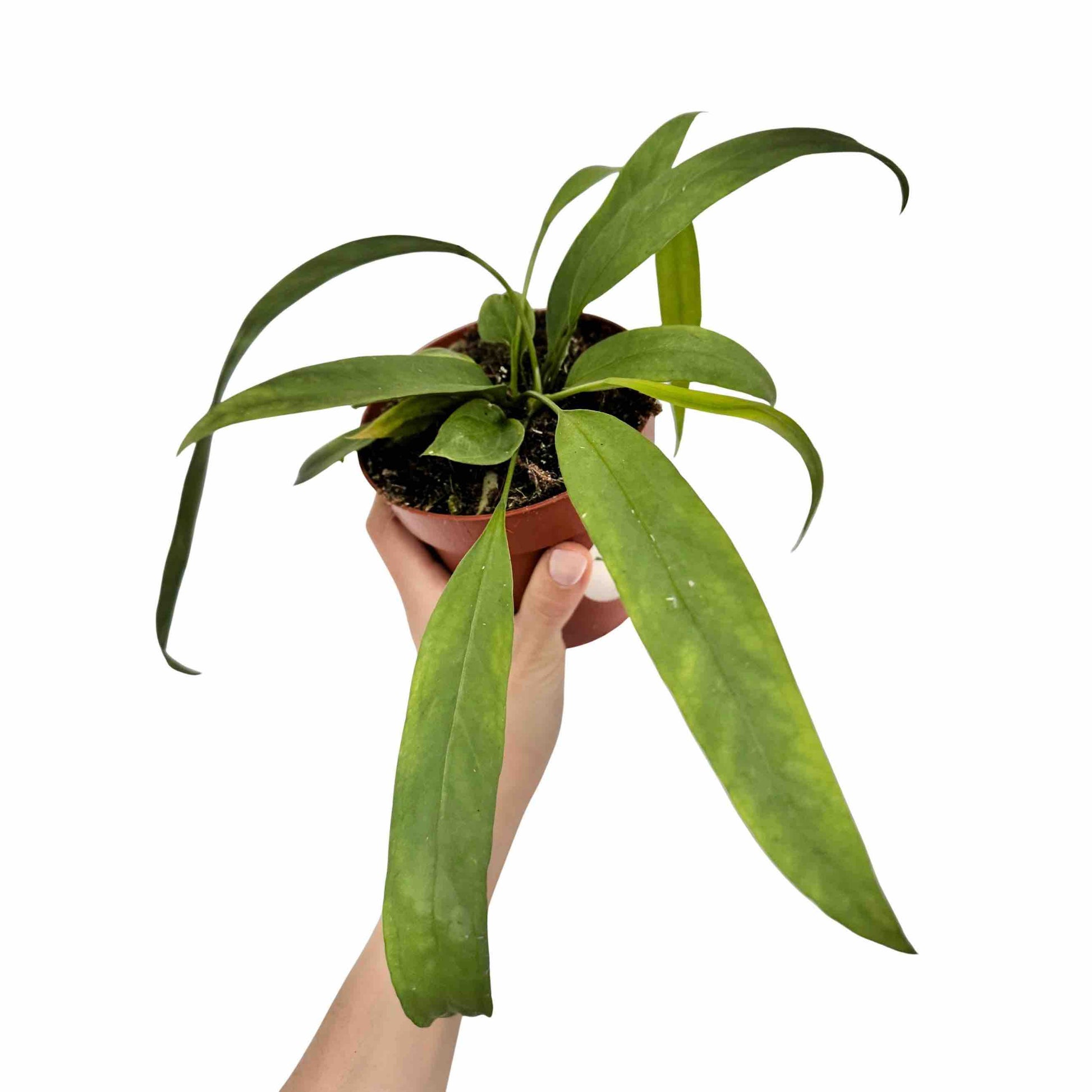
Anthurium Vittariifolium, the exceptional Anthurium with strap-like leaves
Anthurium Vittariifolium is an epiphytic species native to the tropical rainforests of the Amazon in South America. Belonging to the Araceae family, this remarkable Anthurium with its decorative foliage develops leaves that can reach 90 to 120 cm in length at maturity, making it one of the most spectacular species of its genus for collectors.
Its narrow, drooping, deep green leaves contrast with the plant's natural cascading habit, making it particularly striking when grown vertically or in a hanging pot. Each leaf has finely marked veins and a smooth, slightly leathery texture, giving it a unique botanical presence in any interior. The ribbon-leaf Anthurium vittariifolium is a rare tropical plant, prized for its graphic foliage and incomparable sculptural appeal.
Adopt the Anthurium Vittariifolium today and give your interior an exceptional botanical touch, delivered directly to your home.
Description
Maintenance tips
Care of Anthurium Vittariifolium
☀️ Light
Anthurium vittariifolium thrives in bright, indirect light, away from direct sunlight which would scorch its delicate foliage. Place it near an east- or northeast-facing window, where the light remains soft and diffused. For dimly lit interiors, ourgrow light for dimly lit indoor environmentsIt effectively compensates for the lack of natural light, without harmful UV rays.
💧 Watering
Allow the substrate to dry out completely between waterings. Excessive moisture promotes root rot, which is particularly dangerous for this epiphytic species. In summer, water approximately every 7 to 10 days; in winter, water every 12 to 15 days depending on the ambient temperature. Use room-temperature water, ideally filtered or decanted.
🪴 Substrate
We recommend oursubstrate specially designed for AnthuriumDesigned to provide optimal aeration, efficient drainage, and the essential nutrients for healthy growth, it replicates the conditions of epiphytic roots in their natural environment.
⭐️ Additional tips
Anthurium vittariifolium has long, drooping leaves that easily accumulate dust. Wipe them regularly withOur microfiber gloves to promote photosynthesis, gently passing over each side of the sheet so as not to damage the smooth texture.
For overall foliage maintenance, ournatural care kit for houseplantsThis includes a sprayer, microfiber gloves and concentrated black soap, a simple routine to keep the plant healthy and protected.
Anthurium vittariifolium is a remarkable plant that rewards every bit of attention given to its foliage. With regular and appropriate care, its long green leaves will remain vigorous and spectacular all year round.
Guarantee
Order with complete peace of mind.
At Plant and Stories, the health of our plants and the satisfaction of our customers are our top priorities.
That's why all our indoor plants come with a 30-day guarantee after receipt, so you can order with complete confidence.
Our plants are rigorously selected, in perfect health, acclimatized, and shipped with care using secure packaging designed for their protection.
Despite all our precautions, unforeseen events during transport can sometimes weaken a plant. Don't worry: our team is here to help.
💌 How to claim your warranty?
Take a clear photograph of the plant in question.
Send the photos to this address: contact@plantandstories.com, specifying your order reference.
We will respond quickly with a solution tailored to your situation 💚
Shipping
Your plants and accessories delivered with care.
At Plant and Stories, every order is prepared with love, whether it's for your houseplants or accessories.
✅ Carefully selected plants.
Our plants are rigorously selected, acclimatized and delicately packaged in secure and recyclable packaging.
Shipping takes place from Monday to Wednesday only, in order to avoid any prolonged transit over the weekend and to preserve their freshness.
📦 Durable accessories
Your accessories are also carefully prepared and shipped from Monday to Friday to ensure fast and secure delivery.
They are packaged with the utmost care to avoid any shock or damage during transport.
🚚 Fast and reliable delivery
We collaborate with trusted carriers, recognized for their quality of service.
Once handed over to the carrier, your order will be delivered within 24 to 72 hours, depending on your geographical area.
Delivery available in mainland France and Europe.
🌱 An eco-responsible commitment
All our packaging is recyclable, designed to limit environmental impact while ensuring optimal protection for your plants and accessories.
🤝 Customer service that listens to you
A question or a problem upon receipt? Our responsive customer service is there to assist you.
At Plant and Stories, every detail counts to ensure your order arrives in perfect condition… and with a smile 🌿
Everything you need to know Anthurium Vittariifolium
What light exposure is best for my Anthurium Vittariifolium?
Anthurium Vittariifolium thrives in bright, indirect light, ideally placed 1 to 2 meters from an east or southeast-facing window, protected from direct sunlight.
In its natural Amazonian habitat, this epiphytic species grows under the dense canopy of rainforests, where light filtering through the tree foliage represents its usual light environment. It tolerates moderate partial shade, but its growth will be slower and new leaves less developed in insufficient light.
In winter, move the plant slightly closer to the window to compensate for the reduced light intensity. Avoid direct south-facing locations without protection, as this will cause scorching of the long, strap-like leaves, which are particularly sensitive to direct heat.
Important tip 🌿Do not suddenly move your Anthurium Vittariifolium from a dark area to a very bright area: acclimate it gradually over two to three weeks to avoid leaf stress.For rooms with insufficient lighting, ourhorticultural lamp suitable for indoor plantsoffers a full spectrum that faithfully mimics natural light, without harmful UV rays.
Is Anthurium Vittariifolium toxic to animals and children?
Anthurium Vittariifolium is toxic to cats, dogs and young children, due to the presence of calcium oxalate crystals throughout its plant tissues.
These microscopic crystals, present in the leaves, stems, and sap, cause immediate irritation of the oral mucosa, throat, and digestive system if chewed or ingested. This mechanism is common to all members of the Araceae family, to which Anthurium vittariifolium belongs.
If ingested by an animal or child, the most common symptoms are excessive salivation, difficulty swallowing, vomiting, and mouth irritation. These symptoms are usually mild but require prompt veterinary or medical attention.
What precautions should be taken on a daily basis?
Place your Anthurium Vittariifolium in a high location, out of reach of young children and pets. A tall stand or wall shelf is ideal for this naturally trailing plant.
With a suitable location, this spectacular plant can be enjoyed peacefully in a home with pets or children.
Why are the leaves of my Anthurium Vittariifolium turning yellow?
The leaves of the Anthurium Vittariifolium most often turn yellow due to overwatering, lack of light, or nutrient deficiency.
If the leaves turn yellow and become limp, the problem usually stems from excess water causing the beginning of root rot.
If the leaves gradually turn yellow while remaining firm and dry, the plant often lacks light or fertilizer.
If the yellowing is accompanied by small light spots, a dull appearance or fine webbing, it may be a mite infestation, common indoors, especially in dry atmospheres.
Anthurium Vittariifolium, due to its epiphytic habit and long strap-like leaves, is particularly sensitive to excess stagnant water at the base: yellowing often starts at the base of the oldest leaf before spreading if the problem is not corrected quickly.
Important tip 🌿One or two old leaves turning yellow from time to time is perfectly normal: it is part of the plant's natural cycle.On the other hand, there is cause for concern if several leaves turn yellow rapidly, if the phenomenon spreads to young leaves, or if growth slows down significantly.
When and how should I repot my Anthurium Vittariifolium?
Anthurium Vittariifolium is ideally repotted in spring, between March and May, when growth resumes actively.
Repotting is necessary when:
The roots emerge through the drainage holes.
Growth is slowing down.
or that the substrate compacts too quickly after watering.
As a general rule, repotting every 2 years is sufficient for an adult plant.
Anthurium Vittariifolium develops an aerial and epiphytic root system, with thick and fleshy roots that need space to oxygenate: avoid choosing a pot that is too large, which would retain moisture for too long and weaken these particular roots.
Choose a pot 2 to 3 cm wider than the old one, and make sure it has drainage holes. Ourtransparent pots to monitor the rootsare ideal: their transparency allows you to easily check the condition of the root system after repotting, without disturbing the plant.
Prepare a well-draining and aerated substrate, specially designed for tropical plants.We recommend ourComplete range of substrates for tropical plantsDesigned to promote drainage, root oxygenation, and healthy long-term growth. For Anthurium Vittariifolium, choose ourpremium blend designed for Anthurium rootsformulated to reproduce the natural epiphytic conditions of this species.
Carefully remove the plant from its pot, tapping the pot if necessary to loosen the root ball without pulling on the long stems.
Gently loosen the roots if they are very compacted, without breaking them.
Place a layer of substrate at the bottom of the pot, position the plant upright, then fill with substrate without burying the crown.
Important tip 🌿After repotting, water the plant to help the potting mix settle around the roots and eliminate any air pockets. Ensure that excess water can drain freely.Repotting every two years is sufficient to ensure healthy and balanced growth of your Anthurium Vittariifolium.
When and how should I fertilize my Anthurium Vittariifolium?
Anthurium Vittariifolium should be fertilized every 2 to 3 weeks from March to October, with a liquid fertilizer diluted in the watering water.
During autumn and winter, from November to February, significantly reduce or stop fertilizing. This is a period of dormancy during which the plant produces few or no new leaves.
Anthurium Vittariifolium, thanks to its long, strap-like leaves that can reach more than a meter, has greater nutrient requirements than short-leaved Anthuriums: a regular supply of potassium particularly promotes the strength and shine of its exceptional foliage.
A well-balanced intake promotes:
denser, more colorful foliage
steady growth,
and improved plant resistance.
👉 For best results, we recommend ourconcentrated fertilizer for houseplantsEasy to dose, with fast visible results. Practical tips are printed directly on the back of the label and on the product information sheet, for simple and hassle-free use.
Important tip 🌿Never fertilize your Anthurium Vittariifolium in a dry substrate: this could burn its particularly sensitive epiphytic roots.Water normally first, then apply the diluted fertilizer 2 to 3 days later, when the soil is slightly moist. Regular but moderate fertilization will keep your Anthurium Vittariifolium vigorous and healthy 💚
How do I properly water my Anthurium Vittariifolium?
Water Anthurium Vittariifolium when the substrate has dried out completely, approximately every 7 to 10 days in summer and every 12 to 15 days in winter. Use room temperature water.
How do I know when to water?
The finger test remains the most reliable method: insert your index finger into the substrate to a depth of 2 to 3 cm. If the substrate is dry, it's time to water. If it's still damp, wait a few more days.
Anthurium vittariifolium is an Amazonian epiphytic species whose roots, accustomed to drying out between rainfalls in their natural environment, tolerate a slight, temporary drought better than persistent moisture at the base of the stem. Filtered or decanted water is preferable, as this species is sensitive to lime, which can cause light-colored spots on the leaves.
Important advice:When in doubt, it's always better to wait a little longer than to overwater. Plants adapt better to underwatering than to overwatering, which quickly causes root rot.
How do I take cuttings from my Anthurium Vittariifolium?
Anthurium Vittariifolium is propagated by division of the rhizome or separation of basal shoots, ideally in spring, between March and April, when the plant resumes its active growth.
Method by division or separation of wasteAnthurium vittariifolium naturally produces offshoots at the base of the main stem, each with its own embryonic root system. Locate an offshoot with at least 2 to 3 well-developed leaves and some visible roots. Gently separate it from the mother plant usingOur pruning shears have a straight point for a clean cut.taking care to preserve as many roots as possible around the shoot to promote rapid recovery.
Separate the offshoot at the base with a clean cut, being careful not to crush the fleshy roots characteristic of this epiphytic species.
Install the discharge in ourtransparent pots for cuttingswhich allow for easy monitoring of root development without disturbing the plant.
Keep the cutting in a warm place, at 20 to 24°C, with bright indirect light and good ambient humidity.
For final transplanting once the roots are well established, use ouraerated and well-draining potting soil for Anthurium, specially formulated to reproduce the natural epiphytic conditions of this Amazonian species and promote vigorous rooting.
Important tip 🌿Anthurium vittariifolium typically takes 4 to 6 weeks to develop a sufficiently strong root system after division. The first signs of success are the appearance of a new, growing leaf and white roots visible through the transparent pot. Avoid overwatering during this phase: the potting mix should remain slightly moist, never soggy.
The essentials regarding Anthurium Vittariifolium
Anthurium vittariifolium: identity and origin
Anthurium vittariifolium is an unusual tropical aroid, native to the rainforests of South America, particularly Colombia and Peru. Its full botanical name,Anthurium vittariifoliumEngl., refers to an epiphytic species with remarkably long and narrow leaves, which can exceed one meter in length under good conditions. This strap-like foliage, a deep, glossy green, naturally cascades down, making it one of the most spectacular Anthuriums to grow in hanging baskets or on a high shelf.
Anthurium care: light, watering and substrate
This epiphytic species appreciates abright indirect lightNever expose it to direct sunlight, which quickly burns its foliage. Water moderately: wait until the top few centimeters of soil are dry between waterings, approximately every 7 to 10 days depending on the season. To preserve its aerial root system and long-term health, choose ourSpecial Anthurium substrate enriched with biostimulantsformulated to combine drainage and optimal moisture retention.
Where should you place your Anthurium for long, healthy foliage?
Vittariifolium thrives in a bright, humid room, away from cold drafts and direct sunlight.
Window is:Soft morning light, ideal for this species
Distance :1 to 2 meters from a sunny window
Temperature :between 18 and 26°C, without sudden variations
Frequently asked questions: Why are the tips of the leaves of my Anthurium vittariifolium turning brown?
Browning tips are almost always a sign of insufficient ambient humidity.Anthurium vittariifoliumis a species of tropical undergrowth accustomed to humidity levels above 60%: in a heated apartment in winter, the air often drops below this threshold without us realizing it. Regular misting with ourCare pack with spray— Note that the link is only used once — and watering adjusted to the season is usually enough to correct the situation. After 2 to 3 weeks of acclimatization indoors, a monthly application oftropical liquid fertilizersupports the growth of the long leaves characteristic of this species.
Buy Anthurium vittariifolium at Plant and Stories
Our Anthurium vittariifolium is in stock and carefully shipped to ensure it arrives in perfect condition. Each plant is selected by our team of specialists in rare tropical Araceae, with particular attention paid to foliage quality. To complete your display, ourtransparent pots with optimal drainageare perfectly adapted to the epiphytic root system of Anthurium vittariifolium.