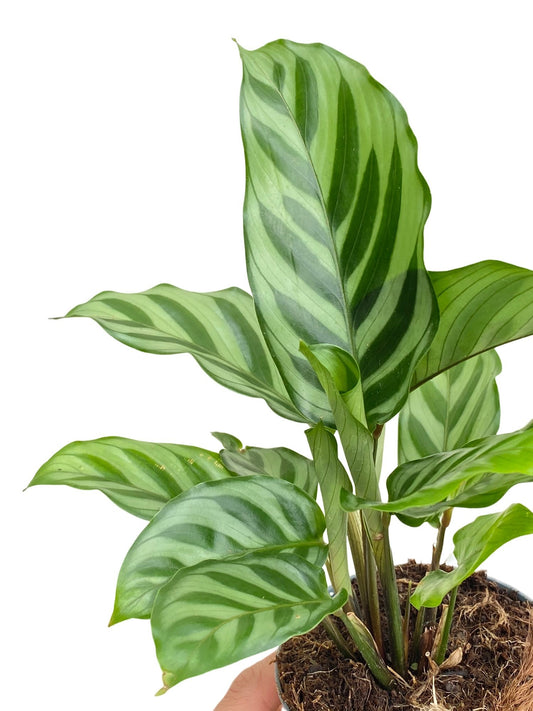
How to care for Calathea plants?

CARE INSTRUCTIONS: CALATHEA

Introduction
Calatheas are a family of houseplants highly prized for their spectacular leaves with unique patterns and vibrant colors.
It includes approximately 60 different species .
Native to the tropical forests of South America , Calathea plants are renowned for their ability to bring an exotic and elegant touch to any interior.
These plants are characterized by their broad and often marbled , striped or spotted leaves, with patterns that vary from one species to another.
Calatheas are also known for their nyctinastic movement , where the leaves fold at night and unfold during the day, giving the impression that the plant is "sleeping".
Although Calatheas require specific care, their beauty and elegance make it well worth the effort for indoor plant lovers.
Features
-
Common name: Calathea
-
Scientific name: Calathea spp.
-
Family: Marantaceae
-
Origin: South America
-
Flower color: White ( rare indoors )
-
Flowering period: Can flower in summer if conditions are ideal.
-
Ideal temperature: 18-24°C
-
Humidity: High
-
Vegetation type: Perennial
-
Foliage type: Evergreen
Did you know that?

Calatheas are not only prized for their spectacular aesthetics, but also for their air-purifying capabilities .
They help eliminate certain toxins present in indoor air, thus helping to create a healthier and fresher environment .
HOW TO CARE FOR A CALATHEA? | IN BRIEF
Light :
Prefers moderate indirect light. Avoid direct sunlight which can burn the delicate leaves.
Water :
Water when the top of the soil is dry to the touch. Maintain light moisture without letting the soil become waterlogged.
Use filtered water or rainwater to avoid the buildup of minerals that can damage leaves.
Avoid overwatering to prevent root rot.
Temperature :
Ideally between 18°C and 24°C. Avoid cold drafts and temperatures below 15°C.
Humidity :
Prefers high humidity. Mist the leaves regularly , especially in summer when the air is dry, or use a humidifier to maintain a relative humidity of 60% or higher.
WHAT TYPE OF SOIL DOES CALATHEA NEED?
A light, well-drained potting mix is essential.
Use a houseplant mix with perlite to improve drainage .
To make your life easier and get the best for your Calathea, we recommend our " Special Calathea Soil " which will perfectly meet the needs of your Calathea and Maranta.
Our specialized and professional substrate is composed of essential elements for the well-being of Calathea such as perlite , vermiculite , a good base of potting soil enriched with fertilizers and trace elements, etc.
WHEN SHOULD I REPOT MY PLANT?
Repot in the spring every two years or when the roots start to grow out of the current pot.
We recommend always repotting in a pot with drainage holes , preferably transparent , to facilitate monitoring of root development , substrate moisture , and to ensure that the roots remain healthy.
It may be a good idea to put a thin layer of clay pebbles at the bottom of your pot with drainage holes to allow excess water to drain away and prevent the roots from sitting in stagnant water.
HOW TO PROPAGATE A CALATHEA?
Calathea propagates mainly by division and not by stem cuttings.
The method: When repotting, carefully divide the plant into sections, each with several leaves and attached roots.
Replant the divisions in separate pots with drainage holes using a suitable potting mix such as our "Special Calathea Substrate" .
HOW TO PREVENT AND TREAT PESTS?
Inspect regularly for signs of scale insects, aphids, or spider mites.
In case of infestation, treat with natural and biological methods such as black soap.
Find our organic recipe for fighting pests on the product page of our black soap for plants .
For greater effectiveness, we recommend applying the solution with our pair of microfiber plant cleaning gloves .
It will allow you to gently eliminate unwanted elements.
IN SHORT, HERE IS OUR EXPERT ADVICE
-
Provide moderate indirect light for optimal growth. Above all, avoid direct sunlight.
-
Maintain high humidity to prevent the leaves from drying out. Mist its foliage regularly in summer when the air is dry.
-
Water regularly with filtered water if possible, allowing the soil to dry slightly between waterings.
-
Repot every 2 years to ensure healthy and sustainable growth.
-
Clean its foliage regularly to remove dust, limescale and promote photosynthesis.
-
Inspect the plant often to prevent any potential pest infestation as early as possible.

Laura Bruneau
Jardinière & autrice