

Aglaonema: care, light, pink Aglaonema and varieties

To care for an Aglaonema, place it in indirect light, away from direct sun, water when the top 1 to 2 inches of soil are dry, keep it above 59 °F and away from cold drafts, and repot it in spring when roots emerge from the pot.
These guidelines come from Clemson University Extension’s Chinese evergreen fact sheet and the UF/IFAS (University of Florida) Aglaonema growing guide. One distinction matters: pink Aglaonema, like red varieties, needs more light than green Aglaonema to retain its color.
This guide covers light requirements by color, watering, minimum temperature, yellow or brown leaves, repotting, propagation, and toxicity to cats. To compare it with other houseplants, see our indoor foliage plant guide.
🌿 Pink (Pink, Pinky Promise), red, green, or variegated Aglaonema: how color makes a difference
Not all Aglaonema are grown in quite the same way: leaf color indicates how much light the plant needs. Clemson Extension puts it simply: all-green cultivars grow in low light, variegated types need low to medium light, and none likes direct sun on its leaves.
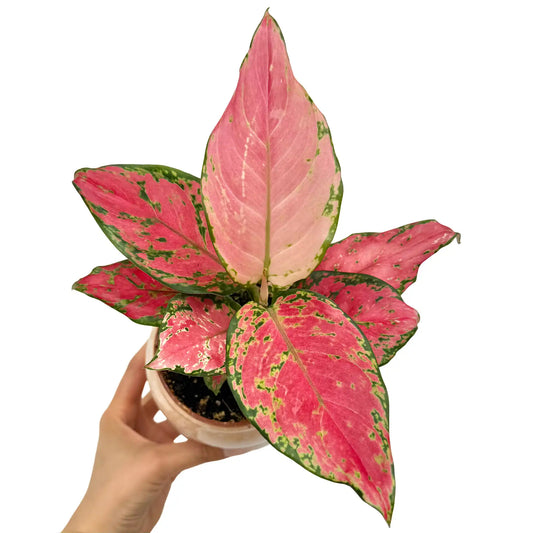
For a pink cultivar such as 'Light Pink Star', the RHS (Royal Horticultural Society) profile notes that brighter light intensifies its color. That is why pink Aglaonema (called Aglaonema pink on plant labels, or sold as Pinky Promise) or red varieties fade in the back of a room, while green Aglaonema holds up there.
Conversely, UF/IFAS reminds growers that Aglaonema should never be placed in full sun, which can scorch the leaves. Silver-variegated Aglaonema falls somewhere in between.
| Feature | What it means for you |
|---|---|
| Green Aglaonema | The most tolerant: it grows in low light (Clemson), making it ideal away from a window |
| Silver or variegated Aglaonema | Low to medium light (Clemson); 'Silver Bay' prefers rather low light (UF/IFAS) |
| Pink or red Aglaonema | More intense color in bright light (RHS), but no direct sun: place near an east- or west-facing window |
| Compact growth | 12 to 35 inches tall and wide, according to Clemson—suitable for a low cabinet, shelf, or floor |
🔎 Aglaonema at a glance (Aglaonema commutatum and cultivars)
Here is a verified profile of Aglaonema, sometimes spelled aglaonéma. According to Plants of the World Online (POWO) from the Royal Botanic Gardens, Kew, the genus Aglaonema Schott, published in 1829, comprises 26 accepted species distributed from northeastern India to Papua New Guinea.
The most widely cultivated species, Aglaonema commutatum Schott (1856), is native to central Malesia, the Philippines, and Sulawesi, where it grows as a subshrub in humid tropical forests.
Commercial pink and red Aglaonema are cultivars: NC State lists several, such as 'Lucky Red', 'Red Emerald', and 'Lady Valentine', but many names used in retail do not have a botanical profile.
To distinguish it from Dieffenbachia, NC State Extension (North Carolina State University) recommends counting the main lateral veins: Aglaonema has 5 to 8.
| Criterion | Verified details |
|---|---|
| 🏷️ Botanical name | Aglaonema Schott (1829), 26 species; leading species: Aglaonema commutatum Schott (POWO) |
| 🧬 Family | Araceae, like Dieffenbachia, Philodendron, and Caladium |
| 🌳 Type | Evergreen herbaceous perennial, grown as a houseplant (NC State); hardiness rating H1B (RHS) |
| 🌍 Origin | From northeastern India to Papua New Guinea, in humid, shady tropical forests (POWO, UF/IFAS) |
| 🍃 Foliage | Elongated 4- to 8-inch leaves, green or variegated with white, silver, pink, or red (NC State) |
| 🌸 Flowers | White spadix and greenish-white spathe, rare indoors, followed by red berries (NC State) |
| 📏 Size | 12 to 35 inches tall and wide, according to Clemson; 4 to 20 inches for a pink cultivar such as 'Light Pink Star' (RHS) |
| ⚠️ Toxicity | Insoluble calcium oxalates: toxic to cats, dogs, and horses (ASPCA, for Aglaonema modestum); low toxicity for the genus (NC State) |
📋 Quick care sheet
Essential growing guidelines, all in one glance.
| Factor | Guideline |
|---|---|
| Light | Indirect; low for green Aglaonema, brighter for pink or red varieties; never direct sun (Clemson, UF/IFAS) |
| Watering | When the top 1 to 2 inches of soil are dry; keep soil moist but never waterlogged (Clemson, UF/IFAS) |
| Potting mix | Soilless potting mix enriched with humus (Clemson), well-draining (NC State), in a pot with drainage holes |
| Humidity | Low to medium is sufficient (Clemson); very dry air causes browning leaves (NC State) |
| Temperature | Ideally 68 to 81 °F; tolerates 55 °F (Clemson); keep it above 59 °F |
| Repotting | In spring or early summer, when the roots fill the pot (Illinois Extension) |
| Fertilizer | Highly diluted balanced fertilizer about once a month indoors (UF/IFAS); excess can burn leaf edges |
| Toxicity | Toxic to pets if ingested; sap irritates the skin, so gloves are recommended (RHS) |
| Difficulty | Easy: NC State lists it among the easiest houseplants to grow |
📍 Where to place an Aglaonema: location, light, and bathrooms
Place your Aglaonema in a bright room, away from direct sun: NC State says it does well in filtered light or bright indirect light. UF/IFAS notes that it tolerates light as low as 25 foot-candles, or about 270 lux, which explains its reputation as a plant for dim rooms; however, only green Aglaonema truly thrive in such conditions.
For pink or red Aglaonema, move it closer to an east- or west-facing window, or place it back from a south-facing window behind a sheer curtain. A bright bathroom suits it: the humidity is a bonus, though not essential, according to Clemson. Avoid entry doors and air vents, as cold drafts can mark its leaves.
☀️ Ideal location: East- or west-facing window for pink or red Aglaonema; a bright spot away from the window for green Aglaonema
🌡️ Warmth: Ideally 68 to 81 °F (Clemson); never below 59 °F, as UF/IFAS has observed cold damage 3 to 7 days after exposure to temperatures below 50 to 55 °F
🌳 Aglaonema outdoors: The RHS rates it H1B (minimum 50 to 59 °F): summering it outdoors in the shade is only an option if nighttime temperatures stay above 59 °F; bring it indoors as soon as nights turn colder
🪴 Repotting Aglaonema: when and how
Repot your Aglaonema while it is actively growing, in spring or early summer, as recommended by University of Illinois Extension.
According to the same source, the telltale signs are roots emerging from the drainage holes or appearing on the surface, a rootbound root ball, new leaves smaller than usual, or a plant wilting between normal waterings.
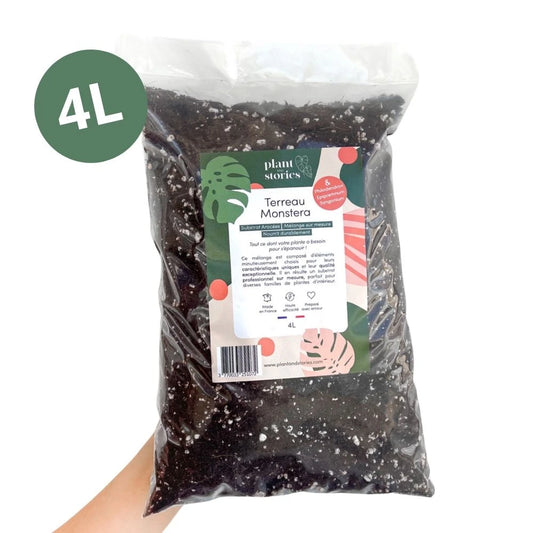
Clemson recommends a commercial soilless potting mix enriched with humus, in a pot with drainage holes; our universal potting mix enriched with biostimulants is suitable.
Choose a pot only slightly larger: too much soil dries slowly and encourages root rot, warns Iowa State University Extension. After buying a plant, also read our guide to repotting a plant after purchase.
| Step | What to do |
|---|---|
| 1. Choose the right time | Spring or early summer, during active growth (Illinois Extension); never in the middle of winter |
| 2. Prepare the pot | Use a pot with drainage holes, only slightly wider than the old one; do not add a layer of pebbles at the bottom—the potting mix provides drainage |
| 3. Remove the plant | Tap the pot to loosen the root ball; untangle or trim circling roots (Illinois Extension); wear gloves |
| 4. Replant | Replant at the same depth as before in fresh potting mix, gently firmed; separate any well-rooted offsets at the same time |
| 5. Water | Water right away to settle the soil around the roots (Illinois Extension), then empty the saucer |
columns: 4
columns_mobile: 2
-
-

 Livraison offerte
Aglaonema Silver Bay - 17cm Pot - Height 70-75cm
Regular price From 54,95 €Regular price -
-
Set of pink baby plants: Tradescantia, Philodendron and Aglaonema – 6 cm pot
Regular price From 44,95 €Regular price -

 Livraison offerte
Dieffenbachia Compacta - 17cm Pot - Height 45-50cm
Regular price From 49,95 €Regular price -

 Livraison offerte
Dieffenbachia Camille (Camilla) - 17cm Pot - Height 45-50cm
Regular price From 44,95 €Regular price -
Monstera Soil - Enriched with Mycorrhiza and Bacillus - Araceae Substrate
Regular price From 9,50 €Regular price8,50 €Sale price From 9,50 € -
Live sphagnum moss - Sphagnum moss for plants - Sphagnum moss - Live sphagnum moss for plants
Regular price 9,50 €Regular price8,50 €Sale price 9,50 €





✂️ Aglaonema care: watering, humidity, and fertilizer
Aglaonema care involves only a few simple tasks, as long as you check by touch rather than following a schedule. Clemson recommends watering when the top 1 to 2 inches of soil are dry, using room-temperature water; UF/IFAS advises keeping the soil moist but never waterlogged.
NC State adds that you should reduce watering in winter, though the plant does not need a true dormant period, and avoid cold water. As for humidity, Clemson says it grows well in homes with low to moderate humidity; if leaf edges turn brown in winter, see our solutions for increasing air humidity without misting.
💧 Watering Aglaonema: Check with your finger: water thoroughly when the top 1 to 2 inches are dry, let it drain, and empty the saucer; water less often in winter
💧 Water: Use room-temperature water (Clemson), never cold water (NC State)
💧 Humidity: Low to moderate is sufficient (Clemson); use a tray of moist pebbles or group plants together if the air is very dry
🌱 Fertilizer: Highly diluted balanced fertilizer once a month (UF/IFAS: 20-20-20 at 50 ppm nitrogen), only in spring and summer—for example, half-strength of our liquid fertilizer for houseplants
🧹 Cleaning: Wipe leaves with a damp cloth and cut fully dried leaves off at the base
🍂 Aglaonema in winter: cold, light, and watering
Winter is the riskiest season for Aglaonema, more because of the cold than lack of water. Clemson says it is sensitive to temperatures below 50 °F; UF/IFAS notes that 'Silver Queen' is particularly vulnerable and that damage appears as gray spots that turn dark and greasy, 3 to 7 days after exposure, starting with the older leaves.
Keep it above 59 °F, away from cold windows at night and from doors. Protect it during transport after purchase, too: Iowa State notes that even brief exposure to freezing temperatures damages tropical plants, and advises limiting time in a cold car or garage.
As for light, move it closer to a window, especially if it is pink or red, and water less often. For other plants, our guide to houseplants in winter offers more advice.
📅 Seasonal care calendar
| Season | Key task |
|---|---|
| 🌸 Spring | Growth resumes: repot if roots are crowded, divide offsets, and resume diluted fertilizer |
| ☀️ Summer | Active growth: water when the top 1 to 2 inches of soil are dry, fertilize once a month, and provide indirect light |
| 🍂 Fall | Growth slows: water less often and bring the plant indoors before nighttime temperatures drop below 59 °F |
| ❄️ Winter | Relative dormancy: reduce watering, do not fertilize, keep above 59 °F and away from drafts |
🌱 Propagating and dividing Aglaonema
The two methods that work at home are dividing offsets and taking stem cuttings.
To divide the plant, take advantage of spring repotting: separate offsets growing from the base, keeping their roots attached. The RHS and NC State list this method, and UF/IFAS identifies it, along with stem cuttings, as the basis of propagation, since in vitro propagation has not been successful in this genus. For cuttings, UF/IFAS uses sections bearing 4 to 5 leaves.
Clemson offers another useful tip: when an older Aglaonema loses its lower leaves and its stem becomes bare, you can cut off the top and root it. Plant the cutting in a light potting mix, in a warm spot with indirect light; our article on propagating in water or potting mix can help you choose a method. Wear gloves: the sap irritates skin.
🐛 Yellow, brown, or curling leaves: causes and solutions
A yellow leaf on an Aglaonema is not necessarily a cause for concern: Iowa State notes that a healthy plant naturally sheds its oldest leaves. When several leaves turn yellow or brown, the same source points first to growing conditions: overwatering or underwatering, drafts, dry air, too much or too little light, or a sudden change in exposure.
For leaves that curl, none of the sources consulted addresses this symptom specifically: first check whether the root ball is too dry, whether the plant has been exposed to a cold snap, or whether it’s getting too much sun—the three causes that distort foliage in the table below. UF/IFAS also describes new leaves that are “hooked,” linked to changes in light, fertilizer, watering, and temperature.
For other plants, read our article on yellowing lower leaves.
| Symptom | Probable cause | Solution |
|---|---|---|
| Yellow, limp leaves; wet soil | 🍄 Overwatering and poorly draining potting mix: root rot (Clemson, NC State) | Let the top 2.5 to 5 cm of soil dry out, empty the saucer, and check the roots; see our guide to root rot |
| Yellow leaves dropping after being moved | ☀️ Sudden change in light, or a warm or cold draft (Iowa State) | Change its exposure gradually, and keep it away from doors and air vents |
| Gray spots that turn dark and greasy | ❄️ Cold damage below 10 to 13 °C, visible 3 to 7 days later (UF/IFAS) | Remove damaged leaves and move the plant somewhere warm, above 15 °C |
| Brown, brittle tips and edges | ⚠️ Excess fertilizer salts (UF/IFAS, Clemson) or very dry air (NC State, Iowa State) | Flush the potting mix thoroughly, fertilize less often and at a lower concentration, and increase ambient humidity |
| Pale, faded leaves standing upright | 💧 Too much light or heat (UF/IFAS) | Move it out of direct sun; very discolored leaves do not always turn green again |
| White, cottony clusters; fine webs beneath leaves | 🐛 Mealybugs (RHS), spider mites, aphids, or scale insects (NC State) | Isolate the plant and clean the leaves; see our guides to mealybugs and spider mites |


🌸 Our Aglaonema varieties: Pink Star and other pink, red, silver, and green varieties
Here are the Aglaonema in our Aglaonema collection, described from our own production photos; the pink and red cultivars do not have authoritative botanical references unless noted. Looking for the “Pinky Promise” plant (Aglaonema Pinky Promise)? This is a sales name used for pink Aglaonema, not a botanical name: none of the sources consulted (POWO, RHS, NC State) describes it, and we do not sell it under this name; the care advice for pink Aglaonema applies to it.
| Variety | What makes it special |
|---|---|
| Pink Aglaonema: Pink Star, Painted Celebration, Salmon Fantasy | Green leaves extensively covered in bright pink or salmon; this group needs the most indirect light to retain its color (RHS) |
| Red Aglaonema: Jazzy Red, Cherry Baby | Crimson to bright red centers with dark green edges; like pink varieties, it needs bright indirect light to retain its color |
| Aglaonema Silver Bay | Large leaves with pale green centers and silvery highlights, edged in dark green (RHS, NC State); upright growth, produces many offsets, and prefers lower light (UF/IFAS); about 90 cm tall according to its RHS profile |
| White Aglaonema: White Joy, Corn Silk | Ivory-cream leaves marked with green; medium indirect light, no direct sun |
| Aglaonema Apple Green | Bright apple green with a lighter central vein; a green Aglaonema, the group that tolerates low light (Clemson) |
| Aglaonema pictum 'Tricolor' | Aglaonema pictum species (cultivar cited by NC State) with a camouflage pattern in green, silver, and light green, according to NC State; care for it like other variegated Aglaonema |
🎨 Aglaonema mixes and pairings: which plants go well with it?
Aglaonema shares its needs with other aroids that thrive in bright shade: warmth, indirect light, and consistently moist but not waterlogged soil. It makes a natural pairing with a Dieffenbachia, its relative with similar leaves, or a Spathiphyllum, which adds white flowers.
To mix Aglaonema in the same planter, combine a green, a silver, and a pink variety: place the pink one near the window and water the whole planter by feel. For the least bright corners, our selection of indoor plants for dark rooms offers other options, and you can find all our varieties in the Aglaonema collection.
⚠️ Is Aglaonema toxic to cats and dogs?
Yes. The ASPCA’s “Chinese Evergreen” profile (American Society for the Prevention of Cruelty to Animals), based on Aglaonema modestum, classifies it as toxic to dogs, cats, and horses due to its insoluble calcium oxalates.
The signs listed include oral irritation, pain and swelling of the mouth, tongue, and lips, excessive drooling, vomiting (except in horses), and difficulty swallowing.
The ASPCA profile covers only one species; NC State’s genus profile reports the same calcium oxalate crystals in Aglaonema, describes its toxicity as low, and notes that its sap can cause dermatitis, while the RHS states that its cultivars are harmful if eaten and irritating to the skin and eyes.
Pink Aglaonema is therefore no less toxic than green varieties. Keep it out of reach of pets and children, wear gloves when handling it, and call your veterinarian if it is ingested. If you have a cat, consult our list of non-toxic plants for cats.
✅ Our expert tips for success
Keep four tips in mind to help your Aglaonema thrive. Choose its spot based on its color: low light for a green variety, bright light without direct sun for a pink or red Aglaonema. Water by feel, when the top 2.5 to 5 cm of soil is dry, and water less in winter. Protect it from the cold: never let it get below 15 °C, and keep it out of drafts.
Finally, repot in spring when roots emerge from the pot, and divide the offsets to propagate your plant.
Aglaonema is the plant I most often recommend to people who think they don’t have a green thumb. The first thing I watch for is cold: an Aglaonema placed against a window in January will suffer quickly, much more than from a missed watering. With pink varieties, I always say the same thing: they want bright light, not sun. A well-placed pink Aglaonema will stay colorful for years.

Laura Bruneau
Jardinière & autrice


