Indoor green plants: which ones to choose and how to care for them?

An indoor green plant, in fact, encompasses almost everything: Pothos, Ficus, Monstera, Sansevieria… all evergreen species, grown in pots, from which we do not expect spectacular blooms. The choice depends mainly on two things: the light in your home, and the time you are willing to devote to maintenance.
At Plant and Stories, our green plants are grown in France and selected for their graphic and colorful foliage, not for a fleeting flower. This guide helps you choose the right species, and above all, keep it healthy over time.
What is an indoor green plant?
The term encompasses all species with dominant foliage, whether they are climbing, trailing, or in a dense clump. Unlike flowering plants, the main appeal remains the shape, texture, and color of the leaves, not a two-week blooming peak before it disappears.
It is deliberately a broad category. It covers very different families from one another: from the hardy climbing Pothos to the more demanding Ficus, and the Philodendron with its sometimes enormous leaves. And it is precisely this diversity that allows you to create a varied interior, without limiting yourself to a single plant silhouette.

The most beautiful green plants with graphic foliage
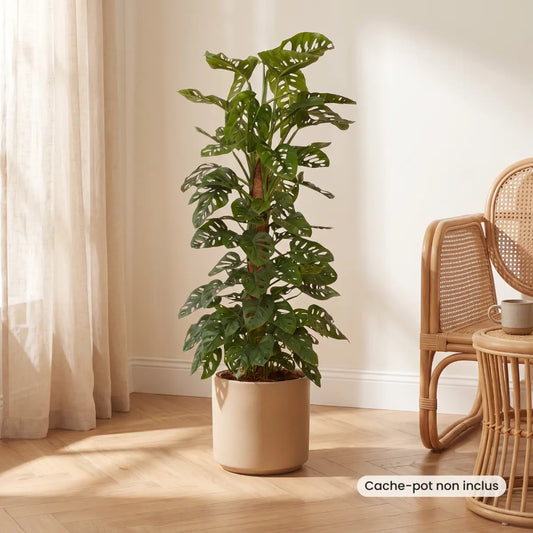
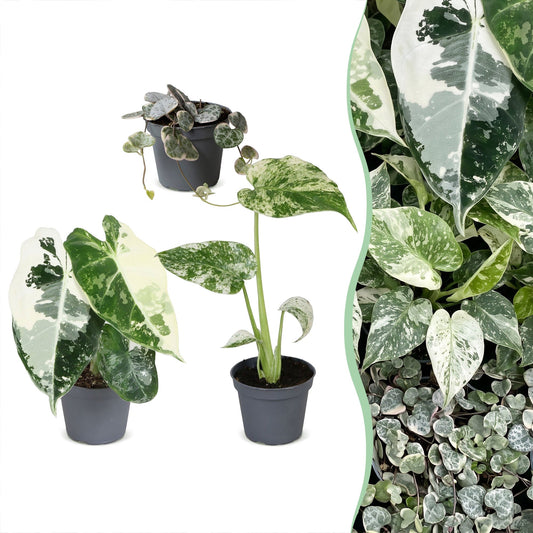
Some species clearly stand out for their particularly decorative foliage. The Monstera with their characteristic cutouts, recognizable at first glance. The Calathea with their almost hand-drawn patterns, like printed fabric. The Philodendron, with shapes so varied that we sometimes find it hard to believe they belong to the same genus.
columns: 4
columns_mobile: 2
-
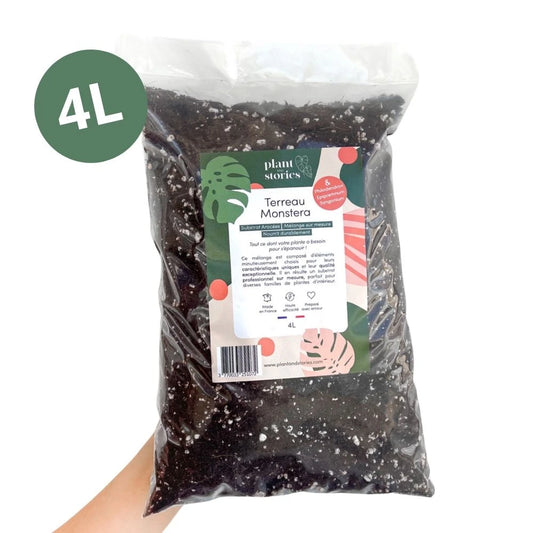
Monstera Soil - Enriched with Mycorrhiza and Bacillus - Araceae Substrate
Regular price From 9,50 €Regular price23,75 €Sale price From 9,50 €9,50 €From 7,60 €Sale -
Set of Transparent Araceae Pots - Transparent Growing Pots for Plants
Regular price From 8,97 €Regular price9,75 €Sale price From 8,97 €8,97 €From 7,18 €Sale -
Live sphagnum moss - Sphagnum moss for plants - Sphagnum moss - Live sphagnum moss for plants
Regular price 9,50 €Regular price9,50 €7,60 € -
Transparent climbing plant support - Pack of 3 + free velcro (Monstera, Pothos)
Regular price From 9,99 €Regular price13,89 €Sale price From 9,99 €9,99 €From 8,00 €Sale





A successful urban jungle, in fact, does not rely on the color of the flowers. It plays on these foliage contrasts: a large cut leaf next to fine and trailing foliage, a dark shade that highlights a lighter green. It is this play of textures that gives the impression of a living, almost wild interior.
Easy green plants for bright or shaded rooms
Depending on your exposure, some species almost naturally impose themselves:
- Bright room: Ficus, Monstera, Philodendron
- Shaded room: Sansevieria, Zamioculcas, Pothos
And if your home clearly lacks natural light, don't panic, there are shade plants selected precisely to grow without a single ray of direct sunlight. There is no need to feel guilty because your living room overlooks an inner courtyard: there is a plant for that.
Air-purifying green plants to clean the air
Several studies suggest that dense foliage helps filter certain compounds present in indoor air. Formaldehyde, benzene, xylene… these names may mean nothing to you, but they are present almost everywhere in our modern interiors: glues, paints, furniture.
Be careful, a plant never replaces good ventilation. But as a complement, it certainly does its part. To learn more about the subject, check out our article on easy plants that purify the air, which details the most cited species and their specificities.
Maintenance: light, watering, and suitable substrate
Three fundamentals are enough for most green plants:
- Adapt the light to the species, not the other way around. You cannot move a window, but you can move a pot
- Check the substrate before every watering, always, even when you are in a hurry
- Choose an airy substrate, specific to the botanical family concerned, rather than an approximate universal mix
For beginners, an easy-care plant remains the safest starting point. It is better to succeed with a simple plant than to get discouraged with a capricious species in the first month.


Our green plants acclimatized in France
All our green plants grow at the Serres de Beaudreville, then are gradually acclimatized, step by step. This is not just a marketing argument: a plant coming directly from a climate very different from ours undergoes a shock, which quickly shows on its foliage.
Creating a lasting collection, truly adapted to your interior and not just aesthetically pleasing in a photo, starts here. And with a rating of 9.9/10 based on 2,697 reviews, we can say that our method has proven itself.
The trap I see most often is choosing your plant based on a photo rather than according to your room. My advice: start with your actual light. For a bright room, Ficus, Monstera, or Philodendron; for a shaded corner, Sansevieria, Zamioculcas, or Pothos. Then, forget the watering calendar: check the substrate before every watering, and offer each family a suitable airy mix rather than an approximate universal potting soil.

Laura Bruneau
Jardinière et autrice