

Large-leaved plants: 10 XXL indoor plants

The most spectacular large-leafed indoor plant is the Strelitzia nicolai, whose leaves can reach nearly 2 m in the wild, according to NC State, followed by the dwarf banana plant, the Alocasia macrorrhizos, the Ficus lyrata and the Monstera deliciosa.
A large-leafed plant can transform a room all by itself, but each one has its own requirements: light, warmth, floor space and, if you have a cat, toxicity. This guide compares 10 large-leafed houseplants species by species, helps you choose based on leaf shape and room, and links to each plant's full care guide.
🌟 What is a large-leafed plant?
A large-leafed plant is one whose leaf blade is significantly larger than a hand, often 30 cm or more: this is the case with Monstera deliciosa, whose leaves NC State describes as “gigantic,” measuring 30 cm and more, and with Alocasia, whose leaves are about 30 to 90 cm long.
These tropical or exotic plants belong to many different families: Araceae (Monstera, Alocasia, Philodendron, Anthurium), Moraceae (ficus), Strelitziaceae (Strelitzia), Musaceae (banana plant), palms (Kentia) and Asparagaceae (Yucca). They have in common a strong visual presence, growth that requires space, and a large leaf surface that collects dust.
Large leaves do not necessarily mean a large plant: Anthurium clarinervium stays compact, while Strelitzia nicolai eventually grows too large for most homes, the RHS warns.
| Benefit | What it means |
|---|---|
| Instant impact | One plant is enough to anchor a living-room corner or a bright entryway |
| Variety of shapes | Fiddle-shaped, elephant-ear, split, ribbon-like or velvety leaves: plenty of styles to choose from |
| Long-lasting plants | Ficus, Kentia and Yucca can thrive for years, with repotting about every 2 to 3 years (RHS) |
| Pet-safe options | Kentia and dwarf banana plants are classified as non-toxic to cats and dogs by the ASPCA |
📊 10 large-leafed houseplants: a comparison
Here are 10 large-leafed houseplants compared across five criteria: leaf, size, light, minimum temperature, and toxicity to cats and dogs.
The reference information comes from the RHS and NC State Extension (°F converted to °C and rounded; figures are approximate). Toxicity information uses the ASPCA's wording when a species-specific listing exists, and notes when it does not. Each plant name links to its care guide.
| Plant (guide) | The leaf | Size and light | Minimum temperature | Cats and dogs |
|---|---|---|---|---|
| Strelitzia nicolai | Banana-like leaves, about 2 m long in the wild (NC State) | Eventually grows too large for most homes (RHS); needs plenty of light, near a large window | Never below 10 to 12 °C (RHS, Strelitzia genus) | NC State: “toxic to humans, dogs, cats, and horses,” low severity; the ASPCA listing “Bird of Paradise Flower” is for S. reginae |
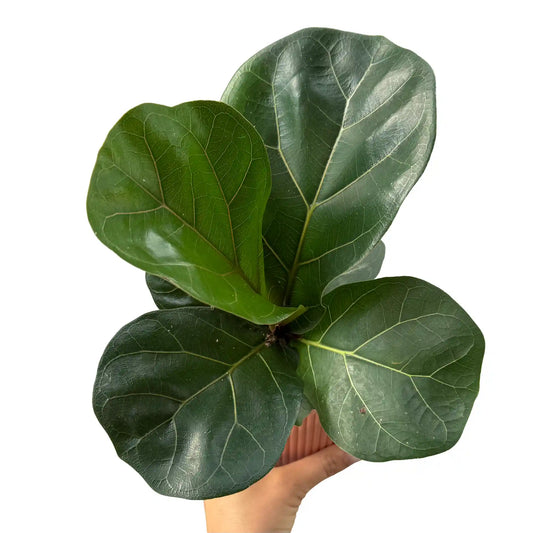
| Ficus lyrata | Fiddle-shaped, up to about 45 cm long (NC State) | About 0.6 to 3 m tall indoors; bright, indirect light, away from afternoon sun | Above about 13 °C (NC State) | NC State: “toxic to humans, cats, and dogs if ingested”; no ASPCA listing found for this species |
| Monstera deliciosa | Split and perforated, 30 cm and larger (NC State) | About 1.8 to 2.4 m tall indoors; moderate light, out of direct sun | Prefers about 16 to 29 °C (NC State) | ASPCA: “Toxic to Dogs, Toxic to Cats” (listing “Cutleaf Philodendron”) |
| Alocasia macrorrhizos | Arrow- or heart-shaped, about 30 to 90 cm long (NC State, Alocasia genus) | About 0.6 to 3 m tall; bright shade or partial shade | Daytime optimum of about 20 to 25 °C (NC State) | ASPCA: “Toxic to Dogs, Toxic to Cats, Toxic to Horses” (listing “Alocasia”) |
| Philodendron gloriosum | Velvety, with pale veins (product description) | Bright, indirect light; never direct sun (NC State, genus) | Ideal temperature is about 18 to 29 °C (NC State, Philodendron genus) | No ASPCA listing for this species; NC State (genus): calcium oxalate, low severity |
| Dwarf banana plant (Musa acuminata 'Dwarf Cavendish') | Huge, paddle-shaped leaves, damaged by strong winds (NC State) | Eventually about 2.5 to 4 m tall (RHS); full sun is ideal, but it tolerates partial shade | Minimum of 10 to 15 °C (RHS, hardiness rating H1B) | ASPCA: “Non-Toxic to Dogs, Non-Toxic to Cats, Non-Toxic to Horses” (listing “Banana”) |
| Kentia (Howea forsteriana) | Long, arching fronds (NC State) | Slow-growing; tolerates fairly low light (RHS) | 16 °C at night in winter (RHS) | ASPCA: “Non-Toxic to Dogs, Non-Toxic to Cats” (listing “Kentia Palm”) |
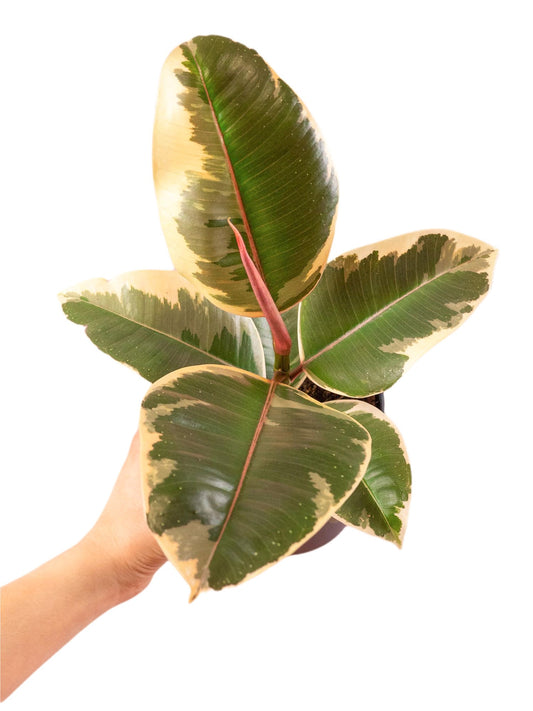
| Ficus elastica 'Tineke' | Thick and leathery, up to about 43 cm long; 'Tineke' has cream variegation (NC State) | About 0.6 to 3 m tall indoors; bright, indirect light or partial shade | Above about 13 °C (NC State) | No ASPCA listing for this species (the “Indian Rubber Plant” listing is for Ficus benjamina); NC State: “Problem for Cats,” “Problem for Dogs” |
| Anthurium clarinervium | Velvety, heart-shaped leaves with white veins (NC State) | Compact plant; bright, indirect light; direct sun causes leaf scorch | About 18 to 29 °C (NC State, genus) | The ASPCA listing “Flamingo Flower” is for A. scherzerianum: “Toxic to Dogs, Toxic to Cats, Toxic to Horses” |
| Yucca (Yucca gigantea, formerly elephantipes) | Long, narrow, about 30 to 45 cm long, with a soft, spineless tip (NC State) | Tree-like growth habit; prefers full sun | Bring indoors below about 10 °C (NC State) | ASPCA: “Toxic to Dogs, Toxic to Cats, Toxic to Horses” (listing “Yucca,” saponins) |
📋 Quick fact sheet
Common care guidelines for large-leafed houseplants, based on the RHS, NC State Extension and Iowa State University.
| Factor | Rule of thumb |
|---|---|
| Light | Bright, indirect light for most; Yucca and banana plants like sun, while Kentia tolerates fairly low light (RHS) |
| Direct sun | It burns the leaves of Anthurium and philodendrons behind glass (NC State) |
| Watering | Water when the surface of the potting mix is dry, never on a schedule; a dry pot is lighter (RHS) |
| Temperature | None tolerate cold: depending on the species, minimums range from 10 °C (Strelitzia, Yucca) to 16 °C (Kentia) |
| Drafts | Avoid them: they cause ficus leaves to drop (RHS, NC State) |
| Space | Allow for the mature size: about 1.8 to 2.4 m indoors for a Monstera, and more for a Strelitzia nicolai |
| Leaves | Clean with a sponge or soft, damp cloth and plain water (Iowa State University) |
| Repotting | Every 2 to 3 years in spring, into a pot 5 to 10 cm wider (RHS) |
| Fertilizer | Use liquid fertilizer during the growing season, never on dry potting mix (RHS) |
| Toxicity | Kentia and banana plants are non-toxic; Monstera, Alocasia and Yucca are toxic (ASPCA); Anthurium is toxic according to NC State |
How to choose a large-leafed plant in 6 steps
When choosing a large-leafed plant, start with the light and the height available, not the photo: a large plant in the wrong spot drops leaves and ends up getting in the way. The RHS notes that strong summer sun can scorch sensitive plants through glass, while in winter they benefit from all the daylight they can get.
Also measure the floor space and ceiling height, then check the room's minimum temperature and whether you have a cat or dog.
| Step | What to do |
|---|---|
| 1. Assess the light | Large sunny window: Strelitzia, banana plant, Yucca; bright filtered light: Ficus lyrata, Monstera, Anthurium; less-bright corner: Kentia |
| 2. Measure the space | Small space or shelf: Anthurium clarinervium; living-room corner: Ficus, Monstera, Kentia; large room: Strelitzia nicolai or banana plant |
| 3. Check the temperature | Cool room in winter (below 16 °C at night): avoid Kentia; choose Yucca or Strelitzia instead, as they can withstand temperatures down to about 10 °C |
| 4. Consider your pets | If you have a cat or dog: Kentia or banana plant, both classified as non-toxic by the ASPCA |
| 5. Choose the leaf shape | Split, velvety, fiddle-shaped, ribbon-like or variegated: see the leaf-shape table below |
| 6. Choose a support and pot | Use a stake for Monstera, a heavy, stable pot for tall plants, and always choose one with a drainage hole |
columns: 4
columns_mobile: 2
-

 Livraison offerte
Strelitzia Nicolai - 19cm Pot - Height 80 - 90cm
Regular price 64,95 €Regular price64,95 €51,96 €Livraison offerte -

 Sold out
Monstera Deliciosa
Regular price From 9,95 €Regular price9,95 €From 7,96 €Sold out -
-

 Sold out
Alocasia Macrorrhizos variegata
Regular price From 14,95 €Regular price19,95 €Sale price From 14,95 €14,95 €From 11,96 €Sold out -

 Sold out
Philodendron Gloriosum
Regular price From 9,95 €Regular price9,95 €From 7,96 €Sold out -
Musa acuminata Dwarf Cavendish - Banana plant - 21cm pot - Height 70-75cm
Regular price From 59,95 €Regular price59,95 €From 47,96 €Livraison offerte -

 Livraison offerte
Howea Forsteriana - Kentia Palm - 19cm Pot
Regular price From 69,95 €Regular price69,95 €From 55,96 €Livraison offerte -
Ficus Elastica Tineke
Regular price From 8,95 €Regular price8,95 €From 7,16 €




🧭 Large-leafed, long narrow-leafed or fuzzy plants: choosing by leaf shape
Leaf shape is often the first thing people look for: a large, round leaf, a long, narrow leaf, a fuzzy leaf, or a green-and-white leaf. This table matches each shape with suitable plants, including an example from our selection. The descriptions come from NC State, the RHS or, where noted, our product listing.
| The leaf you want | Plants to consider |
|---|---|
| Plant with very large or giant leaves | Strelitzia nicolai, banana plant and Alocasia, whose leaves measure about 30 to 90 cm for Alocasia (NC State); try our Strelitzia nicolai in a 19 cm pot or our Alocasia macrorrhiza variegata |
| Plant with large, broad, round green leaves | Ficus lyrata, with fiddle-shaped leaves, and Ficus elastica, with leaves the RHS describes as “large and leathery”; see our Ficus lyrata |
| Green plant with long, narrow leaves | Yucca, with narrow leaves about 30 to 45 cm long (NC State); Kentia, with its fronds; or a Dracaena with long, ribbon-like leaves, such as our Dracaena Janet Craig |
| Indoor plant with long, pointed leaves | Yucca, whose tips are soft and spineless according to NC State, and Sansevieria, with its upright leaves |
| Plant with large, fuzzy or velvety leaves that feel soft to the touch | Anthurium clarinervium, with velvety, heart-shaped leaves according to NC State, and Philodendron gloriosum, prized for its velvety leaf blade |
| Plant with large, split (often described as jagged) leaves | Monstera deliciosa, with its split, perforated leaves: compare its forms in our Monstera variety comparison |
| Plant with large green-and-white leaves | Ficus elastica 'Tineke', green and cream according to NC State, or our Alocasia macrorrhiza variegata, with cream variegation |
| Plant with thick leaves | Ficus elastica, with its thick, leathery leaves, like our Ficus elastica Tineke |
📐 Exotic-leaved giants: Strelitzia nicolai, banana plant and Alocasia
Strelitzia nicolai, or giant white bird of paradise, is a member of the Strelitziaceae family native to southern Africa. Its banana-like leaves can reach nearly 2 m in the wild, according to NC State.
It is the most spectacular plant in this selection, but also the most space-consuming: the RHS (Royal Horticultural Society) Strelitzia guide notes that it can eventually reach 10 m and become too large for most homes over time.
It needs plenty of light, near a large window, and temperatures should never fall below 10 to 12°C. The dwarf banana plant (Musa acuminata 'Dwarf Cavendish') eventually reaches 2.5 to 4 m according to the RHS Musa acuminata 'Dwarf Cavendish' profile, which classifies it as H1B: it can spend the summer outdoors but needs at least 10 to 15°C.
NC State recommends never allowing its potting mix to dry out and protecting it from wind, which damages its large leaves; the hardy garden banana is a different plant, covered in our guide to the Japanese banana (Musa basjoo).
Finally, Alocasia is a genus of 80 species from tropical Asia and eastern Australia, including Alocasia macrorrhizos, known as “giant taro,” according to NC State's Alocasia profile. Their arrow- or heart-shaped leaves measure around 30 to 90 cm; they prefer bright shade and regular watering, reduced in winter, and are susceptible to spider mites.
📐 Indoor trees: Ficus lyrata, Ficus elastica, Kentia and Yucca
Ficus lyrata, or fiddle-leaf fig, is a member of the Moraceae family native to tropical West and Central Africa. Its violin-shaped leaves can reach around 45 cm, and it grows to 0.6 to 3 m indoors according to NC State's Ficus lyrata profile.
It is sensitive to overwatering, and NC State links leaf drop to watering too much or too little; temperature fluctuations near a radiator or air conditioner cause brown spots.
Ficus elastica, or rubber plant, has thick leaves reaching around 43 cm; NC State describes 'Tineke' as a variegated cultivar in green, cream, or pale yellow, and notes that overwatering or cold drafts cause its leaves to drop.
For both ficuses, the RHS ornamental fig guide recommends wearing gloves when pruning, as the white sap can irritate the skin.
Kentia (Howea forsteriana), a palm endemic to Australia's Lord Howe Island according to NC State, grows slowly and tolerates fairly low light, but needs a nighttime temperature of 16°C in winter, according to the RHS indoor palm guide.
Yucca gigantea, long sold under the name Yucca elephantipes, prefers full sun and is especially susceptible to overwatering, according to NC State's Yucca gigantea profile; its leaves, around 30 to 45 cm long, have a soft tip and no spines.
📐 Striking foliage: Monstera, Philodendron gloriosum and Anthurium clarinervium
Monstera deliciosa, an aroid native from Mexico to Panama, grows to around 1.8 to 2.4 m indoors according to NC State Extension's Monstera deliciosa profile, which recommends moderate light without direct sun and thorough watering, then waiting until the top quarter to third of the potting mix has dried out.
As a climbing plant, it appreciates a moss pole. Philodendron gloriosum is an aroid native to Colombia, classified as a climbing plant by POWO (Plants of the World Online, Kew); it is especially prized for its velvety foliage with pale veins.
Like other philodendrons, it prefers bright, indirect light and an ideal temperature of around 18 to 29°C, according to NC State's Philodendron profile, which notes that philodendrons generally adapt to the humidity levels found in a home.
Anthurium clarinervium, native to Chiapas, Mexico, according to POWO, has heart-shaped, velvety, dark green leaves with white veins, as described in NC State's Anthurium profile.
It needs bright, indirect light, watering when the potting mix feels dry to the touch, preferably with rainwater, and warm, humid air to prevent brown tips.
🗓️ Large-leaved plants through the seasons
Large-leaved plants follow the rhythm of the light: they put out new leaves from spring to late summer, then slow down in winter.
The RHS houseplant guide recommends applying liquid fertilizer once or twice a month during the growing season, no more than once a month in winter, and never to dry potting mix.
Keep the Strelitzia moist but not waterlogged in summer; from late November onward, let its potting mix dry out noticeably between waterings, according to the RHS. In winter, move plants closer to the light, keep them away from radiators, and read our guide to caring for houseplants in winter.
📅 Seasonal care calendar
| Season | Key task |
|---|---|
| 🌸 Spring | Repot if roots are growing out of the pot, resume fertilizing, move the banana plant outdoors to a sheltered spot when nights stay mild |
| ☀️ Summer | Water more often, checking the potting mix by touch; filter or diffuse sunlight for Anthurium and philodendrons; clean the leaves |
| 🍂 Fall | Reduce fertilizing, bring plants indoors before the first cold spells (below around 10°C for Yucca, according to NC State), move them back near the light |
| ❄️ Winter | Water less often, keep all plants away from radiators and cold doors, keep Kentia at 16°C at night (RHS) |
🐛 Mistakes to avoid with large-leaved plants
Mistakes with large-leaved plants are mostly about their location: too small a space, too little light, too cold, or too exposed to drafts. Next comes overwatering, which NC State flags for Ficus lyrata, Yucca, and philodendrons, and dust, which quickly dulls a large leaf surface. Here are the most common mistakes, plant by plant.
| Mistake | Why it's a problem | Solution |
|---|---|---|
| Putting a Strelitzia nicolai in a small living room | It eventually grows too large for most homes, according to the RHS | Give it a large, bright space, or choose a Ficus lyrata or Kentia |
| Placing a ficus near a radiator or door | Temperature fluctuations and drafts cause leaves to drop (RHS, NC State) | Choose a bright, stable location away from vents |
| Letting the banana plant dry out | NC State recommends never allowing its potting mix to dry out | Water as soon as the surface dries during the growing season, and a little less in winter when growth slows |
| Watering Yucca like a tropical plant | Overwatering causes root rot (NC State) | Let the potting mix dry out between waterings |
| Putting Anthurium or a philodendron in direct sun | Direct sun scorches the leaves (NC State) | Bright light filtered through a sheer curtain, or move it a meter away |
| Keeping a Kentia in a cold room in winter | The RHS recommends 16°C at night in winter for the Howea genus | Place it in a heated room, away from the radiator |
| Shining the leaves with household soap | Detergents damage the leaf's waxy cuticle, according to Iowa State University Extension | Use clean water and a soft cloth; use a soft brush for velvety leaves |


🌿 Our 10 large-leaved plants and their care guides
This guide compares the plants; each profile then covers watering, repotting, and common problems. Here are our 10 large-leaved plants, with an example from our selection, plus all our XXL plants in the largest sizes.
| Our selection | Why choose it |
|---|---|
| Strelitzia nicolai | The most spectacular, for a large, bright space; see our Strelitzia nicolai in a 19 cm pot |
| Ficus lyrata | The fiddle-leaf fig, with violin-shaped leaves, is a star of bright living rooms; our Ficus lyrata, and all Ficus varieties |
| Monstera deliciosa | The best-known split leaves, grown on a support; our Monstera deliciosa |
| Alocasia macrorrhizos | Elephant-ear leaves, variegated on our Alocasia macrorrhiza variegata |
| Philodendron gloriosum | Velvety foliage with pale veins; our Philodendron gloriosum |
| Dwarf banana plant | The most exotic, for a very bright room; our Dwarf Cavendish banana plant (Musa acuminata) |
| Kentia | The palm that tolerates fairly low light, and is non-toxic according to the ASPCA; our Kentia in a 19 cm pot and our indoor palm guide |
| Ficus elastica 'Tineke' | Thick leaves variegated with cream; our Ficus elastica Tineke |
| Anthurium clarinervium | A compact plant with large, velvety leaves; our Anthurium clarinervium |
| Yucca | Long, pointed leaves for a sunny window; our Yucca elephantipes |
🔑 Toxicity of large-leaved plants to cats and dogs
Of these 10 plants, only two are classified as non-toxic to cats and dogs by the ASPCA: Kentia (the ASPCA's “Kentia Palm” profile) and banana plant (the “Banana” profile, based on Musa acuminata).
Monstera deliciosa is classified as “Toxic to Dogs, Toxic to Cats” by the ASPCA (American Society for the Prevention of Cruelty to Animals), due to insoluble calcium oxalates that cause mouth irritation, excessive drooling, vomiting, and difficulty swallowing.
The ASPCA also classifies Alocasia as toxic (to dogs, cats, and horses; same oxalates) and Yucca as toxic (saponins, vomiting).
For the others, there is no ASPCA listing for the exact species: NC State classifies Ficus lyrata as “toxic to humans, cats, and dogs if ingested,” lists Strelitzia nicolai as toxic with low severity, and identifies Ficus elastica as a “Problem for Cats” and a “Problem for Dogs.”
For Anthurium clarinervium, NC State states “toxic if ingested,” with low severity (the ASPCA listing “Flamingo Flower,” based on Anthurium scherzerianum, classifies it as “Toxic to Dogs, Toxic to Cats, Toxic to Horses”); for Philodendron gloriosum, NC State notes mouth and throat irritation at the genus level, with low severity.
Beware of listings with similar names: the ASPCA listing “Indian Rubber Plant” refers to Ficus benjamina, and the “Fiddle-Leaf” listing is for a philodendron (Philodendron bipennifolium), not Ficus lyrata. Explore our pet-friendly plants and our list of plants that are non-toxic to cats.
🔑 Also: more large-leaf plants
Other large-leaf plants make a great addition to this selection: Areca, a palm with long fronds that needs plenty of light and at least 13°C (55°F) in winter, according to the RHS; Schefflera, with its umbrella-shaped leaves; and Calatheas, with their decorative large leaves and greater humidity needs.
If you're looking for a large plant for a low-light corner, our guide to plants for dark rooms has more ideas, and a grow light can help brighten a dark room.
For decorating, placement, and general care tips for these plants, read our tips for placing and caring for a large-leaf plant; and to create an entire look, see our guide to creating an urban jungle.
Finally, it is often said that large leaves purify the air: this is a gross exaggeration, as our investigation into air-purifying plants shows.
✅ Our tips for growing large-leaf plants successfully
To grow a large-leaf plant successfully, first choose one suited to the light and ceiling height in your room: Strelitzia, banana plant, or Yucca near a large window; Ficus lyrata, Monstera, and Anthurium in bright, filtered light; Kentia for a less sunny spot. Check each species' minimum temperature, water when the soil feels dry, and regularly wipe the leaves with clean water.
If you have a cat or dog, Kentia and banana plants are the safest choices, according to the ASPCA. Find all these plants in our collection of large and medium-sized plants, and remember to repot after purchase only if the roots are growing out of the pot.
My favorite is still Ficus lyrata: just one fiddle-shaped leaf is enough to dress up a wall. But I often recommend starting with a Kentia or Monstera, which are more forgiving, before investing in a Strelitzia nicolai, which really does need plenty of space and light. My favorite care task is cleaning the leaves: wipe them with a damp cloth, and the plant regains its shine. And when there's a cat at home, Kentia is always my first choice.

Laura Bruneau
Jardinière et autrice


