Ficus: The Complete Guide to All Varieties

It's hard to find a genus as diverse as Ficus. On one side, the large, glossy elastica. On the other, the lyrata, more demanding but strikingly decorative. In between, the ginseng with its exposed roots, or the more classic but just as effective benjamina. In short, there's a Ficus for (almost) every home.
Ficus: a genus with many different faces
What do all Ficus varieties have in common? Dense, often glossy foliage, and growth that can become impressive over time. Beyond that, every variety has its own personality—to the point that it's sometimes hard to believe they belong to the same botanical genus, as is the case with most families of indoor plants.
Star varieties (elastica, lyrata, ginseng, benjamina, tineke)
Ficus elastica stands out for its thick, glossy, almost rubbery leaves. Ficus lyrata, nicknamed the fiddle-leaf fig for its large, violin-shaped leaves, needs a little more attention but makes an immediate statement.
Ficus ginseng, with its exposed, knobby roots, looks like an easy-care little bonsai.
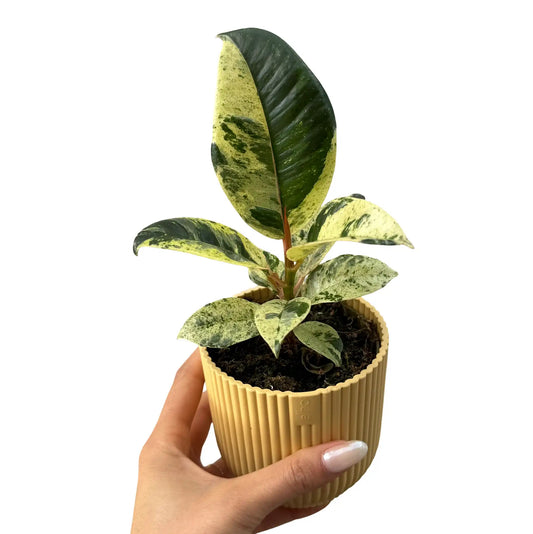
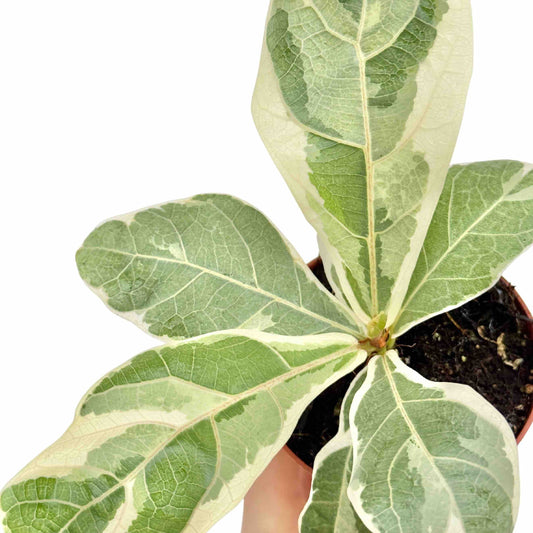
Ficus benjamina remains a hardy classic, perfect as a first purchase. And Tineke, with its cream-white variegation, adds a lighter, brighter touch to the collection.
Where to place your Ficus so it thrives
Ficus likes bright, indirect light, as the Royal Horticultural Society (RHS) points out. Too much direct sun can scorch the leaves. Not enough light, and growth slows significantly, sometimes stopping altogether. Avoid moving it too often, too: Ficus tends to react poorly to sudden changes in its environment. As for temperature, the University of Florida (UF IFAS) recommends keeping it at around 16°C or above.
columns: 4
columns_mobile: 2
-
Duo - Universal Substrate 10L + Universal Liquid Fertilizer 250ml + free graduated pipette
Regular price 32,00 €Regular price37,00 €Sale price 32,00 €Sale -
Fertilizer for All Indoor Plants - 250ml Liquid Fertilizer - Root and Foliar Fertilizer + Free Graduated Pipette!
Regular price 18,00 €Regular price20,00 €Sale price 18,00 €Sale -

 Livraison offerte
Ficus Lyrata - 21cm Pot - Height 75 - 85cm
Regular price From 54,95 €Regular price -

 Livraison offerte
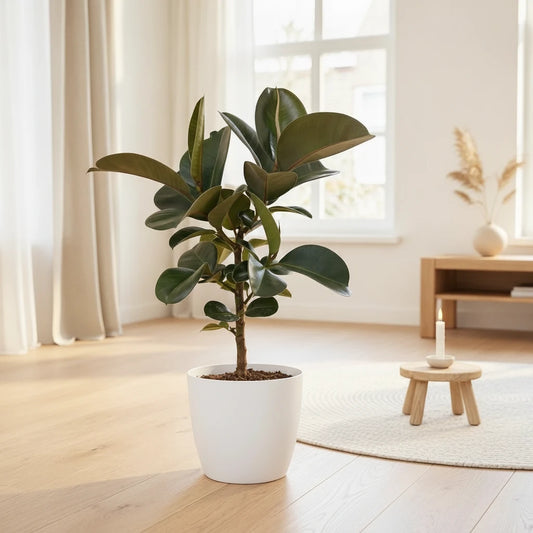
Rubber Plant - Ficus Elastica Cloe - 19cm Pot - Height 65cm
Regular price From 59,95 €Regular price





Watering and caring for Ficus
Check the soil before each watering, and let the top third of the pot dry out between waterings. Too much water, and the leaves turn yellow. Not enough, and they drop, often all at once—something that worries many beginners, even though the plant usually bounces back once watering is corrected.

Suitable soil and repotting
Ficus (in the Moraceae family, according to Kew (Plants of the World Online)) does well in soil similar to that used for Araceae: this mix works just as well for Ficus as for Monstera, thanks to its balance of water retention and drainage. Repot about every two years, in spring, as soon as the roots start circling the bottom of the pot.
Why is my Ficus losing its leaves?
This is the question we get most often. And the answer comes down to three things: stress, light, watering. A recent move, a change of season, too much or too little water, and Ficus responds by shedding a few leaves to conserve its resources.
In most cases, there's no need to panic. Keep its environment stable, adjust watering, and a boost from concentrated liquid fertilizer for tropical plants often helps kick-start more vigorous growth.
Mealybugs, spider mites: Ficus pests
Ficus isn't particularly vulnerable to pests, but two uninvited guests show up regularly: mealybugs, identified by their small brown shells or cottony clusters along the stems, and spider mites, which are harder to spot and leave a fine web on the undersides of leaves when the air is too dry.
For mealybugs, a cotton swab dipped in 70% rubbing alcohol is the simplest solution when an infestation is just starting. For spider mites, increasing humidity and regularly showering the foliage is often enough to deter them—they hate moisture.
Of course, the best approach is to prevent the problem in the first place: checking the undersides of the leaves once a month, especially during the heating season, helps you spot an infestation before it becomes difficult to treat.
Cleaning Ficus for healthy, breathing foliage
Ficus's large, glossy leaves, especially those of elastica, quickly collect dust. And dusty foliage doesn't photosynthesize as well—much like a dirty window that filters the light.
A soft, slightly damp cloth, used about once a month, is more than enough. For Ficus varieties with smaller, more numerous leaves, like benjamina, a lukewarm shower is more practical than cleaning each leaf individually. It's also a chance to discreetly inspect each leaf as you go and spot any potential problems before they get worse.


Laura Bruneau
Jardinière & autrice