

Ficus 'Alii' (Ficus maclellandii): care, light and leaves

To care for a Ficus 'Alii', place it in a bright room with indirect light, water when the top few centimetres of potting mix are dry, and keep it between 18 and 27°C, away from drafts. This small indoor tree with sword-shaped leaves is related to Ficus maclellandii, although it is often found under the name Ficus binnendijkii 'Alii'.
This guide focuses on what sets it apart: its name, growth habit, light tolerance, and the issue of its leaves. For the basics common to all ficuses, see our complete Ficus care guide.
🌿 Why choose a Ficus 'Alii'
The Ficus 'Alii' offers the silhouette of a real little tree, with fine, flexible foliage that cascades down, very different from the large round leaves of a rubber plant.
According to NC State Extension (the North Carolina State University Extension), its olive-green leaves, thin and 3 to 10 inches long (about 8 to 25 cm), have a cascading effect, and this cultivar is easier to grow than other varieties.
Above all, the University of Florida (UF/IFAS, Institute of Food and Agricultural Sciences) states that 'Alii' can be used under 50 foot-candles, or about 540 lux, where other indoor ficuses require 100 to 200 foot-candles.
It is often said that it loses fewer leaves than the Ficus benjamina: none of the authoritative sources consulted confirm this, so we cannot guarantee it.
| Asset | What this means for you |
|---|---|
| Elegant tree-like growth habit | An upright trunk and fine, cascading foliage that dresses a corner of the room |
| Moderate light tolerance | Usable under about 540 lux according to UF/IFAS, less demanding than other ficuses |
| Considered easy to grow | Easier to grow than other varieties according to NC State Extension |
| Colorful new shoots | New red leaves when they emerge, according to UF/IFAS |
🔎 The Ficus 'Alii' ID card
According to Plants of the World Online (POWO), the database of the Royal Botanic Gardens, Kew, the accepted name of the species is Ficus maclellandii King, published in 1887, in the Moraceae family.
Its natural range extends from Assam, Bangladesh, and the Eastern Himalayas to Myanmar, Thailand, Laos, Cambodia, Vietnam, southern China, and the Malay Peninsula; it is a tree of the humid tropical biome.
The name Ficus binnendijkii, under which 'Alii' circulates in trade and in the UF/IFAS guide, does not return any results on POWO and is not among the synonyms of Ficus maclellandii: we therefore retain the association proposed by NC State Extension, which presents 'Alii' as the best-selling cultivar of this species, and keep binnendijkii as a commercial name.
UF/IFAS cites 'Alii' (or 'Sabre') and 'Amstel King' as cultivars, described as shrubs or trees with long sword-shaped leaves, red when they emerge.
| Criterion | Verified detail |
|---|---|
| 🏷️ Botanical name | Ficus maclellandii 'Alii' (species Ficus maclellandii King); also sold as Ficus binnendijkii 'Alii' |
| 🧬 Family | Moraceae (Moraceae) |
| 🌳 Type | Evergreen tropical tree, grown as an indoor tree |
| 🌍 Origin | South and Southeast Asia, from Assam to Vietnam and southern China |
| 🍃 Foliage | Narrow sword-shaped leaves, about 8 to 25 cm, red when emerging then olive green |
| 🌸 Flowering | Flowers enclosed in small figs, of no decorative interest indoors |
| 📏 Size | About 1.8 to 3 m tall and 1.2 to 1.8 m wide indoors according to NC State Extension |
| ⚠️ Toxicity | Toxic to dogs, cats, and horses; latex can irritate the skin |
📋 Quick technical sheet
The essential care points, gathered at a glance.
| Parameter | Guideline |
|---|---|
| Light | Bright and indirect; tolerates moderate light (about 540 lux) |
| Watering | When the top 2.5 to 5 cm of potting mix are dry, empty the saucer |
| Substrate | Well-draining potting mix for green plants, perforated pot |
| Humidity | Tolerates ambient air; moist pebble tray near heating |
| Temperature | Ideally 18 to 27°C, never below about 16°C |
| Repotting | When the roots fill the pot, never within 4 weeks after purchase |
| Fertilizer | Two applications per year are sufficient according to NC State, during the growing season |
| Toxicity | Toxic to animals, gloves recommended for pruning |
| Difficulty | Easy, provided you find it a stable place |
📍 Where to place a Ficus 'Alii' in the house
Place your Ficus 'Alii' near a bright window, without direct burning sun in the middle of summer: NC State Extension indicates that the species does best in bright indirect light, while putting deep shade (less than 2 hours of direct sun) among the possible exposures.
That is its main advantage over other ficuses: UF/IFAS judges it usable under 50 foot-candles, or about 540 lux, two to four times less than the 100 to 200 foot-candles lighting retained for other indoor ficuses.
For heat, UF/IFAS judges a temperature of about 18 to 27°C (65 to 80°F) the most suitable for indoor ficuses and asks to keep them above about 16°C (60°F) permanently. Then choose a permanent place, away from radiators and open doors.
☀️ Ideal: Near a large east or west window, in bright filtered light
🌥️ Acceptable: Bright room further from the window, or supplemented with a grow light
🚫 To avoid: Dark corner, radiator, cold draft, repeated moves
🪴 Repotting a Ficus 'Alii' grown as a tree
Repot your Ficus 'Alii' when the roots fill the pot or come out through the drainage holes, never within the month following purchase. According to NC State Extension, it needs a well-draining potting mix, as it does not like waterlogged potting mixes.
Take a perforated pot just slightly wider than the old one: too large a volume of potting mix stays wet for a long time. On a specimen grown as a tree on a trunk, keep the root collar at the same level as before and brace the trunk with a stake if the root ball is still light.
| Step | The right move |
|---|---|
| 1. Choose the time | When the roots fill the pot, at least 4 weeks after installation |
| 2. Choose the pot | Perforated pot just slightly wider than the old one, heavy if the specimen is tall |
| 3. Remove from pot | Remove the root ball, untangle the roots that are circling |
| 4. Repot | Draining potting mix, root collar at the same level, stake if needed |
| 5. Water | Water thoroughly, drain completely, return immediately to the same place |
columns: 4
columns_mobile: 2
-

 Livraison offerte
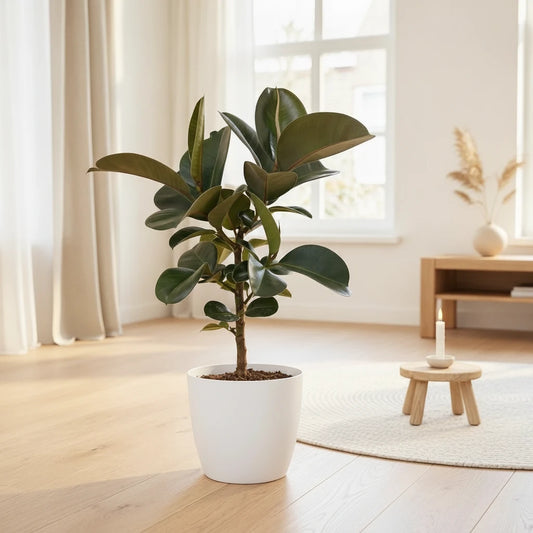
Rubber Plant - Ficus Elastica Cloe - 19cm Pot - Height 65cm
Regular price From 64,95 €Regular price64,95 €From 51,96 €Livraison offerte -

 Sold out
Ficus elastica 'Abidjan'
Regular price 14,95 €Regular price19,95 €Sale price 14,95 €14,95 €11,96 €Sold out -
Ficus Elastica Tineke
Regular price From 8,95 €Regular price8,95 €From 7,16 € -



✂️ Ficus 'Alii' care: watering, humidity, and fertilizer
The care of the Ficus 'Alii' relies on measured watering: NC State Extension advises watering once the top 1 to 2 inches of potting mix, or about 2.5 to 5 cm, have dried. Push a finger into the potting mix before each watering, water thoroughly then empty the saucer.
It accommodates the air of our interiors; near a heater, a moist pebble tray helps more than misting (see how to increase air humidity). On the fertilizer side, NC State Extension estimates that two applications per year are sufficient: place them during the growing season, at the label dose, and give nothing in winter.
💧 Watering: When the top 2.5 to 5 cm of potting mix are dry, then empty the saucer
🔹 Control: Finger in the potting mix before each application, especially near a heater
💧 Humidity: Moist pebble tray under the pot or grouped plants
🌱 Fertilizer: Two applications per year in spring and summer, nothing in winter
🧹 Cleaning: Leaves wiped to capture more light and spot pests
🍂 Pruning the Ficus 'Alii' and following it through the seasons
The pruning of the Ficus 'Alii' remains light: shorten the branches that unbalance the silhouette, above a leaf, with clean pruning shears. Wear gloves, because NC State Extension indicates that its stems contain a latex that can cause contact dermatitis in some people.
NC State Extension classifies it in USDA zones 11a and 11b, those of frost-free climates: it remains an indoor plant all year in France. An outdoor summer outing sheltered is only conceivable if the nights remain above about 16°C, the UF/IFAS threshold, and every change of place remains a stress.
📅 Care calendar by season
| Season | Key move |
|---|---|
| 🌸 Spring | First of the two fertilizer applications, light pruning, repotting if the roots fill the pot |
| ☀️ Summer | More frequent watering, bright filtered light, outdoor sheltered only if nights exceed about 16°C |
| 🍂 Autumn | Bring in before cool nights, spaced then stopped fertilizer, reduced watering |
| ❄️ Winter | Fixed and bright place, at least 16°C, away from radiators, dry potting mix on top before watering |
🌱 Propagating a Ficus 'Alii'
NC State Extension cites stem cuttings and sowing for Ficus maclellandii. In practice, take in spring or summer a semi-hardwood cutting, remove the bottom leaves, let the latex dry then plant it in a light just moist mix, in the warmth and bright light without direct sun.
For the neighboring cultivar 'Amstel King', UF/IFAS specifies that the difficulty of rooting imposes still aerial marcotting in production, a safer technique on thick branches. For the details of the methods common to ficuses, refer to our Ficus guide.
🐛 Common problems: causes and solutions
Why is my Ficus 'Alii' losing its leaves? Most often because of a change in light.
Regarding the Ficus benjamina, NC State Extension explains in its Ficus benjamina sheet that a moved Ficus can lose its leaves to produce new ones adapted to the new light; the source only says it for this species, but UF/IFAS reminds that a move is a stress for any indoor ficus.
UF/IFAS links the drop of green leaves to the lack of light and ethylene, for example that of a faulty space heater, and reminds the damage of the cold below about 16°C. On the pest side, NC State Extension cites for this species whiteflies, mealybugs, ficus mealybug and thrips; see also mealybugs.
| Symptom | Probable cause | Solution |
|---|---|---|
| Green leaves falling after a move | ☀️ Light change, the plant renews its foliage | Choose a permanent bright place and do not move it anymore |
| Leaf drop in a dark corner | ☀️ Light too weak, even for an 'Alii' | Bring closer to the window or supplement with a grow light |
| Dark spots and drop after a draft | ❄️ Cold snap, below about 16°C | Move away from openings and cold glass |
| Yellow leaves, potting mix wet deep down | 💧 Excess water, waterlogged potting mix | Wait until 2.5 to 5 cm of potting mix dries, empty the saucer |
| Sticky honeydew, small white flies | 🐛 Whiteflies or mealybugs | Isolate, wipe the leaves, treat if the attack persists |
| Silvery or deformed leaves | 🐛 Thrips | Shower the foliage, cut the very affected parts |


🌸 Our varieties of Ficus trees
Here are the Ficus trees closest to the 'Alii', to compare the growth habits and requirements. Our Ficus binnendijkii 'Alii' in a 17 cm pot (60 to 80 cm tall) is not yet online; find the others in our Ficus collection.
| Variety | Its asset |
|---|---|
| Ficus 'Alii' (17 cm pot) | Narrow sword-shaped leaves, cascading growth habit, tolerance to moderate light |
| Ficus 'Amstel King' | Glossy dark green banana-shaped leaves, small weeping habit (NC State), propagated by air layering in production (UF/IFAS) |
| Ficus elastica 'Cloé' | Rubber plant with large glossy leaves and a more massive silhouette |
| Ficus elastica 'Abidjan' | Rubber plant with very dark, almost black foliage |
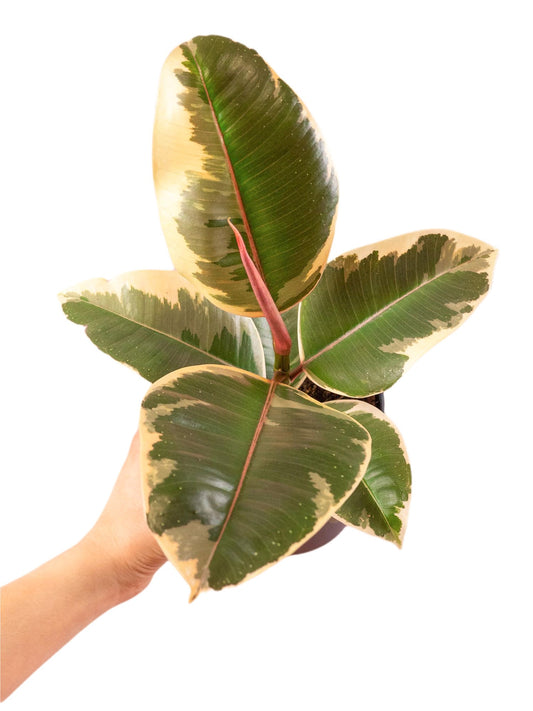
| Ficus elastica 'Tineke' | Variegated rubber plant with green and cream or pale yellow tones for a light touch |
| Ficus maclellandii 'Alii Variegated' | Chartreuse leaves mottled with dark green, with bronze new growth, according to NC State Extension |
🎨 Which plants to pair with your Ficus 'Alii'
The delicate foliage of the Ficus 'Alii' contrasts beautifully with the large leaves of other indoor trees. Pair it with the Ficus elastica 'Tineke' to contrast narrow leaves with broad variegated ones, or with the Ficus 'Audrey' for a duo of tree-shaped ficuses.
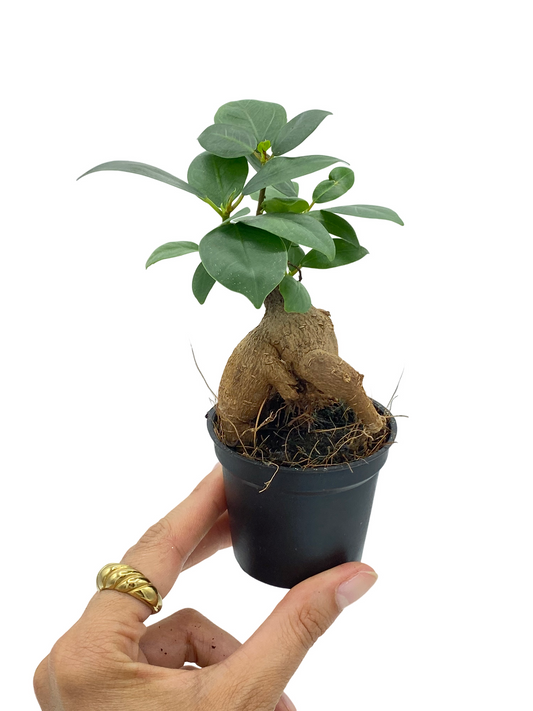
The Schefflera adds palm-like foliage at mid-height, while the Ficus ginseng completes the scene on a coffee table.
For a slightly dimmer room, consider a grow light, and browse our large and medium plants or our office plants; if your plant arrives by parcel, read our guide on acclimating a plant after buying it online.
⚠️ Is Ficus 'Alii' toxic to cats and dogs?
Yes. The ASPCA (American Society for the Prevention of Cruelty to Animals) does not have a dedicated entry for Ficus maclellandii: its "Weeping Fig" entry covers ficuses in general (Ficus sp.) and classifies them as toxic to dogs, cats, and horses due to a proteolytic enzyme called ficin and a psoralen called ficusin.
Contrary to what is sometimes reported, it is not caused by calcium oxalates. NC State Extension also notes that the latex in the stems can cause contact dermatitis in some people. Keep it out of reach of animals that chew on leaves and contact a veterinarian if ingested.
✅ Our expert tips for success
Remember three key things for your Ficus 'Alii': a bright, permanent spot; watering only when the top few centimeters of potting mix are dry; and a stable temperature of 18 to 27°C (64 to 81°F), never below around 16°C (61°F). Its true strength, according to sources, is that it tolerates moderate light better than other ficuses; otherwise, it is still a ficus that reacts to every change in location.
If it loses leaves, check the light, temperature, and watering before moving it, and discover its relatives in all our indoor plants.
I love the Ficus 'Alii' for its delicate foliage, which moves with the slightest breeze and softens the corner of a living room. When people ask me if it loses fewer leaves than a benjamina, I honestly tell them I haven't found a source that proves it. What I have observed is that it settles in as soon as you find it a bright spot and stop moving it. I always wait for the top of the potting mix to dry before watering.

Laura Bruneau
Jardinière et autrice


