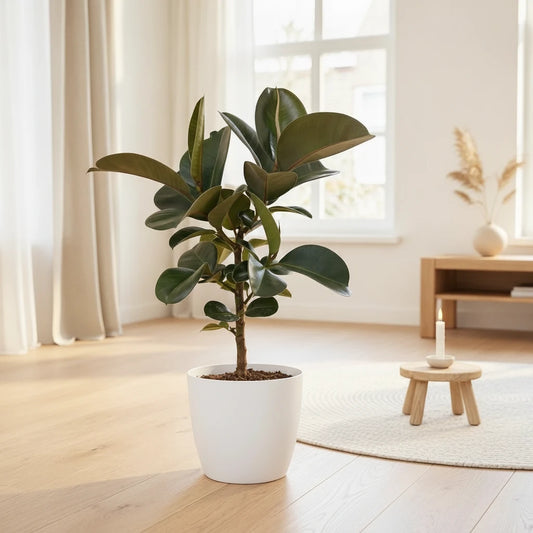
Ginseng ficus (Ficus microcarpa): care, pruning and watering

To care for a Ficus ginseng, give it the brightest spot in the house, keep its potting mix just moist without ever waterlogging it, and maintain it between 18 and 27°C, away from drafts; above all, do not move it once it is settled. This indoor bonsai is a cultivar of Ficus microcarpa recognizable by its base of swollen roots.
This guide deals only with what makes it special: its roots, its cultivation as a bonsai, its pruning, and its famous leaf drop. For the basics common to all indoor ficuses, see our complete Ficus care guide.
🌿 Why the Ficus ginseng is so appealing
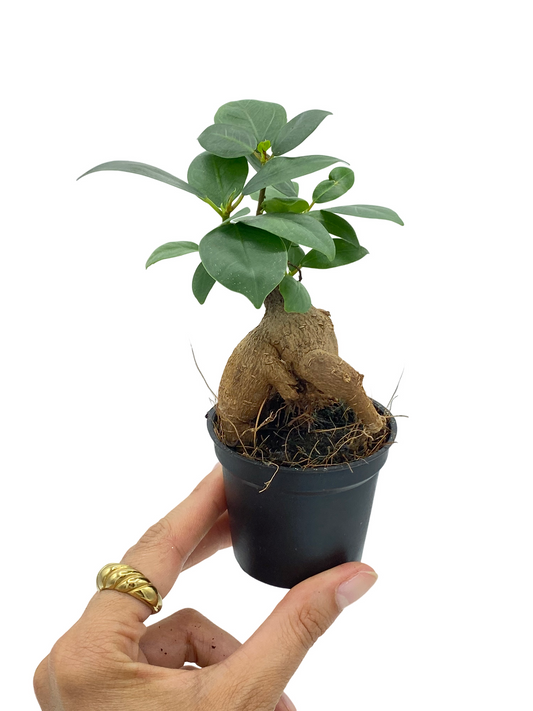
The Ficus ginseng offers a pre-formed bonsai: a stocky and sculptural root base, topped with a small canopy of dark green and shiny leaves.
According to NC State Extension (the North Carolina State University extension), this cultivar grows a little faster and is easier to care for than other bonsai species, making it a very good first bonsai. It thrives indoors all year round, tolerates pruning well, and remains compact in a small pot.
It also finds its place on a bright desk, among our office plants.
| Asset | What this means for you |
|---|---|
| Instant bonsai silhouette | Thick roots and small foliage that make an impression without years of training |
| Bonsai for beginners | Easier and faster than other bonsai species according to NC State Extension |
| Indoor cultivation | A tropical bonsai that lives in the house all year round, not a garden tree |
| Tolerates pruning | It reforms easily and keeps a table or desk size |
🔎 The Ficus ginseng ID card
According to Plants of the World Online (POWO), the database of the Royal Botanic Gardens, Kew, the accepted name of the species is Ficus microcarpa L.f., published in 1782, in the Moraceae family.
Its natural range covers tropical and subtropical Asia up to the western Pacific: from India and Sri Lanka to Southeast Asia, the Philippines and New Guinea, up to Japan and Australian Queensland. In nature, it is a large tree of the humid tropical regions.
The name "ginseng" refers to a cultivar: NC State Extension describes it as widely used in bonsai for its thick and bulbous roots, reminiscent of ginseng, which rise out of the soil, its dark green, leathery, teardrop-shaped leaves, and its grayish bark.
As with all ficuses, the same guide specifies that the flower is inverted: the reproductive organs are enclosed in the small fig, so that we never see flowers in the proper sense. The RHS (Royal Horticultural Society) lists it under the name Ficus microcarpa 'Ginseng' in its Ficus microcarpa 'Ginseng' guide.
| Criterion | Verified detail |
|---|---|
| 🏷️ Botanical name | Ficus microcarpa 'Ginseng' (species Ficus microcarpa L.f.) |
| 🧬 Family | Moraceae (Moraceae) |
| 🌳 Type | Evergreen tropical tree, cultivated as an indoor bonsai |
| 🌍 Origin | Tropical and subtropical Asia up to the western Pacific |
| 🍃 Foliage | Small dark green, shiny and leathery, teardrop-shaped leaves |
| 🌸 Flowering | Flowers hidden in small figs, with no decorative interest indoors |
| 📏 Size | More than 12 m tall in 20 to 50 years in the ground according to the RHS; kept small by bonsai pruning |
| ⚠️ Toxicity | Toxic to dogs, cats, and horses; sap is an allergen to the skin |
📋 Quick technical sheet
The essential care points, gathered at a glance.
| Parameter | Guideline |
|---|---|
| Light | Very bright, as close as possible to a south or west window |
| Watering | Keep the potting mix just moist, never waterlogged; frequent checks in a small pot |
| Substrate | Draining mix: potting mix, gravel or sand and soil-based potting mix |
| Humidity | Humid air appreciated: tray of wet pebbles, grouped plants |
| Temperature | Ideally 18 to 27°C, never below about 16°C |
| Repotting | In spring, before the growth spurt, with root pruning |
| Fertilizer | Low-dose balanced liquid fertilizer, every 2 weeks during the growing season |
| Toxicity | Toxic to animals, gloves recommended for pruning |
| Difficulty | Easy, provided you do not move it anymore |
📍 Where to place a Ficus ginseng in the house
Place your Ficus ginseng as close as possible to the brightest window, ideally facing south or west: the RHS (Royal Horticultural Society) gives it a full sun exposure, south or west, sheltered from the wind, and NC State Extension recommends a sunny and warm location.
Lack of light is its main enemy indoors: the University of Florida (UF/IFAS, Institute of Food and Agricultural Sciences) lists it among the causes of green leaf drop in ficuses.
Regarding heat, UF/IFAS considers a temperature of about 18 to 27°C (65 to 80°F) the most suitable for indoor ficuses and asks to keep them above about 16°C (60°F) at all times, including transport. Choose a stable place, away from radiators, open doors, and iced-over windows in winter, and do not touch it again.
☀️ Ideal: Ledge or table against a south or west window, in a heated room
🌥️ Acceptable: East window very bright; slower growth, watch for leaf drop
🚫 To avoid: Back of the room, radiator, cold draft, repeated moves
🪴 Repotting a Ficus ginseng as a bonsai
Repot your Ficus ginseng in spring, ideally before the growth spurt: this is the period the RHS bonsai guide recommends for repotting and root pruning.
Untangle the long roots and cut them cleanly to get a clean root ball; the frequency depends on the vigor of the tree, with fast-growing species requiring intervention every year. For the mix, the RHS suggests two parts peat-free potting mix, two parts coarse sand or non-calcareous gravel, and one part soil-based potting mix like John Innes No. 3. Keep the swollen base well clear, out of the substrate.
| Step | The right move |
|---|---|
| 1. Choose the time | In spring, before the growth spurt, never within 4 weeks of purchase |
| 2. Unpot | Remove the root ball, untangle the long fine roots |
| 3. Prune the roots | Cut the roots that are too long cleanly for a clean root ball |
| 4. Prepare the mix | Potting mix, gravel or coarse sand and soil-based potting mix, in a perforated pot |
| 5. Repot and water | Same level as before, swollen roots clear, water thoroughly then drain |
columns: 4
columns_mobile: 2

✂️ Ficus ginseng care: watering, humidity and fertilizer
Ficus ginseng care relies on regular and monitored watering: UF/IFAS indicates that ficuses need a lot of water and a moist substrate, while the NC State Extension species guide reminds that excess water rots the roots.
In a small bonsai pot, the potting mix dries quickly: the RHS recommends checking all year and notes that in summer a bonsai may require watering once or twice a day.
NC State Extension observes that high humidity, from 70 to 100%, promotes the formation of aerial roots; in an apartment, a tray of wet pebbles helps more than misting (see how to increase humidity).
For fertilizers, the RHS recommends a low-dose balanced liquid fertilizer every two weeks during the growing season.
💧 Watering: When the surface of the potting mix starts to dry, water thoroughly, then empty the saucer
🔹 Check: Finger in the potting mix often, especially in summer and near heating
💧 Humidity: Tray of wet pebbles under the pot or grouped plants
🌱 Fertilizer: Balanced liquid fertilizer, low dose, every 2 weeks in spring and summer
🧹 Cleaning: Wipe leaves to keep maximum light and spot pests
🍂 Pruning a Ficus ginseng and following it through the seasons
To prune a Ficus ginseng, shorten the branches that stick out of the desired silhouette with clean pruning shears, keeping a few leaves on each branch.
According to the RHS, a young bonsai is pruned about once a year, a subject formed several times a year to stay balanced, and an evergreen tree tolerates light pruning at any time of the year.
The RHS classifies Ficus microcarpa 'Ginseng' in pruning group 1, that of light pruning, and lists it as a skin allergen: wear gloves to prune. Classified H1b, it can spend the summer outside sheltered, but must come inside before the nights drop below 10 to 15°C.
📅 Care calendar by season
| Season | Key move |
|---|---|
| 🌸 Spring | Repotting and root pruning if needed, resume fertilizer, training pruning |
| ☀️ Summer | Frequent watering in a small pot, fertilizer every 2 weeks, possible outdoor placement sheltered |
| 🍂 Autumn | Bring in before nights below 15°C, space out then stop fertilizer, reduced watering |
| ❄️ Winter | Fixed and bright place, at least 16°C, away from radiators, barely moist potting mix |
🌱 Propagating a Ficus ginseng
NC State Extension recommends stem cuttings for this cultivar, and the RHS also mentions sowing, bud cuttings with a leaf, and semi-hardwood cuttings. Take in spring or summer a semi-hardwood cutting, remove the bottom leaves and plant it in a light just moist mix, in the heat and bright light without burning sun.
Know that a branch cutting starts without the swollen root base of the mother plant: you will get a young Ficus microcarpa to shape patiently. For the other methods common to ficuses, refer to our Ficus guide.
🐛 Common problems: causes and solutions
Why does my Ficus ginseng lose its leaves? This is the most frequent question, and the answer often lies in a recent stress. In its guide on indoor ficuses, UF/IFAS links the drop of green leaves to lack of light, ethylene released by a faulty space heater, and even fumes from a freshly painted room; cold causes necrotic spots and massive drop.
A drop of yellow leaves signals water stress, and the loss of the oldest leaves with slowed growth points to an excess of fertilizer salts.
Regarding pests, NC State Extension lists thrips, mealybugs, aphids, and spider mites; according to the University of California IPM program (UC IPM), the Cuban laurel thrips mainly attacks Ficus microcarpa, curling its leaves along the midrib and leaving reddish-purple marks, damage that is mostly aesthetic.
| Symptom | Probable cause | Solution |
|---|---|---|
| Green leaves that suddenly fall | ☀️ Recent move or lack of light | Fix the plant near a very bright window and do not move it anymore |
| Necrotic spots and massive drop | ❄️ Cold snap (draft, iced-over window, transport) | Place in the heat, above about 16°C, away from openings |
| Yellow leaves that fall | 💧 Water stress: potting mix too dry or too waterlogged | Check the potting mix often, water thoroughly then let drain |
| Oldest leaves lost, slowed growth | 💧 Excess fertilizer salts | Rinse the potting mix thoroughly and dilute the fertilizer. |
| Leaves folded along the vein, reddish-brown to purplish markings | 🐛 Cuban coiner thrips (leaf galls) | Cut off the affected tips, isolate the plant, and treat if necessary |
| Cottony clusters, brown shields, or fine webbing | 🐛 Scale insects or spider mites | Remove with cotton soaked in alcohol and spray the foliage with water |


🌿 Our selection for more information
To learn more about your Ficus ginseng, here are our resources and companion plants. We are also preparing DIY Ficus ginseng bonsai terrarium kits (28 cm and Dome XL at 30 cm high), which are not yet online.
| Our selection | Why choose it |
|---|---|
| Ficus ginseng | Our Ficus ginseng bonsai in a 6 cm pot, ready to find its place near a window |
| our Ficus varieties guide | To compare ginseng with other indoor Ficus plants, from benjamina to rubber plants |
| our Ficus collection | All our Ficus plants together, to complete a collection of indoor fig plants |
| our guide to humidity in terrariums | Before placing a bonsai under glass, the right steps to prevent excessive condensation |
🎨 Which plants to pair with your Ficus ginseng
Ficus ginseng creates a beautiful zen scene with other miniature tree-like plants. Crassula ovata also offers a thick trunk and a small tree silhouette, with much more spaced-out watering, to be placed in a separate pot.
The Schefflera brings palm-like foliage in contrast with the small leaves of the ginseng, and the Sansevieria adds graphic verticality at the foot of the window.
Find all our fig plants in our Ficus collection and, if your plant arrives by parcel, read our guide for acclimating a plant after an online purchase.
⚠️ Is Ficus ginseng toxic to cats and dogs?
Yes. The ASPCA (American Society for the Prevention of Cruelty to Animals) does not have a specific entry for Ficus microcarpa: its "Weeping Fig" entry covers Ficus plants in general (Ficus sp.) and classifies them as toxic to dogs, cats, and horses due to a proteolytic enzyme, ficin, and a psoralen, ficusin.
For its part, the RHS lists Ficus microcarpa 'Ginseng' as a skin allergen and recommends wearing gloves when handling it. Place it out of reach of animals that bite leaves and young children, and contact a veterinarian in case of ingestion.
✅ Our expert tips for success
A successful Ficus ginseng depends on three rules: the brightest spot in the house, potting mix that is just moist and checked often, and a stable temperature of 18 to 27 °C without drafts. Add a light fertilizer every two weeks during the growing season, light pruning to maintain the silhouette, and spring repotting when the roots fill the pot.
If it loses its leaves, do not move it again: check the light, cold, and watering, then give it time to regrow its foliage.
Ficus ginseng is often the first bonsai that is given to me or brought to me saying that it is losing its leaves. Almost every time, it has just been moved. So I choose a window for it as soon as it arrives and I don't move it anymore; it turns green again in a few weeks. I then like to prune it a little in spring to keep a dense canopy above its sculpted roots.

Laura Bruneau
Jardinière & autrice