

Indoor bonsai: which species to choose and how to care for them

An indoor bonsai is a tropical or subtropical tree, such as Ficus ginseng (Ficus microcarpa), Carmona, Serissa or Podocarpus, grown in a small pot and pruned to resemble a mature tree. Temperate-climate trees such as maple, pine and juniper are not indoor bonsai: they need to spend winter outdoors.
This guide will help you choose the right species for your light and temperature conditions, then care for it throughout the year: placement, watering by touch, potting mix, repotting and pruning. Each species links to its own care guide, and our bonsai trees round out the selection.
🌟 Why an indoor bonsai needs to be a tropical tree
An indoor bonsai needs to be a tropical or subtropical tree because homes stay warm year-round, which these species appreciate, while hardy trees need a proper winter.
According to the Brooklyn Botanic Garden, temperate-climate species need a period of cold dormancy each year to live a long and healthy life, whereas it is easy to recreate the conditions tropical and subtropical species need at home.
The Missouri Botanical Garden is even more emphatic: growing a hardy outdoor bonsai indoors usually ends in failure. The RHS also describes bonsai as generally tropical or semi-tropical species.
| Advantage | What this means |
|---|---|
| Warm indoor temperatures | Ficus ginseng does well in temperatures above 20 °C year-round (NC State), like those in a heated room |
| No winter dormancy | Unlike maple or pine, these species do not need a cold winter to resume growth (Brooklyn Botanic Garden) |
| Can go outdoors in summer | Indoor bonsai can spend the summer outside, just like other houseplants (Missouri Botanical Garden) |
📊 Indoor bonsai species: a comparison
The best indoor bonsai species are Ficus microcarpa, the most forgiving, followed by Carmona, Podocarpus, Schefflera, jade plant and Portulacaria; Serissa is best left to experienced growers. The table compares their light requirements, recommended indoor temperatures and level of difficulty.
Hardiness follows the RHS scale: H1B corresponds to 10 to 15 °C, H1C to 5 to 10 °C, H2 to 1 to 5 °C and H3 to -5 to 1 °C. In a pot, always aim for the upper end of the range.
| Species | Light | Recommended indoor temperature | Difficulty | Best for |
|---|---|---|---|---|
| Ficus microcarpa (Ficus ginseng) | Full sun, 6 or more hours of direct sunlight a day (NC State Extension) | Above 10 to 13 °C (the RHS ornamental fig growing guide) | Easy: grows quickly and is easier to care for than other bonsai (NC State) | First bonsai; any bright room |
| Carmona (Fukien tea tree) | Full sun; east-, south- or west-facing window (RHS) | H1C, 5 to 10 °C (RHS) | Moderate: needs frequent pruning to stay dense (RHS) | Growers who enjoy its small white flowers, which appear year-round (RHS) |
| Serissa japonica (tree of a thousand stars) | Partial shade; morning sun and afternoon shade (Missouri Botanical Garden) | Loses its leaves at around 4 °C (Missouri Botanical Garden) | Difficult: very temperamental and drops its leaves at the slightest change | Patient, experienced gardeners |
| Podocarpus macrophyllus (Buddhist pine) | Sun to partial shade; tolerates shade (NC State) | Hardy to around -15 °C (USDA zones 7a to 9b according to NC State): overwinter in a cool, bright room or conservatory | Easy, but dislikes waterlogged soil | Conservatory, entryway or cool, bright bedroom |
| Schefflera arboricola (umbrella tree) | Bright, indirect light (RHS Schefflera genus profile) | Never below 10 °C: the RHS species profile rates it H1C (5 to 10 °C) | Easy | Beginners; less sunny rooms |
| jade plant (Crassula ovata) | Bright light; west- or south-facing position (RHS) | H2, 1 to 5 °C (RHS) | Easy: needs very little water | Beginners; sunny windowsill |
| Portulacaria afra (elephant bush) | Full sun to partial shade (RHS) | H1B, 10 to 15 °C (RHS) | Easy | Succulent enthusiasts |
| Sophora prostrata 'Little Baby' | Bright light | Hardy shrub to around -10 °C (H4 according to the RHS): happier outdoors or in a cold conservatory than in a heated apartment (see its profile for detailed hardiness information) | Moderate | Growers who enjoy fine, zigzagging foliage |
| Chinese elm (Ulmus parvifolia) | Plenty of light (RHS) | A very hardy tree (H7 according to the RHS) that does better outdoors, with a cool winter; listed by the RHS bonsai guide (Royal Horticultural Society) among indoor bonsai that need consistent temperature and humidity | Moderate | Growers with a very bright room |
📋 Quick care facts
General guidelines for indoor bonsai, based on advice from the RHS, Missouri Botanical Garden and NC State.
| Care factor | Guideline |
|---|---|
| Origin | Tropical or semi-tropical species (RHS) |
| Placement | Near a bright south- or east-facing window (Missouri Botanical Garden), away from drafts |
| Light | As much as possible: 6 or more hours of direct sunlight for Ficus ginseng (NC State) |
| Temperature | Above 10 to 13 °C for tropical Ficus (RHS) |
| Watering | When the surface of the potting mix feels dry to the touch, until water runs out through the drainage hole |
| Potting mix | Very free-draining: 2 parts peat-free potting mix, 2 parts coarse sand or grit, 1 part loam-based potting mix (RHS) |
| Fertilizer | Low-dose balanced liquid fertilizer every two weeks during the growing season (RHS) |
| Repotting | Every two or three years, depending on the species' vigor (RHS), in early spring |
| Pruning | Pinch vigorous shoots in spring, leaving enough leaves (Missouri Botanical Garden) |
How to care for an indoor bonsai in 6 steps
To care for an indoor bonsai, place it in the brightest room, water it when the surface of the potting mix feels dry to the touch, feed it while it is growing, pinch its shoots and repot it every two or three years, depending on its vigor. The Missouri Botanical Garden notes that bonsai pots are small and dry out quickly.
After buying your bonsai, give it a few weeks to acclimate before repotting, as we explain in our guide to repotting a plant after purchase.
| Step | What to do |
|---|---|
| 1. Choose a spot | Place it by a bright south- or east-facing window (Missouri Botanical Garden), away from radiators and drafts |
| 2. Water by touch | Feel the potting mix: water slowly when its surface feels dry to the touch, until water runs out through the pot's drainage hole |
| 3. Empty the saucer | Never leave the pot sitting in water: excess water is the leading cause of leaf drop in Ficus (RHS) |
| 4. Feed | Apply a low-dose balanced liquid fertilizer from spring to late summer; too much fertilizer causes excessive growth that is more susceptible to pests and disease (RHS) |
| 5. Pinch | Trim overly long shoots in spring and summer, leaving enough leaves to maintain vigor |
| 6. Repot | In early spring, every two or three years depending on vigor (the RHS recommends this for Schefflera): remove large, old roots and preserve as many fine roots as possible (Missouri Botanical Garden) |
columns: 4
columns_mobile: 2
-

 Livraison offerte
Ball Bonsai - Height 25-30cm (ceramic)
Regular price From 59,95 €Regular price -

 Livraison offerte
Bonsai S - 15cm Pot - Height 30-35cm (mixed ceramics)
Regular price 64,95 €Regular price -


Ficus Ginseng Bonsai and Red Fittonia Terrarium Kit, 25 cm Ø Globe Jar, with or without tools
Regular price From 99,95 €Regular price -

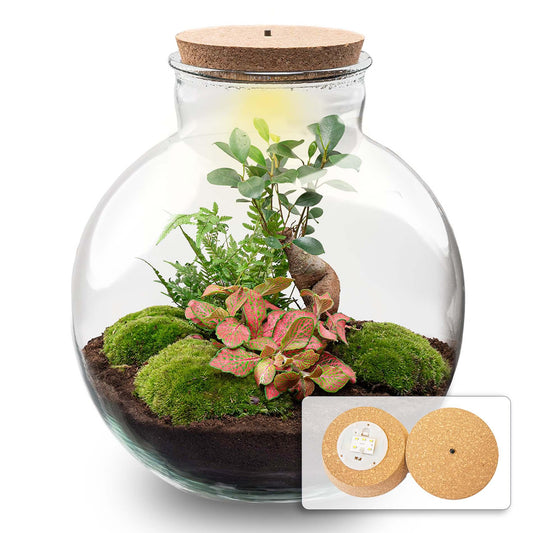
Large Ficus Ginseng bonsai and Fittonia terrarium kit, Ø 31 cm jar, with tools or LED stopper
Regular price From 104,95 €Regular price -

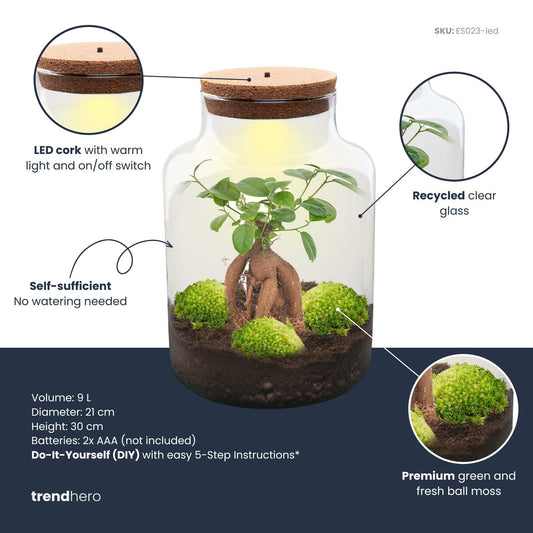
Illuminated terrarium kit featuring a Ficus Ginseng bonsai in a milk bottle, 21 cm diameter × 30 cm high, with or without tools
Regular price From 89,95 €Regular price -
Egg-shaped Ficus Ginseng bonsai terrarium kit, glass jar Ø 17.5 cm, height 30 cm
Regular price 99,95 €Regular price -
Fertilizer for All Indoor Plants - 250ml Liquid Fertilizer - Root and Foliar Fertilizer + Free Graduated Pipette!
Regular price 18,00 €Regular price20,00 €Sale price 18,00 €Sale -
Straight-point pruning shears - Stainless steel plant pruners
Regular price 7,50 €Regular price10,00 €Sale price 7,50 €Sale





🧭 Where to place a bonsai at home, room by room
Place an indoor bonsai in the brightest room in your home, close to a sunny window and away from drafts: this is the advice of the Brooklyn Botanic Garden's bonsai gardener, who believes apartments are better suited to tropical trees. Keep it away from radiators too.
According to the Missouri Botanical Garden, a south- or east-facing window is ideal. More than a meter or two from a window, light levels drop quickly: a LED grow light can make up for dark rooms and short winter days.
| Room or situation | Our advice |
|---|---|
| Living room with a south-facing patio door | Ideal for Ficus, Carmona, jade plant and Portulacaria; use a light curtain if summer sun scorches the leaves |
| North-facing window | Too dark for a bonsai without a grow light; Schefflera, which does well in bright indirect light (RHS), is the best fit |
| Near a radiator | Avoid: dry air and uneven heat. See our tips for dealing with dry air from heating |
| Windowsill in winter | Beware of cold window glass at night, a common cause of temperature shock |
| Balcony or garden in summer | Possible for most indoor bonsai; start them in partial shade and bring them back inside before nights turn chilly |
📐 Watering an indoor bonsai: the touch test
Water an indoor bonsai when the surface of the potting mix feels dry to the touch. Water thoroughly until it runs out through the drainage hole, then empty the saucer. Because its pot is small and shallow, this comes around sooner than with a typical potted plant. The Missouri Botanical Garden recommends using a fine spray to avoid washing away the potting mix.
For Ficus, the RHS ornamental fig growing guide recommends letting the potting mix dry slightly between waterings in spring and summer, then keeping it just barely moist in winter.
Succulent species need even less water: the RHS recommends watering Portulacaria generously from mid-spring to mid-autumn and keeping it almost dry for the rest of the year. For jade plant, the RHS profile calls for slightly moist potting mix during the growing season and very sparse watering in winter. Check the mix by touch before each watering.
📐 Bonsai potting mix, repotting and fertilizer
An indoor bonsai grows in a very free-draining potting mix, is repotted in early spring every two or three years depending on the species' vigor, and is fed diluted liquid fertilizer while it is growing.
For the mix, the RHS bonsai guide (Royal Horticultural Society) recommends 2 parts peat-free potting mix, 2 parts coarse sand or lime-free grit and 1 part loam-based potting mix.
According to the RHS, Carmona prefers a slightly acidic bonsai mix, while jade plant and Portulacaria do best in cactus potting mix. Good drainage comes from the pot's drainage hole and the free-draining mix—nothing else. For feeding, the RHS recommends a low dose every two weeks during the growing season, while the Missouri Botanical Garden advises reducing watering and feeding when growth slows in winter.
Our guide on when to fertilize your houseplants covers the schedule, and our fertilizers and plant care products bring together the right fertilizers.
📐 Pruning an indoor bonsai: pinching and care
Pruning an indoor bonsai mainly means pinching or cutting back overly long shoots while it is growing to keep the canopy dense, without ever removing most of the leaves all at once. The Missouri Botanical Garden recommends removing a large proportion of vigorous new growth in spring, while leaving enough leaves to maintain the tree's vigor.
Wear gloves when handling Ficus: the RHS notes that their white, sticky sap can irritate the skin and worsen allergies.
For Ficus ginseng, its swollen roots and distinctive shape are covered in our Ficus ginseng profile, and you can also find all the Ficus varieties.
📐 Indoor bonsai and pets: toxicity by species
Several indoor bonsai are toxic to dogs and cats, and some to horses, according to the ASPCA (American Society for the Prevention of Cruelty to Animals). These include Ficus, jade plants, Schefflera and Podocarpus: keep them out of pets' reach and always check the exact species of your bonsai before drawing conclusions.
The ASPCA lists the Jade Plant, which it identifies as Crassula argentea, as Toxic to Dogs, Toxic to Cats, Toxic to Horses, with clinical signs including vomiting, depression and incoordination.
The ASPCA's Schefflera profile, which covers the genus, states Toxic to Dogs, Toxic to Cats, due to calcium oxalate crystals, which can cause mouth irritation, excessive drooling, vomiting and difficulty swallowing.
The ASPCA lists Yew Pine (Podocarpus macrophylla) as Toxic to Dogs, Toxic to Cats, Toxic to Horses, with severe vomiting and diarrhea (spelled “sever vomiting and diarrhea” by the ASPCA). The ASPCA also lists the entire Ficus genus (Weeping Fig profile, Ficus sp.) as Toxic to Dogs, Toxic to Cats, Toxic to Horses: keep your Ficus ginseng out of pets' reach. We could not find an ASPCA profile for either Carmona or Serissa, so we cannot draw conclusions about these species.
If you have a cat at home, see our list of plants that are non-toxic to cats.
🗓️ An indoor bonsai care calendar through the seasons
An indoor bonsai is repotted and pruned in spring, grows and is fed in summer, slows down in fall, and needs plenty of light and little water in winter. The RHS recommends repotting in spring, while the Missouri Botanical Garden advises doing so just before new growth begins.
In winter, light levels drop and heating dries out the air: the RHS cites low temperatures, insufficient light, excess fertilizer and cold drafts among the causes of leaf drop in Ficus. Our guide to houseplants in winter covers the best practices.
📅 Seasonal care calendar
| Season | Key task |
|---|---|
| 🌸 Spring | Repot every two or three years, depending on vigor; pinch vigorous shoots; resume feeding with a low dose of liquid fertilizer |
| ☀️ Summer | Active growth: check the soil more carefully when watering; fertilize every two weeks (RHS); move outside to partial shade if desired |
| 🍂 Fall | Bring indoors before the nights turn cool; reduce then stop fertilizing; check for scale insects |
| ❄️ Winter | Place in the brightest spot, away from radiators; keep the substrate barely moist for Ficus (RHS); do not repot |
🐛 Mistakes to avoid with an indoor bonsai
The most common mistakes with an indoor bonsai are buying a hardy species that cannot tolerate indoor conditions, placing it too far from a window, watering on a fixed schedule instead of checking the soil, and moving it repeatedly—all of which can cause leaf drop. Here's how to avoid them.
| Mistake | Why it's a problem | Solution |
|---|---|---|
| Keeping a maple, pine or juniper indoors | These hardy trees almost always fail indoors (Missouri Botanical Garden) | Grow them outdoors, like a Japanese maple in a pot |
| Placing the bonsai far from a window | Insufficient light causes Ficus leaves to drop (RHS) | Move it closer to the window or add a grow light |
| Watering at a set time without checking | Overwatering is the main cause of leaf drop (RHS) | Check the soil before watering, then empty the saucer |
| Letting the substrate dry out completely | The small pot dries out quickly (Missouri Botanical Garden) | Check with your finger more often in summer and near heating |
| Moving the bonsai constantly | Ficus benjamina readily drops its leaves when moved (RHS) | Find a spot for it and leave it there |
| Overfertilizing | Excessive growth, susceptible to pests and diseases (RHS) | Use a low dose, only during the growing season |
| Ignoring pests | Ficus ginseng is prone to thrips and scale insects (NC State) | Inspect the undersides of the leaves; see our guides to scale insects and spider mites |


🌿 Our indoor bonsai and their care guides
This guide helps you choose; each species also has its own complete profile, and you can find all our bonsai in our bonsai collection. Our bonsai in pots are sold as an assortment: the species varies from one plant to another, so ask us which species it is before adopting one.
If your bonsai is a temperate-climate species, such as an oak, grow it outdoors, or at least keep it in a cool, very bright room in winter.
| Our selection | Why choose it |
|---|---|
| Ficus ginseng | The easiest option, in a terrarium kit, among our Ficus: Ficus ginseng and red Fittonia bonsai terrarium kit, large kit in a 31 cm jar, egg-shaped kit, illuminated kit in a milk bottle or illuminated kit with Fittonia, from our terrarium collection; to create your own jar, see our guide to plants for terrariums |
| Bonsai in ceramic pots | Already shaped: our Ball bonsai, pruned into a ball shape, or our S bonsai in a 15 cm pot |
| Sophora prostrata | A small tree with fine foliage and zigzagging branches, best grown in a cool, very bright room (currently unavailable in our store) |
| Crassula ovata | The succulent bonsai for sunny windowsills, also featured in our guide to indoor succulents |
| umbrella tree | The most tolerant species for a less sunny room |
| Pachira | Often sold with braided trunks; a small indoor tree rather than a traditional bonsai |
| Bonsai care | Our liquid fertilizer for houseplants, our all-purpose substrate to mix with grit, our straight-tip pruning shears and our saucers |
🔑 How long does a bonsai live?
A bonsai has no fixed lifespan: with the right growing conditions, including suitable light, watering based on soil moisture and regular repotting, it can live for a very long time. Some outdoor bonsai in major botanical collections are several centuries old, far older than most houseplants.
The Brooklyn Botanic Garden mentions a Rocky Mountain juniper in its collection that is around 500 years old. We could not find an authoritative source giving a specific lifespan for indoor bonsai. Longevity depends mainly on the species, light and watering.
That's also what makes it such a lovely gift, if you're wondering which plant to give, alongside our gift ideas.
✅ Our tips for growing a successful indoor bonsai
To grow an indoor bonsai successfully, choose a tropical or subtropical species, starting with Ficus microcarpa, jade plant or Schefflera; give it the brightest spot in the house, water based on soil moisture and repot in spring. Leave maples, pines and junipers in the garden. Browse our full bonsai selection to find yours.
I almost always recommend Ficus ginseng as a first bonsai: it's very forgiving and quickly shows when it's short on light or water. In my view, the real secret is light, much more than watering. And I prefer to find it one spot by the window and leave it there all year rather than move it around to suit the decor.

Laura Bruneau
Jardinière & autrice


