Sophora prostrata 'Little Baby': care, pruning and hardiness

To care for a Sophora prostrata 'Little Baby', give it full sun, soil or potting mix that drains quickly, water when the surface feels dry, and shelter from the wind. This is a hardy outdoor shrub that tolerates temperatures down to around -10 to -5°C, but it does not do well in the dim light of a living room.
This dwarf sophora, sometimes spelled “sophora prostata” or even “sephora,” is a New Zealand kowhai (Sophora) in the Fabaceae family, the pea family. Its fine zigzagging branches give it a striking shape, and it is often sold as a bonsai or houseplant.
This guide, reviewed against RHS information and botanical databases, explains what it is, where to place it, how to prune it, and why it loses its leaves.
🌿 Why Sophora Little Baby is so appealing
Sophora 'Little Baby' is prized for its shape: according to the RHS (Royal Horticultural Society) profile for Sophora 'Little Baby', it forms a dense mound of fine, flexible branches that grow in a zigzag pattern, covered in compound leaves made up of tiny oval leaflets.
In spring, it bears clusters of pea-shaped yellow flowers. It is an evergreen shrub that stays green all year in the garden, and the RHS says it is generally trouble-free with pests. It grows slowly: the RHS estimates 10 to 20 years for it to reach its mature size, which explains its popularity as a potted plant and bonsai.
| Feature | What it means for you |
|---|---|
| Striking shape | Zigzagging branches create the silhouette of a natural bonsai |
| Evergreen foliage | A small shrub that stays green all year on a sunny patio |
| Spring flowers | Clusters of pea-shaped yellow flowers in spring (RHS) |
| Slow growth | Takes 10 to 20 years to reach 1 to 1.5 m, according to the RHS: little pruning needed |
🔎 Sophora 'Little Baby' at a glance
The name of this plant calls for a little clarification. It is sold commercially as Sophora prostrata 'Little Baby', but the RHS lists it as Sophora 'Little Baby', without a species name, and notes “Sophora prostrata misapplied,” meaning the name has been applied incorrectly.
The species Sophora prostrata Buchanan does exist: the EPPO (European and Mediterranean Plant Protection Organization) database places it in the Fabaceae family and locates it on New Zealand's South Island.
According to Trees and Shrubs Online, the International Dendrology Society's encyclopedia of temperate trees and shrubs, it grows in grassland and rocky places east of the Main Divide, and may be a fertile, juvenile form related to Sophora microphylla.
The New Zealand Plant Conservation Network (NZPCN) describes it as endemic to the eastern South Island, from Marlborough to the Waitaki Valley, and classifies it as “At Risk – Declining.” We have found no source establishing the exact parent species of 'Little Baby'; simply bear in mind that it is a kowhai cultivar.
| Criterion | Verified details |
|---|---|
| 🏷️ Botanical name | Sophora 'Little Baby' (RHS), sold as Sophora prostrata 'Little Baby'; parent species not established |
| 🧬 Family | Fabaceae, the pea family |
| 🌳 Type | Evergreen, bushy shrub with fine zigzagging branches |
| 🌍 Origin | New Zealand kowhai; S. prostrata is endemic to the South Island (NZPCN) |
| 🍃 Foliage | Evergreen, with compound leaves made up of tiny oval leaflets |
| 🌸 Flowers | Clusters of pea-shaped yellow flowers in spring (RHS) |
| 📏 Size | 1 to 1.5 m tall and wide in 10 to 20 years (RHS) |
| ⚠️ Toxicity | Harmful if ingested, including to dogs (RHS) |
📋 Quick care facts
Essential growing information, all in one place.
| Factor | Guideline |
|---|---|
| Light | Full sun, south- or west-facing position (RHS) |
| Watering | Check by touch and water when the surface is dry; never leave water in the saucer |
| Potting mix | Well drained: chalky, loamy or sandy soil, with any pH (RHS) |
| Humidity | Outdoor air; no known special requirements, no misting needed |
| Temperature | Hardy to H4, or around -10 to -5°C (RHS); more vulnerable in a pot |
| Repotting | In spring, into a pot only slightly larger, with drainage holes |
| Fertilizer | Light application in spring, using shrub fertilizer at a reduced rate (home-care guideline) |
| Toxicity | Harmful if ingested; wear gloves, according to the RHS |
| Difficulty | Easy outdoors in sun; challenging indoors in low light |
📍 Where to plant a Sophora: sun, shelter, and indoors
Plant or position your Sophora 'Little Baby' in full sun, facing south or west, in a spot sheltered from the wind: these are the conditions specified in the RHS profile. Contrary to a common recommendation, partial shade is not suitable: no source supports it, and the RHS recommends full sun.
Indoors, it belongs right beside a very bright window, and preferably only for part of the year. According to University of Illinois Extension, a plant that does not get enough light becomes leggy, pale, and may lose its leaves—exactly what happens to a Sophora kept at the back of a room.
The simplest option is to grow it outdoors, in a pot or in the ground, on a sunny balcony or patio.
☀️ Ideal: A sunny, south- or west-facing patio or balcony sheltered from the wind, in a pot or in well-drained ground
🏠 Possible: Beside a very bright window or in a bright conservatory; move it outdoors as soon as possible
🚫 Avoid: The back of a room, a dark corner, heavy waterlogged soil, or exposure to icy winds
🪴 Planting and repotting Sophora prostrata
Above all, Sophora 'Little Baby' needs soil that drains well: the RHS says it grows in chalky, loamy, or sandy soil, whether acidic, neutral, or alkaline, as long as it is well drained.
For a pot, choose a container with drainage holes, a free-draining potting mix (good-quality potting compost lightened with pumice or fine gravel), and a heavy terracotta pot that is more stable in the wind.
Remember that the RHS hardiness scale notes that H4 plants are more vulnerable to cold in pots: insulating the pot or placing it close to a wall can help in winter. Spring is the best time to repot, into a pot only slightly wider than the root ball.
| Step | What to do |
|---|---|
| 1. Choose a location | Full sun, south or west facing, sheltered from the prevailing wind |
| 2. Prepare the pot or hole | Use a pot with drainage holes or dig a hole twice the width of the root ball; loosen the soil |
| 3. Improve drainage | Mix fine gravel or pumice into the potting mix if the soil is heavy |
| 4. Plant | Set the root ball at the same level as it was in the pot, without burying the base of the stems |
| 5. Water | Water thoroughly, let it drain, then wait until the surface is dry |
columns: 4
columns_mobile: 2
-
-
-

 Livraison offerte
Bonsai S - 15cm Pot - Height 30-35cm (mixed ceramics)
Regular price 64,95 €Regular price -

 Livraison offerte
Ball Bonsai - Height 25-30cm (ceramic)
Regular price From 59,95 €Regular price -

 Sold out




✂️ Caring for and watering Sophora Little Baby
Caring for Sophora prostrata 'Little Baby' is straightforward if drainage is good. Check the potting mix by touch and water when the surface is dry, as the RHS recommends in its houseplant growing guide for potted plants: do not follow a fixed schedule, and lift the pot—it will feel lighter when dry.
There is no need to keep the potting mix constantly moist or aim for high humidity: no source calls for this, and waterlogged mix can lead to root rot. The RHS says it is generally trouble-free with pests and rarely affected by armillaria root rot. In winter, water a potted plant outdoors very sparingly, and only if the potting mix is dry.
💧 Watering: Check by touch; water when the surface is dry; always empty the saucer
🌱 Fertilizer: One light application in spring is enough (home-care guideline)
✂️ Pruning: Light pruning to remove dead wood or an overlong stem
🧣 Overwintering: Outdoors down to around -5°C; protect or shelter the pot if temperatures drop lower
👀 Keep an eye on: Few pests (RHS); check drainage if the leaves drop
🍂 Pruning Sophora Little Baby and seasonal calendar
As for mature size, Sophora 'Little Baby' reaches 1 to 1.5 m in height and spread, according to the RHS, over 10 to 20 years. The larger species Sophora prostrata is listed at 1.5 to 2.5 m by the RHS profile for Sophora prostrata Buchanan.
As for pruning, the RHS places 'Little Baby' in pruning group 1, one of its pruning groups: evergreen shrubs that need very little pruning. Remove only diseased, damaged, congested, or crossing shoots, and those growing in an unwanted direction.
Since the flowers appear in spring, prune just after flowering to avoid removing the buds.
📅 Seasonal care calendar
| Season | Key task |
|---|---|
| 🌸 Spring | Yellow flowers, repot if needed, gradually move into the sun, apply light fertilizer |
| ☀️ Summer | Full sun, check more frequently for watering in a pot, light prune after flowering |
| 🍂 Fall | Reduce watering, move the pot close to a sheltered wall, do not fertilize |
| ❄️ Winter | Minimal watering, protect the pot below around -5°C, shelter from icy winds |
🌱 Propagating Sophora: cuttings, seeds, and bonsai
The RHS lists two propagation methods: sowing in a seed tray under a cold frame in spring, and taking semi-ripe stem cuttings with bottom heat in summer or autumn. A cultivar such as 'Little Baby' will come true to type from a cutting, whereas a seed-grown plant may differ.
Take a current-season stem cutting whose base is beginning to harden, remove the lower leaves, and insert it into a light, free-draining mix in a warm, bright place. If it does not root, our article on cuttings that fail to root can help.
For Sophora as a bonsai, no authoritative source provides a care protocol specific to this plant: it is sold as a “bonsai” because its zigzagging branches and slow growth evoke a miniature tree. Grow it instead as a small outdoor shrub in a shallow pot: full sun, very free-draining potting mix, watering by touch, and light shaping.
🐛 Common problems: causes and solutions
The most common problem with Sophora 'Little Baby' is leaf drop, almost always linked to its location or watering. Here are the causes supported by the available sources, and how to address them.
| Symptom | Likely cause | Solution |
|---|---|---|
| Leaves dropping indoors | ☀️ Not enough light: the plant becomes leggy and loses its leaves (University of Illinois) | Place beside a very bright window or move into the sun |
| Leaves turn yellow, then drop | 💧 Waterlogged potting mix, a pot without drainage holes, or a full saucer | Water when the surface feels dry; use a pot with drainage holes and free-draining mix |
| Foliage damaged after winter | ❄️ Temperatures lower than its H4 hardiness range, especially in a pot (RHS) | Shelter the pot below around -5°C; prune dead wood in spring |
| Leaves drop after moving | ☀️ Sudden change in light or temperature | Acclimatize it gradually; see our article on temperature shock |
| Long, sparse branches | ☀️ Insufficient light | Move into full sun, then prune lightly to encourage denser growth |
| No flowers | ☀️ Insufficient light or a plant that is too young | Full sun, south or west facing (RHS), and patience |


🌿 Our recommendations for further reading
Sophora is no longer available from Plant and Stories. If you like its zigzagging shape, these striking plants and their care guides may be good alternatives, each with its own needs.
| Our pick | Why choose it |
|---|---|
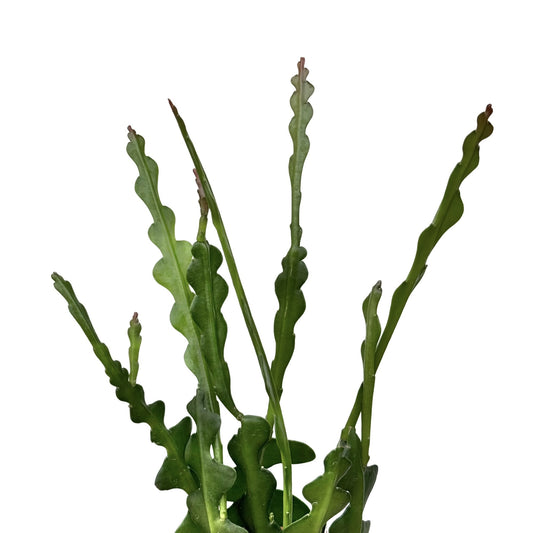
| zigzag cactus | The cactus with flat, fishbone-shaped stems, for a bright indoor spot; see our Epiphyllum anguliger |
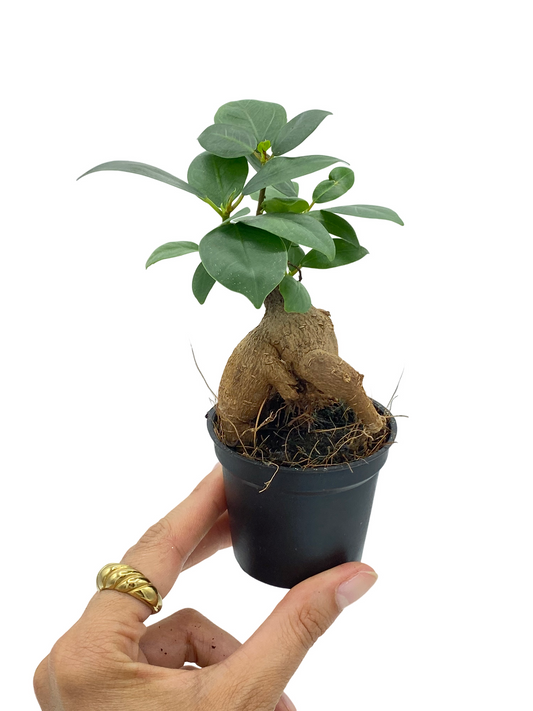
| Ficus ginseng | Bonsai-like appearance indoors, more tolerant of apartment living; see our Ficus ginseng |
| Muehlenbeckia complexa (wire vine) | Wire vine, with fine, tangled stems, for outdoors |
| Rhipsalis | An epiphytic cactus with fine, trailing stems, for indoors |
🎨 Pairing Sophora in a pot or garden
On a sunny patio, Sophora 'Little Baby' pairs well with other plants with fine foliage and a relaxed habit, such as Muehlenbeckia complexa, which also forms a tangle of fine stems.
For an exotic arrangement that can withstand winter, our guide to hardy exotic plants and our selection of plants for balconies and patios will give you ideas.
In winter, it can provide evergreen structure in a winter planter. Indoors, if you're looking for this sculptural silhouette without direct sunlight, opt instead for the zigzag cactus or Ficus ginseng.
⚠️ Is Sophora toxic to children and pets?
Yes, keep Sophora 'Little Baby' out of reach: the RHS classifies it as “harmful if swallowed,” advises wearing gloves and other protective gear when handling it, and notes that it is also harmful to dogs.
For kowhai in general, Massey University's (New Zealand) toxic plants database states that all parts are toxic, that most poisonings are caused by the seeds, and that their alkaloid, cytisine, acts like nicotine.
Regarding animals, the veterinary guide to toxic plants by Anthony Knight (Colorado State University College of Veterinary Medicine, distributed by IVIS) lists kowhai (Sophora tetraptera) among toxic Sophora species: these plants contain quinolizidine alkaloids related to cytisine, and dogs are at risk if they ingest the seeds.
We couldn't find an ASPCA fact sheet for this Sophora: if your pet ingests any, call your veterinarian. If you're looking for a cat-safe plant, see our list of non-toxic plants for cats.
✅ Our expert tips for success
Sophora 'Little Baby' is primarily an outdoor shrub: full sun, well-draining soil, watering when the soil feels dry, and shelter from the wind are all it needs to stay dense. Don't leave it at the back of a living room, where it will lose its leaves, and protect the pot when temperatures drop below around -5°C.
Also, don't confuse it with Sophora japonica, now Styphnolobium japonicum, a tree from China that reaches about 15–23 m, according to NC State Extension (North Carolina State University). Finally, prune lightly after flowering and keep seeds and branches out of the reach of children and pets.
I really love this little Sophora for its shape: it looks like calligraphy in three dimensions. The disappointments people tell me about almost always come from keeping the plant indoors, far from a window. I recommend giving it a proper sunny spot outdoors, in a well-draining pot, and watching it grow at its own pace. It's a plant for the patient, rewarding above all those who leave it in the sun.

Laura Bruneau
Jardinière & autrice