Ficus lyrata (fiddle-leaf fig): care, light, pruning and propagation

To care for a Ficus lyrata, place it in the brightest room, near a window but out of the harsh afternoon sun, water only when the top 2 inches of potting mix are dry, keep it between 18 and 27 °C without ever letting the temperature drop below about 16 °C, and leave it in place once it has settled in.
The fiddle-leaf fig is a true tropical tree: its violin-shaped leaves, the largest of those on figs grown indoors, quickly react to any mistake involving light, water or cold. This guide answers the most common questions: where to place it, why it drops or develops spots on its leaves, how to encourage branching and propagate it, and which varieties to choose.
For the basics common to the entire Ficus genus, see our complete Ficus care guide.
🌿 Why the fiddle-leaf fig is the star of indoor trees
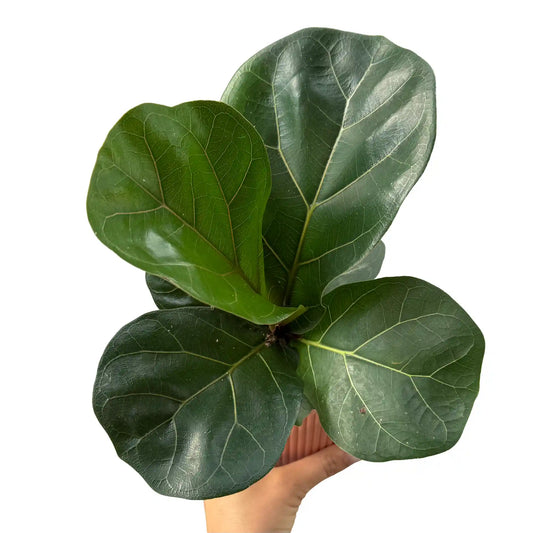
Ficus lyrata owes its popularity to its leaves: according to NC State Extension, they are leathery, lyre- or violin-shaped, deep green and more matte than glossy, with a puckered surface and prominent veins, and measure about 30 to 45 cm long.
According to the UF/IFAS Ficus Production Guide, this species has the largest leaves of any fig grown for indoor use. The same NC State source gives it a height of 0.6 to 3 m as a houseplant, a moderate growth rate and low maintenance requirements, provided it has a spacious, bright spot. A single plant is enough to dress up a living room corner.
| Advantage | What it means for your home |
|---|---|
| 30 to 45 cm violin-shaped leaves | A striking silhouette that can define a room on its own |
| Tree-like growth habit | A trunk that branches as it matures or after the top is pruned |
| Low maintenance | Few tasks once you have found the right spot, according to NC State Extension |
| Several sizes | From a young tabletop plant to a 75–85 cm specimen, as well as compact and variegated forms |
🔎 Ficus lyrata at a glance
According to Plants of the World Online (POWO), the Royal Botanic Gardens, Kew database, the accepted name is Ficus lyrata Warb., described by German botanist Otto Warburg; Ficus pandurata Sander is a synonym.
Its natural range spans eleven countries in West and Central Africa: Benin, Cameroon, Gabon, Ghana, Guinea, Guinea-Bissau, Côte d'Ivoire, Liberia, Nigeria, Sierra Leone and Togo, in the tropical moist biome. POWO classifies it as a hemiepiphytic tree: the plant can germinate on another tree before rooting in the ground.
When grown in the ground in a tropical climate, the UF/IFAS Ficus lyrata tree profile describes it as a 25- to 50-foot tree, or about 7.5 to 15 m.
| Characteristic | Verified details |
|---|---|
| 🏷️ Botanical name | Ficus lyrata Warb. (synonym: Ficus pandurata Sander) |
| 🧬 Family | Moraceae, the family of the common fig |
| 🌳 Type | Evergreen tropical tree, hemiepiphyte, grown as an indoor tree |
| 🌍 Origin | West and Central Africa, from Guinea to Gabon: 11 countries listed by POWO |
| 🍃 Foliage | Leathery, puckered, violin-shaped leaves about 30 to 45 cm long, with prominent veins |
| 🌸 Flowers | Flowers hidden inside small, round figs about 1 cm across, green at first and red when ripe (UF/IFAS) |
| 📏 Size | About 7.5 to 15 m in the ground in the tropics (UF/IFAS); 0.6 to 3 m indoors (NC State) |
| ⚠️ Toxicity | Mildly toxic to dogs and cats (ASPCA); sap can irritate the skin |
📋 Quick care guide
Essential growing guidelines, all at a glance.
| Factor | Guideline |
|---|---|
| Light | Bright, near a window; morning sun is tolerated, but not afternoon sun |
| Watering | When the top 2 inches of potting mix are dry; empty the saucer |
| Potting mix | Rich, well-draining potting mix, preferably peat-free |
| Humidity | Average; keep away from radiators, which dry out the air |
| Temperature | Ideally 18 to 27 °C; never below about 16 °C |
| Repotting | In spring, when the roots fill the pot; not within the first month after purchase |
| Fertilizer | Houseplant fertilizer from spring to late summer; do not overfertilize |
| Toxicity | Mildly toxic to pets; wear gloves when pruning |
| Difficulty | Intermediate: easy if kept in a bright, stable spot |
📍 Where to place a Ficus lyrata in your home
Place your Ficus lyrata near a large window in the brightest room: NC State Extension recommends bright, indirect light and protection from the afternoon sun, which scorches the leaves.
According to the University of California Agriculture and Natural Resources extension (UC ANR), it appreciates morning sun, while insufficient light results in leggy growth and dull or yellowing leaves.
As for warmth, the University of Florida Institute of Food and Agricultural Sciences guide to indoor Ficus (UF/IFAS) considers 65 to 80 °F, or about 18 to 27 °C, the most suitable indoor range, and recommends keeping Ficus above 60 °F, about 16 °C, at all times. Keep it away from radiators, air conditioners and frequently opened doors.
☀️ Ideal: In front of an east-facing window, or a south- or west-facing window behind a sheer curtain
🌥️ Acceptable: A bright room, a little farther from the window, with a grow light in winter
🚫 Avoid: Dark corners, cold window glass, heating or air-conditioning vents, and moving the plant
🪴 Repotting a Ficus lyrata
Repot your Ficus lyrata in spring, when the roots fill the pot or emerge from the drainage holes, and never within the first month after bringing it home (see when to repot a plant after purchase).
According to the RHS (Royal Horticultural Society), it is grown under cover in a loam-based, peat-free potting mix, in full or filtered light, and tolerates acidic, neutral or alkaline pH; NC State Extension recommends moist, well-drained soil.
Choose a pot with drainage holes that is only slightly wider than the old one, heavy enough to stabilize a large plant, and a general-purpose potting mix, lightened if needed. Keep the root crown at the same level and stake the trunk until the roots have filled the new pot.
| Step | What to do |
|---|---|
| 1. Choose the right time | Spring, with roots visible beneath the pot, at least 4 weeks after the plant has settled in |
| 2. Choose a pot | A pot with drainage holes, only slightly wider than the old one; weigh it down for a plant over 1 m tall |
| 3. Remove the plant | Lay the plant on its side, slide out the root ball without pulling on the trunk, and wear gloves |
| 4. Reposition | Use well-draining potting mix, keep the root crown at the same level, and stake the plant if it leans |
| 5. Water | Water thoroughly, empty the saucer, then wait for the top 2 inches of potting mix to dry |
columns: 4
columns_mobile: 2
-

 Livraison offerte
Ficus Lyrata - 21cm Pot - Height 75 - 85cm
Regular price From 54,95 €Regular price -

 Sold out
-
-
Fertilizer for All Indoor Plants - 250ml Liquid Fertilizer - Root and Foliar Fertilizer + Free Graduated Pipette!
Regular price 18,00 €Regular price20,00 €Sale price 18,00 €Sale -

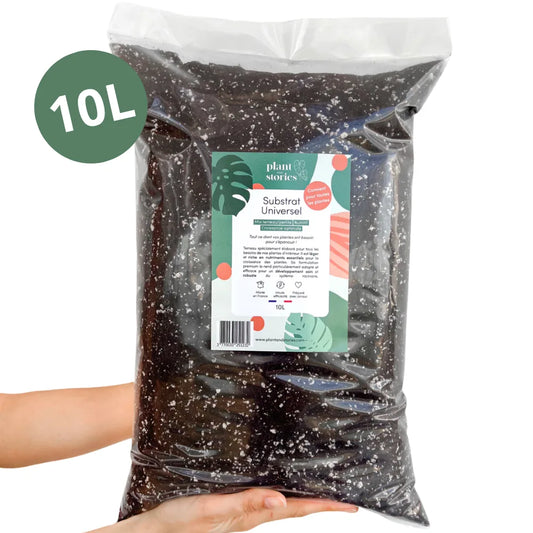
Universal Substrate enriched with Mycorrhizae and Bacillus - Premium Quality - Universal potting mix
Regular price From 9,50 €Regular price8,50 €Sale price From 9,50 €





✂️ Ficus lyrata care: watering, dusting and fertilizing
Caring for a Ficus lyrata comes down to watering based on touch: the University of California Agriculture and Natural Resources extension (UC ANR) recommends watering when the top two inches of potting mix, or about 5 cm, are dry, and never letting the pot sit in the drained water, which can cause root rot.
NC State Extension describes it as sensitive to overwatering and links leaf drop to either too much or too little water. Its large leaves collect dust, so remember to clean the leaves with a soft, damp cloth, including the undersides.
Feed it with a liquid houseplant fertilizer from spring to late summer, following the label directions: according to UC ANR, excess fertilizer scorches the leaf edges.
💧 Watering: Water thoroughly when the top 2 inches of potting mix are dry, then empty the saucer
🔹 Check: Push a finger into the potting mix before watering, especially in winter
💧 Humidity: Keep the pot away from radiators; group plants together or use a tray of damp pebbles
🧹 Cleaning: Wipe the leaves with a soft, damp cloth so they can capture the light
🌱 Fertilizer: From spring to late summer, following the label directions; none in winter
🍂 Pruning a Ficus lyrata and caring for it through the seasons
Can you cut off the top of a Ficus lyrata? Yes: the University of California Agriculture and Natural Resources extension (UC ANR) says pinching the tips of young shoots at the ends of branches makes the plant bushier, and a cut-back plant will produce new leaves along the trunk.
Prune in spring, just above a leaf, using clean pruning shears; blot the white latex that oozes out and wear gloves, as the RHS (Royal Horticultural Society) classifies the plant as a skin allergen. The RHS places it in pruning group 1, for plants that need little pruning.
In summer, NC State Extension says it can be moved to a sheltered patio, but should be brought back indoors in autumn.
📅 Seasonal care calendar
| Season | Key task |
|---|---|
| 🌸 Spring | Top pruning or pinching, repot if the roots fill the pot, resume fertilizing |
| ☀️ Summer | Water more often as needed, use a sheer curtain during the hottest hours, move outdoors under cover only if nighttime temperatures stay above about 16 °C |
| 🍂 Autumn | Bring indoors before cool nights, water less often, stop fertilizing at the end of the season |
| ❄️ Winter | Keep it in a fixed, bright spot at a minimum of 16 °C, away from radiators; let the top 2 inches of potting mix dry before watering |
🌱 Propagating a Ficus lyrata by cuttings and air layering
NC State Extension recommends stem cuttings for Ficus lyrata, and UC ANR describes taking a head cutting about 15 cm (6 inches) long with one leaf and rooting it in water.
The RHS also lists seed, bud cuttings, a leaf taken with its bud and a piece of stem, and semi-ripe cuttings; a leaf alone, without a bud, will not produce a new plant.
For a thick branch, choose air layering: according to UF/IFAS, growers traditionally use this method on Ficus lyrata stock plants, and the same guide recommends a vertical incision rather than girdling to limit the small reddish spots caused by water stress on the undersides of the leaves. Let the latex dry before planting, and keep the cutting warm in bright light out of direct sun.
🐛 Ficus lyrata problems: why it drops leaves or develops spots
A Ficus lyrata that drops leaves is almost always reacting to a change: insufficient light, being moved, cold or incorrect watering. UF/IFAS links the drop of green leaves to insufficient light or ethylene from a faulty space heater, and heavy leaf drop accompanied by necrotic, slimy spots to cold damage, hence its recommendation to keep the plant above about 16 °C.
NC State Extension attributes brown spots to temperature fluctuations near heating or air-conditioning vents, and sunburn to direct sunlight; see also temperature shock.
As for pests, the same source lists scale insects, aphids, thrips and mites: see mealybugs, thrips and spider mites.
| Symptom | Likely cause | Solution |
|---|---|---|
| Green leaves dropping after purchase or a move | ☀️ Change in light, adjustment stress | Choose a permanent bright spot and do not move the plant for 4 weeks |
| Heavy leaf drop, necrotic and slimy spots | ❄️ Cold damage below about 16 °C (UF/IFAS) | Keep it away from cold windows and doors; maintain 18 to 27 °C |
| Brown spots across the leaf blade | ⚠️ Temperature fluctuations near a radiator or air conditioner | Move it once and for all away from air vents |
| Yellow leaves, soil wet deep down | 🍄 Overwatering, early root rot | Wait until the top 5 cm of soil have dried, and empty the saucer |
| Brown, dry leaf edges | 💧 Air too dry near a heat source or too much fertilizer (UC ANR) | Move it away from the heater, group plants together, and return to the recommended fertilizer dose |
| Discolored patches on upper leaves | ☀️ Scorching from direct afternoon sun | Use a sheer curtain or move the plant back one meter |
-

Classic test description


🌸 Our Ficus lyrata varieties
Here are the fiddle-leaf fig forms you may come across. According to the RHS profile for 'Bambino', 'Bambino' is a compact, upright shrub 1 to 1.5 m tall and 0.5 to 1 m wide, reaching maturity in 2 to 5 years. Sources differ on 'Compacta': UF/IFAS describes it as having large leaves clustered closely together on short petioles, while NC State says its leaves are smaller. Browse all our Ficus and, to compare other species, our guide to Ficus varieties.
| Variety | What makes it special |
|---|---|
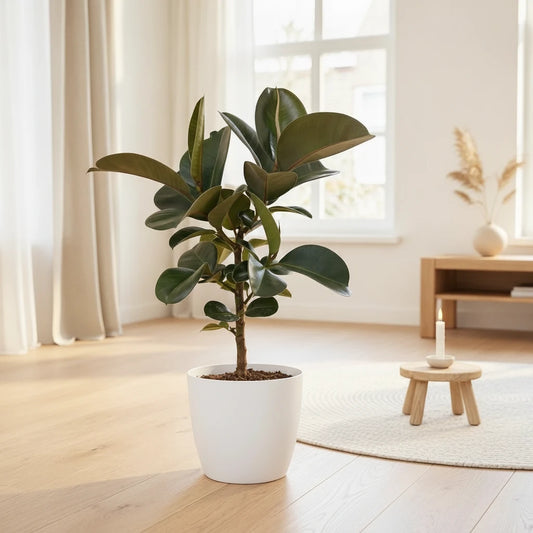
| Ficus lyrata, 75–85 cm tall in a 21 cm pot | The classic fiddle-leaf fig, already trained as a standard tree: the ideal size for a living room corner |
| young Ficus lyrata in an 11 cm pot | The same fiddle-leaf fig as a young plant, ready for you to grow and shape yourself |
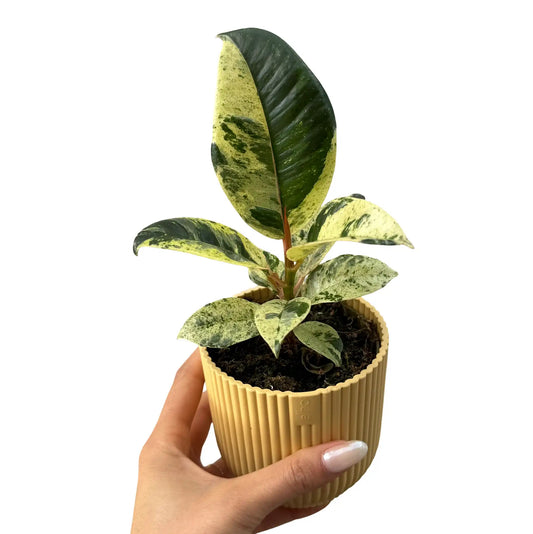
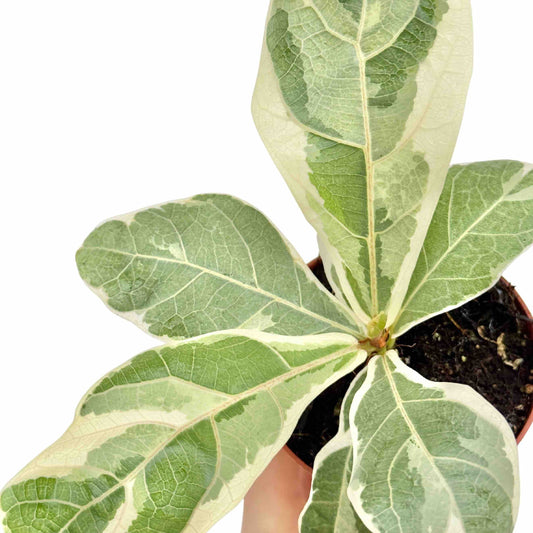
| Ficus lyrata 'Variegata' | Leaves variegated in green and cream, an uncommon form according to NC State |
| 'Bambino' | Dwarf form, 1 to 1.5 m tall according to the RHS, for a smaller room |
| 'Compacta' | Up to 5 feet (about 1.5 m) tall, with smaller leaves according to NC State |
| 'Little Sunshine' | Small plant with bright green, fiddle-shaped leaves according to NC State |
🎨 What plants to pair with your fiddle-leaf fig
The fiddle-leaf fig makes a statement on its own, but it looks even better surrounded by shorter plants that enjoy the same light.
Place a Ficus elastica 'Tineke' at its feet for a touch of variegation, or a Ficus 'Audrey', another tree-form fig with smaller oval leaves, if you like Ficus arrangements.
In a very large room, a Strelitzia or a Kentia adds more vertical lines; also browse our selection of large-leaved plants and our large and medium-sized plants.
For a slightly dark corner, consider an LED grow light; near a heater, learn how to increase humidity, and if your plant arrives by mail, how to acclimate a plant after buying it online.
⚠️ Is Ficus lyrata toxic to cats and dogs?
Yes, mildly. The ASPCA does not have a profile for Ficus lyrata in its toxic plant database, but in a news article, the ASPCA (American Society for the Prevention of Cruelty to Animals) writes that the fiddle-leaf fig, the English name for Ficus lyrata, is “mildly toxic to dogs and cats.”
A small amount ingested may cause “mild gastrointestinal irritation,” with vomiting and diarrhea among the most common signs; the sap can also irritate the skin.
NC State Extension rates the species as mildly toxic to people, cats, and dogs, with possible mouth irritation, drooling, and vomiting if ingested, while the RHS lists it as a skin allergen. Keep it out of reach of pets and young children, and call a veterinarian if it is ingested.
✅ Our expert tips for success
To grow a Ficus lyrata successfully, remember three rules: choose the brightest spot in your home and leave it there, water only when the top 5 cm of soil are dry, and keep it warm at 18 to 27°C, never below about 16°C.
If it drops a few leaves after arriving, leave things as they are for four weeks; if it grows too tall, cut off the top in spring to encourage branching and propagate the cutting. Find our fig trees among our houseplants.
The fiddle-leaf fig is one of the indoor trees that tolerates being moved least well. My advice: decide where it will go before bringing it home—choose the brightest spot, away from the heater—then just check the soil with your finger and wipe its large leaves. If it drops a few leaves after arriving, wait before changing anything.

Laura Bruneau
Jardinière & autrice