

Strelitzia (Bird of Paradise): care, flowering and species

To grow a successful Strelitzia, or bird of paradise, give it the brightest spot in the house, never less than 10 to 12°C, generous watering in season, and a drier rest in winter, as recommended by the RHS (Royal Horticultural Society) Strelitzia growing guide.
The Strelitzia reginae, with its orange and blue flower, remains compact; the Strelitzia nicolai and the white bird of paradise sold under the name "augusta" become giants. This care guide untangles who is who, then details light, watering, flowering, moving outdoors, and toxicity, with every figure sourced. You can find our plants in the Strelitzia collection.
🌟 Why the bird of paradise is so appealing
The bird of paradise appeals with its banana-like foliage, its architectural silhouette, and its bird-beak flower, one of the most recognizable in the plant world. The genus originates from southern Mozambique to South Africa according to POWO (Plants of the World Online, Kew), which locates Strelitzia reginae from the Western Cape to KwaZulu-Natal.
The RHS has awarded the reginae its Award of Garden Merit, and reminds that you often have to wait for maturity to see the first flower.
| Asset | What it changes |
|---|---|
| A unique flower | Each reginae flower lasts up to a month, in winter and spring (RHS) |
| Slow growth | The RHS estimates 10 to 20 years to reach adult size |
| Two sizes | Reginae from 1 to 1.5 m for a living room (RHS), giant nicolai for large spaces |
| Known pests | Scale insects, spider mites, and mealybugs are the main ones to watch out for (RHS) |
📊 Reginae, nicolai, augusta, alba: who is who?
Four names circulate for the bird of paradise, but two species dominate indoors: the Strelitzia reginae with its orange flower and the Strelitzia nicolai with its white flower. According to the POWO fact sheet for Strelitzia augusta, the name Strelitzia augusta Thunb. is a synonym of Strelitzia alba, another species with a white flower.
On the RHS hardiness scale, H1B means a plant that can go outdoors in summer, with a minimum of 10 to 15°C.
| Species | Flower | Adult size | Origin | Temperature, in practice |
|---|---|---|---|---|
| Strelitzia reginae, bird of paradise | Orange and blue, bird-beak shaped (RHS) | 1 to 1.5 m tall, 0.5 to 1 m wide (the RHS fact sheet for Strelitzia reginae) | Western Cape to KwaZulu-Natal (POWO) | H1B; never below 10 to 12°C; briefly tolerates around −2°C outdoors (the University of Wisconsin Extension) |
| Strelitzia nicolai, giant white bird of paradise | White and blue, under a purple-black bract (NC State Extension) | 8 to 12 m in the ground (the RHS fact sheet for Strelitzia nicolai); leaves up to 1.5 m on 2 m petioles | Eastern Zimbabwe to KwaZulu-Natal and eastern Botswana (the POWO fact sheet for nicolai) | H1B; does not tolerate below around 10°C (NC State) |
| Strelitzia alba (syn. S. augusta) | White, dark spathe (SANBI) | Up to 10 m in nature (SANBI) | Garden Route coast, Western Cape (SANBI) | No published RHS rating: grow it like nicolai |
| "Strelitzia augusta" in trade | Rarely seen indoors | Giant; 160 or 180 cm in our collection | Horticultural name for a giant white bird of paradise | Same needs as nicolai: bright light and warmth |
| Strelitzia juncea | Orange, close to reginae, smaller flower according to Clemson | Not rated by our sources | Southern Western Cape (the POWO fact sheet for juncea) | No published RHS rating |
| Reginae with yellow flower | Yellow and purple for 'Kirstenbosch Gold' (RHS); yellow with blue tongue for 'Mandela's Gold' (Clemson) | Like reginae | Horticultural selection | Like reginae |
📋 Quick fact sheet
The care guidelines for Strelitzia reginae and nicolai in pots, according to the RHS, NC State, and American university extensions.
| Guideline | The rule |
|---|---|
| Light | Lots of bright light: sunny large window or veranda; a little shade in summer during flowering (RHS) |
| Temperature | Never below 10 to 12°C; ventilate above 20°C (RHS) |
| Ideal nights | 13 to 18°C for reginae (NC State) |
| Watering | Fresh but never waterlogged substrate in spring and summer; from late November, let dry thoroughly between waterings (RHS) |
| Humidity | Around 60% relative humidity appreciated (Clemson); tray of wet gravel (RHS), grouped plants, or humidifier |
| Substrate | Peat-free potting mix based on loam, with gravel for drainage (RHS) |
| Fertilizer | Liquid fertilizer from spring to late summer, monthly (RHS, NC State fact sheets) to every two weeks (RHS guide) |
| Repotting | In spring after flowering, when the roots fill the pot, in a pot just slightly larger (RHS) |
| Propagation | Division of rooted offsets in spring (RHS); sowing possible but slow |
| Toxicity | Strelitzia reginae: Toxic to Dogs, Toxic to Cats, Toxic to Horses (ASPCA (American Society for the Prevention of Cruelty to Animals)) |
How to care for a Strelitzia (bird of paradise) in 7 steps
To care for a Strelitzia, remember the order of priorities: light first, then warmth, watering by touch, fertilizer in season, and a pot that is never too large. These steps apply to reginae as well as nicolai: the RHS gives the same growing instructions under cover for both species.
| Step | The right action |
|---|---|
| 1. Choose the spot | In front of the brightest window, south or west, away from cold drafts |
| 2. Check the warmth | Never below 10 to 12°C, nor against a radiator |
| 3. Water by touch | Thoroughly when the first 2 to 3 centimeters of the substrate are dry, then empty the tray |
| 4. Feed in season | Liquid fertilizer from spring to late summer, nothing in winter |
| 5. Boost humidity | Grouped plants, tray of wet gravel, or humidifier during heating |
| 6. Dust | Wipe the large leaves with a damp cloth, without polish (Wisconsin) |
| 7. Topdress every spring | Replace the first 5 centimeters of potting mix with new (RHS) |
columns: 4
columns_mobile: 2
-

 Livraison offerte
Strelitzia Reginae - Bird of Paradise - 12cm Pot
Regular price From 39,95 €Regular price39,95 €From 31,96 €Livraison offerte -

 Livraison offerte
Strelitzia Nicolai
Regular price From 54,95 €Regular price54,95 €From 43,96 €Livraison offerte -

 Livraison offerte
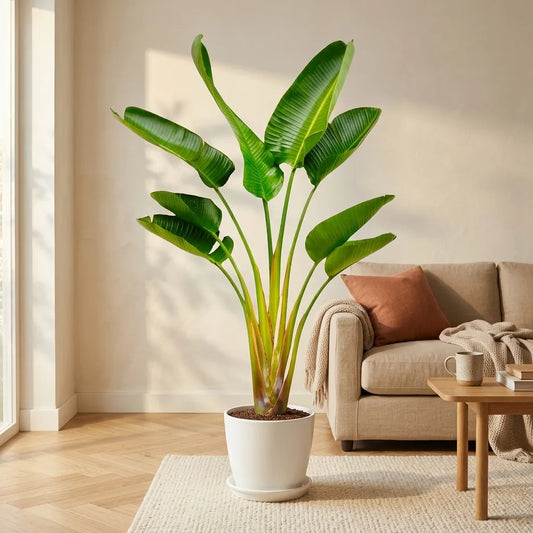
Strelitzia augusta - Giant White Bird of Paradise
Regular price 124,95 €Regular price124,95 €99,96 €Livraison offerte -

 Livraison offerte
Strelitzia Nicolai - 19cm Pot - Height 80 - 90cm
Regular price 64,95 €Regular price64,95 €51,96 €Livraison offerte -

 Livraison offerte
Strelitzia Nicolai - 21cm Pot - Height 80cm
Regular price From 69,95 €Regular price69,95 €From 55,96 €Livraison offerte -

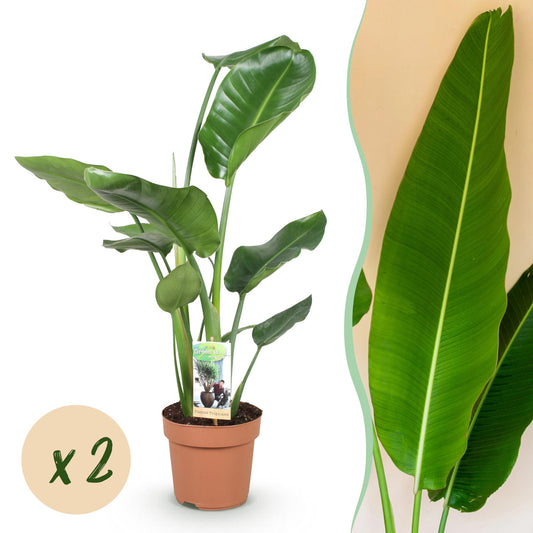
Strelitzia Nicolai - Bird of Paradise - Set of 2 Plants - 17cm Pot - Height 70-90cm
Regular price From 84,95 €Regular price84,95 €From 67,96 €Livraison offerte -

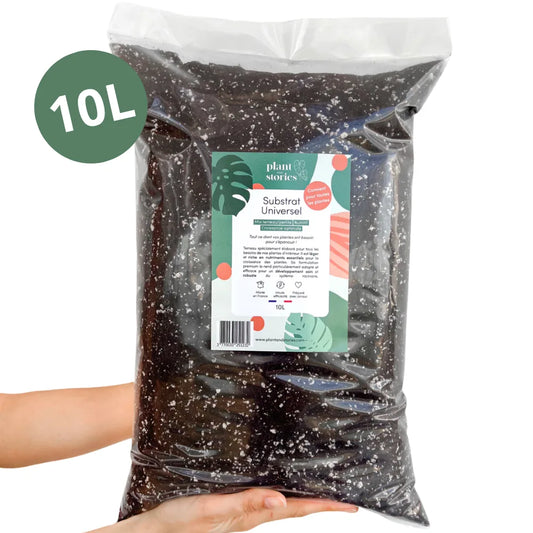
Universal Substrate enriched with Mycorrhizae and Bacillus - Premium Quality - Universal potting mix
Regular price From 9,50 €Regular price23,75 €Sale price From 9,50 €9,50 €From 7,60 €Sale -
Fertilizer for All Indoor Plants - 250ml Liquid Fertilizer - Root and Foliar Fertilizer + Free Graduated Pipette!
Regular price 18,00 €Regular price20,00 €Sale price 18,00 €18,00 €14,40 €Sale



🧭 Where to place a Strelitzia: light, sun, and temperature
Place your Strelitzia in front of the brightest window in the house, south or west, where it receives gentle direct sun, and never in a room that drops below 10 to 12°C. The RHS recommends a large sunny window or veranda, with a little shade when it flowers, as too strong sun fades the colors.
According to NC State, full sun corresponds to 6 hours or more of direct sun per day.
| Your situation | What you need to know |
|---|---|
| South or west large window | Ideal: the RHS classifies it as full sun or partial shade, east, south, or west exposure |
| East window | Possible: the RHS cites east exposure for reginae, and nicolai gets by according to NC State on 2 to 6 hours of direct sun; the brighter the light, the better it flowers |
| Dark room or north window | Avoid: poor growth and no flowers; see our full sun plants for the brightest spots |
| Veranda | Perfect if it stays above 10 to 12°C in winter and is ventilated above 20°C (RHS) |
| Near a radiator | Dry air and brown leaf edges: move it away and boost humidity |
| Large volume, high ceiling | Nicolai or "augusta", to keep near the light; see our XXL plants |
| Patio in summer | Yes, in the warmth, in the sun and sheltered from the wind, after acclimatization (RHS, Wisconsin) |
🌺 How to make a bird of paradise flower
A bird of paradise flowers when it is an adult, very well lit, well fed in season, and a little cramped in its pot. The RHS indicates that a reginae generally takes 5 to 10 years before flowering, and that a slightly tight pot promotes flowering.
A division flowers faster: 2 to 3 years according to the University of Clemson Extension, compared to 4 to 10 years or more for a seedling. The same source warns that an excess of fertilizer gives a lot of leaves and few or no flowers. Indoors, reginae flowers open in winter and spring (RHS).
In the ground in a hot climate, the University of Florida (UF/IFAS) cites up to three dozen flower stalks per year on a mature plant, each holding two weeks in a vase.
🤍 Strelitzia nicolai and augusta: caring for the white bird of paradise
Strelitzia nicolai is cared for like reginae, but it is grown mainly for its foliage: it rarely flowers indoors. The RHS specifies that it can reach 10 m and becomes too large for most houses; its species fact sheet indicates that it only flowers with enough light and fertilizer, better if it is a little tight.
NC State estimates 5 to 6 years before flowering and describes gray-green leaves up to 2 m long, which the wind easily tears. The same source reports a very vigorous root system: in the ground, keep it away from walls and paths. As for the name, the RHS cites Strelitzia alba subsp. nicolai as a synonym of nicolai, and POWO links Strelitzia augusta to Strelitzia alba.
In trade, the "augusta" label designates a giant white bird of paradise: we cannot certify the species of each batch without a flower, but its culture is that of nicolai. SANBI, the South African National Biodiversity Institute, places alba and nicolai among the three large arborescent Strelitzia of southern Africa.
☀️ Strelitzia outdoors: summer outing and mild coast
The Strelitzia readily spends the summer outdoors, in the warmth, in the sun and sheltered from the wind, but it goes back inside before the nights approach 12°C, according to the RHS. The University of Wisconsin advises gradually acclimating it to the sun, under penalty of burns.
In the ground, all year round, it remains reserved for gardens where frost is exceptional, light, and brief: reginae tolerates around −2°C for a limited time according to Wisconsin, and the University of Florida judges nicolai cold sensitive. On the coast, UF/IFAS notes that reginae tolerates light salt spray.
For truly hardy exotic foliage, prefer the Japanese banana tree (Musa basjoo), and browse our banana trees.
🐾 Is Strelitzia toxic to cats and dogs?
Yes: the ASPCA classifies Strelitzia reginae as "Toxic to Dogs, Toxic to Cats, Toxic to Horses". It cites gastrointestinal irritants ("GI irritants") as the toxic principle and "Mild nausea, vomiting, drowsiness; caused mainly by fruit and seeds" as clinical signs: mild nausea, vomiting, and drowsiness, especially because of the fruit and seeds.
The ASPCA has no fact sheet for Strelitzia nicolai; NC State says it is toxic to humans, dogs, cats, and horses, with low severity, and advises gloves because the plant can irritate the skin.
Do not confuse it with Caesalpinia gilliesii, also called bird of paradise: the ASPCA judges it more toxic, see its ASPCA fact sheet for Caesalpinia gilliesii.
If you have a pet, consult our lists of non-toxic plants for cats and non-toxic plants for dogs, or our safe plants for animals.
🗓️ Strelitzia through the seasons
The Strelitzia grows and feeds from spring to late summer, then slows down in autumn and spends the winter drier, always above 10 to 12 °C. The RHS advises reducing watering in autumn and, from the end of November, allowing the substrate to dry out quite noticeably between waterings.
Keep it away from icy windows to avoid thermal shock, and read our guide to indoor plants in winter.
📅 Care calendar by season
| Season | Key action |
|---|---|
| 🌸 Spring | Repotting if the roots fill the pot, dividing offshoots, top-dressing the top 5 centimeters, resuming fertilizer (RHS) |
| ☀️ Summer | Watering as soon as the surface dries, liquid fertilizer, taking outside into the sun and shelter from the wind after acclimatization |
| 🍂 Autumn | Bringing back inside before nights close to 12 °C, reduced watering, stopping fertilizer |
| ❄️ Winter | Resting in light above 10 to 12 °C, substrate almost dry between waterings from late November; reginae flowering possible until spring |
🐛 Split, yellow or brown leaves: Strelitzia problems
Strelitzia problems come mainly from lack of light, excess water and dry air. Split leaves, however, are often normal: the RHS notes that in a windy place, the large leaves tear, and NC State that nicolai leaves split easily in the wind.
| Mistake | Why it's a problem | The solution |
|---|---|---|
| Believing that a split leaf is diseased | Large leaves tear along the veins in the wind (RHS, NC State) | Do not cut anything; shelter it from the wind and avoid traffic |
| Watering too often | Roots rot from excess water (NC State, Clemson); yellow leaves and a soft base are often signs of this, according to our experience | Water by touch, empty the saucer, use a perforated pot and well-draining substrate |
| Forgetting to water in summer | Leaves curling along their length: often thirst, according to our growing experience | Water thoroughly as soon as the substrate is dry to a depth of 2 to 3 cm |
| Leaving it far from the window | Little growth and no flowers (RHS) | South or west bay window, or auxiliary grow light |
| Repotting into a pot that is too large | A slightly tight pot flowers better (RHS) | A pot just slightly larger, only when the roots fill it |
| Leaving the air too dry | Brown edges, spider mites (RHS) | Grouped plants, damp gravel, humidifier; treat spider mites |
| Ignoring cottony clusters | Mealybugs and scale insects weaken the plant (RHS) | Clean the foliage and follow our guide against mealybugs |
| Over-fertilizing | Lots of leaves, few or no flowers (Clemson) | Respect the dose and stop in winter |


🌿 Our Strelitzia and guides to go further
Each Strelitzia below has its own sheet; the associated guides help you with the pot, fertilizer and humidity.
| Our selection | Why choose it |
|---|---|
| Strelitzia reginae in a 12 cm pot | The compact bird of paradise with orange flowers: best suited for a bright living room |
| Strelitzia nicolai in a 17 or 21 cm pot | The banana-leaf giant, in two pot sizes, with or without a basket |
| Strelitzia nicolai from 80 to 90 cm and Strelitzia nicolai 80 cm in a 21 cm pot | Two intermediate sizes to decorate a living room corner |
| Set of 2 Strelitzia nicolai | Two plants to frame a bay window or a bright entrance |
| Strelitzia augusta, giant white bird of paradise 160 or 180 cm | The immediate XXL effect, grown like a nicolai |
| All our Strelitzia | The entire range, and our large and medium indoor plants |
| Pot and potting mix | Our universal substrate enriched with biostimulants or our potting mixes for indoor plants, lightened with gravel |
| Fertilizer and light | Our liquid fertilizer for indoor plants (see how to choose a fertilizer for a green plant) and our full spectrum grow light |
🔑 Repotting and dividing a Strelitzia
Repot your Strelitzia in spring, after flowering, only when the roots fill the pot, and choose a container just slightly larger. The RHS recommends a peat-free potting mix based on loam, added with gravel, and repotting approximately every two years.
For a large specimen, the University of Wisconsin advises not to rush to repot beyond about 90 cm tall and instead to renew the top potting mix about once a year. To divide, detach offshoots with healthy leaves and roots in early spring (RHS); the Wisconsin warns that a division can prevent flowering for a few years.
Drainage comes from the pot hole and a well-draining substrate: read how to repot a plant after purchase.
✅ Our tips for a successful Strelitzia
To make your Strelitzia successful, give it the brightest window, never less than 10 to 12 °C, water by touch and fertilizer in season, then a drier winter. Choose the reginae for the orange flower and a living room, the nicolai or the "augusta" for the giant effect.
For other ideas, see our large-leaf indoor plants, our indoor tropical plants or what plant to give, and our entire collection of birds of paradise.
I recommend the reginae to anyone dreaming of flowers and having a real bay window, and the nicolai to anyone wanting large graphic foliage without waiting for flowering. My criterion remains light, long before watering: a well-placed Strelitzia forgives a lot. And I think that a split leaf simply tells the life of the plant, there is no need to worry about it.

Laura Bruneau
Jardinière et autrice


