Monstera Adansonii: Care, Light, and Watering (Complete Guide)

The playful little brother of the famous deliciosa, the Monstera adansonii captivates with its leaves riddled with regular holes, as if cut out with cookie cutters. More compact, it is equally suited to climbing growth or hanging, where its foliage cascades down. Easy and rewarding, it nevertheless requires clearing up a series of persistent confusions: with the deliciosa, with the obliqua and with the faux mini-monstera. This verified guide sorts them out and details all the care.
columns: 4
columns_mobile: 2
-
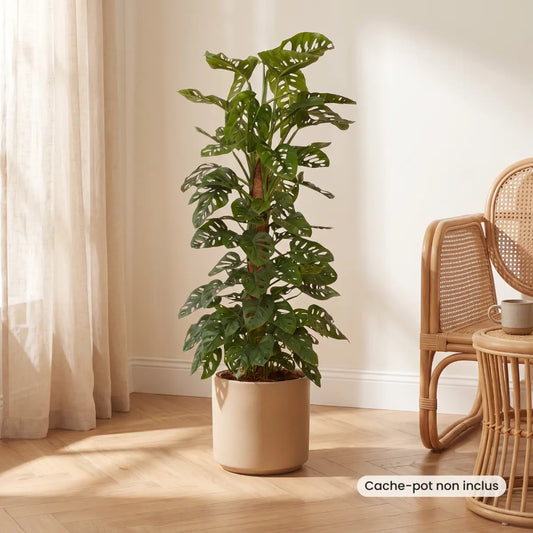
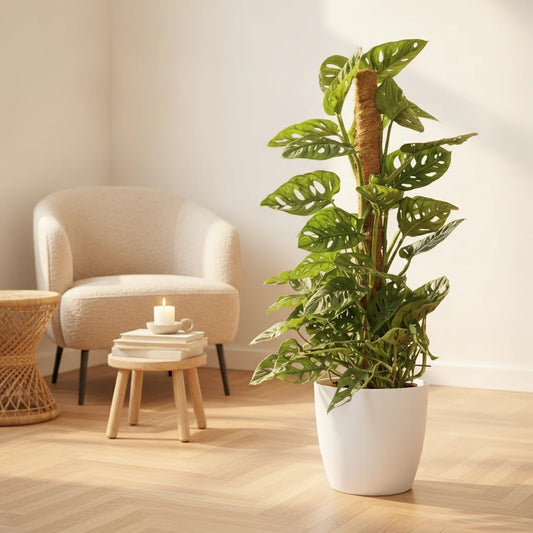
Monstera Adansonii - Monkey Mask with coco stake - 19cm pot - Height 90cm
Regular price From 64,95 €Regular price -

 Livraison offerte
Monstera Adansonii Monkey Mask - 12cm Pot - Height: 25-35cm
Regular price 39,95 €Regular price -
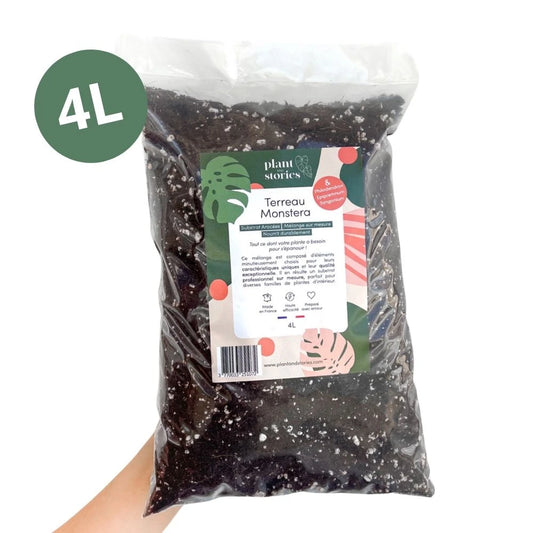
Monstera Soil - Enriched with Mycorrhiza and Bacillus - Araceae Substrate
Regular price From 9,50 €Regular price23,75 €Sale price From 9,50 €Sale -
Transparent climbing plant support - Pack of 3 + free velcro (Monstera, Pothos)
Regular price From 9,99 €Regular price13,89 €Sale price From 9,99 €Sale -
Transparent Araceae Pot - Transparent growing pot for plants
Regular price From 1,95 €Regular price1,95 €Sale price From 1,95 €






🌿 Why adopt a Monstera adansonii?
The Monstera adansonii (Monstera adansonii Schott, Araceae family) is a hemi-epiphytic vine originating from the tropical forests of Central and South America, as well as the West Indies. Indoors, it forms a supple plant measuring 0.9 to 2 meters, whose oval leaves are pierced with enclosed holes, entirely enclosed in the blade.
It is an excellent first Monstera: more compact than the deliciosa, it grows quickly, takes cuttings in no time, and showcases a hanging basket or a moss pole. You just have to avoid confusing it with its cousins.
| Asset | What it means for you |
|---|---|
| Lace foliage | Regular, enclosed holes that create a unique graphic effect |
| Compact size | Smaller than the deliciosa, it is suitable for modest interiors |
| Climbing or trailing | Train it on a moss pole or let it cascade in a hanging basket |
| Express propagation | A node cutting roots in a few weeks in water |
🔎 The Monstera adansonii ID card
A botanical point is essential, as few plants are so easily confused. The Monstera adansonii belongs to the genus Monstera, Araceae family (Araceae), and not to a hypothetical Monstera family. Its native range, from tropical America and the West Indies, is documented byKew (Plants of the World Online). Its holes remain enclosed and never reach the edge of the leaf, unlike the deliciosa.
| Criterion | Verified detail |
|---|---|
| 🏷️ Botanical name | Monstera adansonii Schott (1830) |
| 🧬 Family | Araceae (Araceae) |
| 🔎 Genus | Monstera |
| 🌍 Origin | Tropical America and the West Indies |
| 🌳 Growth habit | Climbing or trailing vine |
| 🔎 Indoor size | 0.9 to 2 m; up to 4 m as an established vine |
| 🍃 Foliage | Oval leaves with enclosed holes, entire margin |
| ⚠️ Toxicity | Calcium oxalates: harmful to humans and animals |
📋 Quick technical sheet
The essential care points, gathered at a glance.
| Parameter | Guideline |
|---|---|
| Light | Bright but indirect; east or west window |
| Watering | When the first few cm of the substrate are dry; reduced in winter |
| Substrate | Aerated aroid mix (potting soil, bark, perlite); well-draining |
| Humidity | Moderate to high, 50 to 60% |
| Temperature | 18 to 25 °C; minimum 10 to 15 °C |
| Repotting | Every 2 to 3 years, in spring |
| Fertilizer | Balanced, from April to September |
| Toxicity | Calcium oxalates; irritating sap |
| Difficulty | Easy, ideal for beginners |
📍 Where to place your Monstera adansonii: light and location
Like all Monsteras, the adansonii requires light to pierce its leaves. In too dark a situation, it produces solid leaves, without holes; in direct sunlight, it burns. The right measure is bright filtered light, a few steps from a well-exposed window.
☀️ Light: Bright and indirect, near an east or west window; a lack of light produces leaves without holes.
📐 Location: In a hanging basket or on a moss pole, sheltered from cold drafts and away from radiators.
💦 Humidity: Humid air limits brown edges: group plants, place the pot on a humidity tray (water below the level of the pot) or use a humidifier, as recommended by the NC State Extension.
🪴 Repotting and substrate: the basics of a healthy plant
The adansonii shares the needs of all Monsteras: an aerated and well-draining substrate, renewed every 2 to 3 years in spring. Its roots hate standing water; a potting soil weighted down with compact peat is an open door to rot. Repot in a pot just slightly larger, preserving the aerial roots that help the plant climb.
| Step | The right move |
|---|---|
| Choose the pot | One size up, +2 to +4 cm; never too large |
| Prepare the substrate | Potting soil lightened with bark and perlite for an aerated mix |
| Unpot and inspect | Remove the old substrate, cut soft or brown roots |
| Install a support | Moss pole for climbing growth, or hanging pot |
| Finish | Water moderately, indirect light, fertilizer only 4 weeks later |
columns: 4
columns_mobile: 2
-
Monstera Soil - Enriched with Mycorrhiza and Bacillus - Araceae Substrate
Regular price From 9,50 €Regular price23,75 €Sale price From 9,50 €Sale -
Set of Transparent Araceae Pots - Transparent Growing Pots for Plants
Regular price From 8,97 €Regular price9,75 €Sale price From 8,97 €Sale -
Live sphagnum moss - Sphagnum moss for plants - Sphagnum moss - Live sphagnum moss for plants
Regular price 9,50 €Regular price -
Transparent climbing plant support - Pack of 3 + free velcro (Monstera, Pothos)
Regular price From 9,99 €Regular price13,89 €Sale price From 9,99 €Sale




✂️ Daily care: watering, light and humidity
The adansonii is not very demanding, but reactive: it quickly shows its needs through its foliage. Consistency is key, and excess water remains the main danger.
💧 Watering: Wait until the first few cm of substrate are dry, then water and empty the saucer. Space out in winter.
☀️ Light: Bright indirect light all year round; bring closer to the window in winter to keep the holes.
💧 Humidity: Humid air: grouping plants, humidity tray (water below the level of the pot) or humidifier (see our guide to increase the humidity of the air).
🌱 Fertilizer: A diluted balanced fertilizer, every 2 to 4 weeks from April to September.
🧹 Cleaning: Shower the foliage from time to time to remove dust and prevent spider mites.
🍂 The Monstera adansonii through the seasons
The pace follows the light received. In spring and summer, growth is sustained: regular watering, high humidity, light fertilizer and occasional repotting. In autumn and winter, everything slows down; reduce watering, suspend fertilizer and make sure to keep the plant away from dry heat sources.
📅 Care calendar by season
| Season | Key move |
|---|---|
| 🌸 Spring | Repotting, resumption of watering and fertilizer; new perforated leaves. |
| ☀️ Summer | Active growth: regular watering, high humidity, light fertilizer. |
| 🍂 Autumn | Space out watering; last fertilizer application in September. |
| ❄️ Winter | Rest: rare watering, no fertilizer, away from radiators. |
🌱 How to propagate a Monstera adansonii?
It is one of the easiest Monsteras to multiply. Cut a stem bearing at least one node, ideally with a small aerial root, then place the cutting in clear water or damp sphagnum moss, in bright indirect light at 18-24 °C. Roots often appear in 2 to 4 weeks; repot when they reach 3 to 5 cm.
Spring and summer offer the best success rates. One plant can thus produce several in one season.
🐛 Common problems: causes and solutions
The adansonii foliage is an excellent indicator of health. Here are the most common symptoms and their solutions.
| Symptom | Probable cause | Solution |
|---|---|---|
| Leaves without holes | ☀️ Young plant or lack of light | Bring closer to bright indirect light, install a moss pole, be patient |
| Brown and dry edges | ⚠️ Air too dry | Increase air humidity: grouping, humidity tray, humidifier |
| Yellow leaves, soft base | 💧 Excess water | Let dry, empty the saucer, lighten the substrate |
| Burned leaves | ☀️ Too strong direct sunlight | Move to indirect light, filter with a sheer curtain |
| Slowed growth, dull foliage | ☀️ Lack of light or nutrients | Bring closer to light and fertilize from April to September |
| Fine webs, pale spots | ⚠️ Spider mites (dry air) | Shower, increase humidity, isolate and treat |


🌸 Our Monstera adansonii varieties
The Monstera adansonii is mainly available in horticultural forms, distinguished by the shape of the leaves and variegation. These are not different species.
| Variety | Its asset |
|---|---|
| Monstera adansonii (type) | Oval leaves with enclosed holes, climbing or trailing growth |
| Narrow-leaf form | Elongated, highly perforated foliage, lace effect |
| Wide-leaf form | Broader and more rounded leaves, fast growth |
| Round form | Distinctly rounded leaves, rarer in cultivation |
| Archipelago (variegated) | Cream variegated cultivar, spectacular but slow and fragile; its dedicated care sheet is online |
🎨 Adansonii, obliqua or Rhaphidophora: never make mistakes again
Three confusions recur constantly. The Monstera obliqua, very rare, has a blade so perforated that it has more empty space than leaf: the plant sold as obliqua is almost always an adansonii. The Rhaphidophora tetrasperma, nicknamed mini-monstera, is not a Monstera at all but a different genus, originating from Southeast Asia. Finally, the deliciosa stands out with its large leaves cut all the way to the edge.
To compare all the species, consult our Monstera comparison guide and the Monstera deliciosa sheet.
⚠️ Is the Monstera adansonii toxic?
Yes. Like the other Araceae of the genus Monstera, the adansonii contains calcium oxalates in the form of raphides. If ingested, they strongly irritate the mouth, tongue and digestive tract; the sap can cause skin redness. The plant is harmful to humans as well as cats and dogs.
Keep it out of reach of children and animals, and wear gloves when taking cuttings, as recommended by the Royal Horticultural Society (RHS).
✅ Our expert advice for success
The Monstera adansonii is one of the most beautiful Monsteras to start with: compact, graphic and easy to propagate. Give it bright indirect light to pierce its leaves, a well-draining substrate, measured watering and a moss pole, and it will climb quickly. Above all, remember not to confuse it with the obliqua or the Rhaphidophora, and to watch out for excess water. With these verified guidelines, you have a spectacular and long-lasting plant.
I am often asked why an adansonii loses its holes. Nine times out of ten, it is the light. Bring it closer to a bright window, give it a support to climb, and the new leaves will be pierced again. A climbing adansonii is a happy adansonii.

Laura Bruneau
Jardinière & autrice