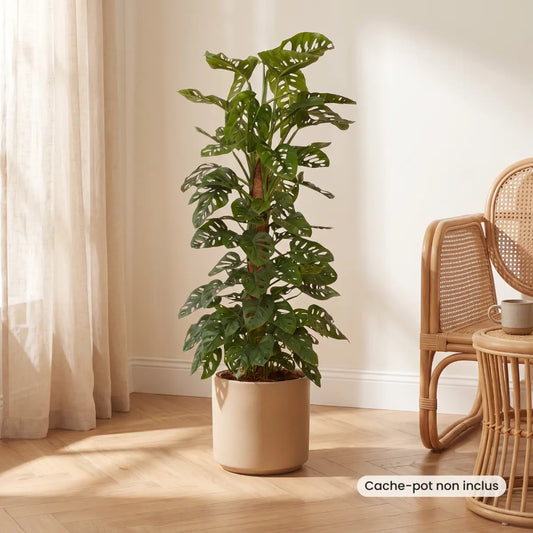
Monstera (Monstera deliciosa): what kind of light and exposure does it need?

The Monstera needs bright but indirect light: place it near an east or west window, or set back from a south window behind a sheer curtain, without direct sunlight on the leaves. This is the most important setting for a Monstera deliciosa (the classic Monstera): in very low light, it grows slowly and its leaves remain without holes, in full sun they burn.
This page is exclusively about light and exposure.
For complete care of the Monstera plant indoors, read our Monstera deliciosa care guide; for watering and repotting, our step-by-step Monstera repotting and watering.
The entire range is gathered in the Monstera collection.
columns: 4
columns_mobile: 2
-

 Livraison offerte
Monstera Deliciosa - 12cm Pot
Regular price From 39,95 €Regular price39,95 €From 31,96 €Livraison offerte -

 Livraison offerte
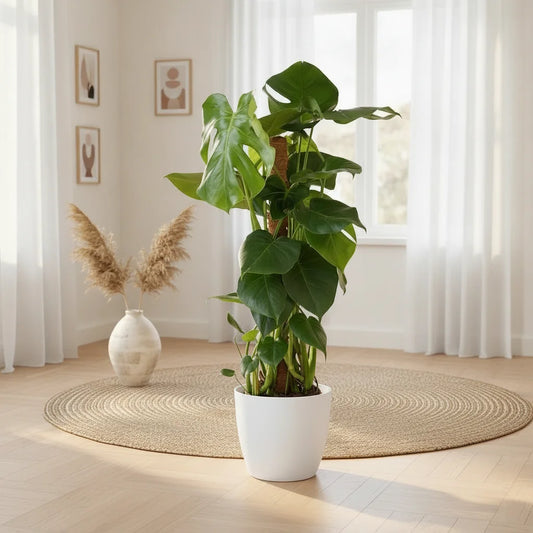
Monstera Deliciosa with stake - 19cm pot - Height 90cm
Regular price From 64,95 €Regular price64,95 €From 51,96 €Livraison offerte -
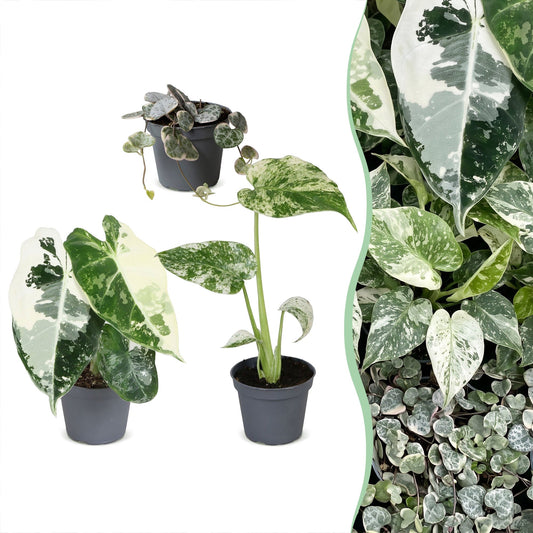
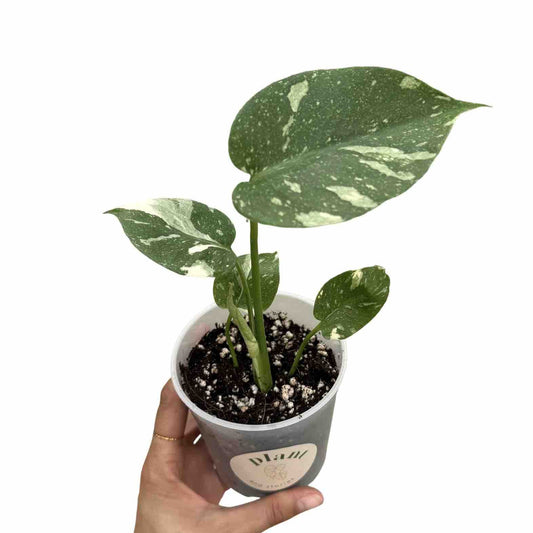
Monstera Thai Constellation
Regular price From 19,95 €Regular price24,95 €Sale price From 19,95 €19,95 €From 15,96 €Sale -

 Sold out
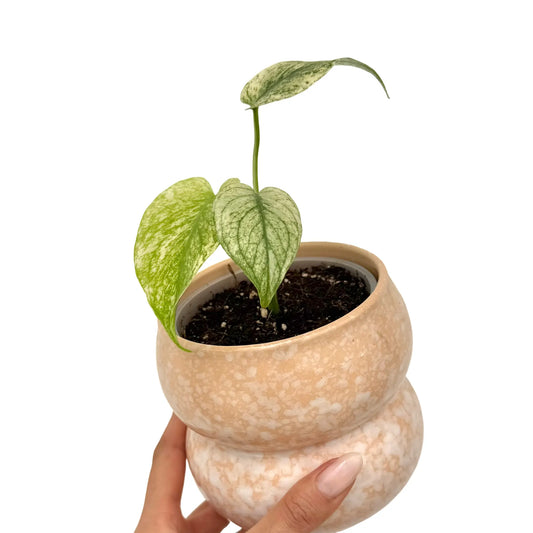
Monstera Deliciosa Mint
Regular price From 39,95 €Regular price79,95 €Sale price From 39,95 €39,95 €From 31,96 €Sold out



🌿 Why light decides everything for the Monstera
The Monstera deliciosa Liebm. is, according to Plants of the World Online, Kew's database, a vine of the humid tropical forests, originating from Mexico (Veracruz, Oaxaca, Chiapas) to Guatemala.
In its natural environment, it grows under large trees and climbs their trunks: the guides from the University of Florida (UF/IFAS) describe it as an understory plant that grows best under light shade, in filtered light, with intense sun exposure that can burn the leaves.
This is exactly what you need to reproduce at home: lots of brightness, little direct sun.
Light even changes the shape of the leaves: a study from the University of Costa Rica published in the Revista de Biología Tropical (Díaz-Valverde et al.) compared Monstera deliciosa growing outdoors, in the sun or in the shade, on the university campus: the sun leaves had a larger surface of holes and were thicker and denser than the shade leaves.
| Asset | What it changes at home |
|---|---|
| More cut-out leaves | In very low light, the leaves have fewer holes (RHS): a good place, it's the condition of the fenestrations |
| Regular growth | A well-lit plant remains compact instead of stretching towards the window (WSU Extension) |
| Dark green foliage | In light shade, the leaves are darker than in full sun, where they pale and burn (UF/IFAS) |
| Less watering risks | A well-lit plant drinks more regularly; in the shade, the potting mix stays moist longer |
🔎 The ID card of the Monstera deliciosa
Here is the verified ID card of the Monstera deliciosa, focused on what matters for light. The accepted name and area of origin come from Kew.
The RHS (Royal Horticultural Society) Monstera deliciosa sheet classifies it as H1B: it can go out in summer but does not tolerate winter outdoors. NC State Extension (North Carolina State University) recommends medium brightness without direct sun and specifies that only adult leaves have holes.
Its common names are false philodendron, Swiss cheese plant or Swiss cheese plant in English.
| Criterion | Verified detail |
|---|---|
| 🏷️ Botanical name | Monstera deliciosa Liebm. (Kew POWO) |
| 🧬 Family | Araceae (Araceae) |
| 🌳 Type | Evergreen vine that climbs thanks to its aerial roots |
| 🌍 Origin | From Mexico to Guatemala, humid tropical forests (Kew POWO) |
| 🍃 Foliage | Large perforated and cut leaves, only on adult leaves (NC State) |
| ☀️ Light | Bright and indirect, without direct sun that burns the leaves (RHS) |
| 📏 Size | About 1.8 to 2.4 m indoors (6 to 8 feet according to NC State), 4 to 8 m at maturity according to the RHS |
| ⚠️ Toxicity | Insoluble calcium oxalates: toxic to dogs and cats (ASPCA) |
📋 Quick technical sheet
The essential growing points, gathered at a glance.
| Parameter | Reference |
|---|---|
| Ideal light | Bright and indirect (RHS): lots of brightness, little or no direct sun |
| Direct sun | Avoid: it can burn the leaves (RHS); tolerable only if it is mild and filtered |
| East or west window | The best place according to the RHS, very close to the glass; sheer curtain to the west in summer |
| South window | Set back, up to about 1.5 m (Illinois Extension), or behind a sheer curtain |
| North window | As close as possible to the glass; often too little from October to March (Colorado State) |
| Maximum distance | At 1 to 3 m from an east or west window, the light is already low (Illinois Extension) |
| Winter | Bring closer to the window, without the leaves touching the cold glass |
| Horticultural lamp | LED (Colorado State), 14 to 16 hours of lighting per day, never more than 16 hours (Illinois Extension) |
| Variegated varieties | More light than green leaves (NC State), never burning sun |
| Temperature | 18 to 25 °C all year according to the RHS, away from cold drafts |
📍 Where to place a Monstera: window orientation and distance
Place your Monstera about one meter from an east or west window, or a little further from a south window. The RHS, in its Monstera growing guide, recommends indirect light, for example near a west or east facing window, or in a brighter room, away from the window.
The University of Illinois Extension quantifies the distance: you get bright light right in front of an east or west window, or up to 5 feet (about 1.5 m) from a south window.
At 3 to 10 feet (about 1 to 3 m) from a south window, the light becomes medium, and it is already low at the same distance from an east or west window. Light therefore drops very quickly when you move away from the glass.
🌅 East or west window: The best choice: soft morning sun in the east. In the west, the afternoon sun heats up more in summer: a light sheer curtain is enough to filter it.
🌞 South or north window: In the south, move the plant back or filter with a sheer curtain. In the north, put it almost against the glass: Colorado State classifies this exposure as low light from October to March.
🔄 Turn the pot: The Monstera leans towards the light source. Rotate the pot a quarter turn from time to time to keep a balanced plant.
🪴 Brightness: find the right place for your Monstera in 5 steps
To locate the bright and indirect light required by the RHS, the University of Florida (UF/IFAS) classifies indoor light into four levels measured at noon. Near a window without direct sun, the light is medium (100 to 500 foot-candles, about 1,100 to 5,400 lux).
Near a window with a little sun softened by a blind or sheer curtain, it is high (500 to 1,000 foot-candles, about 5,400 to 10,800 lux). Beyond that, just behind a window in full sun, it is direct sun that burns the leaves. The Monstera likes between medium light and filtered high light.
A lux meter app on a phone gives a sufficient order of magnitude to compare two locations.
| Step | The right move |
|---|---|
| 1. Identify the orientation | East or west first; south set back or with sheer curtain; north only very close to the glass |
| 2. Measure the light | Shadow test or lux meter app at noon, at leaf height, on two or three locations |
| 3. Choose the distance | Very close to an east or west window, up to about 1.5 m from a south window (Illinois Extension) |
| 4. Acclimate gradually | If you bring the plant closer to a sunnier window, do it in steps and watch for burns |
| 5. Observe the new leaves | Larger and more cut-out: the place is suitable. Small, pale and spaced: bring it closer |
columns: 4
columns_mobile: 2
-
Live sphagnum moss - Sphagnum moss for plants - Sphagnum moss - Live sphagnum moss for plants
Regular price 9,50 €Regular price9,50 €7,60 € -
Livraison offerte
Monstera Deliciosa - 12cm Pot
Regular price From 39,95 €Regular price39,95 €From 31,96 €Livraison offerte -
Sold out
Monstera Deliciosa Mint
Regular price From 39,95 €Regular price79,95 €Sale price From 39,95 €39,95 €From 31,96 €Sold out -
Monstera Thai Constellation
Regular price From 19,95 €Regular price24,95 €Sale price From 19,95 €19,95 €From 15,96 €Sale -

 Sold out
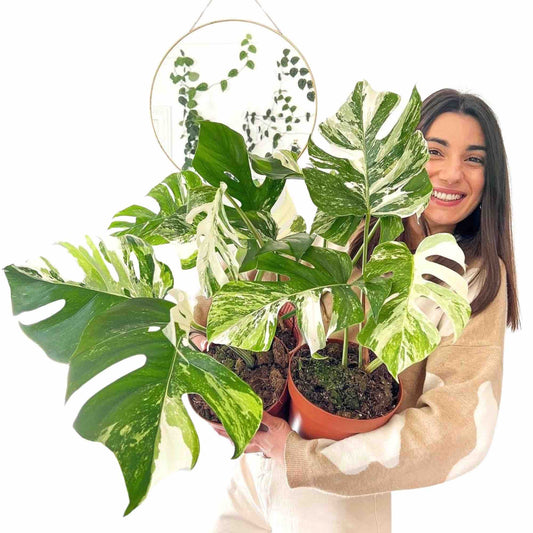
Variegated Monstera
Regular price 69,95 €Regular price89,95 €Sale price 69,95 €69,95 €55,96 €Sold out -

 Livraison offerte
Monstera Adansonii Monkey Mask - 12cm Pot - Height: 25-35cm
Regular price 39,95 €Regular price39,95 €31,96 €Livraison offerte -
Transparent climbing plant support - Pack of 3 + free velcro (Monstera, Pothos)
Regular price From 9,99 €Regular price13,89 €Sale price From 9,99 €9,99 €From 8,00 €Sale -
Monstera Soil - Enriched with Mycorrhiza and Bacillus - Araceae Substrate
Regular price From 9,50 €Regular price23,75 €Sale price From 9,50 €9,50 €From 7,60 €Sale


✂️ Light and regular care: what changes according to the location
Light rules the pace of everything else: a well-lit Monstera grows, drinks and feeds more than a Monstera installed in the shade. The steps below are summarized; the detailed watering and repotting method is in our Monstera step-by-step guide.
💧 Watering: The brighter the place, the faster the potting mix dries. Water when the top of the potting mix has dried, never out of habit; in winter, the RHS recommends keeping the potting mix just moist, and a less bright place also slows down the drying.
🌱 Fertilizer: The RHS recommends a balanced liquid fertilizer once a month during growth. A plant lacking light does not benefit from it: correct the location first.
🪢 Support: The Monstera climbs towards the light. The RHS recommends training the stems on a foam support; see our guide to the foam support for Monstera or a transparent support that does not cast a shadow.
🔹 Clean leaves: Dust blocks the light. Wipe the large leaves with a soft and damp cloth when they become dull.
🔹 Substrate: An airy potting mix prevents the roots from staying waterlogged when the light drops, for example our Monstera potting mix.
🍂 Monstera light in winter and summer
In winter, the days shorten and the light drops: bring your Monstera closer to the window. Colorado State University Extension notes that, from October to March, a south window gives strong light at less than 2 feet (about 60 cm), while a north window only gives low light.
The same source recommends avoiding that the foliage touches the glass, because the winter cold like the summer heat damages it. In summer, do the opposite: move the plant back or pull a sheer curtain in front of a south or west window. The RHS classifies it as H1B: it can spend the summer outside in light shade, then come in before the cool nights, because it requires 18 to 25 °C all year.
For everything else of the cold season, read our guide to indoor plants in winter.
📅 Care calendar by season
| Season | Key move |
|---|---|
| 🌸 Spring | Increasing light: bright place without direct sun, resume fertilizer |
| ☀️ Summer | Sheer curtain in front of south and west windows, or outside in light shade |
| 🍂 Autumn | Bring the plant in, bring it closer gradually to the window |
| ❄️ Winter | As close as possible to the glass without touching it; horticultural lamp if the room is dark |
🌱 Horticultural lamp: the solution for a Monstera in a dark room
If no window gives enough brightness, a grow light takes over. The Illinois Extension indicates that a lighting duration of 14 to 16 hours is enough and that you should not exceed 16 hours, because plants need a rest period.
Colorado State recommends horticultural LEDs, which consume up to 50% less energy than old discharge lamps and heat very little. Place the lamp above the foliage, plug it into a timer and keep the leaves out of reach of the heat.
To choose the spectrum, the power and the height of the lamp, consult our guide LED lighting for plants: how to choose and our instructions use an LED horticultural lamp.
Our full spectrum horticultural lamp attaches above a large Monstera.
🐛 Light problems: Monstera lacking light or having too much
A Monstera lacking light shows it on its new leaves and stems.
The WSU Extension (Washington State University) guide What Can Go Wrong With Houseplants describes light deficiency by weak and stretched stems, small and pale leaves, and a plant leaning to one side; excessive light by leaves curling downwards and new leaves that are too small.
The RHS adds that in very low light, the leaves have fewer holes. Aerial roots, on the other hand, are not a sign of light deficiency: the RHS reminds us that they help the Monstera attach itself to climb. However, long bare stems growing towards the window, with many aerial roots, show a plant that is looking for both light and support.
| Symptom | Probable cause | Solution |
|---|---|---|
| New leaves without holes or slits | ☀️ Too little light or still a young plant (RHS, NC State) | Move closer to the window; provide a stake for it to climb |
| Long stems, spaced out and pale leaves | ☀️ Lack of light (WSU Extension) | Place the plant closer to an east, west, or filtered south window, or add a lamp |
| Plant leaning towards the window | ☀️ Light coming from one side (WSU Extension) | Rotate the pot a quarter turn regularly; stake it |
| Brown or dry yellow patches in the center of the leaves | ☀️ Direct sun scorch (RHS, UF/IFAS) | Move it back or filter with a sheer curtain; burned areas will not turn green again |
| Light green leaves curling downwards | 💧 Too much light (WSU Extension, UF/IFAS) | Move the plant away from the glass or place it behind a sheer curtain |
| Browning leaf edges | ⚠️ Air too dry, especially in a heated home (RHS) | Move away from the heat source, group your plants |


🌸 Our Monstera varieties and their light needs
All varieties share the same principle: bright light, no scorching sun. NC State specifies that variegated cultivars need more light than dark green cultivars. Here is where to place each one.
| Variety | Its strength |
|---|---|
| Monstera deliciosa (green) | The classic shape: east or west window, or set back from a south window; see our Monstera deliciosa care guide |
| Monstera deliciosa 'Thai Constellation' | Variegated cultivar: more light than a green Monstera according to NC State, without direct sun that burns the leaves (RHS); see our Thai Constellation sheet |
| Monstera deliciosa variegata | Variegated too: more light than a green Monstera according to NC State, without direct sun (RHS); see Monstera Deliciosa Variegata: care |
| Monstera deliciosa 'Mint' | Mint green variegation (product sheet): like any variegated cultivar, more light than a green Monstera according to NC State, near an east or west window as recommended by the RHS |
| Monstera adansonii | Neighboring species, smaller and very perforated; its detailed needs are in our Monstera adansonii guide |
🎨 Monstera in a dark room or north-facing window: what to do?
A Monstera can survive in a dark room, but it will not thrive: it grows little and its leaves remain without holes. If your home faces north, place it right in front of the glass and supplement with a grow light from October to March.
For a really dark corner, it is better to choose a plant that tolerates low light: see our selection of houseplants for dark rooms and our guide north-facing window: which plants to choose. Keep the Monstera for the brightest room in the home, often the living room.
⚠️ Is Monstera toxic to cats and dogs?
Yes. The ASPCA (American Society for the Prevention of Cruelty to Animals) classifies Monstera deliciosa, which it also calls Swiss cheese plant or split-leaf philodendron, as toxic to dogs and cats due to its insoluble calcium oxalates.
The described signs are mouth irritation, intense burning of the mouth, tongue, and lips, excessive salivation, vomiting, and difficulty swallowing. The RHS says it is harmful if ingested and irritating to the skin and eyes.
In case of ingestion, call your veterinarian, and consult our list of non-toxic plants for cats.
✅ Our expert tips for success
For a healthy Monstera, remember three settings: bright but indirect light, a place right by an east or west window or slightly set back from a south window, and no scorching sun on the leaves. Move it closer to the glass in winter, filter the sun in summer, and add a grow light if the room is dark.
New leaves are your best indicator: large and slit, the location is right; small, pale, and spaced out, it needs more light.
When I am shown a Monstera whose leaves do not slit, I first ask where it is placed, long before talking about watering. My first advice is almost always to move it closer to a bright window, behind a sheer curtain, then judge by the next leaves. I also advise turning the pot from time to time: a Monstera leaning towards the window simply says where its light comes from.

Laura Bruneau
Jardinière et autrice