Skip to product information
1 of 5

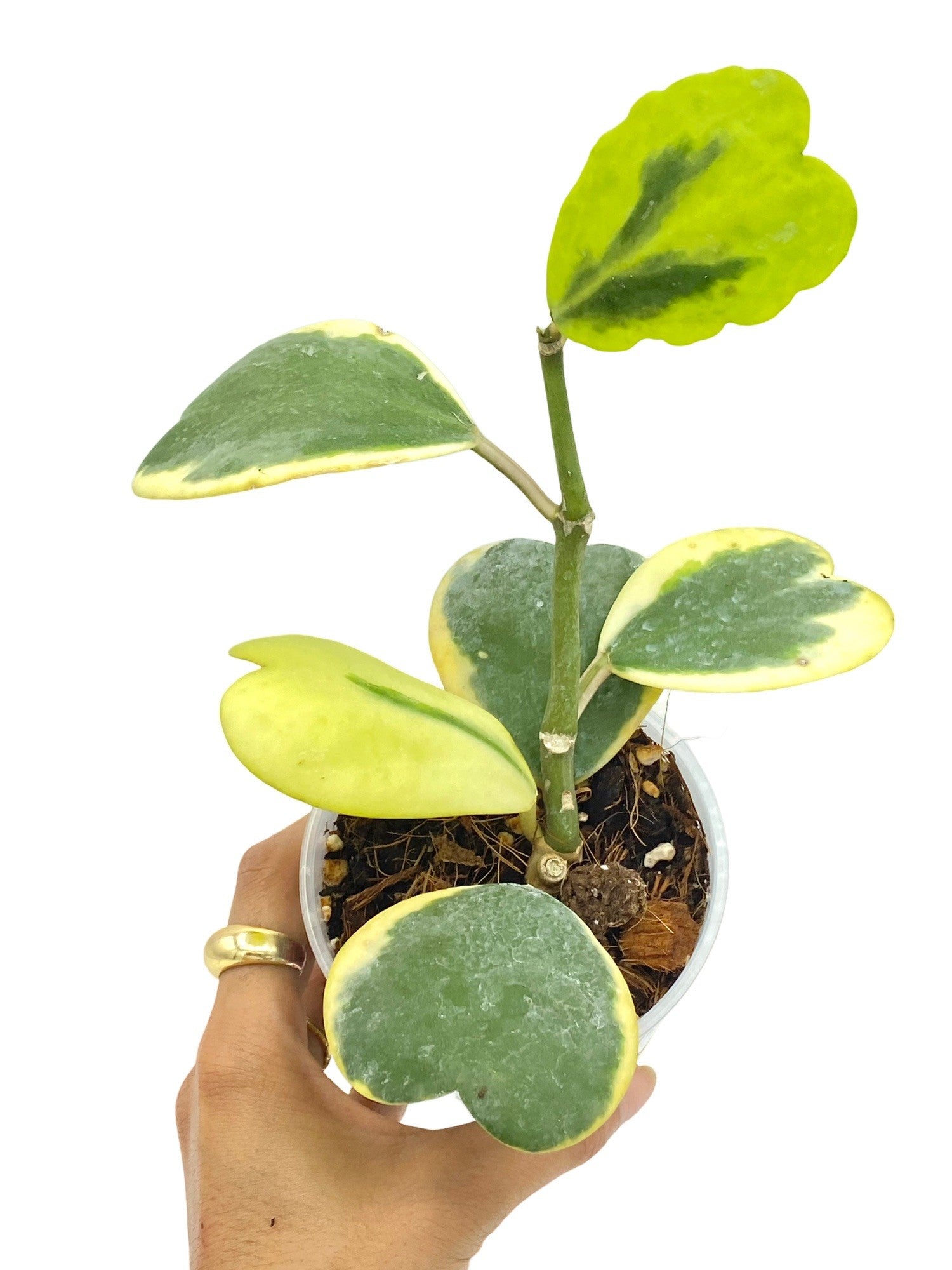
Hoya Kerrii Variegata

Hoya Kerrii Variegata

A variegated green heart

Regular price 12,95 €
Regular price Sale price 12,95 €
Sale Sold out
Taxes included. Shipping calculated at checkout.
🤍 White blooms🌸 Fragrant flowers🐾 Pet friendly
Pot diameter
Quantity

Pay in 2, 3 or 4 interest-free installments from €50 with Klarna

Low stock: 4 left

  • Careful delivery with optimal protection
  • Plant health guaranteed for 30 days
Une question ? Nos experts vous répondent 01 89 48 03 62

About

Hoya Kerrii Variegata, the heart-shaped plant with unique variegated foliage

Hoya kerrii Variegata is a succulent climbing plant native to the rainforests of Southeast Asia, particularly Thailand, Laos, and Vietnam. Belonging to the Apocynaceae family, this variegated variety of Hoya kerrii is distinguished by its fleshy, heart-shaped leaves with cream and ivory edges framing a vibrant green center. The plant can reach stem lengths of up to 1.5 meters indoors, and its growth remains slow but steady throughout the warm season.

Its two-toned foliage is an invitation to tenderness: each thick, slightly waxy leaf displays a delicate gradient between deep green and creamy shades, sometimes tinged with pale yellow. Hoya kerrii, also called sweetheart plant , can produce small umbels of fragrant, star-shaped flowers when mature, a discreet spectacle that crowns years of patient care. Its succulent texture gives it a unique botanical presence, both sculptural and gentle.

Adopt the Hoya Kerrii Variegata today and give your home a touch of tropical delicacy.

Description

Maintenance tips

Guarantee

Order with complete peace of mind 💚

At Plant and Stories, the health of our plants and the satisfaction of our customers are our top priorities.

That is why all our indoor plants come with a 30-day guarantee after delivery, so you can order with confidence.

Our plants are carefully selected, fully healthy, acclimated, and shipped with care using secure packaging designed to protect them.

Despite all our precautions, an incident during transport can sometimes weaken a plant. Don't worry: our team is here to help.

💌 How to make a claim under your guarantee?

  • Take a photo of the plant in question upon delivery.
  • Send the photos immediately to this address: sav@plantandstories.com, including your order reference.

We will respond quickly with a solution tailored to your situation 💚

Shipping

Your plants and accessories delivered with care.

At Plant and Stories, every order is prepared with love, whether it's for your houseplants or accessories.

✅ Carefully selected plants.

  • Our plants are rigorously selected, acclimatized and delicately packaged in secure and recyclable packaging.
  • Shipping takes place from Monday to Wednesday only, in order to avoid any prolonged transit over the weekend and to preserve their freshness.

📦 Durable accessories

  • Your accessories are also carefully prepared and shipped from Monday to Friday to ensure fast and secure delivery.
  • They are packaged with the utmost care to avoid any shock or damage during transport.

🚚 Fast and reliable delivery

  • We collaborate with trusted carriers, recognized for their quality of service.
  • Once handed over to the carrier, your order will be delivered within 24 to 72 hours, depending on your geographical area.
  • Delivery available in mainland France and Europe.

🌱 An eco-responsible commitment

  • All our packaging is recyclable, designed to limit environmental impact while ensuring optimal protection for your plants and accessories.

🤝 Customer service that listens to you

A question or a problem upon receipt? Our responsive customer service is there to assist you.

At Plant and Stories, every detail counts to ensure your order arrives in perfect condition… and with a smile 🌿

View full details
  • Order prepared with love

  • Optimal protection

  • Quality plants

  • A team that is always attentive

Simple & reassuring

From the greenhouse to your living room

Ordering plants online is completely risk-free with us. Here is your worry-free journey.

1

You are ordering

100% secure payment, in full or in 3 interest-free installments with Klarna.

Risk-free
2

We prepare it by hand

Each plant is selected, inspected, and secured in suitable packaging.

Expert treatment
3

Ships within 24–48 hours

Ship at the beginning of the week to avoid having it stuck in transit over the weekend.

Fast delivery
4

Arrival guarantee

A problem with your delivery? Photos are all we need: we’ll replace it or refund you.

No stress
★★★★★9.99/10 from over 2,880 verified reviews

Already over 87,000 plants delivered with a smile

Hoya Kerrii Variegata

Propriétés des plantes

Hoya Kerrii Variegata


Luminosité
Bright indirect light
Arrosage
Allow to dry thoroughly between waterings.
Difficulté de culture
Easy
Toxicité animaux
Non-toxic
Température idéale
18 to 24°C
Emplacement conseillé
Pendant light or shelf, indirect lighting
Humidité
Normal
Substrat
Light epiphyte mix (bark, perlite)
Rempotage
Every 2–3 years, in spring
Fertilisation
Every 2–3 weeks, from March to October
Croissance
Slow
Nom latin
Hoya kerrii 'Variegata'
Noms communs
Hoya heart, heart plant
Famille botanique
Apocynaceae
Origine
Indochina (Thailand, Laos, Cambodia, Vietnam), Malaysia, Java
Port
Climbing
Forme du feuillage
Heart-shaped
Couleur du feuillage
Variegated, yellow to cream margin
Couleur de floraison
White with a pinkish-brown to purple core
Feuillage
Persistent
Parfumé
Yes
Dépolluante
No

Your satisfaction is our priority

If you have any questions about the delivery of your package, or if anything is wrong upon its arrival, our team is here for you.

Feel free to contact us Monday through Friday, from 9 a.m. to 5 p.m., by phone at 01 89 48 03 62 or by email at sav@plantandstories.com.

We will do our utmost to find a solution quickly. 🌱

Help and solutions:

Everything you need to know Hoya Kerrii Variegata

What light exposure is best for my Hoya Kerrii Variegata?

The Hoya Kerrii Variegata thrives in bright, indirect light, ideally placed 50 to 100 cm from an east or west facing window.

Native to the rainforests of Southeast Asia, this plant is naturally accustomed to light filtered through the canopy. The distinctive feature of the Variegata variety is that its cream and ivory areas, lacking active chlorophyll, require more intense light exposure than a typical Hoya Kerrii to maintain balanced growth.

In autumn and winter, place it near the brightest window in your home. In spring and summer, a light curtain is enough to protect it from the direct midday sun, which could burn its fleshy leaves.

Important tip 🌿Avoid moving the plant too frequently: Hoya Kerrii Variegata adapts to its location and sudden changes in exposure can cause slowed growth or flower buds to drop during the flowering phase.For dark interiors, ourhorticultural lamp suitable for indoor plantsoffers a full spectrum to compensate for the lack of natural light without risk to the foliage.

Is Hoya Kerrii Variegata toxic to animals and children?

Hoya Kerrii Variegata is considered non-toxic to cats, dogs and young children according to available botanical data.

Unlike other popular houseplants such as Dieffenbachia or Pothos, Hoya Kerrii Variegata does not contain dangerous concentrations of calcium oxalate crystals, nor significant amounts of irritating latex compounds. Therefore, it is generally well-tolerated in case of contact or accidental ingestion of small quantities.

However, as with any houseplant, ingestion in large quantities can cause mild digestive upsets such as nausea or slight vomiting, in both animals and young children.

What precautions should be taken on a daily basis?

As a precaution, it is advisable to keep Hoya Kerrii Variegata out of reach of young children and pets that tend to chew on plants. The waxy, thick nature of the leaves may particularly attract the attention of cats.

In case of ingestion of a large quantity, consult a veterinarian or doctor immediately. Hoya Kerrii Variegata remains one of the safest climbing plants to have at home, and its coexistence with pets and children is perfectly feasible with a few simple precautions.

Why are the leaves of my Hoya Kerrii Variegata turning yellow?

The leaves of Hoya Kerrii Variegata most often turn yellow due to overwatering, lack of light, or nutrient deficiency.

  • If the leaves turn yellow and become soft or translucent, the problem usually stems from excess water causing the beginning of root rot.
  • If the leaves gradually turn yellow while remaining firm and dry, the plant often lacks light or fertilizer, which is particularly common in variegated areas that are less chlorophyll active.
  • If the yellowing is accompanied by small light spots, a dull appearance or fine webbing, it may be a mite infestation, common indoors especially in dry atmospheres.

Since Hoya Kerrii Variegata is a succulent plant, it stores water in its thick leaves: yellowing accompanied by softening of the leaf blade is therefore an early warning sign that should not be ignored, as root rot can set in quickly in this case.

Important tip 🌿One or two old leaves that turn yellow from time to time is perfectly normal and is part of the plant's natural cycle.On the other hand, there is cause for concern if several leaves turn yellow rapidly, if the phenomenon affects young leaves, or if growth slows down significantly.

In case of a mite infestation, prioritize ourplant-friendly biological treatments, effective and safe for your home.

When and how should I repot my Hoya Kerrii Variegata?

The Hoya Kerrii Variegata is ideally repotted in spring, between March and May, when growth resumes actively.

Repotting is necessary when:

  • The roots emerge through the drainage holes.
  • Growth is slowing down despite good exposure and regular fertilization.
  • or that the substrate compacts too quickly after watering.

As a general rule, repotting every 2 to 3 years is sufficient for the Hoya Kerrii Variegata, which grows slowly and tolerates being cramped in its pot very well, which can even promote flowering.

Hoya Kerrii Variegata develops a relatively fine and uninvasive root system for a climbing plant: avoid choosing a pot that is too large, as an excess of substrate volume around the roots greatly increases the risk of rot.

Choose a pot 2 to 3 cm wider than the old one, and make sure it has drainage holes. Ourtransparent pots to monitor the rootsare ideal: their transparency allows you to monitor the root system without disturbing the plant.

Prepare a very well-draining substrate, designed to dry quickly between waterings.We recommend ourwell-draining substrates enriched with biostimulants, as well as ourpremium substrate adapted to the needs of Hoyaspecially formulated to meet the requirements of this climbing succulent.

  1. Carefully remove the plant from its pot, tapping the pot if necessary to loosen the root ball without pulling on the stems.
  2. Gently loosen the roots if they are very compacted, without breaking them.
  3. Place a layer of substrate at the bottom of the pot, position the plant upright, then fill with substrate without burying the crown.

Important tip 🌿After repotting, water moderately to help the substrate settle around the roots. Ensure that excess water drains freely.Repotting is a source of stress for the plant: repotting every 2 to 3 years remains the ideal frequency to ensure healthy and balanced growth.

When and how should I fertilize my Hoya Kerrii Variegata?

Hoya Kerrii Variegata should be fertilized every 2 to 3 weeks from March to October, with a liquid fertilizer diluted in the watering water.

During autumn and winter, from November to February, significantly reduce or stop fertilizing. This is a period of dormancy during which the plant produces few or no new leaves.

The variegated nature of Hoya Kerrii Variegata means that its chlorophyll-free areas are less metabolically active: it is therefore important not to overdose on fertilizer, at the risk of burning the fine roots and unbalancing the development of the stems.

A well-balanced intake promotes:

  • denser, more colorful foliage with more contrasting variegation
  • steady growth of climbing stems,
  • and improved plant resistance to seasonal variations.

👉 For best results, we recommend ourliquid fertilizer formulated for HoyaTailored to their specific needs, with results visible quickly. Practical advice is printed directly on the back of the label and on the product information sheet.

Important tip 🌿Never fertilize a plant in a dry substrate: this could burn the roots.Water normally first, then apply diluted fertilizer 2 to 3 days later, when the soil is slightly moist. Excess fertilizer can cause leaf burn. Regular but moderate fertilization will keep your Hoya Kerrii Variegata vigorous and healthy 💚

How do I properly water my Hoya Kerrii Variegata?

Water Hoya Kerrii Variegata when the substrate has dried out completely, approximately every 10 to 14 days in summer and every 20 to 30 days in winter. Use room temperature water, preferably filtered or left to stand for 24 hours to reduce limescale.

How do I know when to water?

The finger test remains the most reliable method: insert your index finger into the substrate to a depth of 2 to 3 cm. If the substrate is dry, it's time to water. If it's still damp, wait a few more days.

Thanks to its fleshy, succulent-textured leaves, the Hoya Kerrii Variegata stores water in its thick blade and tolerates periods of inactivity very well. However, it is particularly sensitive to overwatering, which quickly leads to root rot that is difficult to reverse.

Important advice:When in doubt, it's always better to wait a little longer than to overwater. Succulents like Hoya Kerrii Variegata are better able to adapt to underwatering than to overwatering, which quickly causes their roots to rot.

How do I propagate my Hoya Kerrii Variegata?

Hoya Kerrii Variegata is propagated by stem cuttings with at least one node, ideally in spring or early summer when the plant enters its active growth phase.

Nodal stem cutting methodContrary to popular belief, a single heart-shaped leaf cut on its own will never produce a new plant: without a node, the leaf will survive for a while but will not produce any stem or roots. To successfully propagate a cutting, take a section of stem with at least one node and one or two leaves, making a clean cut just below the node with ourStainless steel blade pruning shears for taking cuttings without damaging the plantwhich promotes root development and limits the risk of infection.

  1. Take a stem cutting of about 8 to 12 cm, with at least one clearly visible node, by cutting cleanly below the node.
  2. Allow the cutting to air dry for 1 to 2 hours to prevent any risk of rot, then place the cutting in ourtransparent pots to monitor root developmentfilled with water or moist substrate.
  3. Keep the cutting in a bright place without direct sunlight, at a temperature between 20 and 25 °C.

Hoya Kerrii Variegata roots well in water or in ourlive sphagnum moss to maintain root moisturewhich offers a slightly humid environment ideal for the delicate roots of this variegated variety. Once the roots are well formed, transplant into ourenriched drainage mix for climbing succulents.

Important tip 🌿Rooting of Hoya Kerrii Variegata generally takes 3 to 6 weeks, depending on the temperature and ambient light. The first white roots appear at the node: this is a sign that the cutting has rooted successfully and can be transplanted. The variegated variety roots slightly more slowly than the all-green form, due to its lower chlorophyll activity.

Gros plan sur les fleurs du Hoya Kerrii avec leurs petits pétales blancs et centres rouge-orangé perlés de nectar doré

The essentials regarding Hoya Kerrii Variegata

Hoya Kerrii Variegata: identity and origin

The Hoya Kerrii Variegata (Hoya kerrii'Variegata') is a climbing succulent native to the tropical forests of Southeast Asia, particularly Thailand and Vietnam. Itsthick foliageHeart-shaped, variegated with cream and green, it's an instantly recognizable plant. Like all Hoyas, it produces gracefulfloral umbelsto thefragrant blooms, which appear on mature stems after several years of indoor cultivation.

Hoya Kerrii care: light, watering and substrate

This Hoya thrives in bright, indirect light, ideally near an east- or west-facing window. Its variegated leaves require more light than a solid green form; insufficient exposure gradually diminishes the contrast.spaced wateringIt is essential: wait until the substrate is completely dry before watering again, every two to three weeks during dry periods. Repot after 2 to 3 weeks of acclimatization in ourHighly draining substrate for Hoya, enriched with biostimulantsformulated for the roots of climbing succulents.

Where should you place your Hoya for optimal growth and flowering?

This variegated heart thrives in a bright and stable interior, sheltered from cold drafts.

  • Window is:soft morning light, ideal all year round
  • Brightness:1 to 2 meters maximum from a well-exposed window
  • Temperature :between 18 and 26°C, without falling below 12°C
  • Dark room:OURfull spectrum horticultural lamppreserves variegation and stimulates flower stalks
  • Dry air:OURCare pack with spraycompensates for the lack of humidity without wetting the leaves

Frequently asked questions: Why isn't my Hoya Kerrii Variegata flowering?

The absence of flowering in theHoya kerrii'Variegata' is most often explained by a lack of light or overwatering, which prevents the winter dryness necessary for the flower stalks to develop. In winter, significantly reduce watering and keep the plant in a cool room around 15°C (59°F): this seasonal contrast is the horticultural signal that initiates flowering. Never remove the flower stalks after flowering: Hoyas will rebloom from the same points. A regular supply of ourHoya special liquid fertilizerIn spring and summer, it effectively supports flowering.

Buy Hoya Kerrii Variegata at Plant and Stories

Our Hoya Kerrii Variegata is in stock and carefully shipped to ensure it arrives in perfect condition. Each plant is selected and inspected by our team of rare tropical plant specialists. To showcase its climbing stems, pair it with ourtransparent arch supports for Hoyaand to ourfixing clipsto guide the growth of Hoya Kerrii Variegata with elegance.

Show moreShow less
👉 To learn more