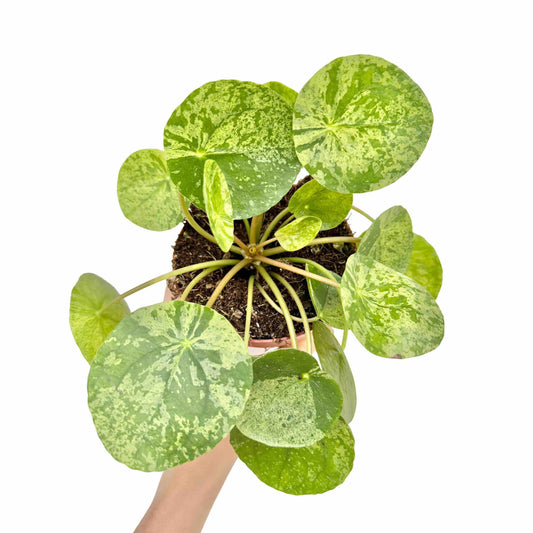
How to care for a pilea?

CARE INSTRUCTIONS: PILEA PEPEROMIOIDES

Introduction
The Pilea peperomioides , commonly known as the Chinese money plant , is a popular houseplant thanks to its round, glossy leaves that resemble coins.
Originating in southern China , this easy-to-care-for plant has spread throughout the world as a symbolic gift of wealth and prosperity.
Features
- Common name: Chinese money plant
- Scientific name: Pilea peperomioides
- Family: Urticaceae
- Origin: China
- Flower color: Greenish-white (although flowering is rare indoors)
- Flowering period: Can flower in summer if conditions are optimal.
- Ideal temperature: 15-25°C
- Humidity: Moderate
- Vegetation type: Perennial
- Foliage type: Evergreen
Did you know that?
Pilea peperomioides , despite its current worldwide popularity as a houseplant, was once extremely rare outside of China, its country of origin.
In the 1940s, a Norwegian missionary named Agnar Espegren discovered this plant in China and began sharing it with friends and acquaintances upon his return to Norway.
Through exchanges between plant enthusiasts , the Pilea has slowly but surely made its way across Europe and the rest of the world, mainly through cuttings and exchanges between plant lovers, rather than through traditional plant trade.
Thus, Pilea peperomioides has become a symbol of sharing and community among indoor plant enthusiasts.
HOW TO CARE FOR A PILEA PEPEROMIOIDES? | IN BRIEF
Light :
Prefers bright but indirect light . Avoid direct sunlight which can burn the leaves.
Water :
Water when the soil is dry throughout. It prefers to dry out for several days before watering.
Ensure that the substrate is dry to a depth of several centimeters below the soil surface.
Avoid overwatering to prevent root rot.
Temperature :
Ideally between 15°C and 25°C. Avoid cold drafts .
Humidity :
Prefers moderate humidity.
WHAT TYPE OF SOIL IS NEEDED FOR PILEA PEPEROMIOIDES?
A well-draining potting mix is essential. Use a houseplant mix with a little perlite to improve drainage .
We recommend our " Perlite potting mix " which will meet 100% of the needs of Pilea peperomioides!
WHEN SHOULD I REPOT MY PLANT?
Repot in the spring every two years, or whenever you notice that the plant is becoming too cramped in its current pot.
HOW TO PROPAGATE A PILEA PEPEROMIOIDES?

Pilea peperomioides is a plant that lends itself wonderfully to propagation , thus offering an excellent opportunity to share this unique species with those around you.
Propagation can be achieved in several ways , but leaf cuttings are particularly popular for their simplicity and effectiveness.
The leaf propagation method :
It starts with selecting a healthy and robust leaf from your Pilea.
It is important to choose a well-developed leaf attached to a stem.
Using clean scissors or pruning shears, carefully cut the stem a few centimeters from the leaf.
This cut will prepare the leaf for the next stage of propagation.
Once the leaf stem is prepared, plant it directly into a pot filled with fresh, well-drained potting soil.
The potting soil should be moist , thus promoting the rooting of the new cutting.
Position the pot in a warm spot in your home where the cutting can receive plenty of indirect light.
Avoid direct sunlight , which could damage the young shoot before it has a chance to establish itself.
Leaf cuttings can also be taken directly in water , offering an alternative and visually interesting method of watching roots develop.
To do this, place the cut stem in a container of clear water , making sure to change the water regularly to avoid stagnation.
Once the roots have reached a sufficient length , the cutting can be transplanted into soil.
Besides leaf cuttings, Pilea peperomioides can also be propagated by division , thanks to its rhizomes.
The division method:
This plant tends to naturally produce offshoots at its base , which greatly facilitates division.
To proceed, gently separate the offshoots from the mother plant , taking care to keep a portion of their roots intact to ensure their survival and growth once replanted.
Replanting the offshoots is similar to that of leaf cuttings.
Use quality potting soil and ensure optimal conditions are maintained to encourage root development and growth of new plants.
With a little patience and care, your Pilea peperomioides cutting will flourish, giving you a new plant to admire or share.
The offshoots can also root directly in water.
Make sure to place the cuttings in a warm and bright room.

HOW TO PREVENT AND TREAT PESTS?
Inspect regularly to prevent signs of mealybugs, thrips or spider mites.
In case of infestation, treat with natural and biological methods such as black soap.
Find our organic recipe for fighting pests on the product page of our black soap for plants .
For greater effectiveness, we recommend applying the solution with our pair of microfiber plant cleaning gloves .
It will allow you to gently eliminate unwanted elements.
HERE ARE OUR EXPERT ADVICE:
- Ensure bright but indirect light to avoid sunburn.
- Allow the substrate to dry out thoroughly between waterings.
- Repot every 2 years to encourage growth.
- Collect the offshoots to share your Pilea with friends and family.

Laura Bruneau
Jardinière & autrice