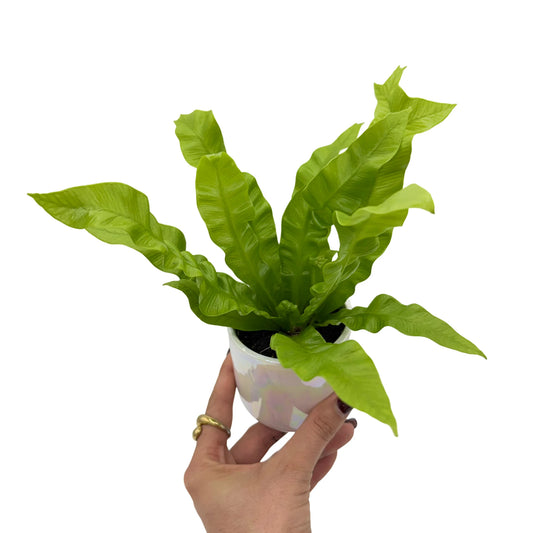
Boston fern (Nephrolepis exaltata): care and humidity

To care for a Boston fern, place it in bright, filtered light, keep its potting mix slightly moist but never waterlogged, water it with soft water, and give it humid air, away from radiators. Behind this common name is Nephrolepis exaltata, an epiphytic fern from tropical America whose 'Bostoniensis' form gave the whole species its nickname.
Unlike asparagus fern, which is mistakenly called a fern, this is a true fern: it never flowers, bears spores on the undersides of its leaflets, and sends out slender runners.
This guide draws on the RHS (Royal Horticultural Society), NC State Extension (North Carolina State University), and the University of Wisconsin horticultural extension service. It will help you understand why an indoor fern dries out, how to propagate it, and which variety to choose.
🌿 Why choose a Boston fern?
The Boston fern adds generous greenery: its fronds grow upright, then arch and droop as they mature, as described by the RHS. This makes it perfect in a hanging planter, on a stool, or on a column. It thrives in the ambient humidity of bathrooms, making it an ideal choice for a bright bathroom.
Finally, it is a safe plant for homes with pets: the ASPCA classifies it as non-toxic to dogs and cats, a point that several online guides get wrong.
| Benefit | What it means for your home |
|---|---|
| Arching, trailing fronds | A cascade of greenery in a hanging planter or on a high shelf |
| Thrives in humid air | A plant that benefits from the steam of a bathroom or bright kitchen |
| Non-toxic to cats and dogs | A fern you can safely place within pets' reach (ASPCA) |
| Propagates on its own | Its runners produce young plants that are easy to separate and repot |
🔎 Boston fern at a glance
According to Kew (Plants of the World Online, Nephrolepis exaltata), the accepted name is Nephrolepis exaltata (L.) Schott: an epiphytic fern of the subtropical biome, native to tropical and subtropical America (Florida, the Caribbean, Central America, Brazil, Hawaii…).
The name 'bostoniensis' is no longer recognized there as a botanical variety: POWO lists it as a synonym of the subspecies exaltata, and it is now used as a cultivar name. The RHS describes an evergreen, bushy fern with a rhizome that sometimes produces runners, growing 0.5 to 1 m tall in 2 to 5 years.
| Feature | Verified details |
|---|---|
| 🏷️ Botanical name | Nephrolepis exaltata (L.) Schott; 'Bostoniensis' is a cultivar |
| 🧬 Family | Depending on the classification: Polypodiaceae (POWO), Lomariopsidaceae (RHS), or the separate family Nephrolepidaceae (PPG I classification) |
| 🌳 Type | True evergreen fern, epiphytic in the wild, with runners |
| 🌍 Origin | Tropical and subtropical America (POWO) |
| 🍃 Foliage | Light to medium green, pinnate fronds that grow upright before arching |
| 🌸 Flowers | None: reproduces via spores borne on the undersides of the leaflets |
| 📏 Size | 0.5 to 1 m tall, with a spread of 1 to 1.5 m (RHS); fronds up to 4 feet, or about 1.2 m (University of Wisconsin) |
| ⚠️ Toxicity | Non-toxic to dogs and cats (ASPCA; NC State) |
📋 Quick care guide
Essential growing tips, all at a glance.
| Factor | Guideline |
|---|---|
| Light | Bright, filtered light; east- or west-facing window, or behind a sheer curtain in a south-facing window |
| Watering | Keep the potting mix consistently moist during the growing season, drier in winter; use soft water |
| Potting mix | Peat-free, airy, well-draining potting mix, with an acidic to neutral pH (RHS) |
| Humidity | Moderate to high; use a tray of damp pebbles or group plants together |
| Temperature | RHS H1b (minimum 10 to 15 °C); nights around 18 °C (65 °F, University of Wisconsin); keep away from radiators |
| Repotting | In spring, when the root ball is full of roots; divide if needed |
| Fertilizer | Balanced fertilizer at half strength once a month during the growing season (RHS) |
| Toxicity | Non-toxic to dogs and cats (ASPCA) |
| Difficulty | Easy if the air isn't too dry; fussy near heaters |
📍 Where to place a Boston fern and when to bring it home
The right spot for a Boston fern is bright but out of harsh sunlight: the University of Wisconsin horticultural extension service recommends an east-facing window, or a sheer curtain in front of a south- or west-facing window, while NC State Extension says it can manage with less than 2 hours of direct sunlight a day.
The RHS recommends a partially shaded position and stresses the need for good ventilation without cold drafts.
📍 Ideal spot: near an east- or west-facing window, in a bright bathroom or kitchen where the air is naturally more humid; see our selection of plants for the bathroom.
🕰️ Best time: spring, when growth resumes: the RHS and the University of Wisconsin recommend this season for repotting, dividing, or separating runners.
🧺 Hanging planter or column: its fronds eventually trail down, so a hanging planter or tall stand shows off its shape and keeps it away from the dry air near heated floors.
🪴 How to repot a Boston fern step by step
Repot in spring, only when the roots and runners have filled the pot. The RHS recommends peat-free, all-purpose potting mix, or a blend of 1 part loam, 2 parts coarse sand, and 3 parts leaf mold, with an acidic to neutral pH.
Choose a pot that is only slightly wider, with drainage holes: its fine roots like to stay cool, not sit in water.
| Step | What to do |
|---|---|
| 1. Prepare | Water with soft water the day before so the root ball comes out intact. |
| 2. Choose a pot | Just a few centimeters wider, with drainage holes. |
| 3. Prepare the potting mix | Use a light, peat-free potting mix enriched with leaf mold or fiber. |
| 4. Plant | Set the crown at the same level as before, without burying the center of the fronds. |
| 5. Water | Water gently, let it drain, then return it to filtered light. |
columns: 4
columns_mobile: 2
-

 Livraison offerte Sale
Nephrolepis exaltata Green Lady - Pet-friendly - 12cm pot - Height 25-30cm
Regular price From 39,95 €Regular price44,95 €Sale price From 39,95 €Livraison offerte Sale -

 Livraison offerte
Phlebodium aureum Blue Star - Pet-friendly - 12cm pot - Height 25-30cm
Regular price From 39,95 €Regular price -

 Livraison offerte
Asplenium Crispy Wave - Crispy Wave Fern - 12cm Pot
Regular price From 39,95 €Regular price


✂️ Everyday Boston fern care
Caring for a Boston fern comes down to keeping the root ball moist, using soft water, and providing humid air. NC State Extension recommends moist soil that should never dry out completely, while the RHS cautions that overly wet fronds can rot: aim for consistency rather than heavy watering.
💧 Watering: Water as soon as the surface of the potting mix begins to dry; empty the saucer once the water has drained.
💧 Water quality: Use rainwater or filtered water: the RHS guide to epiphytic ferns notes that repeated use of hard water neutralizes the acidity these ferns prefer.
💧 Humidity: Place a tray of damp pebbles under the pot or group plants together, rather than misting.
🌱 Fertilizer: Apply balanced liquid fertilizer at half strength once a month in spring and summer.
🧹 Cleaning: Cut dry or yellowing fronds back to the base to let air circulate through the center of the clump.
🍂 Watering a Boston fern through the seasons
Does a fern need a lot of water? Above all, it needs consistent watering: the RHS recommends moderate watering during the growing season, then sparing watering in winter. The University of Wisconsin considers it the most drought-tolerant of commonly grown ferns, but it grows best with consistent moisture.
In winter, the real danger isn't a cold room but dry air from the heating: this is when leaflet tips turn brown. Read our guide to dry air and heating to adapt your room.
📅 Seasonal care calendar
| Season | Key task |
|---|---|
| 🌸 Spring | Repot, divide, or separate runners; resume fertilizing at half strength |
| ☀️ Summer | Water regularly with soft water, use a humidity tray, protect from direct sunlight |
| 🍂 Fall | Gradually space out watering, stop fertilizing, bring indoors before temperatures fall below 10 °C |
| ❄️ Winter | Keep the root ball just moist, provide maximum light, maintain a room temperature around 16 to 18 °C, and keep away from radiators |
🌱 How to propagate a Boston fern: runners and division
Boston ferns can be propagated without cuttings: the University of Wisconsin explains that their long, slender runners root as soon as they touch the soil and form a new plant. The RHS recommends separating rooted runners in late winter or early spring, then potting them into small pots.
For a large clump, divide it in spring by cutting the root ball vertically into two or four sections with a clean knife, keeping as many fronds as possible on each division. Growing from spores at 21 °C is possible (RHS), but the University of Wisconsin notes that cultivars do not come true from spores, and 'Fluffy Ruffles' is sterile.
🐛 Common problems: causes and solutions
An indoor fern that dries out almost always signals an issue with the air or water, rarely a disease. Here are the most common symptoms, their likely causes, and what to do; most of these causes are documented by the University of Wisconsin, NC State Extension, and the RHS.
| Symptom | Likely cause | Solution |
|---|---|---|
| Brown leaflet tips and edges | ⚠️ Air is too dry, especially in winter near a heater | Move away from the radiator, place on a tray of damp pebbles, group with other plants |
| Brown, dry frond tips | 💧 Too much fertilizer | Flush the root ball with soft water, then resume at half strength during the growing season only |
| Leaflets turning yellow and falling off | ☀️ The root ball has dried out (missed watering) or light is too low | Water thoroughly and move closer to an east- or west-facing window |
| Blackened center, limp fronds | 🍄 Fronds or root ball too wet; rot | Empty the saucer, water at the base without wetting the center, improve ventilation |
| Fine webs, dull foliage | 🕷️ Spider mites encouraged by dry air | Shower the plant, increase humidity, isolate it |
| Small scale-like bumps or cottony clusters | 🐛 Mealybugs | Remove with a cotton swab dipped in alcohol and check weekly |


🌸 Our Nephrolepis varieties and related ferns
Here are some of the easiest Nephrolepis forms to find, along with two related ferns that we grow, for a variety of textures and sizes.
| Variety | What makes it special |
|---|---|
| Nephrolepis exaltata 'Green Lady' | Dense clump of bright green, arching fronds; compact and ideal in a 12 cm pot or hanging planter |
| Nephrolepis exaltata 'Bostoniensis' | The historic Boston fern, discovered in 1894 in a shipment of ferns from Philadelphia to Boston (University of Wisconsin) |
| Nephrolepis exaltata 'Fluffy Ruffles' | A smaller, sterile selection (University of Wisconsin) |
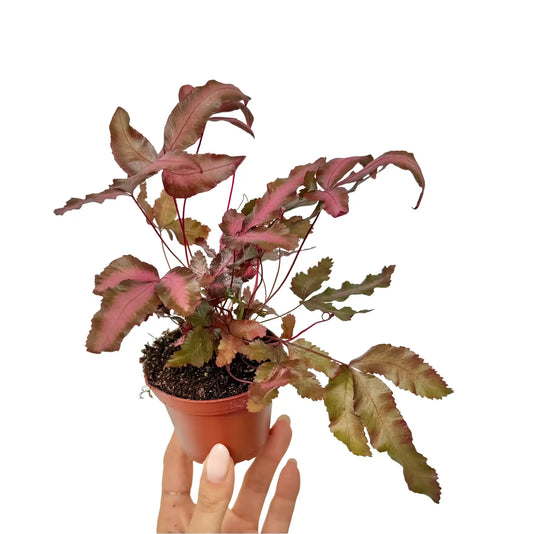
| Phlebodium aureum 'Blue Star' | A related fern with blue-green, lobed fronds and a more sculptural shape |
| Asplenium 'Crispy Wave' | A related fern with a rosette of undivided, wavy fronds and a striking look |
🎨 Which plants pair well with a Boston fern?
Boston ferns share their needs with plants that like soft light and humid air. They make a classic pairing with spider plants in hanging planters: see our Chlorophytum (spider plant) care guide, or our non-toxic plant assortment with Phlebodium.
To compare it with a false fern, read our Asparagus profile: its feathery foliage comes from cladodes, not fronds. Maranta also enjoys humid air and soft water.
To group these plants around a source of humidity, follow our guide to increasing air humidity; and before reaching for the spray bottle, read Misting: useful or not?.
⚠️ Is the Boston fern toxic to cats and dogs?
No. The ASPCA (American Society for the Prevention of Cruelty to Animals) has a profile for the “Boston fern,” listed under the name Nephrolepis exalta bostoniensis, and classifies it as non-toxic to dogs and cats. NC State Extension also states that it is non-toxic to cats, dogs, and horses.
Some guides say it is toxic because of calcium oxalates, but that is not what these two sources indicate. As with any plant, chewing a large amount may upset a sensitive stomach; find more safe ideas in our guide to non-toxic plants for dogs.
✅ Our expert tips for success
Success with a Boston fern comes down to four things: bright, filtered light; a consistently moist root ball watered with soft water; humid air; and winter temperatures above 10 to 15°C, away from heaters. If the tips turn brown, first consider dry air, then fertilizer. And when it outgrows its space, let its runners provide you with new plants in spring.
I love the Boston fern for its generous, almost theatrical look as its fronds spill down from a hanging planter. At my home, it looks its best in the bathroom, away from the living room radiators. My advice: don’t try to mist it every day; focus instead on its location and water, and it will reward you.

Laura Bruneau
Jardinière & autrice