

Indoor palm: which one to choose and how to care for it

The best indoor palm depends above all on your light: in a moderately lit room, choose the Kentia (Howea forsteriana), the most tolerant; for a small space or office, the Chamaedorea elegans, compact and happy in partial shade; near a bay window, the Areca (Dypsis lutescens), which requires a lot of light.
These three palms are classified as non-toxic to dogs and cats by the ASPCA (American Society for the Prevention of Cruelty to Animals).
Their care rests on a common trunk: light without scorching direct sun, consistent watering in summer and lighter in winter, balanced fertilizer, not too dry air, and a heart that is never cut. This guide helps you choose, comparing eleven "palmed" plants sold as palms, including four faux palms, then links to the detailed page for each species.
🌟 Why adopt an indoor palm
An indoor palm brings volume, height, and an exotic silhouette in a single plant, without requiring pruning.
Some species are also remarkably tolerant: the North Carolina State University Extension describes the Kentia as able to withstand low light, dust, central heating, and even a certain amount of neglect.
According to the RHS Chamaedorea growing guide, Chamaedorea has been a popular houseplant since Victorian times, and NC State Extension lists the Areca among the most popular indoor palms.
Another rare asset among large green plants: the three most common palms are safe for pets.
As for the air-purifying effect often highlighted, be cautious: the 1989 NASA study evaluated a system combining plants and an activated carbon filter through which air passed, far from a simple palm placed in a living room.
| Asset | What it changes |
|---|---|
| Immediate winter garden effect | Arching fronds that structure a living room, entryway, or office corner |
| No shaping pruning | Only dry fronds are removed, without ever touching the heart |
| Species for every light | From Kentia tolerating low light to Areca for very bright rooms |
| Pet-friendly | Kentia, Chamaedorea, and Areca are non-toxic to dogs and cats (ASPCA) |
📊 Types of indoor palms: the big comparison
Indoor palms are distinguished above all by their light requirements, their size, and the coolness they tolerate in winter. The table below brings together the guidelines from the RHS (Royal Horticultural Society) indoor palms guide, NC State Extension sheets, and the ASPCA for eleven plants sold as palms.
The first seven are true palms (Arecaceae); the last four only have the look. Rhapis, Livistona, and Caryota are now part of our selection; Phoenix roebelenii is mentioned to help you compare.
The winter temperatures for Kentia, Chamaedorea, and Areca exactly match those of their sheets; note that the RHS pages do not all agree for Chamaedorea (16 °C in the palm guide, about 13 °C on the genus page).
| Plant | Family | Light | Final size (source) | Winter: minimum | Cats and dogs |
|---|---|---|---|---|---|
| Kentia (Howea forsteriana) | Arecaceae, single stem | Tolerates fairly low light (RHS) | 8 to 12 m eventually, much less in a pot (RHS) | Nights around 16 °C (RHS) | Non-toxic (ASPCA) |
| Chamaedorea elegans | Arecaceae, clump of plants | Bright indirect, tolerates partial shade | 1.5 to 2.5 m at maturity (RHS), in a pot, generally 30 to 60 cm, up to 1.2 m over the years | Around 13 °C (RHS, genus page), never below 10 °C (RHS guide) | Non-toxic (ASPCA) |
| Areca (Dypsis lutescens) | Arecaceae, clump | Bright light essential (RHS) | 4 to 8 m eventually (RHS) | 13 °C minimum, ideally above 15 °C (RHS) | Non-toxic (ASPCA) |
| Rhapis excelsa (bamboo palm) | Arecaceae, clump | Supports deep shade (NC State) | About 1.2 to 3.6 m (4 to 12 feet, NC State) | 10 to 15 °C (RHS) | Non-toxic to cats, dogs, and horses (NC State) |
| Phoenix roebelenii (dwarf date palm) | Arecaceae, single stem | Medium to high, without scorching afternoon sun (NC State) | About 1.5 to 1.8 m indoors (5 to 6 feet, NC State) | No frost or cold drafts (NC State) | Non-toxic (NC State); spines at the base of the fronds |
| Caryota mitis (fish tail palm) | Arecaceae, clump | Medium light indoors (NC State) | About 4.5 to 7.5 m in the ground (NC State) | Poor cold resistance (NC State) | Toxic fruits, irritating to the mouth (NC State) |
| Livistona chinensis (Chinese fan palm) | Arecaceae, fan-shaped fronds | Light shade or full sun (UF IFAS) | About 9 m in the ground (30 feet, UF IFAS) | Down to about -7 °C in the ground (20 °F, UF IFAS) | No veterinary data found; thorny petioles in young specimens (UF IFAS) |
| yucca (faux palm) | Asparagaceae (POWO) | Full sun or very strong light | Much more compact in a pot (NC State) | Above about 10 °C (50 °F, NC State) | Toxic (ASPCA, saponins) |
| Beaucarnea (elephant foot) (faux palm) | Asparagaceae with a caudex (see its sheet) | Full sun or maximum light (see its sheet) | Swollen base (caudex) that stores water | About 10 °C according to NC State (see its sheet) | Non-toxic (the ASPCA (Pony Tail sheet)) |
| Dracaena (faux palm) | Asparagaceae (POWO) | Bright indirect | Varies by species | Never below 10 to 15 °C (Dracaena sheet) | Toxic (ASPCA, saponins) |
| Cycas revoluta (faux palm) | Cycadaceae, gymnosperm (NC State) | Filtered light, 4 to 6 hours per day indoors (NC State) | Very slow: up to 50 years or more for about 3 m (NC State) | Frost-free recommended; does not survive below about -9 °C (15 °F, NC State) | Very toxic: cycasin (ASPCA) |
📋 Quick technical sheet
The common care trunk of true indoor palms, according to the RHS guide and American universities.
| Reference | The rule |
|---|---|
| Light | Bright without scorching sun; Kentia and Chamaedorea tolerate less, Areca requires more |
| Summer watering | Substrate that never dries out completely, without standing water (RHS) |
| Winter watering | Let the surface dry slightly before watering (RHS) |
| Fertilizer | Every 2 weeks from April to mid-September (RHS); lighter for Areca |
| Humidity | Wet clay pebble tray, grouped plants, away from the radiator |
| Winter temperature | From 10 to 16 °C minimum depending on the species (see comparison) |
| Repotting | Every 2 years in early spring, if the pot is full of roots (RHS) |
| Pruning | Cut dry fronds, never pull them out; never cut the head (UF IFAS) |
| Pests | Mealybugs, powdery mealybugs, spider mites (RHS) |
How to choose your indoor palm in 6 steps
To choose an indoor palm, start with your room rather than the plant: measure the actual light, the available space, the lowest winter temperature, then check for pets and your budget. This method avoids a classic mistake: an Areca placed in a dark corner, which yellows in a few months.
The six steps below will lead you to the suitable species, then to its detailed sheet.
| Step | The right move |
|---|---|
| 1. Observe the light | Very bright room (bay window): Areca; medium light or corner away from the window: Kentia or Chamaedorea |
| 2. Measure the space | Shelf or desk: Chamaedorea; living room corner: Kentia or Areca in a 17 to 21 cm pot |
| 3. Check the winter | Room that drops to 13 °C: Areca (if bright) or Chamaedorea; for Kentia, the RHS recommends nights around 16 °C |
| 4. Think about pets | Cat or dog: a non-toxic true palm (Kentia, Chamaedorea, Areca) rather than a yucca, Dracaena, or Cycas |
| 5. Set the budget | Start with a young plant: slow growth, but a gentler purchase price |
| 6. Prepare the welcome | Drained pot, tray to empty, wet pebble tray, location away from the radiator |
columns: 4
columns_mobile: 2
-

 Livraison offerte
Howea Forsteriana - Kentia Palm - 17cm Pot - Height 70-75cm
Regular price From 64,95 €Regular price -

 Livraison offerte
Howea Forsteriana - Kentia Palm - 19cm Pot
Regular price From 69,95 €Regular price -

 Livraison offerte
Chamaedorea elegans - Pet-friendly - 12 cm pot - Height 15 cm
Regular price From 39,95 €Regular price -

 Livraison offerte Sale
Dypsis Lutescens Areca - 21cm Pot - Height 90 - 100cm
Regular price From 69,95 €Regular price74,95 €Sale price From 69,95 €Livraison offerte Sale -

 Livraison offerte
Rhapis excelsa - Bamboo palm - 27cm pot - Height 120cm
Regular price 194,95 €Regular price -

 Livraison offerte
Livistona chinensis - Chinese Fan Palm - 24cm Pot - Height 100cm
Regular price 109,95 €Regular price -
 Livraison offerte
Livistona rotundifolia - Round-leaved palm - 17cm pot - Height 70cm
Regular price 59,95 €Regular price -

 Livraison offerte
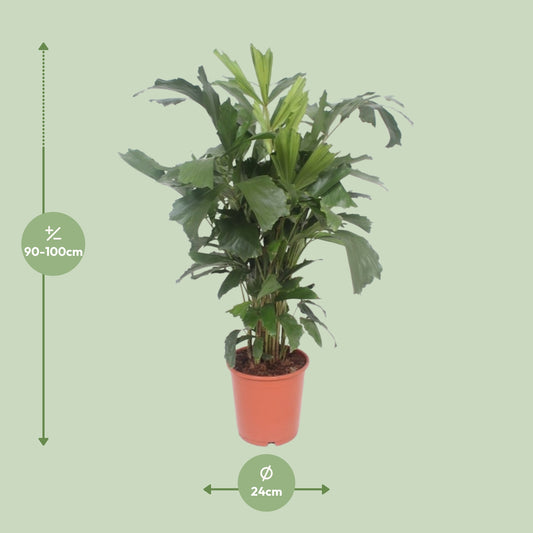
Caryota mitis - Fishtail palm - 24cm pot - Height 110cm
Regular price 119,95 €Regular price


🧭 Which indoor palm to choose according to your situation
The right indoor palm is the one that matches your situation: a poorly lit room, small space, pets, or large bay window do not lead to the same choice. This table summarizes our recommendations, each supported by the comparison guidelines.
For dark rooms, our guide to plants for dark rooms and that of plants for north exposure offer other companions.
| Your situation | Our choice |
|---|---|
| Poorly lit room, north exposure | Kentia, the most tolerant of fairly low light according to the RHS; failing that, the Chamaedorea |
| Small space, office, shelf | Chamaedorea elegans, with 30 to 60 cm fronds (RHS) |
| Bright bay window | Areca, which needs a lot of light, sheltered from direct sun through the glass |
| Cat or dog at home | Kentia, Chamaedorea, or Areca, all non-toxic according to the ASPCA; avoid yucca, Dracaena, and especially Cycas |
| Cool room in winter (around 13 °C) | Areca if the room is bright (13 °C minimum, RHS) or Chamaedorea (about 13 °C according to the RHS genus page); for Kentia, the RHS recommends nights around 16 °C while saying it is tolerant of coolness |
| Want a large specimen right away | Kentia or Areca in a large pot: slow growth makes large specimens valuable |
| Small budget | Young Chamaedorea or young Areca in a 12 cm pot, to grow |
| Palm for the garden | None of these palms: choose the hemp palm (Trachycarpus), much more hardy |
📐 True and faux indoor palms: how to distinguish them
A true palm belongs to the Arecaceae family; many plants sold as "indoor palms" are not part of it.
According to Plants of the World Online (POWO), the database of the Royal Botanic Gardens, Kew, the indoor yucca (Yucca gigantea, sold under the name Yucca elephantipes) belongs to the Asparagaceae family, just like the Dracaena genus, which counts 224 species.
The Cycas revoluta, for its part, is not even a flowering plant: NC State Extension specifies that it is not a true palm but a gymnosperm in the Cycadaceae family, which bears cones like pines.
We sell it (for example, our 15 cm potted Cycas revoluta) for its appearance: keep it in homes without pets or young children.
In contrast, the Beaucarnea (elephant foot), another faux palm in the Asparagaceae family, is classified as non-toxic to dogs and cats by the ASPCA (Pony Tail fact sheet).
This distinction is not just a matter of botany.
Faux palms have different needs: the yucca wants full sun and infrequent watering, and its trunk can be trimmed and propagated by cuttings, which is impossible with a true palm.
Above all, they are not equally toxic: the ASPCA classifies yucca and Dracaena as toxic to dogs and cats due to their saponins, and the ASPCA Sago Palm fact sheet notes the cycasin in Cycas, which can cause liver damage and death if ingested.
📐 Indoor palms and cats: which ones are safe
Yes, several indoor palms are safe for cats: the ASPCA classifies Kentia, Chamaedorea (Parlor Palm fact sheet) and Areca as non-toxic to dogs and cats.
For Rhapis excelsa and Phoenix roebelenii, the NC State Extension Rhapis excelsa fact sheet and the NC State Extension Phoenix roebelenii fact sheet also indicate that they are not toxic to cats, dogs, or horses; however, beware of the very sharp spines that arm the base of the Phoenix fronds.
Two exceptions to know: the NC State Extension Caryota mitis fact sheet notes that the fruits of the fish tail palm contain calcium oxalate crystals, which irritate the mouth, and that Cycas, a faux palm, is highly toxic.
Finally, a cat can chew on the soft leaflets of a non-toxic palm: this damages the foliage without poisoning the cat.
Discover our selection of pet-friendly plants, our complete list of non-toxic plants for cats and our guide to non-toxic plants for dogs.
📐 Never cut the top off a palm
Never reduce the height of a palm by cutting off its top.
According to the University of Florida Institute of Food and Agricultural Sciences (UF IFAS), each palm stem has only one apical meristem, unlike deciduous trees which have several: when this bud is damaged, growth stops and the palm usually dies.
In single-stemmed palms like Kentia, the entire plant is lost.
In clumping palms (Areca, Chamaedorea, Rhapis), only the cut stem stops growing. If your palm becomes too large, the only solution is to find it a higher location, or to choose a more compact species when buying.
🗓️ Caring for an indoor palm through the seasons
The care of an indoor palm follows the rhythm of the seasons: growth and fertilizing from spring to late summer, relative rest in winter. According to the RHS, water in summer so that the substrate never dries out, let the surface dry slightly in winter, and feed every two weeks from April to mid-September.
Areca is an exception: the UF IFAS production note on Areca says it is more sensitive to soluble salts than most green plants, and the RHS Areca fact sheet recommends only 2 or 3 fertilizer applications per season.
Repotting is done every two years in early spring, only if the pot is full of roots, up to 20 to 30 cm pots; in other years, replace about 5 cm of topsoil.
📅 Seasonal care calendar
| Season | Key action |
|---|---|
| 🌸 Spring | Repotting or top-dressing if the pot is full of roots, resume fertilizing in April, more regular watering |
| ☀️ Summer | Substrate never dry, fertilize every 2 weeks (2 to 3 times per season for Areca), monitor for spider mites |
| 🍂 Autumn | Stop fertilizing in mid-September, spaced watering, bring in palms that were outside before cool nights |
| ❄️ Winter | Surface slightly dry before watering, moist pebble tray, 10 to 16 °C minimum depending on the species |
🐛 Brown tips, yellow leaves: mistakes to avoid
Brown tips on an indoor palm most often come from a lack of water or too dry air, sometimes from a shock or draft, as the RHS reminds us, and in Areca from an excess of salts.
For yellow leaves, the RHS distinguishes the occasional yellowing of lower fronds, which is normal aging, from marked yellowing of several fronds, often due to a lack of water; in Areca, a lack of light also makes it yellow.
Regarding pests, the RHS mentions mealybugs, powdery mealybugs, and sometimes spider mites, favored by dry air and heating. Here are the mistakes we see most often, and how to correct them.
| Mistake | Why it's a problem | The solution |
|---|---|---|
| Cutting off the top to limit height | Only one terminal bud per stem: the stem, or the entire plant, dies (UF IFAS) | Choose a species suited to the available height; only remove dry fronds |
| Placing an Areca in a dark corner | It needs a lot of light (RHS): it becomes leggy and yellow | Move it closer to a large veiled window, or choose a Kentia for this spot |
| Letting the root ball dry out in summer | Leading cause of brown tips with dry air (RHS) | Water as soon as the surface dries in summer, moist pebble tray, away from the radiator |
| Misting to humidify | Very brief effect, which does not correct the dry air of a heated room | Moist clay pebble tray and grouped plants |
| Overdoing fertilizer | Salts burn the roots and the tips of the leaflets, especially in Areca (UF IFAS) | Follow the doses, water copiously to rinse, no fertilizer in winter |
| Pulling out old fronds | It injures the stem and opens the door to diseases | Cut completely dry fronds with clean pruning shears, without pulling (RHS) |
| Repotting every year in a large pot | Too much potting mix stays wet and suffocates the roots | Repot every 2 years if needed, barely larger pot; otherwise top-dress |


🌿 Our indoor palms and their detailed fact sheets
This guide is the starting point: each palm has a complete fact sheet with its botanical identity, its step-by-step care, and its problem diagnosis. Here are our fact sheets and the sizes we offer, from young plant to living room specimen.
| Our selection | Why choose it |
|---|---|
| Kentia fact sheet (Howea forsteriana) | The most tolerant palm: fairly low light, dry air, slow growth |
| 17 cm potted Kentia (70 to 75 cm) or 19 cm potted Kentia | Our direct-from-grower Kentia to start with, or an intermediate size to decorate a living room corner or bedroom |
| Chamaedorea fact sheet (dwarf palm) | The small compact palm for offices and shelves, which divides in spring |
| 12 cm potted Chamaedorea elegans | Young plant around 15 cm, perfect on a desk |
| Set of 2 Chamaedorea Palm d'Or | Two 12 cm pots with plants 35 to 40 cm, for a fuller effect |
| Areca fact sheet (Dypsis lutescens) | The clumping palm for very bright rooms, sensitive to salts |
| 21 cm potted Areca (90 to 100 cm) | A clump of light green arched fronds, our most versatile Areca size |
| 12 cm potted Areca | Young Areca to start at a low price on a bright shelf |
| 27 cm potted Rhapis excelsa (120 cm) | The bamboo palm in a clump, the most shade tolerant according to NC State |
| 24 cm potted Livistona chinensis (100 cm) or 17 cm potted Livistona rotundifolia (70 cm) | Two palms with large fan fronds, for a bright room |
| 24 cm potted Caryota mitis (110 cm) | The fish tail palm with cut leaflets, in medium light (NC State) |
| All our indoor palms | The complete collection, from the 15 cm Chamaedorea to the large Kentia |
| Beaucarnea (elephant foot) | The faux palm with a swollen trunk for sunny windows, non-toxic to cats according to the ASPCA |
| hemp palm (Trachycarpus fortunei) | For the garden: the hardy palm, not to be confused with indoor palms |
🔑 Indoor palm or outdoor palm
In most regions of France, an indoor palm does not make it through the winter outside: Kentia requires nights around 16 °C and Areca at least 13 °C according to the RHS. It can, however, enjoy a stay in the shade on a terrace from June to September, and the RHS also advises to ventilate the Kentia well in summer or take it out.
For a palm in the ground, turn to the hemp palm (Trachycarpus fortunei), designed for the garden. And to complete a green corner inside, browse our large and medium plants, our shade plants or all our indoor plants.
✅ Our tips for a successful indoor palm
To succeed with an indoor palm, first choose it according to your light: Kentia for medium rooms, Chamaedorea for small spaces, Areca for very bright rooms. Then give it regular watering in summer and lighter in winter, fertilizer in the right dose from April to mid-September, a moist pebble tray against dry air, and never cut its heart.
At the first sign of dull, speckled fronds, think spider mites; for watering, rainwater limits limescale deposits. Finally, if you have just bought your palm, read our guide to find out when to repot a plant after purchase: a palm is rarely repotted.
When I am asked which indoor palm to choose, I always ask the same question: "where will it live?". In the vast majority of cases, the Kentia is the safest answer, and the Chamaedorea when space is limited. I reserve the Areca for really bright rooms, because it is the one that yellows the fastest when light is lacking. And I remind you that a yucca or a Dracaena are not palms: for a house with a cat, the difference matters.

Laura Bruneau
Jardinière & autrice


