

Schefflera arboricola (dwarf umbrella tree): care, pruning and propagation by cuttings

To care for a Schefflera, place it near a bright window with filtered sunlight, water thoroughly, then let the potting mix dry out almost completely before watering again, and keep it above around 15°C (59°F) in winter. This famous umbrella tree, sold under the name Schefflera arboricola, is now known by the accepted name Heptapleurum arboricola.
It is one of the most tolerant houseplants on the market, but it has an Achilles' heel: extremes, both of water and drought, which result in dramatic leaf drop. This guide brings together proven guidelines from botanical gardens and universities, followed by practical steps to keep the plant dense, well-branched, and healthy.
🌿 Why choose a Schefflera for your home
The Schefflera combines a structured shrub-like form with great tolerance for indoor conditions. Each compound leaf brings together 7 to 9 leaflets arranged in a star shape, like the ribs of an umbrella, hence its nickname umbrella tree. It tolerates less intense light than many tropical plants, grows steadily, and takes pruning very well.
It comes in deep green or cream or yellow variegated versions, allowing it to match all styles of décor.
| Strength | What this means for your home |
|---|---|
| Graphic palmate foliage | A miniature tree silhouette that structures a living room or office |
| Great tolerance | Tolerates medium light and occasional missed waterings better than most tropical plants |
| Easy to prune | You control its height and make it bushier by cutting back the stems |
| Easy to propagate | Semi-hardwood cuttings or air layering to obtain new plants |
🔎 The Schefflera ID card
According to Plants of the World Online (POWO) from the Royal Botanic Gardens, Kew, the accepted name of the species is Heptapleurum arboricola Hayata; Schefflera arboricola is now a synonym, still used in trade. This database describes it as a climbing shrub from the humid tropical forests of Taiwan and Hainan.
The large umbrella tree, formerly Schefflera actinophylla, is itself linked to Heptapleurum actinophyllum according to the POWO record for Heptapleurum actinophyllum, with a natural range from southern New Guinea to northern Australia.
The Missouri Botanical Garden specifies that indoors arboricola generally remains between 0.9 and 1.8 m, while it reaches 3 to 7.5 m in the ground in a tropical climate.
| Criterion | Verified detail |
|---|---|
| 🏷️ Botanical name | Heptapleurum arboricola (syn. Schefflera arboricola) |
| 🧬 Family | Araliaceae, like ivy |
| 🌳 Type | Evergreen shrub, climbing in nature |
| 🌍 Origin | Taiwan and Hainan Island (China), humid tropical forests |
| 🍃 Foliage | Palmate leaves of 7 to 9 shiny leaflets of 5 to 11 cm |
| 🌸 Flowering | Tiny flowers in panicles, rare indoors |
| 📏 Size | 0.9 to 1.8 m indoors, much more in a tropical climate |
| ⚠️ Toxicity | Toxic to dogs and cats (calcium oxalates) |
📋 Quick technical sheet
The essential care guidelines, gathered at a glance.
| Parameter | Guideline |
|---|---|
| Light | Bright and filtered, east, west or south window with a blind |
| Watering | Thoroughly, then let dry out almost completely; space out in winter |
| Potting mix | Rich and well-draining potting soil for houseplants |
| Humidity | High humidity appreciated: humidifiers, tray of wet pebbles |
| Temperature | Not below around 15°C (60°F) in winter |
| Repotting | In spring, when the roots fill the pot |
| Fertilizer | Balanced liquid fertilizer once a month during growth |
| Toxicity | Toxic to dogs and cats, sap is irritating |
| Difficulty | Easy, if you avoid excess water |
📍 Where to place a Schefflera and what light
Place your Schefflera in front of an east, west or south-facing window, behind a blind: the Missouri Botanical Garden recommends 3 to 4 hours of filtered sunlight per day and advises against direct rays, which burn the leaflets.
A location that is too dark produces stretched and bare stems, a location exposed to full sun behind glass leaves dry patches on the leaves. Variegated forms require the brightest place in the house to maintain their marbling.
☀️ Ideal: East or west window, or south bay window with a blind, one meter from the glass
🌥️ Acceptable: Bright room without direct sunlight: slower growth, longer internodes
🚫 To avoid: Dark corner, radiator, cold draft from an open door or window in winter
🪴 Repotting a Schefflera: potting mix and method
The Schefflera grows well in standard potting soil for houseplants, as RHS (Royal Horticultural Society) points out; the Missouri Botanical Garden specifies that the mix must be well-draining.
Repot in spring when the roots cover the root ball or protrude through the drainage hole, in a pot just slightly larger: too large a volume of soil stays damp for a long time and promotes root rot. A pot with holes is essential; never let water sit in the saucer or cachepot.
| Step | The right action |
|---|---|
| 1. Choose the time | In spring, at the start of new growth |
| 2. Prepare the pot | A container with holes, just slightly wider than the old one |
| 3. Prepare the mix | Potting soil for houseplants lightened with a handful of perlite |
| 4. Place the root ball | At the same depth as before, without burying the crown |
| 5. Water and let rest | Water thoroughly, drain, then return to filtered light |
columns: 4
columns_mobile: 2
-

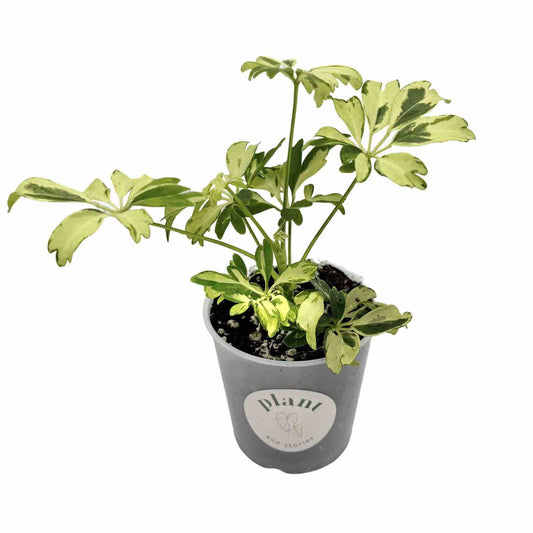 Sold out
-

 Livraison offerte
Schefflera Arab Nora - 21cm Pot - Height 70cm
Regular price From 74,95 €Regular price -

 Livraison offerte
Schefflera Gold Capella - 21cm Pot - Height 70-81cm
Regular price From 64,95 €Regular price -

 Livraison offerte
Schefflera Nora - 21cm Pot - Height 70-82cm
Regular price From 64,95 €Regular price


✂️ Schefflera care: watering, fertilizer and pruning
Schefflera care relies on thorough watering followed by almost complete drying of the potting mix, as recommended by the Missouri Botanical Garden. During growth, RHS recommends a balanced liquid fertilizer once a month; in winter, water sparingly and omit fertilizer.
The plant appreciates high ambient humidity: the Missouri Botanical Garden suggests misting the foliage and placing the pot on a tray of wet pebbles, without the bottom of the pot being submerged.
💧 Watering: Water thoroughly when the potting mix has almost dried out, empty the saucer after a few minutes
🌱 Fertilizer: Balanced liquid fertilizer once a month from spring to the end of summer
💧 Humidity: Misting and tray of wet pebbles, especially near heating
🧹 Cleaning: Wipe the leaflets to remove dust and spot pests early
✂️ Pruning: Cut back in spring just above a leaf to encourage branching
🍂 Pruning a Schefflera that is too tall and caring for it through the seasons
To prune a Schefflera that is too tall, cut the main stem in spring just above a leaf attachment point, at the desired height: new shoots will grow from the cut and the plant will become bushier. RHS classifies this shrub in its pruning group 1, that is, light pruning, and the Missouri Botanical Garden simply advises pruning to control the size.
Classified H1c by RHS, it can spend the summer outdoors sheltered from direct sunlight, but must come inside before the nights cool down. In winter, watering is significantly spaced out and the plant is kept warm, away from cold glass.
📅 Care calendar by season
| Season | Key action |
|---|---|
| 🌸 Spring | Repotting if needed, pruning back, resuming monthly fertilizer, taking cuttings |
| ☀️ Summer | Regular watering after drying out, possible outdoor placement in partial shade, monitoring for spider mites |
| 🍂 Autumn | Bring inside before cool nights, stop fertilizing, space out watering |
| ❄️ Winter | Sparingly watering, minimum 15°C, increased ambient humidity, no fertilizer |
🌱 Propagating a Schefflera: cuttings and air layering
RHS indicates three methods of propagation: sowing, semi-hardwood cuttings and air layering. To take a Schefflera cutting, take in spring or summer the tip of a semi-hardwood stem bearing a few leaves, remove the lower leaves and plant it in a light mix kept just moist, in warmth and bright light without direct sunlight.
Air layering is suitable for bare plants: make an incision in the stem, wrap it in damp sphagnum moss under a film, then sever the new plant once roots are visible.
🐛 Common problems: causes and solutions
Leaf drop is the number one problem for Schefflera, and the Missouri Botanical Garden first explains it by a potting mix that is too damp or too dry. Regarding pests, RHS cites the greenhouse spider mite, mealybugs and scale insects; the Missouri Botanical Garden adds aphids and thrips, with mites being encouraged by dry air.
| Symptom | Probable cause | Solution |
|---|---|---|
| Leaves turning yellow then dropping in large numbers | 💧 Excess water, waterlogged potting mix, stagnant water | Let dry out, empty the saucer, repot in a draining mix if the roots are brown |
| Dry brown leaves dropping | 💧 Prolonged lack of water or very dry air | Water thoroughly as soon as the potting mix has almost dried out, increase humidity |
| Sudden leaf drop after moving | ❄️ Change in light, cold draft | Stabilize the location, keep away from open doors and windows |
| Stretched stems, plant bare at the bottom | ☀️ Lack of light | Move closer to a filtered window and cut back to encourage branching |
| Fine webs, dull leaves with pinholes | ⚠️ Spider mites encouraged by dry air | Shower the foliage, humidify, treat early |
| White cottony clusters, sticky leaves | 🐛 Mealybugs or scale insects | Remove with cotton soaked in alcohol, isolate the plant, treat |


🌸 Our Schefflera varieties
NC State Extension lists notably the 'Compacta', 'Gold Capella' and 'Variegata' cultivars. Here are the Schefflera arboricola we offer, from deep green to variegated forms.
| Variety | Its strength |
|---|---|
| Schefflera 'Nora' | Deep green and glossy palmate foliage, architectural form, delivered in a 21 cm pot |
| Schefflera 'Arab Nora' | Deep green leaflets arranged in a star shape, 70 cm plant in a 21 cm pot |
| Schefflera 'Gold Capella' | Glossy green leaflets variegated with golden yellow, for a very bright room |
| Schefflera arboricola 'Janine' | Irregular green and cream variegation, young plant in a 9 cm pot |
| Schefflera 'Compacta' | Compact form with a dense habit, ideal for a smaller interior |
| Variegated Schefflera arboricola ('Variegata') | Green foliage marbled with cream and pale yellow, to place in full filtered light |
🎨 What plants to pair with your Schefflera
The Schefflera makes a successful duo with other indoor trees with distinctive foliage, which share its needs for filtered light and measured watering.
The Pachira, the money tree brings a braided trunk and broader palmate leaves, the Ficus a glossy, solid leaf, and the Strelitzia, the bird of paradise an even more exotic touch for a very light shade.
Grouped together, these plants create a slightly more humid microclimate, which is beneficial for each of them. To prevent typical Schefflera pests, check out our guides on spider mites and mealybugs.
⚠️ Is Schefflera toxic to cats and dogs?
Yes: the ASPCA (American Society for the Prevention of Cruelty to Animals) classifies Schefflera as toxic to dogs and cats due to its calcium oxalate crystals.
When chewed, it causes irritation and a burning sensation in the mouth, lips, and tongue, excessive salivation, vomiting, and difficulty swallowing.
For the large umbrella tree (actinophylla), its "Umbrella Tree" sheet mentions terpenoids, saponins, and insoluble oxalates, most often resulting in mild vomiting and diarrhea.
The NC State Extension considers this risk to be low, but also notes that the sap can irritate sensitive skin: wear gloves when pruning and keep the plant out of reach of pets and young children.
✅ Our expert tips for success
A successful Schefflera comes down to three rules: bright but filtered light, thorough watering followed by letting it dry out completely, and a stable temperature above around 15°C (59°F) in winter. Add a monthly fertilizer in spring and summer, prune it back as soon as it gets leggy, and keep a close eye out for spider mites when the air gets dry.
If the leaves fall off, check the moisture of the potting mix first before doing anything else: in the vast majority of cases, that's the answer.
I love Schefflera for its generosity: it's often the first plant I recommend to people who think they don't have a green thumb. In my experience, almost all the leaf drop I'm told about comes from a saucer full of water or a recent move of the plant. I don't hesitate to prune it back thoroughly in the spring: it always grows back bushier. And I reserve variegated varieties like 'Gold Capella' for the brightest rooms in the house.

Laura Bruneau
Jardinière & autrice


