Skip to product information
1 of 2

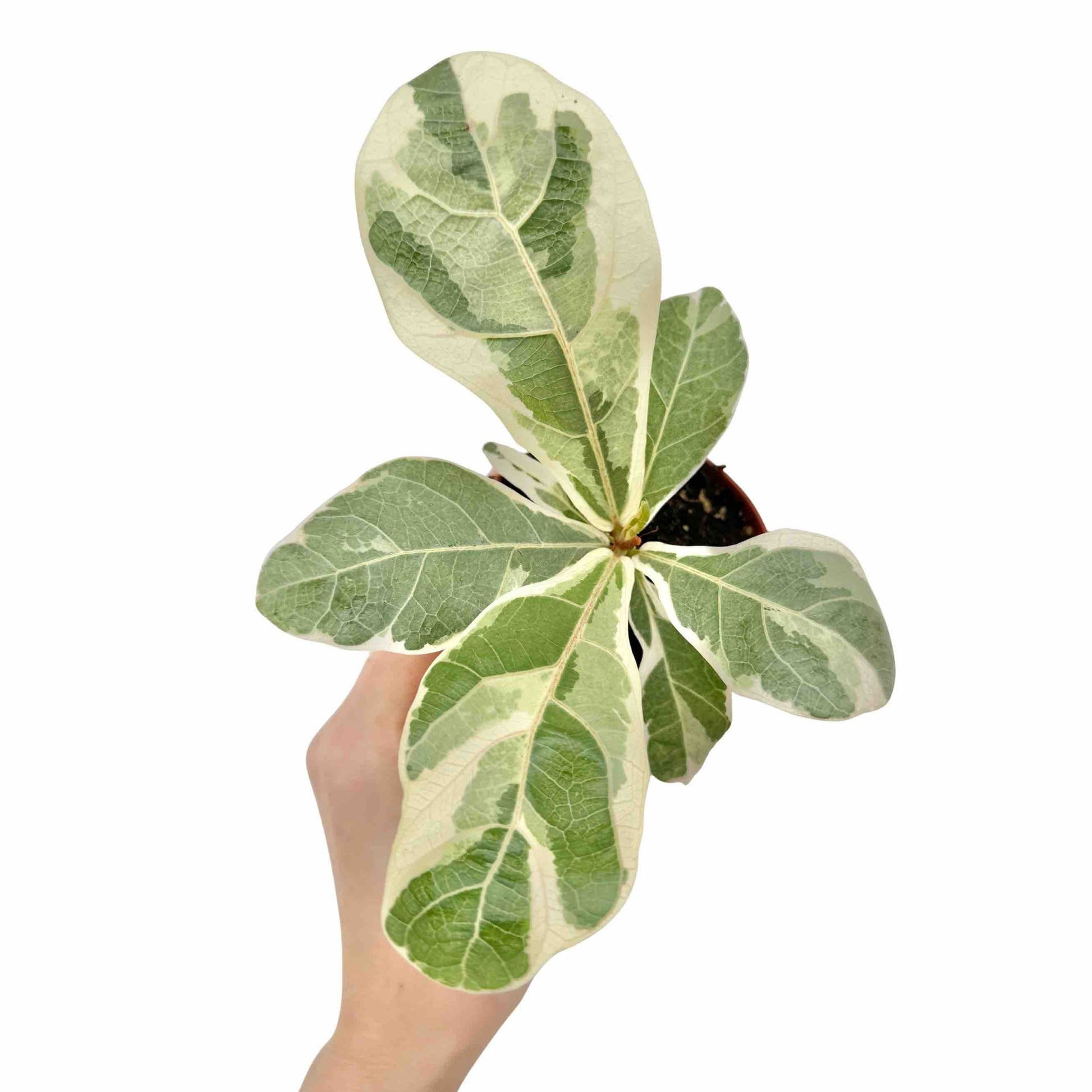
Ficus Lyrata Variegata

Ficus Lyrata Variegata

Exceptional variegated foliage

Regular price 29,95 €
Regular price 39,95 € Sale price 29,95 €
BLACK FRIDAY -20 % Sale Sold out -25%
Taxes included. Shipping calculated at checkout.
29,95 € 23,96 €
Black Friday -20%
Pot diameter
Quantity

Pay in 2, 3 or 4 interest-free installments from €50 with Klarna

Low stock: 1 left

  • Careful delivery with optimal protection
  • Plant health guaranteed for 30 days
Une question ? Nos experts vous répondent 01 89 48 03 62

About

Ficus Lyrata Variegata, the lyre fig tree with variegated foliage

Ficus lyrata 'Variegata' is a rare and highly sought-after form of the fiddle-leaf fig, native to the tropical forests of West and Central Africa. Belonging to the Moraceae family, this ficus can reach 1.5 to 2 meters in height indoors, with slow but steady growth. Like its parent species, it naturally adopts a slender, tree-like form, producing the large, violin-shaped leaves characteristic of the genus.

What distinguishes the Ficus Lyrata Variegata is its spectacular variegated foliage , where each leaf reveals a unique interplay of dark green and cream to ivory patches, never identical from one leaf to the next. The leathery, slightly puckered texture of its large leaves gives them a remarkable sculptural presence. This Ficus is known for its slow growth , making it a stable plant that is easy to integrate into an interior without quickly taking up too much space.

Adopt the Ficus Lyrata Variegata today and give your home evergreen foliage of exceptional botanical rarity.

Description

Maintenance tips

Guarantee

Commandez en toute sérénité 💚

Nos plantes d'intérieur, nos plantes d'extérieur et nos bulbes sont garantis 30 jours à compter de la réception.
Nos plantes sont rigoureusement sélectionnées, en pleine santé, acclimatées et expédiées dans un emballage pensé pour leur protection. Si un aléa survient pendant le transport, notre équipe est là pour vous accompagner.

  1. 💌 Comment bénéficier de la garantie ?
    1. À la réception, sous 48 h : envoyez une photo de votre plante entière à sav@plantandstories.com, avec votre numéro de commande. Même si elle est en parfait état, cette photo est obligatoire : elle active votre garantie de 30 jours et nous permet de vous conseiller dès l'arrivée. Si la plante est abîmée, ajoutez une photo du dégât.
    2. Pendant 30 jours : si votre plante dépérit, écrivez-nous à la même adresse avec des photos et votre numéro de commande.
    3. Nous étudions votre situation et convenons avec vous d'une solution : plante équivalente, avoir, remboursement partiel ou total 💚

Conditions : la plante n'a pas été rempotée et se trouve dans son pot d'origine ; son exposition et son arrosage ont respecté sa fiche d'entretien. Les plantes livrées dans une consigne ou un casier automatique ne sont pas couvertes.

Plantes d'extérieur et bulbes : la garantie s'applique jusqu'à leur plantation. Une fois plantés en pleine terre ou dans un autre contenant, ils ne sont plus couverts. Envoyez-nous votre photo de réception avant de planter.

🧺 Un accessoire défectueux ou non conforme ?
Envoyez une photo et votre numéro de commande à la même adresse. Vous choisissez le remplacement ou la réparation ; si ce n'est pas possible, nous vous remboursons. Tous les frais sont à notre charge.

Cette garantie s'ajoute aux garanties légales. Tous les détails sont dans notre politique « Garantie, retours et remboursements ».

Shipping

Vos plantes et accessoires livrés avec soin 🌿

📦 Quand votre commande part-elle ?
Plantes : expédiées du lundi au mercredi, pour ne pas rester bloquées en transit le week-end.
Accessoires : expédiés du lundi au vendredi.
Plantes et accessoires commandés ensemble : un seul colis, expédié du lundi au mercredi.
Par grand froid ou forte chaleur, nous pouvons décaler l'envoi des plantes de quelques jours pour les protéger. Nous vous prévenons alors par e-mail.

🚚 Qui livre votre colis ?
Commandes préparées par notre équipe : UPS.
Produits « direct producteur » : DPD, puis livraison chez vous par Chronopost, qui vous propose la veille plusieurs options (dont le point relais). Pour une plante, évitez les consignes automatiques (Pickup Station), où notre garantie de 30 jours ne s'applique pas.
Votre numéro de suivi vous est envoyé par e-mail. Vous le retrouvez aussi dans votre espace client, sur la page de votre commande.

⏱ En combien de temps ?
Une fois le colis remis au transporteur :
France continentale : 1 à 2 jours ouvrés
Corse : 3 à 5 jours ouvrés
Union européenne : 24 à 48 h à domicile, 24 à 72 h en point relais
Suisse : 3 à 5 jours ouvrés

💶 Combien ça coûte ?
France continentale : point relais 7,50 €, offert dès 100 € d'achat ; domicile 9,99 €.
Produits « direct producteur » : livraison offerte, à domicile, en France continentale (hors Corse), en Belgique, en Allemagne et aux Pays-Bas.
Autres destinations : tous les tarifs sont dans notre politique d'expédition. Le montant exact s'affiche au moment du paiement.

📸 À la réception
Envoyez sous 48 h une photo de votre plante à sav@plantandstories.com, avec votre numéro de commande : elle active votre garantie.

🌱 Plantes calées sur mesure, emballages recyclables.

🤝 Une question ?
sav@plantandstories.com ou 01 89 48 03 62, du lundi au vendredi de 9 h à 17 h.

View full details
  • Order prepared with love

  • Optimal protection

  • Quality plants

  • A team that is always attentive

Simple & reassuring

From the greenhouse to your living room

Ordering plants online is completely risk-free with us. Here is your worry-free journey.

1

You are ordering

100% secure payment, in full or in 3 interest-free installments with Klarna.

Risk-free
2

We prepare it by hand

Each plant is selected, inspected, and secured in suitable packaging.

Expert treatment
3

Ships within 24–48 hours

Ship at the beginning of the week to avoid having it stuck in transit over the weekend.

Fast delivery
4

Arrival guarantee

A problem with your delivery? Photos are all we need: we’ll replace it or refund you.

No stress
★★★★★9.99/10 from over 2,880 verified reviews

Already over 87,000 plants delivered with a smile

Ficus Lyrata Variegata

Propriétés des plantes

Ficus Lyrata Variegata


Luminosité
Bright indirect light
Arrosage
Let the surface dry between waterings
Difficulté de culture
Confirmed
Toxicité animaux
Toxic (cats, dogs)
Température idéale
18 to 24°C
Hauteur à maturité
100 to 180 cm
Emplacement conseillé
Bright living room, free from drafts
Humidité
Normal
Substrat
Well-draining potting mix for houseplants
Rempotage
Every 2 years
Fertilisation
Fertilizer, every 2-3 weeks
Croissance
Slow
Nom latin
Ficus lyrata 'Variegata'
Noms communs
Lyre fig, ficus lyrata
Famille botanique
Mulberries
Origine
Tropical West and Central-West Africa (Sierra Leone to Gabon)
Port
Erected
Forme du feuillage
Panduriform (violin-shaped)
Couleur du feuillage
Variegated, marbled dark green, cream and pale yellow
Couleur de floraison
(non-ornamental flowering, flowers inside the fig)
Feuillage
Persistent
Parfumé
No
Dépolluante
Yes

Your satisfaction is our priority

If you have any questions about the delivery of your package, or if anything is wrong upon its arrival, our team is here for you.

Feel free to contact us Monday through Friday, from 9 a.m. to 5 p.m., by phone at 01 89 48 03 62 or by email at sav@plantandstories.com.

We will do our utmost to find a solution quickly. 🌱

Help and solutions:

Everything you need to know Ficus Lyrata Variegata

What light exposure is best for my Ficus Lyrata Variegata?

The Ficus Lyrata Variegata thrives in bright, indirect light, ideally placed less than one meter from an east or west facing window, sheltered from direct sunlight.

Its cream and ivory variegation requires more light than the classic green Ficus lyrata: without sufficient light, the lighter areas tend to gradually shrink and growth slows further. In its natural habitat, this fig tree benefits from abundant but never scorching light filtered through the canopy of West African rainforests.

In summer, an east-facing window is ideal. In winter, move it closer to a south-facing window, using a sheer curtain if the sun is intense. Absolutely avoid dark corners or poorly lit hallways.

Important tip 🌿This Ficus is very sensitive to sudden changes in position: move it gradually to get it used to a new exposure, otherwise you risk losing several leaves at once.For dimly lit interiors, ourfull spectrum horticultural lampfaithfully imitates natural light, without harmful UV rays, to preserve the beauty of the variegation all year round.

Is Ficus Lyrata Variegata toxic to animals and children?

Ficus Lyrata Variegata is moderately toxic to cats, dogs and young children.

Like all Ficus species, it produces a viscous white latex that flows out when the leaves or stems are broken. This latex contains irritating compounds, including psoralens and ficins, which can cause skin, eye, or digestive reactions upon prolonged contact or ingestion.

If ingested by an animal or child, the most common symptoms are irritation of the mouth and throat, nausea, vomiting, or mild diarrhea. These symptoms are generally mild but require veterinary or medical attention if a significant amount is ingested.

What precautions should be taken on a daily basis?

Ideally, place your Ficus Lyrata Variegata out of reach of young children and pets, especially high up on a piece of furniture or in a room that is not easily accessible.

Wear gloves when pruning or repotting to avoid direct contact with the sap. With a few simple precautions, this variegated fiddle-leaf fig can easily coexist in a home with older children and well-supervised pets.

Why are the leaves of my Ficus Lyrata Variegata turning yellow?

The leaves of the Ficus Lyrata Variegata most often turn yellow due to overwatering, insufficient light, or a nutrient deficiency.

  • If the leaves turn yellow and become limp, the problem usually stems from excess water causing the beginning of root rot.
  • If the leaves gradually turn yellow while remaining firm and dry, the plant often lacks light or fertilizer.
  • If the yellowing is accompanied by small light spots, a dull appearance or fine webbing, it may be a mite infestation, common indoors, especially in dry atmospheres.

In Ficus Lyrata Variegata, the cream-colored variegated areas are naturally more fragile than the green areas: a lack of light primarily affects these lighter patches, which yellow and then brown before the rest of the leaf is affected. This behavior is specific to variegated forms of Ficus Lyrata and constitutes an early warning sign that should not be ignored.

Important tip 🌿One or two old leaves turning yellow from time to time is perfectly normal: it is part of the plant's natural cycle.On the other hand, there is cause for concern if several leaves turn yellow rapidly, if the phenomenon spreads to young leaves, or if growth slows down significantly.

In case of a mite infestation, prioritize ourplant-friendly biological treatments, effective and suitable for indoor use.

When and how should I repot my Ficus Lyrata Variegata?

Ficus Lyrata Variegata is ideally repotted in spring, between March and May, when growth resumes actively.

Repotting is necessary when:

  • The roots emerge through the drainage holes.
  • Growth is slowing significantly.
  • or that the substrate compacts too quickly after watering.

As a general rule, repotting every 2 years is sufficient for an adult plant.

Ficus Lyrata Variegata develops a robust but shallow root system: prefer a wide pot rather than a deep one, and avoid oversized containers which promote water accumulation at the bottom and the risk of rot.

Choose a pot 2 to 3 cm wider than the old one, and make sure it has drainage holes. Ourtransparent pots to monitor the rootsare ideal: their transparency allows you to easily observe root recovery after repotting, without disturbing the plant.

Prepare a well-draining and aerated substrate, suitable for tropical evergreen plants.We recommend ourwell-draining substrates enriched with biostimulantsdesigned to promote drainage, root oxygenation, and healthy long-term growth. For Ficus Lyrata Variegata, use ourEnriched substrate suitable for aerial roots, draining and nutritive.

  1. Gently remove the plant from its pot by tapping the pot to loosen the root ball without pulling on the stems.
  2. Gently loosen the roots if they are very compacted, without breaking them.
  3. Place a layer of substrate at the bottom of the pot, position the plant upright, then fill in without burying the crown.

Important tip 🌿After repotting, water thoroughly to help the potting mix settle around the roots and eliminate air pockets. Avoid moving the Ficus immediately afterward: this plant is particularly sensitive to environmental stress and needs stability to recover.

When and how should I fertilize my Ficus Lyrata Variegata?

Ficus Lyrata Variegata should be fertilized every 2 to 3 weeks from March to October, with a liquid fertilizer diluted in the watering water.

During autumn and winter, from November to February, significantly reduce or stop fertilizing. This is a period of dormancy during which the plant produces few or no new leaves.

Because of its variegation, the Ficus Lyrata Variegata has particular nutritional needs: the cream and ivory areas, devoid of chlorophyll, reduce the overall photosynthetic capacity of the plant, making a regular supply of micronutrients all the more important to maintain vigorous and well-coloured foliage.

A well-balanced intake promotes:

  • denser, more colorful foliage
  • steady growth,
  • and improved plant resistance.

👉 For best results, we recommend ourconcentrated fertilizer for houseplantsEasy to dose, with fast visible results. Practical tips are printed directly on the back of the label and on the product information sheet, for simple and hassle-free use.

Important tip 🌿Never fertilize Ficus Lyrata Variegata in a dry substrate: this could burn the roots.Water normally first, then apply diluted fertilizer 2 to 3 days later, when the soil is slightly moist. Excess fertilizer can cause leaf burn. Regular but moderate fertilization will keep your Ficus Lyrata Variegata vigorous and healthy 💚

How do I properly water my Ficus Lyrata Variegata?

Water the Ficus Lyrata Variegata when the substrate has dried out completely, approximately every 8 to 12 days in summer and every 12 to 18 days in winter. Use room temperature water.

The Variegated Ficus Lyrata is particularly sensitive to very hard water: regular watering with hard tap water can cause brown spots on the edges of the leaves and gradually alter the variegation. It is best to use filtered water or water that has been left to stand for a few hours before use.

How do I know when to water?

The finger test remains the most reliable method: insert your index finger into the substrate to a depth of 2 to 3 cm. If the substrate is dry, it's time to water. If it's still damp, wait a few more days.

Important advice:When in doubt, it's always better to wait a little longer than to overwater. Ficus Lyrata Variegata tolerates a slight lack of water better than an excess, which quickly leads to root rot that is difficult to treat.

How do I propagate my Ficus Lyrata Variegata?

Ficus Lyrata Variegata is propagated by stem cuttings in water or moist substrate, ideally in spring or early summer when the sap is actively circulating.

Preparing the cuttingSelect a healthy stem with at least one node and one or two well-developed leaves. Make a clean cut just below a node, using ourStainless steel blade pruning shears for taking cuttings without damaging the plantA clean cut reduces the risk of infection and promotes root development. After cutting, allow the white sap to air dry for 30 minutes before placing the cutting in a humid environment to prevent premature rotting. This step is essential for Ficus Lyrata Variegata, whose abundant sap can clog emerging root tissues.

  1. Prepare the cutting and allow the latex to air dry as directed.
  2. Place the cutting in ourtransparent pots to monitor root developmentin clear water changed every 5 to 7 days, or inlive sphagnum moss to maintain root moistureslightly damp but not soaked.
  3. Place the cutting in a warm, bright location, away from direct sunlight, at a stable temperature of at least 20°C.

Once the roots are well formed and reach 3 to 5 cm, transplant the cutting into ourwell-draining substrate for Monstera and Araceae, adapted to the needs of this large-leafed Ficus.

Important tip 🌿Ficus lyrata Variegata roots more slowly than the classic Ficus lyrata: allow 4 to 8 weeks depending on temperature and light. The first signs of success are the appearance of clearly visible white roots and the emergence of a new leaf bud. Maintain a stable temperature and avoid drafts throughout the rooting process.

Ficus Lyrata Variegata avec ses feuilles panachées de vert foncé et de blanc crème dans un petit pot noir

The essentials regarding Ficus Lyrata Variegata

Ficus Lyrata Variegata: identity and origin

Ficus Lyrata Variegata is one of the rarest and most sought-after forms of the fiddle-leaf fig, botanically namedFicus lyrata'Variegata'. Native to the tropical forests of West Africa, it is distinguished by its large, violin-shaped leaves, variegated with cream, ivory white, and deep green, each leaf creating a unique display. Its growth is slow to moderate, and it can reach 1.5 to 2 meters indoors over several years.

Ficus care: light, watering and substrate

The variegated fiddle-leaf fig requires bright, preferably indirect light to preserve the intensity of its variegation. Regular watering is essential, always after checking that the top two to three centimeters of soil have dried out completely, approximately every 10 to 14 days depending on the season. Sensitive to environmental changes, it dislikes frequent moving and cold drafts. Oursubstrate enriched with beneficial fungi that increase root absorptionIt is perfectly suited for evergreen and healthy foliage.

Where should you place your Ficus to preserve its variegation?

This variegated fig tree is particularly demanding in terms of light quality: insufficient exposure gradually dulls the light areas of its leaves.

  • South window:Bright light is ideal, but should be covered in summer.
  • Distance :50 cm to 1.5 meters from a large window
  • Temperature :between 18 and 26°C, without sudden variations
  • Stability:avoid movement and drafts
  • Dark room:OURfull spectrum horticultural lampmaintains the active variegation

Frequently asked questions: Why is my Ficus Lyrata Variegata losing its leaves?

Leaf loss is the most common reaction of the variegated fiddle-leaf fig to a change in conditions: moving, drafts, overwatering, or waterlogged soil are the main causes. Excess water leads to silent root rot, often mistaken for underwatering. After 2 to 3 weeks of acclimatization indoors, repotting in ourtransparent pots with integrated drainageallows you to monitor the condition of the roots directly. Complement with ourliquid fertilizer with complete nutrient balancerestarts leaf growth from spring onwards.

Buy the Ficus Lyrata Variegata at Plant and Stories

Our Ficus Lyrata Variegata is in stock and carefully shipped to ensure it arrives in perfect condition. Plant and Stories selects each specimen for the quality and clarity of its variegation, a rare characteristic for this variety.Anti-limescale microfiber gloves for leaf careare the ideal complement to reveal all the brilliance of the Ficus Lyrata Variegata.

Show moreShow less
👉 To learn more