Skimmia japonica (Japanese skimmia): planting and care

To grow Skimmia japonica successfully, plant it in partial shade or shade, sheltered from cold winds, in cool but well-drained soil. Water it during dry spells for its first two years, then let it grow with almost no pruning.
This evergreen shrub, also known as Japanese skimmia, is one of the stars of autumn and winter planters: the red buds of 'Rubella' and the berries of female plants add colour during the cold season, while its white flowers perfume the spring.
Two misconceptions, however, complicate its cultivation: believing that it requires ericaceous soil, and treating yellow leaves with iron when they are mainly suffering from too much sun or overly dry soil. Here are the guidelines verified by botanical gardens and universities for planting it in a bed or a pot.
🌿 Why skimmia is the winter shade shrub
Skimmia works when the garden is at rest. According to the RHS overview of the genus, it is an evergreen shrub of year-round interest, prized for its fragrant spring flowers and for the long-lasting red or white berries of female plants. The RHS adds that it is rarely damaged by deer or rabbits, a real asset in the countryside.
Its slow growth and naturally rounded shape make it a tidy shrub that stands well on its own, in a shaded border or in a pot on a north-facing balcony.
| Asset | What this means for you |
|---|---|
| Colour in the heart of winter | Red buds on males like 'Rubella', red berries on females, when the garden is bare |
| Made for shade | It thrives in partial shade or shade, where many flowering shrubs become leggy |
| Compact and maintenance-free | Slow growth, naturally neat shape: it stays in its space for years |
| Useful to pollinators | The RHS lists 'Rubella' and 'Nymans' among its pollinator-friendly plants |
🔎 Skimmia japonica at a glance
According to Plants of the World Online (POWO) by the Royal Botanic Gardens, Kew, the accepted name is Skimmia japonica Thunb., a shrub in the Rutaceae family (the citrus family) from the temperate biome, native to Japan, the Kuril Islands, the Nansei archipelago (Ryūkyū), the Primorye Krai, Sakhalin, and Taiwan.
According to NC State Extension, it is a dense, rounded, slow-growing evergreen shrub, approximately 0.6 to 2.1 m (2 to 7 feet) tall, with fragrant cream-white flowers clustered in panicles of approximately 5 to 7.5 cm.
The species is dioecious: male and female flowers grow on different plants, and only females bear red drupes that ripen in autumn and persist throughout the winter.
| Criterion | Verified detail |
|---|---|
| 🏷️ Botanical name | Skimmia japonica Thunb. |
| 🧬 Family | Rutaceae (Rutaceae), the citrus family |
| 🌳 Type | Dioecious evergreen shrub, slow growth |
| 🌍 Origin | Japan, Kuril Islands, Sakhalin, Primorye, Nansei archipelago, Taiwan (POWO) |
| ❄️ Hardiness | H5 according to the RHS: -10 to -15 °C |
| 🍃 Foliage | Evergreen, elliptical, leathery, dark green, up to 10 cm ('Rubella') |
| 🌸 Flowering | Spring: fragrant white flowers; decorative red buds in winter for 'Rubella' |
| 📏 Adult size | 0.5 to 1.5 m depending on the variety, reached in 10 to 20 years ('Rubella', RHS) |
📋 Quick technical sheet
The essential cultivation guidelines, all at a glance.
| Parameter | Guideline |
|---|---|
| Exposure | Partial shade to shade, sheltered; north, east or west for 'Rubella' |
| Soil | Cool but well-drained, humus-rich; acidic to neutral is ideal, alkaline is tolerated by some varieties |
| Hardiness | H5 (RHS): -10 to -15 °C; protect pots and exposed sites |
| Watering | During dry spells for the first 2 years; then fairly drought-tolerant |
| Planting | Autumn or spring preferred; all year round in a container |
| Pruning | Minimal, in spring: shorten a particularly vigorous shoot within the branches |
| Flowering | Spring; buds in winter, berries from autumn to spring on females |
| Maintenance | Easy: 5 cm mulch, monitor for aphids |
| Toxicity | Fruits are not edible: do not consume, gloves recommended by the RHS |
📍 Where and when to plant a skimmia?
Plant your skimmia in partial shade or deeper shade: this is the advice of the RHS (Royal Horticultural Society) skimmia growing guide, which only recommends a sunnier location if the soil does not dry out there.
NC State Extension recommends morning sun followed by dappled shade for the rest of the day, and warns that leaves scorch in full sun. For 'Rubella', the RHS recommends a north, east or west exposure, in a sheltered location.
As for timing, a container-grown skimmia can be planted all year round outside of frost, but autumn and spring remain the best times according to the RHS: this is also when it fills winter planters.
🌥️ Ideal: Light woodland, north or east wall base, sheltered shaded border
⛅ Acceptable: Dense shade or gentle morning sun, if the soil remains cool
🚫 Avoid: Full sun on dry soil, windy and exposed site, waterlogged soil in winter
🪴 Planting a skimmia in the ground or in a pot
Skimmia does not need ericaceous soil. The RHS is clear: it is not an acid-loving plant like rhododendron, and it requires neither acidic soil nor ericaceous potting mix. In the ground, work a cool, humus-rich and well-drained soil, and allow for the variety's adult spread, 1 to 1.5 m for 'Rubella'.
In a pot, the RHS recommends a container just slightly larger than the previous one, 2.5 to 5 cm larger all around, filled with a peat-free multipurpose compost enriched with an earth-based compost (such as John Innes). Finish with a 5 cm layer of organic mulch, leaving space around the base.
| Step | The right approach |
|---|---|
| 1. Choose the location | Sheltered partial shade, soil that does not remain waterlogged in winter |
| 2. Prepare the hole or pot | Loosened and humus-rich soil; pot with drainage holes 2.5 to 5 cm wider than the root ball all around |
| 3. Position the root ball | Rehydrate the root ball, place it at the same level as it was in the container, fill without over-compacting |
| 4. Water | Water copiously at planting, then during dry spells in spring and summer |
| 5. Mulch | 5 cm layer of organic mulch, without touching the base of the stems |
columns: 4
columns_mobile: 2
-

 Livraison offerte Sale
Japanese Skimmia 'Rubella' (Skimmia japonica) – evergreen shade shrub
Regular price From 44,95 €Regular price59,95 €Sale price From 44,95 €44,95 €From 35,96 €Livraison offerte Sale -
Japanese skimmia 'Finchy' (Skimmia japonica) – shade-loving evergreen shrub
Regular price From 44,95 €Regular price44,95 €From 35,96 €Livraison offerte -

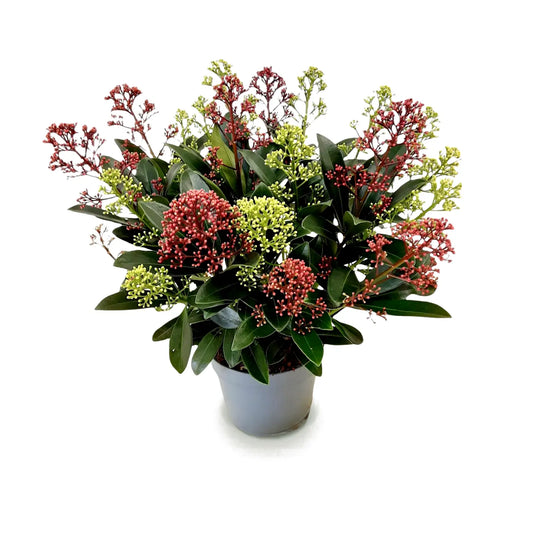
Japanese Skimmia 'Festival' (Skimmia japonica) – evergreen red and white flowering plant – 15 cm pot – Height 30 cm
Regular price 44,95 €Regular price44,95 €35,96 €Livraison offerte -

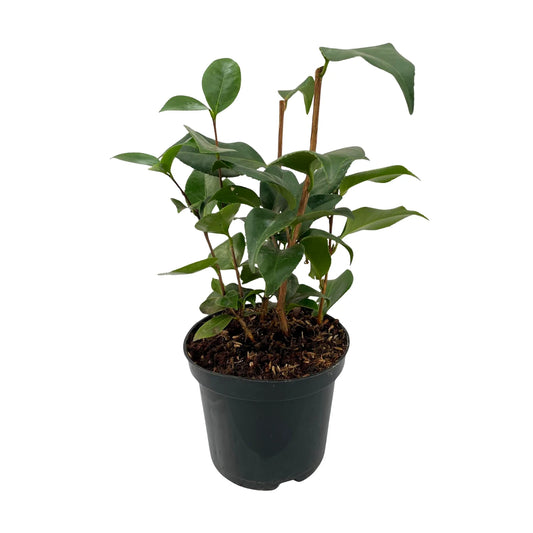
Camellia 'Tricolor' (Camellia japonica) - evergreen flowering shrub - 15 cm pot - Height 30 cm
Regular price From 39,95 €Regular price39,95 €From 31,96 €Livraison offerte -
Viburnum (Viburnum) – Fragrant flowering shrub – 19 cm pot – Height: 90 cm
Regular price 69,95 €Regular price69,95 €55,96 €Livraison offerte -


Bergenia (Bergenia cordifolia) - evergreen perennial groundcover - 11 cm pot - Height 25 cm
Regular price From 39,95 €Regular price39,95 €From 31,96 €Livraison offerte -


Heuchera 'Palace Purple' (Heuchera) - perennial with colorful foliage - 11 cm pot - Height 25 cm
Regular price From 39,95 €Regular price39,95 €From 31,96 €Livraison offerte -
'Blue Maid' Holly (Ilex) - evergreen hedging shrub - 19 cm pot - Height 90 cm
Regular price 74,95 €Regular price74,95 €59,96 €Livraison offerte


✂️ Skimmia care: watering, mulching and pruning
An established skimmia requires little care. The RHS recommends watering young plants during dry periods in spring and summer for the first two years; once established, they are fairly drought-tolerant and no longer require regular watering. In a pot, the water reserve is more limited: check the root ball with your finger and water as soon as it dries on the surface.
As for pruning, its compact shape is sufficient on its own; the RHS even considers that severe cutback to rejuvenate an old plant rarely succeeds.
💧 Watering: During dry spells for the first 2 years, then only in case of severe drought or sun
🍂 Mulching: Renewed 5 cm layer of organic mulch, clear space around the base
✂️ Pruning: In spring, shorten a particularly vigorous shoot inside the branches to hide the cut
🪴 Container cultivation: Monitor the root ball, repot to just slightly larger, watch for spider mites
👀 Monitoring: Aphids in spring and summer, spider mites in hot and dry weather
🍂 Skimmia through the seasons, from winter planter to spring
Skimmia lives out of season. In winter, 'Rubella' bears panicles of very decorative red buds, which open in early spring into fragrant white flowers, according to the RHS 'Rubella' sheet.
On pollinated female plants, the red berries ripen in autumn and remain on the shrub throughout the winter, according to NC State Extension; for reevesiana, the RHS specifies that they often last until the following spring.
Rated H5, it withstands -10 to -15 °C according to the RHS hardiness rating, but this category can suffer in an open and exposed site: in a pot, protect the root ball during severe cold.
📅 Maintenance calendar by season
| Season | Key action |
|---|---|
| 🌸 Spring | Fragrant flowering, planting, light pruning of a particularly vigorous shoot, watering young plants |
| ☀️ Summer | Watering during dry spells, monitoring for aphids and spider mites, cuttings in late summer |
| 🍂 Autumn | Ideal planting, berries ripening on females, planter arrangements |
| ❄️ Winter | Decorative red buds, persistent berries, protecting pots during severe cold, watering by touch outside of frost |
❄️ Skimmia in winter: pot, planter and cold protection
In winter, leave the skimmia outside: in the ground, a mulch is enough; in a pot or planter, protect the root ball from frost, water only when the compost feels dry to the touch and never before a night of frost. This is its great season: the RHS skimmia guide cites it for winter pots, and small plants are sold especially for planters and balcony boxes.
In a pot, the danger comes from the freezing of the compost, which can kill plants according to the RHS container maintenance guide. Rated H5 (-10 to -15 °C), skimmia withstands the cold in the ground, but the RHS hardiness rating specifies that plants rated H4 and H5 are more vulnerable in a container.
| Winter action for a potted skimmia | Why (source) |
|---|---|
| Group the pots against a house wall | Protects the roots from the cold (RHS) |
| Place a thick winter fleece over it on nights of severe frost | Provides about 2 °C of protection (RHS) |
| Remove the saucer | Avoids standing water freezing at the base; the RHS recommends removing saucers in winter |
| Mulch from November to February | Period recommended by the RHS: at least 5 cm, leaving a clear circle around the base |
| Shelter a waterlogged pot | During very wet periods, temporary shelter or a wall's "rain shadow" (RHS) |
| No fertilizer | Unnecessary during the winter months (RHS) |
How to water a skimmia in winter? In a pot, it continues to drink, especially under an eave or covered balcony that stops the rain. Check the root ball with your finger: if the compost is dry, water during a mild day; if it is still cool, wait. Overly dry compost makes the leaves yellow, the RHS reminds, but waterlogged compost that freezes damages the roots: the RHS asks never to water a container if frost is forecast.
As for the substrate, there is no need to look for ericaceous soil: the RHS indicates that skimmia needs neither acidic soil nor ericaceous plant potting mix, and recommends in a pot a mixture of half John Innes No. 3 peat-free soil-based compost and half multipurpose peat-free compost. If you associate it with ericaceous plants like the azalea or the Leucothoe, give them a separate pot or a bag of ericaceous soil.
In a winter planter, skimmia is the structural plant for shaded corners. Our guide for composing a winter planter offers a "Christmas in the shade" recipe around a skimmia, with Christmas rose, rush, and ivy. For the berries, keep in mind that a female needs a male nearby, and that a single male, like our skimmia 'Rubella' with red buds, can pollinate several females according to the RHS.
🌱 Propagate a skimmia by cuttings
Cuttings are the simplest method. According to the RHS, skimmias are propagated by semi-hardwood cuttings from summer to mid-autumn (July to September), or by dry wood from mid-autumn to late winter; the 'Rubella' sheet recommends semi-hardwood cuttings in late summer with bottom heat.
NC State Extension also cites stem cuttings as a mode of propagation. A cutting reproduces the sex of the parent plant: propagate a female plant to get berries, a male plant for pollination.
🐛 Common problems: causes and solutions
Yellow leaves on a skimmia are most often caused by too much sun or very dry, poor, shallow soil, rather than lime-induced chlorosis: this is the RHS explanation, which notes that a treatment with iron is unlikely to help since skimmia is not an acid-loving plant. NC State Extension confirms that leaves scorch in full sun.
Among pests, the RHS guide lists the chestnut scale, whose white deposits appear from late spring to early summer; the 'Rubella' fact sheet also adds scale insects, root-knot nematodes (especially in pots), phytophthora, and armillaria.
| Symptom | Probable cause | Solution |
|---|---|---|
| Yellowing leaves | 💧 Too much sun, or very dry, poor, shallow soil (RHS) | Move to shade, water during dry weather, mulch and enrich the soil; iron is ineffective (RHS) |
| Browned or scorched leaves | ☀️ Full sun on a shade-loving shrub | Replant in partial shade or shade the planter |
| White waxy clusters on stems | 🐛 Chestnut scale | Remove with a brush as soon as they appear, in late spring and early summer |
| Wilting potted plant, roots eaten | 🐛 Root-knot nematode larvae | Remove from pot, inspect the root ball, use biological nematode control |
| Dull, speckled foliage | ☀️ Spider mites in hot, dry weather | Water at the base, return to shade, isolate affected pots |
| No berries | ♀️ Female plant, or female without a male nearby | Plant a male near the females, or choose self-fertile reevesiana |
-

Our flowering outdoor shrubs: buddleias, dogwoods, deutzias, hibiscus, mock oranges and more...
-

Outdoor plants that keep their foliage all year round: evergreen privacy hedges,...


🧭 Our selection for more information
To create a shady area that remains beautiful in winter, here are our neighboring guides and collections, each linking to its dedicated resource.
| Our selection | Why choose it |
|---|---|
| Ericaceous plants | Shade companions that do require acidic soil |
| Rhododendron | Spectacular spring blooms for an acidic shade bed |
| Shade and cool-weather plants | Shrubs and perennials that love partial shade and cool soils |
| Evergreen plants | Evergreens to maintain year-round structure |
🎨 Male or female skimmia, and which plants to pair it with
Male or female? 'Rubella' and 'Fragrans' are males (NC State Extension), without berries but with decorative buds and flowers, while 'Nymans' is a female with 10 mm red berries.
Females need a male nearby; NC State Extension recommends 1 male plant for 6 females, and the RHS notes that hermaphrodite reevesiana fruits on its own. For alkaline soil, the RHS states that 'Nymans' and reevesiana tolerate an alkaline pH, while 'Rubella' requires an acidic to neutral pH.
In the garden, skimmia pairs with camellia, azalea, or leucothoe, with a groundcover of carex at the base. Discover more ideas among our flowering shrubs and our Outdoor plants.
⚠️ Is skimmia toxic to children, cats, and dogs?
Yes, its fruit should be kept out of reach. The RHS states that the fruit is ornamental and should not be eaten, that it can cause mild digestive upset if ingested, and gives the same advice for animals; it also recommends wearing gloves when handling the plant.
NC State Extension rates the toxicity as moderate, limited to the fruit: small quantities can cause nausea, and its fact sheet mentions serious risks (abortion, cardiac arrest) in large quantities. We did not find a skimmia fact sheet in the ASPCA database: we cannot therefore detail the risks specific to cats and dogs.
With young children or curious animals, choose a male plant, which does not bear berries.
✅ Our expert tips for success
A successful skimmia follows a few rules: shade or sheltered partial shade, cool but well-drained soil, no need for ericaceous soil, water during dry weather for 2 years, then almost no pruning. If its leaves yellow, think of sun and dry soil before lime.
Choose a male for the buds, a female and a male for berries, or reevesiana for berries without a partner. To extend the season, our guide what to plant in autumn and our tips for protecting your plants from frost complete this guide.
Skimmia is the shrub I recommend for a north-facing balcony in winter. When a customer writes to me that their skimmia is yellowing, I first ask if it has had too much sun or if it has been thirsty, before talking about ericaceous soil. I like to arrange my planters with a 'Rubella' for its buds and a female for its berries. And with children at home, I simply choose a male.

Laura Bruneau
Jardinière et autrice