

Calathea crocata (Goeppertia crocata): care and flowering

To grow a thriving Calathea crocata, place it in indirect light, keep its potting mix evenly moist but never waterlogged, water it with rainwater or demineralized water, and maintain a temperature of around 18 to 27 °C with humidity close to 60%, away from drafts: these are the guidelines from NC State Extension (the North Carolina State University Cooperative Extension Service).
Its accepted name is now Goeppertia crocata, but it is still sold everywhere under its former name. The care basics common to all Calathea (watering, humidity, repotting) are covered in our Calathea care guide.
This profile focuses on what makes crocata unique: its orange blooms, how long its bracts last, what to do with spent flowers, what we really know about getting it to bloom again, and why its leaves dry out.
🌿 What sets Calathea crocata apart from other Calathea?
Most Calathea are bought for their foliage; crocata, on the other hand, is bought for its flowers. NC State nicknames it the “eternal flame plant” and describes torch-shaped inflorescences that rise above the foliage.
What look like orange petals are actually yellow-orange bracts: the true flower, which is small and tubular, sits in the center at the top of a long flower stalk. That is why the display lasts so long: the bracts stay colorful for up to 3 months, according to NC State. The foliage is no less striking.
The elliptical leaves are dark green on top and reddish purple underneath, a contrast that sets off the orange bracts. It grows as a compact clump, making it an easy flowering plant to place on a table or console.
| Feature | What it means for your home |
|---|---|
| Long-lasting orange blooms | Decorative bracts for up to 3 months, much longer than a bouquet |
| Two-tone foliage | The purple undersides of the leaves add depth even when the plant is not in bloom |
| Compact, clumping growth | A flowering plant that fits on a piece of furniture, with no need for staking |
| Pet-friendly | Considered non-toxic to cats and dogs |
🔎 Calathea crocata at a glance
Here is the verified profile of Calathea crocata. The accepted name, author, year, and native range come from Plants of the World Online (POWO), the database of the Royal Botanic Gardens, Kew, which has listed Calathea crocata É.Morren & Joriss. (1875) as a synonym of Goeppertia crocata since 2012.
The description of the leaves and bracts, as well as the size and toxicity information, comes from the NC State Extension Goeppertia crocata profile. Imperial measurements have been converted to centimeters and rounded.
| Characteristic | Verified details |
|---|---|
| 🏷️ Botanical name | Goeppertia crocata (É.Morren & Joriss.) Borchs. & S.Suárez (2012); synonym: Calathea crocata É.Morren & Joriss. (1875) |
| 🧬 Family | Marantaceae, like Maranta, Stromanthe, and all Calathea |
| 🌳 Type | Evergreen herbaceous perennial with a clumping habit, native to the humid tropical biome |
| 🌍 Origin | Brazil: the states of Bahia and Espírito Santo (POWO) |
| 🍃 Foliage | Elliptical leaves, dark green above and reddish purple below |
| 🌸 Bloom | Yellow-orange bracts on long stalks, with a tubular true flower at the center; spring and summer, lasting up to 3 months |
| 📏 Size | About 50 to 85 cm tall and 30 to 40 cm wide (NC State); sold by us in a 14 cm pot, at 40 to 45 cm tall |
| ⚠️ Toxicity | Non-toxic to cats and dogs (NC State; ASPCA for Calathea) |
📋 Quick care guide
The essential growing guidelines, all in one place.
| Factor | Guideline |
|---|---|
| Light | Indirect, like beneath a canopy; at most a few hours of gentle sun, never intense sunlight |
| Watering | Keep the potting mix evenly moist but never waterlogged; use rainwater or demineralized water |
| Potting mix | Humus-rich, well-draining potting mix with an acidic to neutral pH |
| Humidity | About 60% (NC State) |
| Temperature | About 18 to 27 °C (65 to 80 °F according to NC State), stable and away from drafts |
| Repotting | In spring, when the roots fill the pot; you can divide the plant at the same time |
| Fertilizer | Diluted liquid houseplant fertilizer in spring and summer only |
| Toxicity | Non-toxic to cats and dogs |
| Difficulty | Moderate: sensitive to water quality and humidity, and difficult to get to rebloom indoors |
📍 Where should you place a Calathea crocata to keep it blooming?
This is one of the most frequently asked questions about crocata. NC State recommends indirect light throughout the day, like beneath a canopy, or partial shade with only 2 to 6 hours of direct sunlight. Indoors, this means a bright room near an east-facing window, or a little way back from a south- or west-facing window behind a sheer curtain.
In summer, direct afternoon sun through a window can scorch the foliage. The second criterion, often overlooked, is stability. NC State calls for a consistent temperature and no drafts, which rules out a spot above a radiator or in the path of an entrance door.
☀️ Light: near an east-facing window, or set back from a south- or west-facing window filtered by a sheer curtain
🌡️ Conditions: a stable room at around 18 to 27 °C, away from radiators, air conditioning, and doors
📅 Timing: when you bring it home, put it straight in its permanent spot: repeated moves can stress a plant in bloom
🪴 Repotting and dividing Calathea crocata
Do not repot crocata while it is in full bloom: wait until the bracts have faded and spring returns. The NC State profile recommends an all-purpose, humus-rich potting mix that is moist but well-draining, with an acidic to neutral pH. Choose a pot with drainage holes that is only slightly wider than the old one: too much soil around the roots stays moist for too long.
Repotting is also a good time to propagate the plant, since NC State identifies division as the best method. Our guide to knowing when to repot a plant after purchase can help you choose the right time.
| Step | What to do |
|---|---|
| 1. Wait for the right time | In spring, when the plant is not blooming and the roots fill the pot |
| 2. Prepare the pot | Choose a pot with drainage holes that is only slightly wider than the old one |
| 3. Prepare the potting mix | Humus-rich potting mix lightened with a little perlite or fine bark, to retain moisture without becoming waterlogged |
| 4. Position the root ball | At the same depth as before, without burying the stem bases; fill around it without pressing down hard |
| 5. Water and let it rest | Water with soft water until it drains through, empty the saucer, then keep the plant out of direct sun for a few days |
columns: 4
columns_mobile: 2
-

 Livraison offerte
Calathea Crocata - 14cm Pot - Height: 40 - 45cm
Regular price From 49,95 €Regular price49,95 €From 39,96 €Livraison offerte -

 Sold out
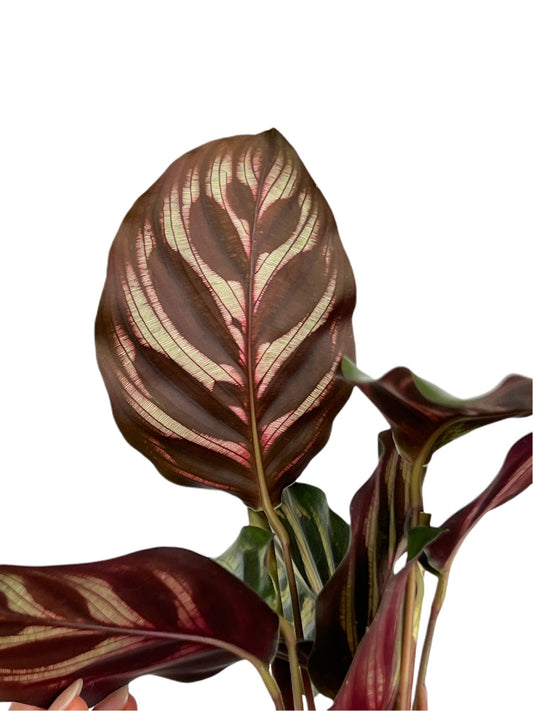
Calathea Makoyana
Regular price From 7,95 €Regular price7,95 €From 6,36 €Sold out -
-

 Livraison offerte
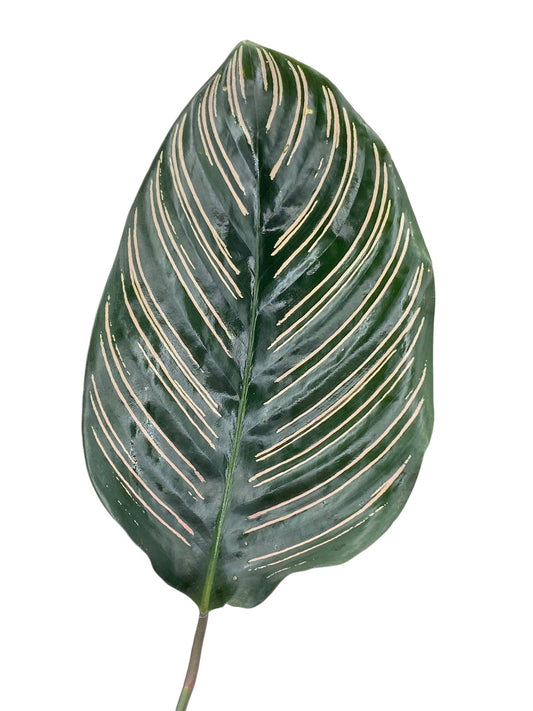
Calathea Rufibarba - 17cm Pot - Height 55-60cm
Regular price From 49,95 €Regular price49,95 €From 39,96 €Livraison offerte




✂️ Calathea crocata-specific care
Caring for crocata starts with looking after a flowering plant: its bracts call for a few steps that foliage Calathea do not, and it is particularly sensitive to water quality. NC State also notes that overwatering causes root rot and that dry air makes the leaves curl.
💧 Watering: Keep the potting mix evenly moist but never waterlogged: water when the surface starts to dry, and empty the saucer
💧 Water quality: Use rainwater or demineralized water; avoid tap water, as its fluoride can brown the leaf edges (NC State)
💧 Humidity: Aim for around 60%: place a tray of damp pebbles under the pot or group plants together rather than misting
🔹 Bracts: Do not wet the inflorescences when watering: pour water at the base, beneath the foliage
🌱 Fertilizer: Use diluted liquid fertilizer in spring and summer; do not fertilize in winter
🍂 Calathea crocata blooms, spent flowers, and reblooming
According to NC State, crocata blooms in spring and summer, and its bracts stay decorative for up to 3 months. When an inflorescence turns brown and dries out, cut its stalk at the base with clean pruning shears: the plant no longer needs to maintain it, and the clump will look tidy. Cutting off a spent flower will not kill the plant; it will continue to grow as a foliage plant.
Getting crocata to bloom again indoors is more challenging. What is established: sufficient indirect light, consistent warmth, and a healthy plant.
However, the NC State profile does not describe any reblooming protocol: in the absence of a reliable source, we will not suggest a specific short-day schedule, and would rather be honest that a new bloom indoors is never guaranteed.
📅 Seasonal care calendar
| Season | Key task |
|---|---|
| 🌸 Spring | Bracts may return; resume diluted fertilizer; repot or divide when the plant is not in bloom |
| ☀️ Summer | Blooming; water regularly with soft water; monitor humidity; avoid intense sun |
| 🍂 Fall | Cut off spent flower stalks, water less often, apply the last fertilizer, bring indoors before cool nights |
| ❄️ Winter | No fertilizer; keep the potting mix just moist; counter dry air from heating; avoid drafts |
🌱 Propagating Calathea crocata by division
Crocata is propagated by division, the method NC State considers best for this plant. In spring, when it is not blooming, remove the root ball from the pot and identify groups of stems, each with its own roots. Separate them by hand or with a clean knife, making sure each division has several leaves and a substantial clump of roots.
Pot each division in a small pot of humus-rich potting mix, water with soft water, and keep it warm in indirect light and humid air while it establishes. A division that is too small will struggle to establish and rarely flowers in its first year: two strong divisions are better than five weak ones. Wait for new leaves to unfurl before returning to a regular watering and fertilizing routine.
🐛 Common problems: causes and solutions
With crocata, most problems show up on the leaves, and drying leaves are the issue people ask about most. NC State lists mealybugs and spider mites as pests to watch for; for humidity, our guide to increasing indoor humidity covers the solutions.
| Symptom | Likely cause | Solution |
|---|---|---|
| Brown, dry leaf edges | 💧 Fluoride in tap water (NC State), or air that is too dry | Switch to rainwater or demineralized water; trim off the dry edges, following the shape of the leaf |
| Curling leaves | ⚠️ Air that is too dry, especially in winter with the heating on | Raise humidity to around 60% with a tray of damp pebbles or by grouping plants together |
| Yellow leaves, soft stems at the base | 🍄 Overwatering and root rot | Let the surface dry slightly, empty the saucer, and check drainage |
| Browning bracts | ☀️ Natural end of blooming, or dry air and direct sun | Cut the flower stalk at the base; if it is happening early, move the plant away from the sun and radiator |
| Fine webbing, dull and speckled leaves | 🕷️ Spider mites, encouraged by dry air | Rinse the foliage, isolate the plant, and increase humidity |
| White, cottony clusters where leaves meet the stems | 🐛 Mealybugs | Remove them with a cotton swab dipped in alcohol and monitor new growth |


🌸 Calathea varieties to compare
Crocata is the Calathea grown for its flowers; its relatives are chosen more for their foliage. Here is how it compares with the Calathea varieties we cover, each linked to its own profile.
| Variety | Its standout feature |
|---|---|
| Calathea crocata | Orange bracts in spring and summer, dark green leaves with purple undersides, compact growth |
| Calathea crocata 'Tassmania' | A selection described by NC State: dense clump, deep green foliage tinged with purple, crimson-red undersides, upright orange flower stalks |
| Calathea ornata | NC State’s pinstripe plant: smooth, glossy leaves striped with pale pink, grown for its foliage |
| Calathea rufibarba | Velvet calathea: wavy leaves with rusty hairs; its small yellow or orange flowers are rare indoors (NC State) |
| Calathea makoyana | Most commonly known as the peacock plant, prized for its patterned foliage |
| Calathea warscewiczii | The other Calathea that flowers indoors, according to NC State: cream-colored flowers amid velvety foliage |
🎨 Which plants pair well with Calathea crocata?
Pair it with plants that share its needs: filtered light, humidity, and soft water.
Calathea makoyana, Calathea zebrina with its large striped leaves, and Maranta, the prayer plant, from the same family, make a Marantaceae corner where the orange bracts stand out against the patterned foliage. Grouping these plants also helps maintain higher humidity around them.
If you love indoor plants that flower for a long time, our guide to getting an Anthurium to bloom again is a great companion to this guide. Find all our Calathea in the Calathea collection, and discover more flowering plants in our flowering plants.
⚠️ Is Calathea crocata toxic to cats?
No. NC State states that Goeppertia crocata is non-toxic to both cats and dogs. The ASPCA (American Society for the Prevention of Cruelty to Animals) also classifies Calathea (Calathea spp., family Marantaceae) as non-toxic to dogs, cats, and horses; this listing covers the genus as a whole and does not specifically mention crocata.
Still, keep it out of reach of a playful cat: a nibbled plant is less likely to flower, and if you have any concerns after ingestion, call your veterinarian.
To create a pet-safe home, see our list of non-toxic plants for cats, our article “Is Calathea safe for pets?” and our pet-friendly plant selection.
✅ Our expert tips for success
Keep three rules in mind for your Calathea crocata. First, water: use rainwater or demineralized water, and keep the substrate evenly moist without overwatering. Next, its environment: filtered light, around 18–27 °C and 60% humidity, away from drafts. Finally, flowering: enjoy its bracts for up to 3 months, cut faded flower stalks back at the base, and treat a second bloom as a bonus rather than a given.
For everything Calathea have in common, our Calathea guide has you covered, and our indoor plant catalog is ready to help you complete your collection.
Crocata is the plant I recommend to anyone who wants a touch of color without giving up a green plant. What I’ve noticed in our home is that damaged leaves are almost always caused by tap water or a radiator that’s too close. I prefer to be honest: getting it to flower again in an apartment takes as much luck as care. But even without flowers, its purple undersides make it beautiful all year round.

Laura Bruneau
Jardinière et autrice


