

Calathea zebrina (Goeppertia zebrina): care and leaves

To care for a Calathea zebrina, place it in gentle, indirect light, keep its potting mix moist but never soggy, water with rainwater or demineralized water, maintain humidity above 60%, and keep the temperature stable at around 18–24°C: these are the guidelines from NC State Extension (North Carolina State University).
Its accepted botanical name is now Goeppertia zebrina, according to POWO (Plants of the World Online, Royal Botanic Gardens, Kew), although it is still sold under the name Calathea. The care basics common to all Calatheas (watering, potting mix, humidity) are covered in our Calathea care guide.
This article focuses on what makes the zebrina unique: its very large velvety leaves, how to diagnose curling or browning, its toxicity, and the common confusion with Alocasia zebrina.
🌿 How can you recognize a Calathea zebrina?
It has some of the largest leaves of any Calathea. NC State describes dark green velvety leaves striped with light green along the veins, like a zebra’s coat, with reddish-purple undersides. Each leaf blade measures 15 to 20 inches long, or about 38 to 50 cm, and 6 to 8 inches wide, or about 15 to 20 cm.
The plant forms an upright clump 1 to 3 feet tall (about 30 to 90 cm) and 1 to 2 feet wide (about 30 to 60 cm). Its velvety leaves distinguish it to the touch from Calatheas with smooth, glossy leaves.
Like other members of the Marantaceae family, it is a prayer plant: NC State notes that its leaves fold up in the dark, a movement called nyctinasty. In the evening, you’ll see its leaves lift, then lower again in the morning: this is normal and not a sign that it is thirsty.
| Benefit | What it means for you |
|---|---|
| Huge velvety leaves | An instant jungle effect with just one plant, without needing a stake |
| Light green stripes and purple undersides | A striking contrast visible from afar, with a violet sheen when the leaves lift |
| Non-toxic to pets | A large decorative plant that’s safe to keep around a curious cat, according to NC State |
| Prayer plant movement | Leaves that move between day and night, making it a living plant to observe |
🔎 Calathea zebrina at a glance
Here is the verified profile of this variety. The accepted name, author, native range, and synonyms come from the POWO entry for Goeppertia zebrina: the species was described in 1831 and has 16 synonyms, including Calathea zebrina (Sims) Lindl. and Maranta zebrina Sims.
The description, size, and toxicity information come from the NC State Extension entry. In this article, we use the name Calathea zebrina, the name you’ll find at garden centers.
| Characteristic | Verified details |
|---|---|
| 🏷️ Botanical name | Goeppertia zebrina (Sims) Nees; synonyms include Calathea zebrina (Sims) Lindl. and Maranta zebrina Sims |
| 🧬 Family | Marantaceae, like Maranta and Stromanthe |
| 🌳 Type | Evergreen herbaceous perennial that grows in clumps, from the tropical moist biome |
| 🌍 Origin | Brazil, from Bahia to Santa Catarina (POWO) |
| 🍃 Foliage | Velvety, dark green with light green stripes, purple undersides, leaves about 38 to 50 cm long |
| 🌸 Flowers | Inconspicuous, white or purple on upright stems; rare indoors |
| 📏 Size | About 30 to 90 cm tall and 30 to 60 cm wide |
| ⚠️ Toxicity | Non-toxic to cats, dogs, and horses (NC State) |
📋 Quick care facts
The essential growing guidelines, all at a glance.
| Parameter | Guideline |
|---|---|
| Light | Gentle and indirect; NC State recommends partial shade; no midday sun |
| Watering | Keep the potting mix moist but never soggy; use rainwater or distilled water |
| Potting mix | Rich in organic matter, well-draining, slightly acidic to neutral |
| Humidity | Above 60%, according to NC State |
| Temperature | Stable, around 18 to 24°C; bring it indoors before temperatures drop below about 16°C |
| Repotting | In spring, when the clump fills the pot; a good time to divide it |
| Fertilizer | Diluted houseplant fertilizer during the growing season; don’t overdo it |
| Toxicity | Non-toxic to cats, dogs, and horses |
| Difficulty | Moderate: sensitive to dry air, tap water, and temperature fluctuations |
📍 Where should you place a Calathea zebrina in your home?
This is the question people are asking in search results, and the answer is filtered light. NC State classifies it as a partial-shade plant: in nature, it grows beneath the canopy of Brazil’s humid tropical forests. Indoors, this means a bright room where the sun does not shine directly on the foliage, or a window screened with a sheer curtain.
Its large velvety leaves don’t tolerate direct sun well, as it can bleach them and scorch their edges. Keep the temperature stable: NC State recommends 65 to 75°F, or about 18 to 24°C, and says never to let it drop below 60°F, or about 16°C.
NC State notes that the genus thrives in humid rooms such as bathrooms and kitchens, provided they are bright.
☀️ Light: An unobstructed east- or north-facing window, or set back from a south- or west-facing window with a sheer curtain
🛁 Ideal room: A bright bathroom or kitchen, away from radiators, air conditioners, and drafts
📅 Timing: Place and repot in spring; in summer, move it outdoors only in the shade and as long as nighttime temperatures stay above about 16°C
🪴 Repotting and dividing a Calathea zebrina
The zebrina forms a clump that spreads through its rhizomes. NC State recommends a rich, well-draining, loamy potting mix that is slightly acidic to neutral, such as a peat-based potting mix or African violet mix. Houseplant potting mix amended with horticultural perlite works well.
Repot in spring, when the roots fill the pot, using a container with drainage holes that is only slightly larger: there is no need to choose an oversized pot just because the plant is tall, since excess potting mix stays soggy, which NC State advises against.
| Step | What to do |
|---|---|
| 1. Choose the pot | Use a pot with drainage holes that is only slightly larger than the current one, preferably wider rather than deeper |
| 2. Prepare the potting mix | Use a peat-based potting mix or African violet mix (NC State), amended with perlite |
| 3. Remove the plant gently | Water the day before, then lift out the root ball without pulling on the velvety leaves |
| 4. Divide if needed | Separate the clump into sections, each with roots and several leaves |
| 5. Water and shelter | Water with soft water, empty the saucer, and keep it in bright shade for a few days |
columns: 4
columns_mobile: 2
-

 Sold out
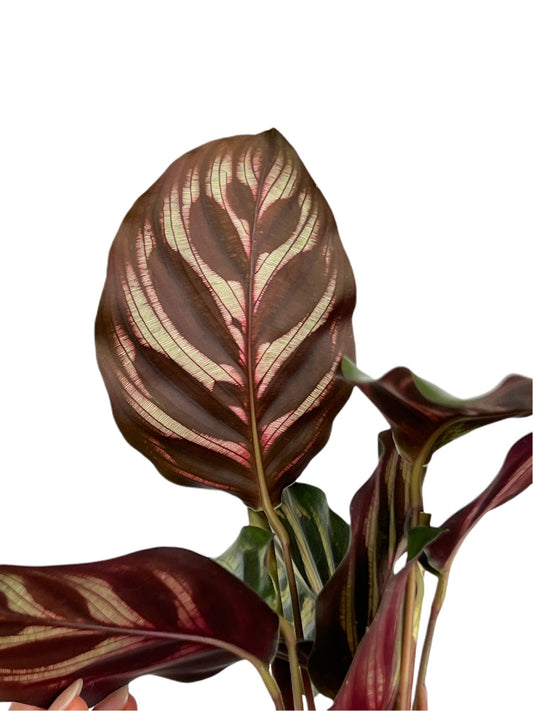
Calathea Makoyana
Regular price From 7,95 €Regular price7,95 €From 6,36 €Sold out -
-

 Livraison offerte
Calathea Crocata - 14cm Pot - Height: 40 - 45cm
Regular price From 49,95 €Regular price49,95 €From 39,96 €Livraison offerte -

 Livraison offerte
Calathea Rufibarba - 17cm Pot - Height 55-60cm
Regular price From 49,95 €Regular price49,95 €From 39,96 €Livraison offerte




✂️ Calathea zebrina care tips
What sets the zebrina apart is its scale: leaves that approach 50 cm in length lose a lot of water through evaporation and show the slightest care issue. Three areas therefore matter more than they do for a small Calathea: water, humidity, and keeping the velvety leaves clean.
NC State recommends keeping the soil moist but not too wet, warns that waterlogged soil causes root rot, and advises using distilled or rainwater to prevent browning caused by fluoride in tap water.
💧 Watering: Once the top of the potting mix dries out, water with room-temperature rainwater or demineralized water; always empty the saucer
💧 Humidity: Aim for above 60% (NC State): use a tray of moist pebbles, group plants together, or use a humidifier
🌱 Fertilizer: Apply diluted houseplant fertilizer during the growing season, then stop in winter; too much can burn the roots
🔹 Velvety foliage: Dust with a soft brush or dry cloth: the velvet traps dust and can be marked by a wet sponge
🔹 Pruning: Cut fully yellow or dry leaves off at the base, and spread out the cleanup over several weeks if many leaves are damaged
🍂 Calathea zebrina through the seasons
It grows from spring through late summer, when light and warmth are plentiful. This is the time to water more regularly, feed lightly, repot, and divide. Fall is the tricky time: the heating comes on and the air dries out, often causing the leaf edges to turn brown.
In winter, water less often without letting the root ball dry out, keep the plant away from cold windows and radiators, and keep an eye on the thermometer: temperatures should not drop below about 16°C.
📅 Seasonal care calendar
| Season | Key task |
|---|---|
| 🌸 Spring | Repot and divide, resume diluted fertilizer, water more often |
| ☀️ Summer | Keep the potting mix moist, monitor humidity, and avoid direct sun |
| 🍂 Fall | Apply the last fertilizer, increase humidity when the heating comes on |
| ❄️ Winter | Water less often without letting it dry out, don’t fertilize, and never let the temperature drop below about 16°C |
🌱 Propagating Calathea zebrina by division
NC State lists division as the way to propagate zebrina. Unlike Pothos or Philodendrons, it cannot be propagated from a piece of stem in water: you need to divide the root clump. In spring, when repotting, loosen the root ball and find groups of leaves attached to their own roots.
Always handle the zebrina by its root ball, never by its leaves: these large velvety leaves bend and become marked with the slightest mishandling. The step-by-step instructions (tools, divisions, aftercare) are the same for the whole genus and are detailed in our Calathea guide. Slow recovery and a few curled leaves in the first few days are normal.
According to NC State, its flowers are inconspicuous, white or purple, appear on upright stems, and are rare indoors: don’t count on getting seeds.
🐛 Common problems: causes and solutions
Most zebrina problems show up on its large leaves, and the NC State entry for the genus Goeppertia offers some simple clues: curling or yellowing leaves may be caused by underwatering, brown edges by air that is too dry, and tap water can damage the foliage.
The species entry also mentions spider mites, mealybugs, aphids, root rot caused by overwatering, and leaf spots caused by poor air circulation.
| Symptom | Likely cause | Solution |
|---|---|---|
| Leaves curling during the day | 💧 Underwatering, dry potting mix (NC State) | Water thoroughly with soft water, then keep the potting mix moist without making it soggy |
| Brown edges and tips | ⚠️ Air that is too dry, especially during the heating season | Increase humidity above 60%: use a tray of moist pebbles or group plants together |
| Leaves gradually turning brown | 💧 Fluoride in tap water (NC State) | Switch to rainwater, distilled water, or demineralized water |
| Yellow, drooping leaves and soft stems | 💧 Overwatering and suffocated roots | Let the potting mix dry slightly, empty the saucer, and check the drainage and roots |
| Dull, speckled leaves and fine webbing | 🕷️ Spider mites, encouraged by dry air | Rinse the foliage with lukewarm water, isolate the plant, and increase humidity |
| Discolored or scorched leaves | ☀️ Direct sunlight on the leaf blades | Move the plant farther from the window or filter the light with a sheer curtain |


🌸 Calathea varieties to compare
The zebrina shares its care needs with other Calatheas, but not its appearance. If you’re looking for similarly graphic foliage, here are some related Calatheas, each covered in its own profile, as well as the plant it is most often confused with. Find all our Calatheas in the Calathea collection.
| Variety | What makes it special |
|---|---|
| Calathea makoyana | Most often called the peacock plant; its appearance and care are covered in our makoyana profile |
| Calathea ornata | Smooth, glossy leaves with fine pale pink stripes on young leaves (NC State): see our ornata profile |
| Calathea rufibarba | Elongated leaves with wavy edges, reddish hairs, and purple undersides (NC State): see our rufibarba profile |
| Calathea crocata | Dark foliage and orange bracts, one of the few Calatheas grown for its blooms: see our crocata profile |
| Calathea warscewiczii | Its velvet-leaved rival: dark green foliage with a feather-like pattern, fuzzy purple undersides, and potentially cream-colored flowers indoors (NC State) |
| Alocasia zebrina | A misleading namesake: a Philippine aroid with striped petioles and smooth, arrow-shaped leaves |
🎨 Which plants pair well with Calathea zebrina?
Pair it with plants that enjoy the same warm, humid setting and bright shade: they benefit together from the moisture they release.
A Boston fern adds fine foliage that contrasts with its large leaves, a Fittonia covers the base of the pots with its colorful veins, and a trailing Chlorophytum completes the picture.
For a pet-safe corner, browse our pet-friendly plant collection; for a humid room, explore our bathroom plant selection, and discover all our indoor plants.
⚠️ Is Calathea zebrina toxic to cats?
No. NC State Extension classifies Goeppertia zebrina as non-toxic to cats, dogs, and horses.
The ASPCA (American Society for the Prevention of Cruelty to Animals) also classifies the genus Calathea (Calathea spp.) as non-toxic to dogs, cats, and horses; its listing covers the genus, not zebrina specifically.
Beware of common names in English: NC State lists zebra plant, zebra prayer plant, and even peacock plant as names for it, a nickname most often given to makoyana. NC State also lists Aphelandra squarrosa, an unrelated acanthaceous plant, as zebra plant. So always check the Latin name before relying on a toxicity list.
Also, don't assume this applies to Alocasia zebrina, a completely different plant. Non-toxic doesn't mean edible: a cat that chews lots of leaves may vomit.
Our list of non-toxic plants for cats and our article Calathea and pets provide more information.
✅ Our expert tips for success
Keep three rules in mind for your Calathea zebrina. First, water: keep the potting mix consistently moist, never waterlogged, and always use soft water, rainwater, or demineralized water. Next, air: maintain humidity above 60% and a steady temperature of around 18–24°C, never letting it drop below about 16°C. Finally, light: keep it soft and indirect, and never let direct sun fall on its large velvety leaves.
As for its name, remember that Calathea zebrina and Goeppertia zebrina refer to the same plant, and that it has nothing to do with Alocasia zebrina: one is a Brazilian marantaceous plant with striped, velvety leaves; the other is a Philippine aroid, according to POWO. Curling leaves are the first sign of underwatering, while brown edges indicate air that is too dry.
Zebrina is the most spectacular Calathea, in my opinion, precisely because its leaves are huge and soft as velvet. What I’ve noticed is that it quickly lets you know what it needs: when its leaves curl, it’s time to water, and when their edges turn brown, the air needs more moisture. I always use rainwater and keep it alongside other tropical plants. And every evening, watching its large leaves rise is still a little spectacle for me.

Laura Bruneau
Jardinière et autrice


