Epipremnum pinnatum: care, varieties and cut leaves

Epipremnum pinnatum is a wild climbing vine in the Epipremnum genus with large leaves. When young, it resembles a pothos with entire leaves, but once attached to a support, its adult leaves widen, thicken, and split into strips, like those of a Monstera. It is also the species from which sought-after cultivars such as 'Cebu Blue' and 'Albo-Variegata' are derived.
This guide explains how to care for it, how to encourage its leaves to split, what is really known about its relationship with golden pothos, how to distinguish it from a Scindapsus or Rhaphidophora, and its toxicity. All our plants from this genus are featured in our Epipremnum collection.
🌟 Why grow an Epipremnum pinnatum instead of a classic pothos
Epipremnum pinnatum is as easy to grow as golden pothos, but it also offers a spectacular transformation: on a support, its adult leaves become thick, leathery, and deeply split, while an indoor pothos generally retains entire heart-shaped leaves.
The RHS (Royal Horticultural Society) Epipremnum pinnatum fact sheet describes larger, thicker, and deeply lobed adult leaves, measuring up to 90 cm long in ideal conditions, and a vine 2.5 to 4 m long in 5 to 10 years.
According to NC State Extension (North Carolina State University), it requires little maintenance and is resistant to most serious diseases.
| Feature | What it means |
|---|---|
| Leaves that change with age | Entire on young plants, split and perforated on adults (NC State) |
| Vigorous vine | 2.5 to 4 m tall in 5 to 10 years according to the RHS |
| Low humidity requirements | Epipremnums do not need very humid air (RHS) |
| Collector cultivars | 'Cebu Blue', 'Albo-Variegata', 'Baltic Blue', 'Skeleton Key' (NC State) |
| Easy to propagate | Stem cuttings in water, or air layering (RHS) |
📊 Cebu Blue, Albo, Marble and cousins: comparing Epipremnums
Commercially available Epipremnum pinnatum are distinguished mainly by the colour and size of their leaves: 'Cebu Blue' retains small, narrow blue-green leaves for a long time, 'Albo-Variegata' has large leaves variegated with creamy white and grows more slowly, and the green form is the most vigorous. The table compares them with the plants they are often confused with.
The descriptions come from NC State and the RHS; trade names not found in these sources are noted.
| Plant | Leaves | Feature | Source | Read or see |
|---|---|---|---|---|
| Epipremnum pinnatum (green form) | Young: elliptical to sagittate, smooth-edged; adult: 30 to 50 cm, split and perforated | The most vigorous; 2.4 to 3 m indoors | NC State | Our green Epipremnum pinnatum on a moss pole, 19 cm pot |
| 'Cebu Blue' | Small, narrow, lanceolate, blue-green | Retains its juvenile form without a support; trails 1.5 to 1.8 m | NC State | Epipremnum 'Cebu Blue' |
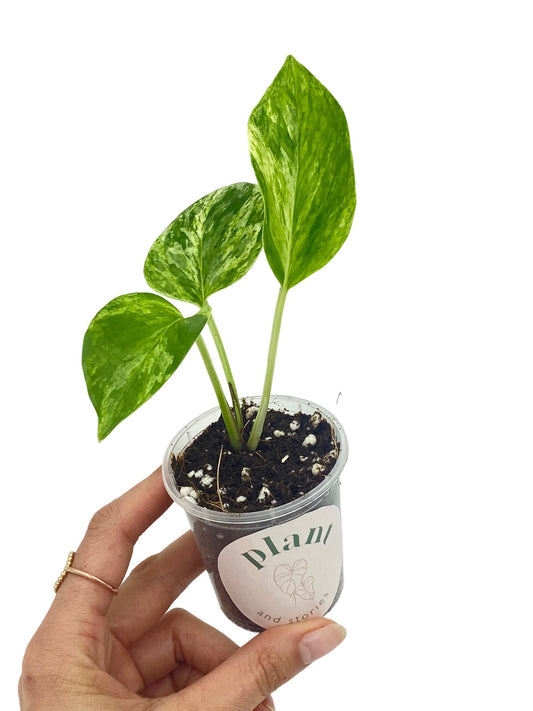
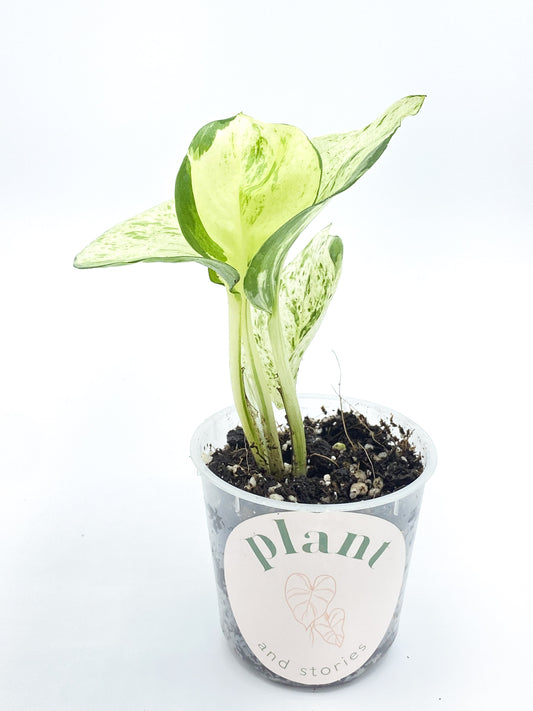
| 'Albo-Variegata' | Large, dark green variegated with creamy white | Slower growth | NC State | Epipremnum pinnatum 'Albo Variegata' on a support, 24 cm pot |
| 'Marble King' | Small, oval, creamy white mottled with green | Light variegation | NC State | Distinct cultivar from our 'Marble Green' |
| 'Baltic Blue' and 'Skeleton Key' | Perforated blue-green; dark green with narrow tip | Collector cultivars | NC State | Not offered here |
| 'Marble Green' and 'Snow Leopard' | Light green marbling; white patches | Trade names | Not described by our sources | Epipremnum pinnatum 'Marble Green' and Epipremnum 'Snow Leopard' |
| Golden pothos (E. aureum or E. pinnatum 'Aureum') | Heart-shaped, green and yellow | Separate species according to POWO, 'Aureum' cultivar of E. pinnatum according to the RHS | RHS, POWO | Our Epipremnum aureum guide |
| Scindapsus pictus 'Argyraeus' | Oval, up to 10 cm, dark green mottled with silver | Different genus, grows slowly | RHS | Scindapsus pictus 'Argyraeus' |
| Rhaphidophora tetrasperma | 15 to 30 cm, split and perforated early | Different genus, called mini monstera | NC State | Rhaphidophora tetrasperma (mini monstera) |
📋 Quick fact sheet
Key facts about Epipremnum pinnatum, according to the RHS, POWO and NC State Extension.
| Key fact | The rule |
|---|---|
| Botanical name | Epipremnum pinnatum (L.) Engl., 1908; Araceae family (POWO) |
| Origin | Tropical and subtropical Asia up to the Pacific and northern Australia; rainforest vine (POWO) |
| Size | 2.5 to 4 m in 5 to 10 years (RHS); 6 to 20 m in the wild (NC State) |
| Light | Bright and indirect, east or west window, or south window behind a sheer curtain (RHS) |
| Temperature | 18 to 30 °C, away from cold drafts and radiators (RHS) |
| Watering | When the substrate is dry 2 cm deep (RHS); rainwater or filtered water at room temperature |
| Substrate | 3 parts peat-free potting mix, 1 part gravel, 1 part orchid bark (RHS) |
| Fertiliser | Indoor plant fertiliser once a month from April to October (RHS) |
| Hardiness | H1b, minimum 10 to 15 °C (RHS); USDA zones 10a to 11b outdoors (NC State) |
| Toxicity | Toxic to humans, cats and dogs: calcium oxalates in the leaves and stems (NC State) |
How to care for an Epipremnum pinnatum in 7 steps
To care for an Epipremnum pinnatum, place it in bright but indirect light at 18 to 30 °C, water only when the substrate is dry 2 cm deep to the touch, feed it from April to October and let it climb a moss pole that you keep moist so its aerial roots can attach to it.
These steps come from the RHS Epipremnum growing guide and its genus page.
| Step | The right action |
|---|---|
| 1. Choose the location | East or west window, or south window behind a sheer curtain; no direct summer sun (RHS) |
| 2. Water by touch | Push a finger into the substrate: water when it is dry 2 cm deep (RHS), until it drains, then empty the saucer |
| 3. Choose soft water | Rainwater or filtered water at room temperature, especially in areas with hard water (RHS) |
| 4. Install a support | A moss or coco pole, generally up to 1 m, to be kept moist (RHS) |
| 5. Tie the stems | Guide each stem against the support, aerial roots on the moss side |
| 6. Feed | Indoor plant fertiliser once a month from April to October (RHS) |
| 7. Prune | Cut just above a leaf to encourage branching; the cuttings make new plants (RHS) |
To keep the moss fresh for longer, see our moss pole guide.
columns: 4
columns_mobile: 2
-

 Livraison offerte
Epipremnum pinnatum - Green vine on moss stake - 19cm pot - Height 80cm
Regular price 59,95 €Regular price59,95 €47,96 €Livraison offerte -


Epipremnum pinnatum 'Albo Variegata' - White Pothos on a moss pole - 24 cm pot - Height 125 cm
Regular price 129,95 €Regular price129,95 €103,96 €Livraison offerte -
 Sold out
Epipremnum pinnatum 'Marble Green'
Regular price 19,95 €Regular price19,95 €15,96 €Sold out -
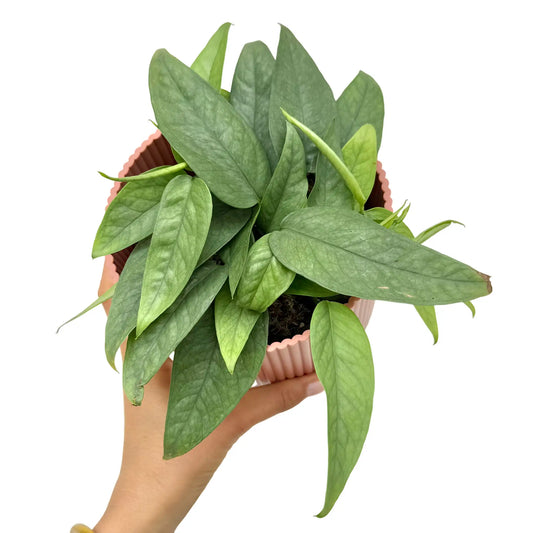
Epipremnum Cebu blue
Regular price From 7,95 €Regular price7,95 €From 6,36 € -

 Livraison offerte
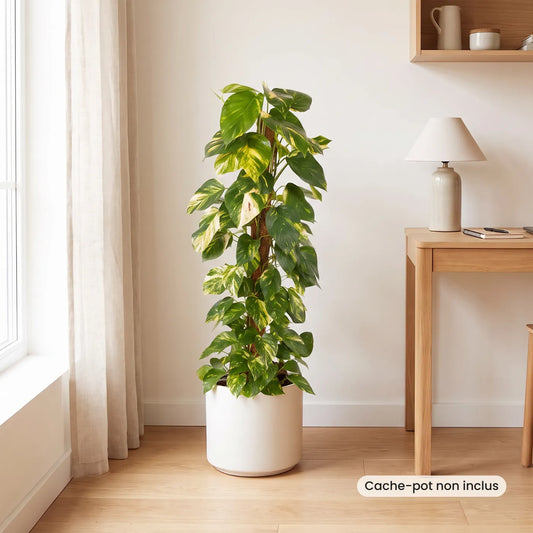
Epipremnum aureum - Golden Pothos on stake - 24cm pot - Height 120cm
Regular price 124,95 €Regular price124,95 €99,96 €Livraison offerte -
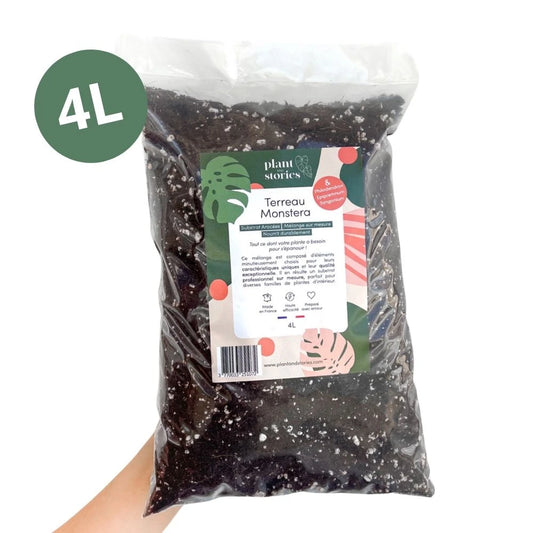
Monstera Soil - Enriched with Mycorrhiza and Bacillus - Araceae Substrate
Regular price From 9,50 €Regular price23,75 €Sale price From 9,50 €9,50 €From 7,60 €Sale -
Set of 2 stackable coconut fiber plant supports + 1m Velcro tape included - Support for climbing plants
Regular price 17,00 €Regular price20,00 €Sale price 17,00 €17,00 €13,60 €Sale -
Transparent plant clips - Transparent plant support clips - Support clips - Plant support clips
Regular price From 4,00 €Regular price4,00 €Sale price From 4,00 €4,00 €From 3,20 €






🧭 Where to place an Epipremnum pinnatum, room by room
Place an Epipremnum pinnatum in a bright room without direct summer sun, at over 18 °C, away from radiators and cold drafts: a living room or office near an east or west window is ideal, a south window is suitable behind a sheer curtain.
The RHS Epipremnum genus page warns that deep shade weakens growth and reduces variegation. For a trailing habit, see our trailing indoor plants.
| Room or situation | Our advice |
|---|---|
| Living room near an east or west window | Ideal, on a floor-standing support |
| South window | Behind a sheer curtain: summer sun burns the leaves (RHS) |
| Hallway or dark corner | Weak growth, reduced variegation (RHS) |
| Shelf or hanging basket | Trailing habit possible, but the leaves remain juvenile (NC State) |
| Near a radiator | Avoid (RHS) |
| Outdoors in summer | Possible in light shade above 15 °C (H1b, RHS), bring in as soon as the nights cool down |
🧬 Epipremnum pinnatum or aureum: what POWO, the RHS and the EPPO say
The link between Epipremnum pinnatum and golden pothos is not settled in the same way everywhere: POWO (Plants of the World Online, Kew) accepts two distinct species, E. pinnatum (L.) Engl., described in 1908, and E. aureum (Linden & André) G.S.Bunting, described in 1964, while the RHS and the EPPO (European and Mediterranean Plant Protection Organisation) place golden pothos in Epipremnum pinnatum.
According to its Epipremnum aureum fact sheet, E. aureum is native only to the island of Moorea in French Polynesia and was introduced to many tropical regions. NC State agrees: plants sold as E. pinnatum 'Aureum' are now classified in the species E. aureum.
The RHS, however, still presents golden pothos as E. pinnatum 'Aureum', and the EPPO lists E. aureum and Scindapsus aureus among the other names of E. pinnatum.
In practice, golden pothos and its cultivars 'Marble Queen', 'N'Joy' or 'Neon' have their own fact sheets: see our complete Epipremnum aureum guide and our golden pothos care (watering, pruning and propagation) fact sheet.
🍃 Leaves that split: obtaining adult foliage
An Epipremnum pinnatum only develops its large split leaves when it climbs: NC State describes elliptical juvenile leaves with smooth edges, then thick, glossy, deeply divided and perforated adult leaves, measuring 30 to 50 cm, and notes that 'Cebu Blue' retains its juvenile form if it does not climb a support. NC State also calls the species dragon-tail plant.
In practice, provide it with a moist moss or coco pole support, bright indirect light and patience. A trailing stem from a hanging basket will instead produce small entire leaves.
To choose and install the support, read our guide for supporting a climbing plant, and to compare it with Monstera leaves, see our Monstera comparison.
🔍 Epipremnum, Scindapsus or Rhaphidophora: how to tell them apart
Epipremnum pinnatum, Scindapsus and Rhaphidophora are three different genera from the same Araceae family, which the trade mixes under the names of pothos or mini monstera. The RHS reminds that Epipremnums are still sometimes sold under the old name Scindapsus.
True Scindapsus pictus 'Argyraeus', or satin pothos, has oval leaves up to 10 cm, dark green mottled with silver, and grows slowly, according to the RHS Scindapsus pictus 'Argyraeus' fact sheet: see our Scindapsus fact sheet.
The NC State Rhaphidophora tetrasperma fact sheet describes a plant native to the Thai and Malay peninsulas with 15 to 30 cm leaves that are fenestrated earlier than those of a Monstera.
To identify an adult Epipremnum pinnatum, look for its thick, glossy leaves, which are cut into strips on either side of the midrib and often marked with small dots or perforations along it (NC State).
🐾 Epipremnum pinnatum and animals: a toxic plant
Epipremnum pinnatum is toxic to cats, dogs, and humans if ingested: NC State rates it as moderately severe, due to the calcium oxalate crystals present in the leaves and stems, with symptoms including mouth and throat irritation, salivation, vomiting, and difficulty swallowing or breathing.
The ASPCA (American Society for the Prevention of Cruelty to Animals) does not have a fact sheet for it, but lists golden pothos, Epipremnum aureum, under the heading Golden Pothos: Toxic to Dogs, Toxic to Cats, citing insoluble calcium oxalates as the toxic principle and clinical signs as "Oral irritation, intense burning and irritation of mouth, tongue and lips, excessive drooling, vomiting, difficulty swallowing".
The RHS adds that the sap can irritate the skin and eyes: wear gloves when pruning. Keep it out of reach of animals, and choose safe species from our list of non-toxic plants for cats.
🗓️ The Epipremnum pinnatum calendar through the seasons
Epipremnum pinnatum is repotted, pruned, and propagated by cuttings in spring, fertilized from April to October, and then requires more spaced-out watering by touch in winter, as winter is when excess water most often causes its roots to rot, warns the RHS. The RHS guide says it has low humidity requirements.
During the heating season, misting briefly increases the humidity around the leaves, which the RHS associates with fewer brown tips; for lasting humidity, group your plants or use a humidifier. See also our tips for houseplants in winter.
📅 Care calendar by season
| Season | Key action |
|---|---|
| 🌸 Spring | Repot every 2 or 3 years, prune, water cuttings, resume fertilizing in April (RHS) |
| ☀️ Summer | Water more frequently by touch, keep the stake moist, protect from direct sunlight |
| 🍂 Autumn | Stop fertilizing in late October, check the undersides of leaves for pests |
| ❄️ Winter | Water more spaced out by touch, room above 18 °C, away from the radiator, no repotting |
🐛 Mistakes to avoid with an Epipremnum pinnatum
The most common mistakes with an Epipremnum pinnatum are overwatering, especially in winter, lack of light, summer direct sunlight, and lack of a stake, which prevents adult leaves from forming. Here is how to avoid them.
| Mistake | Why it's a problem | The solution |
|---|---|---|
| Watering without checking | Root rot, especially in winter (RHS); fungal and bacterial diseases (NC State) | Water when the substrate is dry to a depth of 2 cm |
| Leaving it without a stake | Leaves remain small and undivided (NC State) | Moist moss stake |
| Putting it in the summer sun | Burned leaves (RHS) | Bright indirect light |
| Relegating it to a dark corner | Slow growth, reduced variegation (RHS) | Place near an east or west window |
| Repotting into a pot that is too large | Excess water around the roots (RHS) | One size larger pot |
| Pruning without gloves | Sap irritates the skin and eyes (RHS) | Wear gloves |
| Ignoring pests | Mealybugs, thrips, and spider mites (NC State) | Inspect the undersides of leaves |


🌿 Our Epipremnum pinnatum and their supports
This guide helps you succeed; our Epipremnum pinnatum are delivered already staked for large sizes, and all our Epipremnum are gathered in our Epipremnum collection. Drainage relies on a perforated pot and a well-draining substrate, nothing else.
| Our selection | Why choose it |
|---|---|
| Green Epipremnum pinnatum on a moss stake, 19 cm pot | 80 cm on a moss stake: the vigorous green form, ready to climb |
| Epipremnum pinnatum 'Albo Variegata' on a stake, 24 cm pot | 125 cm on a stake: a large plant variegated with creamy white |
| Epipremnum 'Cebu Blue' | Small silvery-blue leaves, let it climb to see its adult leaves |
| Epipremnum pinnatum 'Marble Green' and Epipremnum 'Snow Leopard' | Marbled or spotted foliage, among our rare plants |
| Stake and sphagnum | Our set of 2 stackable coco fiber stakes and our live sphagnum to keep the support moist, among our stakes and supports |
| Substrate and fertilizer | Our Monstera potting mix enriched with biostimulants, well-draining for aroids, and our liquid houseplant fertilizer |
| Other vines | Our climbing plants and our Philodendron scandens |
✂️ Pruning and propagating an Epipremnum pinnatum
Prune an Epipremnum pinnatum in spring or early summer by cutting just above a leaf, then propagate the pieces: the RHS recommends cutting just below a node, placing the cutting in water in bright light until roots appear, then potting it.
Air layering also works: the RHS suggests pressing a stem against a well-draining substrate until it roots at the node. A cutting taken from an adult stem does not always retain its large leaves: replant it at the base of a stake.
To choose the method, read our guide for propagating in water or potting mix; and watch out for spider mites, mealybugs and thrips, mentioned by NC State.
✅ Our tips for a successful Epipremnum pinnatum
To succeed with an Epipremnum pinnatum, give it bright indirect light, a room between 18 and 30 °C, watering by touch when the substrate is dry to a depth of 2 cm and, above all, a moist moss stake to climb. It is when climbing that its leaves become divided. Find all our Epipremnum to choose between green form, 'Cebu Blue' and 'Albo'.
I love the Epipremnum pinnatum for its rewarded patience: you buy a vine with modest leaves, and one day a divided leaf appears at the top of the stake. In my opinion, it is the best choice for anyone who has already succeeded with a pothos and wants a plant that evolves. My only advice: do not let the moss on the stake dry out, that is what makes all the difference.

Laura Bruneau
Jardinière et autrice