

Poinsettia (Euphorbia pulcherrima): Christmas care and reblooming

To care for a poinsettia, place it in a bright room out of direct sunlight and away from drafts, keep it above 13 to 16°C, and water it only when the surface of the potting mix starts to dry out. These guidelines come from the RHS (Royal Horticultural Society) poinsettia growing guide.
The poinsettia (Euphorbia pulcherrima), also called the Christmas star or Christmas flower, and sometimes spelled poinsetia, poinsetta or poincettia, is not a disposable plant: it is a shrub you can keep and get to flower again the following year, as long as you follow a precise schedule for pruning, summering it outdoors and providing long nights in autumn.
This guide therefore covers the plant's two key phases: Christmas care just after purchase, followed by getting a potted poinsettia to flower again. If you're still choosing between festive plants, our guide to Christmas plants to give as gifts compares them.
🌿 Poinsettia: colorful bracts, not petals
What we take to be the poinsettia's flower isn't a flower at all. The large colorful parts are modified leaves called bracts, while the real flowers, which are greenish-yellow, cluster in the center: these are cyathia, explains the University of Illinois Extension.
According to North Carolina State University Extension (NC State Extension), each cyathium is a small yellow cup less than 2.5 cm across, edged by a large yellow gland, and the bracts are red, pink, white or peach-orange, depending on the variety.
The poinsettia is a short-day plant: it forms flowers and colors its bracts only when nights grow longer, according to the University of Florida Extension (UF/IFAS). That's why it turns red naturally at Christmas, and why you need to recreate these long nights to get it to flower again.
Don't confuse them: the Christmas star is the poinsettia, while the Christmas rose is a hellebore (Helleborus niger), a garden perennial unrelated to it.
| Benefit | What it means for you |
|---|---|
| Color in the heart of winter | Red, pink, white or peach-orange bracts (NC State) when daylight is scarce |
| A plant you can keep | It is a shrub (POWO): with proper care, it regrows in spring and can flower again the following winter |
| Few pest and disease problems | The RHS notes that it generally suffers little from pests and diseases |
| Moderate toxicity | Irritating sap, but toxicity is “generally overestimated,” according to the ASPCA |
🔎 Poinsettia at a glance
Here is the verified profile of the poinsettia. Its name, authors and origin come from Plants of the World Online (POWO), hosted by the Royal Botanic Gardens, Kew; the description, size and toxicity information are from NC State; and its hardiness rating is from the RHS Euphorbia pulcherrima profile.
POWO lists its native range as Mexico and Guatemala, where it grows as a shrub in a tropical biome with a pronounced dry season. The RHS gives it an H1B rating: it can be outdoors in summer, but must be kept under cover for the rest of the year.
| Category | Verified details |
|---|---|
| 🏷️ Botanical name | Euphorbia pulcherrima Willd. ex Klotzsch (1834); synonym Poinsettia pulcherrima (POWO) |
| 🧬 Family | Euphorbiaceae, like all spurges |
| 🌳 Type | Deciduous to semi-evergreen shrub (NC State); H1B hardiness rating, outdoors only in summer (RHS) |
| 🌍 Origin | Mexico and Guatemala, tropical biome with a dry season (POWO) |
| 🍃 Foliage | Large oval leaves with toothed edges (RHS); colorful bracts at the top of the stems |
| 🌸 Flowering | Yellow cyathia in the center of the bracts, in winter, triggered by long nights (NC State, UF/IFAS) |
| 📏 Size | Up to about 3 m in the wild; rarely more than 60 to 90 cm in a pot (NC State) |
| ⚠️ Toxicity | Irritating milky sap; toxicity to dogs, cats and horses is “generally overestimated” (ASPCA) |
📋 Quick growing guide
Essential growing guidelines, all in one place.
| Factor | Guideline |
|---|---|
| Light | Bright, out of direct sunlight (RHS); as much light as possible in winter |
| Watering | When the surface of the potting mix starts to dry out (RHS); never leave water in the cachepot (UF/IFAS) |
| Potting mix | When repotting: 3 parts peat-free loam-based potting mix to 1 part grit (RHS) |
| Humidity | Humidity prolongs flowering (RHS): use a tray of damp pebbles and keep the plant away from radiators |
| Temperature | Minimum 13 to 16°C (RHS); ideally around 20 to 22°C by day and 16 to 18°C at night (Mississippi State) |
| Repotting | Early May, after pruning in April (RHS) |
| Fertilizer | None while flowering (Mississippi State); afterward, use a high-potash fertilizer once a month if you're keeping it (RHS) |
| Toxicity | Sap irritates the skin and eyes: wear gloves when pruning (NC State) |
| Difficulty | Easy while in flower; getting it to flower again requires 14 hours of complete darkness at night |
📍 Where to place a poinsettia: indoors or outdoors in summer, light and drafts
Place your poinsettia in the brightest room, near a window but out of direct sunlight. The RHS recommends bright light, a minimum temperature of 13 to 16°C and a position away from drafts: colder conditions cause physiological shock, and it advises against placing the plant by a fireplace or in an unheated room such as an entrance porch.
Mississippi State University Extension also recommends keeping the plant away from heating vents and radiators, and aims for around 20 to 22°C by day and 16 to 18°C at night (68 to 72°F and 60 to 65°F).
A stable spot is better than moving it around: our guide to winter temperature shock in houseplants explains why a cold draft alone can make leaves drop.
☀️ Poinsettia indoors: Bright window with no direct sunlight; not on a radiator or near an entrance door
🌡️ Warmth: At least 13 to 16°C (RHS), with no sudden fluctuations; it shows signs of stress below about 10°C (50°F) (Mississippi State)
🌳 Poinsettia outdoors: In summer only (H1B, RHS): put it outside when nighttime temperatures stay above about 13°C (55°F), in a sunny spot sheltered from the wind and protected from the midday and afternoon sun, and bring it in before nighttime temperatures fall below about 16°C (Mississippi State)
🪴 Choosing and bringing home a poinsettia: buying, transport and cold
A well-chosen poinsettia keeps its color much longer. When buying one, Mississippi State recommends looking for brightly colored bracts, yellow cyathia that are closed or just beginning to open, and dark green foliage right down to the potting mix. The Illinois Extension adds that the bracts should be colored all the way to the edges and the plant should be about 2.5 times taller than the diameter of its pot.
Avoid plants with yellow or fallen leaves, those packed tightly together, and those that have spent several days in their plastic sleeves, advise both extension services. If you plan to keep it and get it to flower again, choose a branched plant: Mississippi State notes that single-stem, unbranched poinsettias don't flower well again.
| Step | What to do |
|---|---|
| 1. Inspect the plant | Brightly colored bracts, closed yellow cyathia, dark green foliage down to the potting mix (Mississippi State) |
| 2. Check underneath | No yellow or fallen leaves; no aphids or whiteflies beneath the leaves (Illinois) |
| 3. Wrap it for the trip | Use a sleeve closed at the top or a bag, and choose a mild day rather than a frosty one (RHS) |
| 4. Bring it straight home | Go directly to the car and then home: below about 10°C, the plant becomes stressed (Mississippi State) |
| 5. Set it up | Remove the sleeve, place the plant in bright light out of direct sunlight, and empty any water sitting in the cachepot |
columns: 4
columns_mobile: 2
-
Christmas rose 'Christmas Carol' (Helleborus niger) – winter-flowering perennial
Regular price From 44,95 €Regular price -


Japanese skimmias in white and red pairs (Skimmia japonica) – evergreen shade shrubs
Regular price From 44,95 €Regular price -


Japanese Skimmia 'Festival' (Skimmia japonica) – evergreen red and white flowering plant – 15 cm pot – Height 30 cm
Regular price 44,95 €Regular price -

 Livraison offerte
Metallic-effect ceramic planter – precious shimmer
Regular price From 24,95 €Regular price -

 Livraison offerte
Christmas terrarium kit with mini tree, glass jar Ø 18 cm, height 28 cm
Regular price 69,95 €Regular price -

 Livraison offerte
Phalaenopsis Orchid in a Gift Box with Decorative Pot - 9 cm Pot
Regular price 59,95 €Regular price -

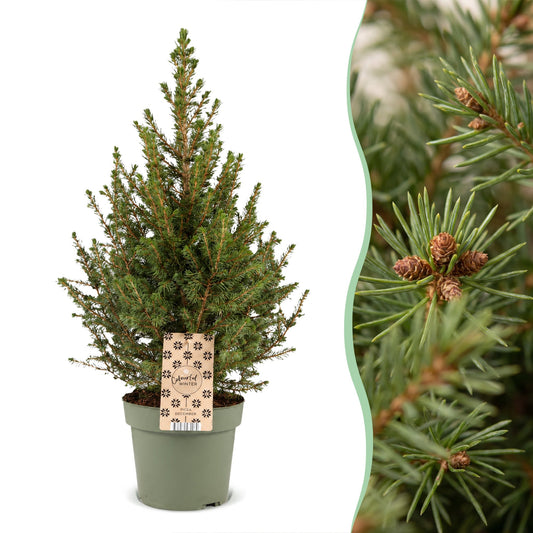
Potted Christmas Tree, Alberta Spruce ‘Conica’ (Picea glauca) – live tree to replant
Regular price From 39,95 €Regular price


✂️ Caring for a potted poinsettia indoors: watering, fertilizer and humidity
At Christmas, caring for a poinsettia mostly comes down to watering: too much water, rather than too little, is what causes it to decline. Mississippi State puts it plainly: overwatering is a major cause of premature leaf and bract drop.
The RHS advises watering sparingly, only when the surface of the potting mix starts to feel dry. Set the pot in a bowl of lukewarm water for 10 to 20 minutes so the root ball can soak it up, then let it drain.
Mississippi State notes that small 10 cm (4-inch) pots dry out faster than 15 or 20 cm pots, so check with your finger rather than following a schedule. To help gauge moisture in the root ball, our guide to moisture meters for houseplants may help.
💧 Watering a poinsettia: Check by touch and water when the surface is dry; soak in lukewarm water for 10 to 20 minutes, then let it drain (RHS); never leave standing water in the cachepot (UF/IFAS)
🌱 Fertilizer: None while flowering (Mississippi State); if you keep it after the holidays, apply a high-potash fertilizer once a month (RHS)
💧 Humidity: The RHS notes that humidity prolongs flowering: use a tray of damp pebbles or group plants together rather than misting; see our article on misting plants
🧣 Winter light: Give it as much light as possible in winter and keep it away from drafts (RHS profile)
🔹 Dry air and heating: Keep it away from heating vents and radiators (Mississippi State); see our solutions for dry air from heating
🍂 Getting a potted poinsettia to flower again: summer care outdoors and long nights
To get a poinsettia to flower again, or turn red again, you need to give it long, completely dark nights in autumn. UF/IFAS notes that flower buds start forming in October and that any artificial light after October 1 delays or interrupts flowering.
The most precise schedule comes from Mississippi State: from October 1 until flowering, provide 14 continuous hours of complete darkness every night and 6 to 8 hours of bright light during the day, for 7 to 10 weeks; the bracts should start to color around late November.
Even the light from a garage lamp or an opening door is enough to prevent flowering at Christmas, the same source warns.
The RHS gives the same basic guidance: 8 to 10 weeks of short days, with less than 12 hours of light, by covering the plant or placing it in a dark room from late September, and keeping the temperature steady at around 18°C for good color.
The detailed RHS profile, however, says to start in November: that's the schedule for natural flowering in December and January. For colored bracts by Christmas, allow 7 to 10 weeks and therefore start between late September and early October, as the RHS guide and American universities recommend.
The University of Arizona Cooperative Extension also recommends 8 to 10 weeks, with nighttime temperatures of around 16 to 21°C (60 to 70°F). In practice, place a large opaque box over the plant each evening, or put it in a closet, then return it to the window each morning.
If your poinsettia no longer produces red leaves, it's almost always because its nights have been interrupted by light.
📅 Seasonal care calendar
| Season | Key task |
|---|---|
| 🌸 Spring | April: cut back hard to about 10 cm and keep the plant at around 13°C (RHS); early May: repot (RHS); resume fertilizing |
| ☀️ Summer | Move outdoors if nighttime temperatures stay above about 13°C (Mississippi State), sheltered from the midday sun; pinch monthly, leaving 4 leaves on each shoot, with the last pinch on September 1 (Mississippi State) |
| 🍂 Autumn | Bring indoors before nighttime temperatures fall below about 16°C; from late September or October 1, provide 14 hours of complete darkness every night for 7 to 10 weeks (Mississippi State) |
| ❄️ Winter | Bracts color around late November (Mississippi State); bright light, minimum 13 to 16°C, water when the surface feels dry, no fertilizer while flowering |
🌱 Care after Christmas: when and how to prune and repot a poinsettia
During the holidays, don't prune: the RHS says pruning is generally unnecessary.
If you want to keep it, cut it back hard in April to about 10 cm and keep it at around 13°C, advises the RHS. Mississippi State recommends cutting it back to about 15 to 20 cm (6 to 8 inches) before moving it outdoors, while the University of Arizona Extension recommends cutting it back to about 20 cm (8 inches) in late April or early May, when the bracts turn a dull green.
During the summer, pinch once a month, leaving four leaves on each shoot to encourage a bushy plant, then stop: Mississippi State sets the last pruning date at September 1, and UF/IFAS at September 10, because pruning later delays flowering. Wear gloves: NC State notes that the milky sap can irritate the skin and damage the cornea if it gets in the eyes.
For repotting, the RHS recommends a mix of three parts peat-free loam-based potting compost (such as John Innes No. 3) to one part grit in early May; the Arizona extension service recommends choosing a pot about 5 to 10 cm (2 to 4 inches) wider than the old one. Mississippi State notes that new shoots appear within two weeks.
The RHS also says it can be propagated from softwood cuttings taken from young shoot tips from spring to early summer; our article on propagating in water or potting compost explains the method.
🐛 Problems: poinsettia dropping leaves or with limp leaves
A poinsettia dropping leaves is almost always reacting to one of three things: cold, overwatering, or a sudden change of location. The RHS cites cold damage as the most common problem, Mississippi State identifies overwatering as a major cause of leaf and bract drop, and the Illinois extension service notes that wilting in wet soil can indicate root rot.
Limp leaves alone therefore don’t tell you whether the plant needs watering: always feel the potting mix before taking action. If your plant already has root damage, see our guide to root rot.
| Symptom | Likely cause | Solution |
|---|---|---|
| Leaves turning yellow and then falling, waterlogged soil | 💧 Overwatering, a major cause of leaf and bract drop (Mississippi State) | Let the surface dry, empty the cachepot, and water only when the mix feels dry |
| Sudden leaf drop after purchase or near a door | ❄️ Cold shock or a draft, the most common problem according to the RHS | Keep it in a stable, bright spot at a minimum of 13 to 16 °C, away from doors and open windows |
| Poinsettia with limp leaves, moist soil | 🍄 Damaged roots: wilting in wet soil can be a sign of root rot (Illinois) | Remove the plant from its pot, trim away brown, soft roots, and repot in dry, free-draining potting mix |
| Poinsettia with limp leaves, dry soil | ⚠️ Simply thirsty, common in small pots that dry out quickly (Mississippi State) | Soak in lukewarm water for 10 to 20 minutes, then let it drain (RHS) |
| Gray mold on the leaves or bracts | 🍄 Gray mold, encouraged by overwatering (RHS) | Remove affected parts, improve air circulation, and water less often |
| Bracts staying green in fall | ☀️ Nights interrupted by artificial light (UF/IFAS, Mississippi State) | Give it 14 hours of complete darkness every night, without exception, until the bracts color up |


🌸 Poinsettia varieties, the red, white, or pink Christmas flower: same care
Poinsettias are mainly distinguished by the color of their bracts: red, pink, white, or peach-orange, according to NC State. The sources consulted give no different care instructions for different colors: white and pink poinsettias are cared for in the same way as red ones. What really matters for reblooming is the plant’s growth habit.
| Variety | What makes it special |
|---|---|
| Red poinsettia | The classic Christmas form, the quintessential red Christmas flower; care and reblooming are the same as for other colors |
| White poinsettia | White bracts (NC State); same care: bright light, a minimum of 13 to 16 °C, and water when the mix feels dry |
| Pink poinsettia | Pink bracts (NC State); same long-night routine to rebloom |
| Peach-orange poinsettia | A color cited by NC State among the varieties’ shades; same care |
| Single-stem poinsettia | Unbranched: Mississippi State says it reblooms poorly and is generally discarded after flowering |
| Branched poinsettia | Several stems from the time of purchase: the best choice if you want to keep it and encourage it to rebloom |
🎨 Which Christmas plants pair well with poinsettias?
Poinsettias are indoor plants; for a display that lasts beyond the holidays, pair yours with plants that can spend the winter outdoors.
Indoors, the amaryllis makes a classic holiday pairing.
If you’re looking for a Christmas plant that will return to the garden every winter, the Christmas rose ‘Christmas Carol’ is a hardy hellebore, while the Japanese skimmias in a white and red duo keep their colorful buds all winter; our guide to Skimmia japonica explains how to grow them.
To dress up the pot, a metallic-effect ceramic cachepot (gold, copper, or silver) works well as long as you empty any water that collects in it.
Indoors, Kalanchoe blossfeldiana, another flowering houseplant, has its own care and reblooming guide, while our guide to houseplants in winter brings together seasonal care tips for your poinsettia and its companions.
⚠️ Are poinsettias toxic to cats and dogs?
Yes, but they are much less toxic than many people think. The ASPCA’s “Poinsettia” profile (the American Society for the Prevention of Cruelty to Animals) classifies them as toxic to dogs, cats, and horses because of their irritating sap: it irritates the mouth and stomach and can sometimes cause vomiting.
The same profile states that their toxicity is “generally overstated.”
On its website for veterinary professionals, ASPCApro, the ASPCA explains that poinsettias have been described as deadly to animals since 1919, although numerous animal studies show this is false: the milky sap may only cause digestive irritation (vomiting, diarrhea).
NC State considers them mildly toxic, and UF/IFAS says they are not poisonous, although some people are slightly allergic to their sap; NC State adds that people with latex allergies may react. Still, keep the plant out of reach of cats that chew on leaves, and call your veterinarian if symptoms occur.
If you have a cat at home, see our list of non-toxic plants for cats.
✅ Our expert tips for success
Remember four key steps for success with your poinsettia. At Christmas, give it the brightest spot possible without direct sunlight, keep it at a minimum of 13 to 16 °C, and protect it from drafts. Water only when the surface of the potting mix dries out, and always empty the cachepot. If you keep it, prune it in April, repot it in May, and let it spend the summer outdoors once the nights are mild.
Finally, from early October onward, give it 14 hours of complete darkness every night for 7 to 10 weeks: this is the only real secret to getting a poinsettia to bloom again.
When a poinsettia drops its leaves in January, I start by asking two questions: where was it during the journey home, and is there water in the cachepot? Getting it to bloom again takes consistency more than skill: it’s the cardboard box you put over it every evening that does the trick. Seeing the bracts turn red a second time is still one of winter’s loveliest rewards for me.

Laura Bruneau
Jardinière & autrice


