Poinsettia (Euphorbia pulcherrima): Christmas care and reblooming

To care for a poinsettia, place it in a bright room away from direct sunlight and drafts, keep it above 13 to 16°C, and water it only when the surface of the potting mix begins to dry. These guidelines come from the RHS (Royal Horticultural Society) poinsettia growing guide.
The poinsettia (Euphorbia pulcherrima), also known as Christmas star or Christmas flower, and sometimes spelled poinsetia, poinsetta, or poincettia, is not a disposable plant: it is a shrub that can be kept and made to bloom again the following year, provided you follow a precise schedule of pruning, summer outdoor care, and long nights in autumn.
This guide therefore covers the plant's two stages: care at Christmas, just after purchase, and then the repowering of the potted poinsettia. If you are still choosing between several festive plants, our guide to Christmas plants to give compares them.
columns: 4
columns_mobile: 2
-


Snow-covered potted Christmas tree, Alberta spruce ‘Conica’ (Picea glauca) - artificial snow
Regular price From 54,95 €Regular price54,95 €From 43,96 €Livraison offerte -


Closed Christmas terrarium kit with Fittonia, heather and decorations, Ø 19 cm glass jar
Regular price 69,95 €Regular price69,95 €55,96 €Livraison offerte -

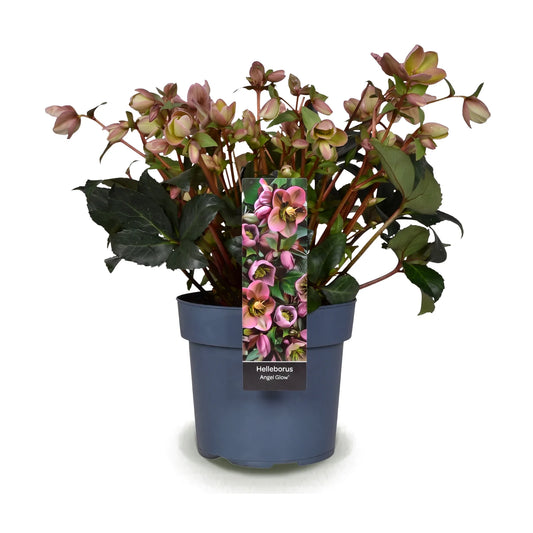
Hellebore 'Angel Glow' (Helleborus x ericsmithii) – winter-flowering perennial – 19 cm pot – height 50 cm
Regular price 59,95 €Regular price59,95 €47,96 €Livraison offerte -
Japanese skimmia 'Finchy' (Skimmia japonica) – shade-loving evergreen shrub
Regular price From 44,95 €Regular price44,95 €From 35,96 €Livraison offerte -


Blue Alberta spruce 'Sander's Blue' (Picea glauca) – dwarf potted Christmas tree – 23 cm pot – 60 cm tall
Regular price From 74,95 €Regular price74,95 €From 59,96 €Livraison offerte -

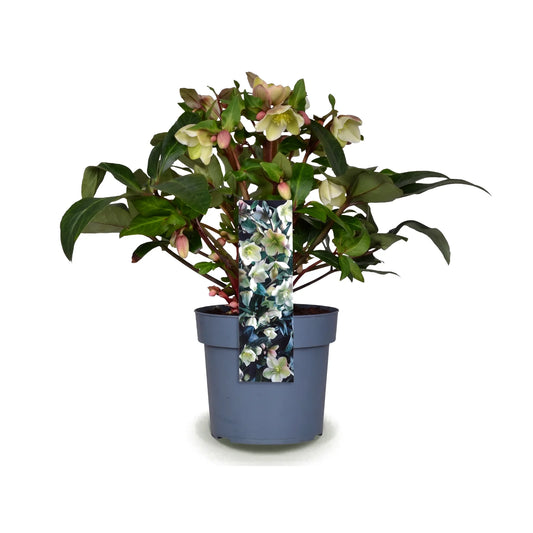
Hellebore 'Diamonfire' (Helleborus × nigercors) – cream-white flowering perennial – 19 cm pot – 40 cm tall
Regular price 59,95 €Regular price59,95 €47,96 €Livraison offerte -

 Livraison offerte Sale
Japanese Skimmia 'Rubella' (Skimmia japonica) – evergreen shade shrub
Regular price From 44,95 €Regular price59,95 €Sale price From 44,95 €44,95 €From 35,96 €Livraison offerte Sale -

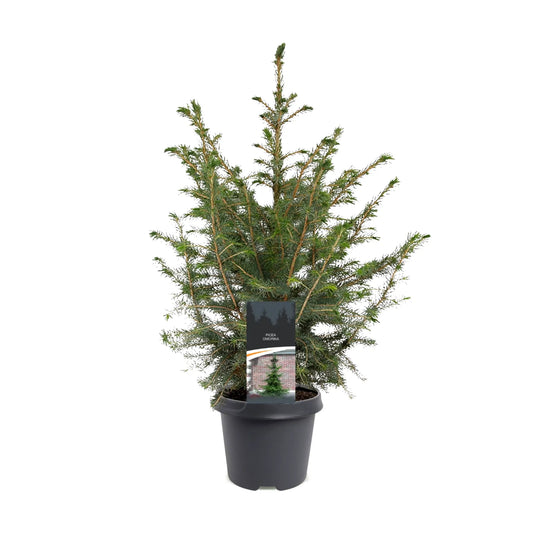
Serbian spruce (Picea omorika) - potted Christmas tree for replanting - 23 cm pot - 70 cm tall
Regular price From 64,95 €Regular price64,95 €From 51,96 €Livraison offerte


🌿 Poinsettia: colored bracts, not petals
What we think of as the poinsettia flower is not one. The large colored parts are modified leaves called bracts, and the real flowers, yellowish-green, are clustered in the center: these are the cyathes, explains the University of Illinois Extension.
According to the North Carolina State University Extension (NC State Extension), each cyathus is a small yellow cup less than 2.5 cm wide, bordered by a large yellow gland, and the bracts are red, pink, white, or peach-orange depending on the variety.
The poinsettia is a short-day plant: it only forms its flowers and colors its bracts when the nights get longer, according to the University of Florida Extension (UF/IFAS). This is why it naturally reddens for Christmas, and why you need to recreate these long nights to make it bloom again.
Do not confuse: the Christmas star is the poinsettia, the Christmas rose is a hellebore (Helleborus niger), a garden perennial with no connection to it.
| Asset | What it means for you |
|---|---|
| Color in the heart of winter | Red, pink, white, or peach-orange bracts (NC State) when light is lacking |
| A plant you can keep | It is a shrub (POWO): properly cared for, it grows back in spring and can bloom again the following winter |
| Few health issues | The RHS notes that it generally suffers little from pests and diseases |
| Moderate toxicity | Irritating sap, but toxicity is "generally overestimated" according to the ASPCA |
🔎 The poinsettia's ID card
Here is the verified ID card of the poinsettia. The name, authors, and origin come from Plants of the World Online (POWO) from the Royal Botanic Gardens, Kew; the description, size, and toxicity from NC State; the hardiness from the RHS Euphorbia pulcherrima fact sheet.
POWO lists it as originating in Mexico and Guatemala, where it grows as a shrub in the tropical biome with a pronounced dry season. The RHS classifies it as H1B: it can go outside in summer, but must live indoors for the rest of the year.
| Criterion | Verified detail |
|---|---|
| 🏷️ Botanical name | Euphorbia pulcherrima Willd. ex Klotzsch (1834); synonym Poinsettia pulcherrima (POWO) |
| 🧬 Family | Euphorbiaceae (Euphorbiaceae), like all euphorbs |
| 🌳 Type | Deciduous semi-evergreen shrub (NC State); H1B hardiness, only outdoors in summer (RHS) |
| 🌍 Origin | Mexico and Guatemala, tropical biome with a dry season (POWO) |
| 🍃 Foliage | Large oval leaves with serrated edges (RHS); colored bracts at the top of the stems |
| 🌸 Flowering | Yellow cyathes in the center of the bracts, in winter, triggered by long nights (NC State, UF/IFAS) |
| 📏 Size | Up to about 3 m in nature; in a pot, rarely more than 60 to 90 cm (NC State) |
| ⚠️ Toxicity | Irritating milky sap; toxicity "generally overestimated" for dogs, cats, and horses (ASPCA) |
📋 Quick technical sheet
The essential growing guidelines, gathered at a glance.
| Parameter | Guideline |
|---|---|
| Light | Bright, without direct sunlight (RHS); maximum light in winter |
| Watering | When the surface of the potting mix begins to dry (RHS); never leave water in the pot cover (UF/IFAS) |
| Substrate | At repotting: 3 parts loam-based potting mix without peat to 1 part gravel (RHS) |
| Humidity | Humidity prolongs the flowering (RHS): tray of damp gravel or grouping plants rather than misting, see our article on misting plants |
| Temperature | 13 to 16°C minimum (RHS); ideal around 20 to 22°C during the day and 16 to 18°C at night (Mississippi State) |
| Repotting | Early May, after April pruning (RHS) |
| Fertilizer | None during flowering (Mississippi State); then potassium-rich, once a month, if you keep it (RHS) |
| Toxicity | Irritating sap for skin and eyes: gloves for pruning (NC State) |
| Difficulty | Easy when flowering; repowering requires 14 hours of complete darkness |
📍 Where to place a poinsettia: indoors or outdoors in summer, light, drafts
Place your poinsettia in the brightest room, near a window, but out of direct sunlight. The RHS requires bright light, a minimum temperature of 13 to 16°C, and no drafts: colder temperatures cause physiological shock, and it advises against the hearth of a fireplace or unheated rooms such as an entrance porch.
The University of Mississippi State Extension also recommends keeping the plant away from heating vents and radiators, and aims for around 20 to 22°C during the day and 16 to 18°C at night (68 to 72°F and 60 to 65°F).
A stable place is better than moving it: our guide to the thermal shock of indoor plants in winter explains why a cold draft is enough to make the leaves fall.
☀️ Poinsettia indoors: bright window without direct sunlight; not on a radiator, nor near an entrance door
🌡️ Heat: at least 13 to 16°C (RHS), without sudden fluctuations; below about 10°C (50°F), it shows signs of stress (Mississippi State)
🌳 Poinsettia outdoors: only in summer (H1B, RHS): take it out when nights remain above about 13°C (55°F), in a sunny but sheltered spot from the wind and protected from noon and afternoon sun, and bring it in before nights fall below about 16°C (Mississippi State)
🪴 Choosing and bringing home a poinsettia: purchase, transport, and cold
A well-chosen poinsettia keeps its colors much longer. At purchase, Mississippi State advises well-colored bracts, closed or barely open yellow cyathes, and dark green foliage down to the substrate; the Illinois Extension adds colored bracts all the way to the edge and a plant about 2.5 times taller than the diameter of its pot.
Avoid plants with yellow or fallen leaves, those that are packed tightly together, and those that have remained in their plastic sleeve for several days, both extensions report. If you plan to keep it and make it bloom again, prefer a branched plant: Mississippi State indicates that single-stemmed, unbranched poinsettias do not rebloom well.
| Step | The right action |
|---|---|
| 1. Look at the plant | Well-colored bracts, closed yellow cyathes, dark green foliage down to the substrate (Mississippi State) |
| 2. Check the underside | No yellow or fallen leaves; no aphids or thrips under the leaves (Illinois) |
| 3. Wrap for the trip | Closed packaging on top or a bag, on a mild day rather than a frost day (RHS) |
| 4. Bring it in quickly | Directly to the car then home: below about 10°C, the plant gets stressed (Mississippi State) |
| 5. Set up | Remove the sleeve, place the plant in the light without direct sunlight, and empty the water that would stagnate in the pot cover |
columns: 4
columns_mobile: 2
-
Christmas rose 'Christmas Carol' (Helleborus niger) – winter-flowering perennial
Regular price From 44,95 €Regular price44,95 €From 35,96 €Livraison offerte -


Japanese skimmias in white and red pairs (Skimmia japonica) – evergreen shade shrubs
Regular price From 44,95 €Regular price44,95 €From 35,96 €Livraison offerte -

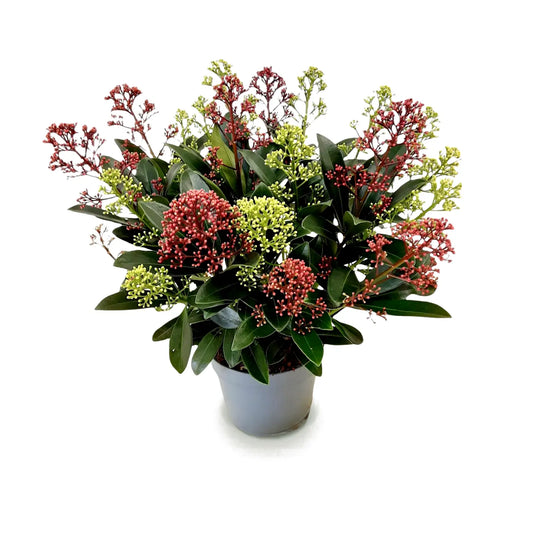
Japanese Skimmia 'Festival' (Skimmia japonica) – evergreen red and white flowering plant – 15 cm pot – Height 30 cm
Regular price 44,95 €Regular price44,95 €35,96 €Livraison offerte -

 Livraison offerte
Metallic-effect ceramic planter – precious shimmer
Regular price From 27,95 €Regular price27,95 €From 22,36 €Livraison offerte -

 Livraison offerte
Christmas terrarium kit with mini tree, glass jar Ø 18 cm, height 28 cm
Regular price 69,95 €Regular price69,95 €55,96 €Livraison offerte -

 Livraison offerte
Phalaenopsis Orchid in a Gift Box with Decorative Pot - 9 cm Pot
Regular price 59,95 €Regular price59,95 €47,96 €Livraison offerte -


Potted Christmas Tree, Alberta Spruce ‘Conica’ (Picea glauca) – live tree to replant
Regular price From 39,95 €Regular price39,95 €From 31,96 €Livraison offerte


✂️ Poinsettia care in a pot and indoors: watering, fertilizer, humidity
The care of the poinsettia plant at Christmas mainly comes down to watering: it is the excess of water, more than thirst, that makes it wither. Mississippi State says it bluntly: overwatering is a major cause of early leaf and bract drop.
The RHS advises watering sparingly, only when the surface of the potting mix begins to look dry, by placing the pot for 10 to 20 minutes in a bowl of warm water so that the root ball soaks up, then letting it drain.
Mississippi State specifies that 10 cm (4 inch) pots dry out faster than 15 or 20 cm ones: therefore check with your finger rather than the calendar. To better judge the moisture of the root ball, our guide to the hygrometer for indoor plants can help you.
💧 Watering the poinsettia: By touch, when the surface is dry; 10 to 20-minute bath in warm water, then drain (RHS); never leave standing water in the pot cover (UF/IFAS)
🌱 Fertilizer: None during flowering (Mississippi State); if you keep it after the holidays, a potassium-rich fertilizer once a month (RHS)
💧 Humidity: The RHS notes that humidity prolongs the flowering: a tray of damp gravel or grouping plants rather than misting, see our article on misting plants
🧣 Light in winter: The maximum light possible in winter, away from drafts (RHS fact sheet)
🔹 Dry air and heating: Away from heating vents and radiators (Mississippi State); our solutions against the dry heating air
🍂 Making a potted poinsettia bloom again: summer outdoor care and long nights
To make a poinsettia bloom again, or make it redden again, you need to give it long and completely dark nights in autumn. UF/IFAS reminds that flower buds begin to form in October and that any artificial light after October 1st delays or interrupts the flowering.
The most precise protocol comes from Mississippi State: from October 1st until flowering, 14 continuous hours of complete darkness every night, 6 to 8 hours of bright light during the day, for 7 to 10 weeks; the bracts must begin to color around the end of November.
Even the light from a garage lamp or an opening door is enough to block the Christmas flowering, this same source warns.
The RHS gives the same logic: 8 to 10 weeks of short days, less than 12 hours of light, by covering the plant or placing it in a dark room from the end of September, with a constant temperature of around 18°C for a beautiful color.
The detailed RHS fact sheet, however, indicates starting from November: it is the calendar of a natural flowering in December and January; for colored bracts by Christmas, you need to count 7 to 10 weeks and therefore start between the end of September and the beginning of October, as the RHS guide and American universities do.
The University of Arizona Extension also counts 8 to 10 weeks, with nights between 16 and 21°C approximately (60 to 70°F). In practice: a large opaque box placed every evening, or a closet, then back to the window every morning.
If your poinsettia no longer makes red leaves, it is almost always because its nights were interrupted by light.
📅 Care calendar by season
| Season | Key action |
|---|---|
| 🌸 Spring | April: severe pruning to about 10 cm, plant kept around 13°C (RHS); early May: repotting (RHS); resumption of fertilizer |
| ☀️ Summer | Outdoors if nights exceed about 13°C (Mississippi State), sheltered from the noon sun; pinch every month leaving 4 leaves per shoot, last pinch on September 1st (Mississippi State) |
| 🍂 Autumn | Back indoors before nights below about 16°C; from the end of September or October 1st, 14 hours of complete darkness every night for 7 to 10 weeks (Mississippi State) |
| ❄️ Winter | Colored bracts around the end of November (Mississippi State); bright light, 13 to 16°C minimum, watering by touch, no fertilizer during flowering |
🌱 Care after Christmas: when and how to prune and repot a poinsettia
During the holidays, do not prune: the RHS indicates that no pruning is generally necessary.
If you want to keep it, cut it back severely in April, to about 10 cm, and keep it around 13°C, the RHS advises; Mississippi State suggests a cut at 15 to 20 cm approximately (6 to 8 inches) before taking it outside, and the Arizona Extension a cut at about 20 cm (8 inches) in late April or early May, when the bracts turn a dull green.
During the summer, pinch out once a month, leaving four leaves on each shoot to obtain a well-branched plant, then stop: Mississippi State sets the final pruning date at September 1, UF/IFAS at September 10, because pruning later delays flowering. Wear gloves: NC State reminds us that the milky sap can irritate the skin and, upon contact with the eyes, damage the cornea.
For repotting, the RHS recommends early May, using a mixture of three parts peat-free loam-based potting mix (such as John Innes No. 3) to one part gravel; the Arizona Extension recommends a pot about 5 to 10 cm (2 to 4 inches) wider than the old one. Mississippi State notes that new shoots appear within two weeks.
The RHS also states that it can be propagated by softwood cuttings taken from the young shoot tips from spring to early summer; our article on propagating in water or potting mix details the method.
🐛 Problems: poinsettia losing its leaves or with limp leaves
A poinsettia losing its leaves is almost always reacting to one of three causes: cold, overwatering, or a sudden change in location. The RHS cites cold damage as the most common problem, Mississippi State lists overwatering as a major cause of leaf and bract drop, and the Illinois Extension notes that wilting on moist soil may indicate root rot.
Limp leaves therefore do not tell you on their own whether to water: always touch the potting mix before acting. For a plant already affected at the root level, see our guide to root rot.
| Symptom | Probable cause | Solution |
|---|---|---|
| Leaves yellowing then falling, waterlogged soil | 💧 Overwatering, a major cause of leaf and bract drop (Mississippi State) | Let the surface dry, empty the pot, and water only when the soil feels dry |
| Sudden leaf drop after purchase or near a door | ❄️ Cold damage or a draft, the most common problem according to the RHS | A stable, bright location at at least 13 to 16°C, away from open doors and windows |
| Limp leaves, moist soil | 🍄 Damaged roots: wilting on moist soil, a possible sign of root rot (Illinois) | Remove from the pot, cut away brown and limp roots, and repot in dry, well-draining potting mix |
| Limp leaves, dry soil | ⚠️ Simple thirst, common in small pots that dry out quickly (Mississippi State) | A 10- to 20-minute bath in lukewarm water, then drain (RHS) |
| Gray fuzz on the leaves or bracts | 🍄 Gray mold, encouraged by overwatering (RHS) | Remove affected parts, improve ventilation, and water less frequently |
| Bracts remaining green in autumn | ☀️ Nights interrupted by artificial light (UF/IFAS, Mississippi State) | Restore 14 hours of complete darkness every night, without exception, until coloration occurs |


🎄 Red Christmas flower: recognizing and choosing the poinsettia
The red Christmas flower given as a gift in December is almost always the poinsettia (Euphorbia pulcherrima), also known as the Christmas star: its color does not come from petals but from bracts, modified leaves that surround its true flowers, the small yellow cyathia in the center. The bracts take on color as the nights lengthen, hence their color at the holidays.
The name often causes confusion: the poinsettia is the Christmas star, not the Christmas rose, and a "red Christmas rose" refers depending on the case to a red poinsettia or a dark red flowering hellebore. The true Christmas rose, Helleborus niger, is a garden perennial with white flowers, sometimes tinged with pink according to the RHS; the purple or dark red flowering hellebores of late winter are generally Christmas roses (Helleborus orientalis and its hybrids), whose flowers the RHS describes as ranging from greenish-white to pink or purple. The table helps you recognize the red holiday plants.
| Christmas plant | What is red | Where to grow it |
|---|---|---|
| Poinsettia (Euphorbia pulcherrima) | The bracts, modified leaves that are red, pink, white, or peach-orange; the true flowers are the small yellow cyathia in the center (Illinois, NC State) | Indoors; outdoors only in summer (RHS H1B) |
| Christmas rose (Helleborus niger) | Nothing: its flowers are white, sometimes tinged with pink (RHS) | In the garden or in a large pot outdoors, very hardy (RHS H7) |
| Christmas rose (Helleborus orientalis and hybrids) | Flowers ranging from greenish-white to pink or purple, often speckled (RHS) | In the garden, in partial shade |
| Amaryllis (Hippeastrum) | Large trumpet-shaped flowers on a stalk, produced from a bulb | Indoors, in a pot |
| Kalanchoe (Kalanchoe blossfeldiana) | Small flowers in tight clusters | Indoors, in a pot |
To choose a beautiful red Christmas flower, use the criteria from Mississippi State and the University of Illinois detailed above: bracts that are well colored all the way to the edge, still-closed yellow cyathia, dark green foliage down to the substrate, and no yellow or fallen leaves. Choose a branched specimen if you want to keep it and make it rebloom, and wrap it for transport in cold weather.
To arrange a holiday table, the red poinsettia pairs well with an amaryllis or a Kalanchoe, and our guide to Christmas plants to give compares these choices.
🔴 How to make a poinsettia turn red?
To make a poinsettia turn red, give it long, completely dark nights in autumn: according to Mississippi State, 14 continuous hours of complete darkness every night starting on October 1, with 6 to 8 hours of bright light during the day, for 7 to 10 weeks. The bracts then begin to take on color toward the end of November.
Even the slightest artificial light during the night is enough to delay coloration, the University of Florida (UF/IFAS) reminds us: cover it every evening with an opaque cardboard box. The bracts take on the color of the variety, red, pink, or white; a poinsettia that remains green has almost always had its nights interrupted. The complete protocol, including the summer care that prepares it, is detailed in the section on reblooming.
🌸 Poinsettia varieties, red, white, or pink Christmas flowers: the same care
Poinsettias are mainly distinguished by the color of their bracts: red, pink, white, or peach-orange according to NC State. The sources consulted do not give different instructions depending on the color: white or pink poinsettias are cared for like red ones. What really matters for reblooming is the plant's growth habit.
| Variety | Its strength |
|---|---|
| Red poinsettia | The classic Christmas shape, the quintessential red Christmas flower; care and reblooming identical to other colors |
| White poinsettia | White bracts (NC State); the same care: bright light, at least 13 to 16°C, watering when the soil feels dry |
| Pink poinsettia | Pink bracts (NC State); the same long-night protocol for reblooming |
| Peach-orange poinsettia | Color mentioned by NC State among the variety shades; identical care |
| Single-stem poinsettia | Unbranched: Mississippi State indicates that it does not rebloom well and generally dies after flowering |
| Branched poinsettia | Several stems upon purchase: the best candidate if you want to keep it and make it rebloom |
🎨 Which Christmas plants to pair with the poinsettia?
The poinsettia lives indoors; for a display that lasts after the holidays, pair it with plants that spend the winter outdoors.
Indoors, the amaryllis forms the classic holiday duo with it.
If you are looking for a Christmas plant that will return to the garden every winter, the 'Christmas Carol' Christmas rose is a hardy hellebore, and the white and red Japanese skimmia duo keep their colorful buds throughout the winter; our Skimmia japonica guide details its cultivation.
To dress up the pot, a ceramic pot with a metallic effect (gold, copper, or silver) works as long as you empty the water that accumulates in it.
Indoors, the Kalanchoe blossfeldiana, another flowering houseplant, has its own care and reblooming guide, and our guide to houseplants in winter gathers the right seasonal practices for your poinsettia and its neighbors.
⚠️ Is the poinsettia toxic to cats and dogs?
Yes, but much less than people think. The ASPCA "Poinsettia" guide (American Society for the Prevention of Cruelty to Animals) classifies it as toxic to dogs, cats, and horses because of an irritating sap: it irritates the mouth and stomach and sometimes causes vomiting.
The same guide states that its toxicity is "generally overestimated".
On its site for veterinarians, ASPCApro, the ASPCA explains that the poinsettia has been presented as deadly to animals since 1919, while many animal studies show that this is false: only digestive irritation (vomiting, diarrhea) due to the milky sap can be observed.
NC State considers its toxicity low and UF/IFAS writes that it is not poisonous, although some people are slightly allergic to its sap; NC State adds that people allergic to latex may react. Still, place it out of reach of a cat that chews on leaves, and call your veterinarian in case of symptoms.
For a household with a cat, consult our list of non-toxic plants for cats.
✅ Our expert tips for success
Remember four actions to make your poinsettia a success. At Christmas, give it the brightest light possible without direct sunlight, at least 13 to 16°C, and no drafts. Water only when the surface of the potting mix is dry, and always empty the pot. If you keep it, prune it in April, repot it in May, and let it spend the summer outdoors once the nights are mild.
Finally, starting in early October, give it 14 hours of complete darkness every night for 7 to 10 weeks: this is the only real secret to making a poinsettia rebloom.
When a poinsettia loses its leaves in January, I first ask two questions: where was it during the trip, and does the pot contain water? Making it rebloom requires consistency more than talent: it is the cardboard placed every evening that makes all the difference. Seeing the bracts turn red a second time remains, for me, one of the most beautiful rewards of winter.

Laura Bruneau
Jardinière et autrice