

Getting an Orchid to Bloom Again: A Guide That Works

To make a Phalaenopsis orchid bloom again, cut the spent flower spike just above the second node, provide it with bright light and a temperature difference of around 5°C at night for one month. These three simple steps trigger the growth of a new flower spike.
A healthy Phalaenopsis has no reason to remain unbloomed: if it refuses to flower, it is almost always because it lacks light or this temperature difference. This guide details each step to get it blooming again, using the proven guidelines of the RHS and the MNHN.
columns: 2
columns_mobile: 2
-
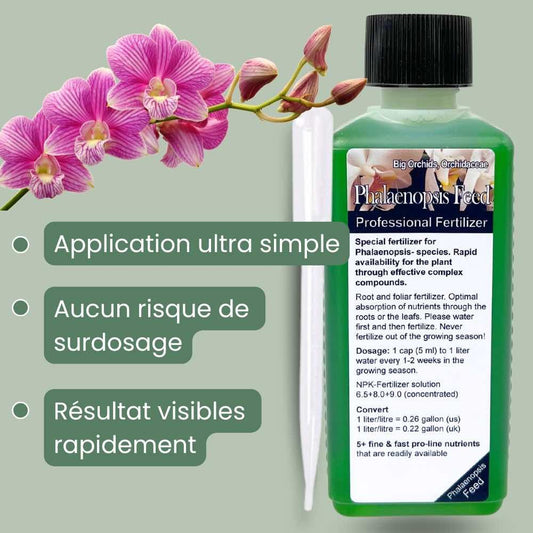
Orchid Fertilizer - Phalaenopsis Fertilizer - 250ml Liquid Fertilizer - Root and Foliar Fertilizer + Free Graduated Pipette!
Regular price 18,00 €Regular price20,00 €Sale price 18,00 €18,00 €14,40 €Sale -
Duo - Premium Orchid Potting Soil 4L + Special Orchid Liquid Fertilizer 250ml + Free Graduated Pipette
Regular price 24,95 €Regular price30,95 €Sale price 24,95 €24,95 €19,96 €Sale


🌸 Why my orchid isn't blooming again
A healthy orchid that isn't blooming again almost always lacks light or a temperature difference between day and night. Flowering is no coincidence: it is triggered when the plant receives enough light and experiences cooler nights, just as it does in its natural environment.
A location that is too dark is the most common cause: an orchid placed far from a window will survive, but it will no longer flower. A lack of fertilizer during the growing season, or a plant weakened by overwatering, also often explains the absence of flowers. The good news: all these causes can be corrected, and the plant will generally start blooming again the following season.
| Common cause | Solution |
|---|---|
| Location that is too dark | Move it closer to an east or west window |
| No day/night temperature difference | Cool the nights by around 5°C for one month |
| Lack of fertilizer | Resume using orchid fertilizer during the growing season |
| Weakened or overwatered plant | Restore healthy watering and potting mix |
✂️ Cutting the flower spike after blooming
Once the last flowers have fallen, cut the spike just above the second node, these small bumps visible on the stem. The MNHN recommends cutting just above the 2nd node when the spike begins to dry; the RHS advises cutting just above the second node below the faded flowers.
A dormant node located below the cut can then produce a new flower branch in a few weeks. If the spike remains green and firm, you can leave it: it can bloom again directly from a node, without the plant having to regrow an entire stem, which saves valuable time.
columns: 4
columns_mobile: 2
-
Premium Orchid Potting Soil, Orchid Substrate, Potting Soil for All Orchids 4L
Regular price 11,99 €Regular price10,95 €Sale price 11,99 €11,99 €9,60 € -
Orchid Fertilizer - Phalaenopsis Fertilizer - 250ml Liquid Fertilizer - Root and Foliar Fertilizer + Free Graduated Pipette!
Regular price 18,00 €Regular price20,00 €Sale price 18,00 €18,00 €14,40 €Sale -
Duo - Premium Orchid Potting Soil 4L + Special Orchid Liquid Fertilizer 250ml + Free Graduated Pipette
Regular price 24,95 €Regular price30,95 €Sale price 24,95 €24,95 €19,96 €Sale -
Transparent Plant Pot - Clear Pot with Perforated Growing Holes
Regular price From 1,95 €Regular price3,25 €Sale price From 1,95 €1,95 €From 1,56 €Sale



🌡️ The trigger: the temperature difference
The real secret to reblooming lies in the temperature. According to the RHS, lowering the temperature by around 5°C at night for one month triggers the growth of a new flower spike.
A slightly cooler room at night, or a sheltered veranda in autumn, naturally reproduces this difference between 18 to 24°C during the day and 16 to 19°C at night, without ever dropping below 16°C.
This is why autumn is the ideal season to get a reluctant orchid blooming again: the nights naturally cool down, which is often enough to trigger flowering. Simply move the plant closer to a window, away from icy drafts, and let the climate do the work for a few weeks.
🌱 Feeding to support reblooming
Applying a special orchid fertilizer every 2 to 3 weeks, from March to October, supports bud formation and flowering. To prevent salt buildup in the potting mix, skip fertilizing every 4 waterings and water with plain water instead. In winter, reduce or stop fertilizing.
| Step | The right action |
|---|---|
| 1. Wait for the flowers to fall completely | The plant is ready to enter its resting phase |
| 2. Cut the spike just above the 2nd node | A dormant node can produce a new stem |
| 3. Provide a 5°C temperature difference at night for one month | This difference triggers the new spike |
| 4. Resume fertilizing every 2 to 3 weeks | It nourishes the buds and flowers |


⏳ How long does it take to bloom again?
Generally, allow anywhere from a few weeks to two or three months between the trigger and the appearance of a new spike, then another few weeks until the flowers open. A Phalaenopsis blooms once or twice a year, with flowers lasting several months: patience is your best ally.
Don't get discouraged if nothing happens in the first week; the plant is working silently before showing a spike.
🌱 Getting an orchid to bloom again when it no longer has a spike
When the spike has completely dried and been cut at the base, the plant must regrow a new flower stem from the base: it takes longer, but it is entirely possible. Focus on the fundamentals that trigger flowering: bright light, a 5°C temperature difference at night for one month, and regular fertilizer.
An orchid that first produces a new leaf and new roots before a spike is on the right track: it is rebuilding its strength. Do not move it constantly or overwater it in hopes of speeding things up, as stress will actually delay flowering. Consistency over several weeks always pays off in the end.
🔁 Can you have two spikes at the same time?
Yes: a vigorous, well-fed orchid can support two flower spikes at the same time, doubling the display. This happens more often with mature plants that are well-lit and regularly fertilized during the growing season.
Do not try to force a second spike on a weakened plant: a beautiful, well-supported bloom is better than an exhausted plant with two spikes it cannot nourish. If your orchid only produces one, that is already a success, and it will bloom again the following year.
🚫 Mistakes that prevent reblooming
Some well-intentioned habits block flowering. Here are the most common ones and how to correct them.
| Mistake | Consequence | What to do instead |
|---|---|---|
| Keeping the plant away from the window | Too little light to flower | Move it closer to an east or west window |
| Heating the room day and night | No temperature difference | Cool the nights by around 5°C |
| Never fertilizing | Plant lacks reserves to flower | Fertilize every 2 to 3 weeks during the growing season |
| Moving the plant constantly | Stress delays the spike | A stable, bright location |
💡 Bringing together all the conditions for reblooming
Reblooming is never the result of a single action, but of several conditions coming together at the same time.
Bright light without direct sunlight, a temperature of 18 to 24°C during the day and 16 to 19°C at night, a difference of around 5°C for one month, fertilizer every 2 to 3 weeks, and healthy roots: when these five elements come together, the spike almost always ends up growing.
If your orchid is taking its time, review these conditions one by one rather than changing everything at once. Most often, it is only missing one—light or the temperature difference—and correcting it is enough. Then give the plant 4 to 8 weeks: reblooming takes time, but it rewards consistency.
Finally, remember that a Phalaenopsis blooms once or twice a year, for several months at a time. Expecting permanent flowering is unrealistic: after a long bloom, the plant needs a resting phase to rebuild its reserves before starting again.
One final point that often reassures beginners: an orchid that does not bloom again immediately is not necessarily sick. As long as its foliage remains green, thick, and firm, and its roots are healthy, the plant is simply rebuilding its strength. Flowering will come as soon as the conditions are met, sometimes with a delay of a few months.
Get into the habit of observing your plant at every change of season: it is at the start of autumn, when the nights cool down, that reblooming most often takes place. One small action at the right time, moving the plant closer to the window, is worth more than ten disorganized interventions throughout the rest of the year.
In summary, getting an orchid to bloom again means restoring the conditions of its natural environment: light, a cooler temperature at night, and regular nourishment. No miracle products, no complicated techniques, just consistency and a little patience. It is within everyone's reach, including beginners who thought they didn't have a green thumb.
Reblooming is nothing magical: it is almost always a matter of light and cooler nights. When a customer tells me that her orchid never flowers again, I ask her where it is placed: nine times out of ten, it is too dark. We move it closer to the window, let the autumn nights do their work, and the spike starts growing all on its own.

Laura Bruneau
Jardinière et autrice


