

Tineke Ficus (Ficus elastica): care, light and variegation

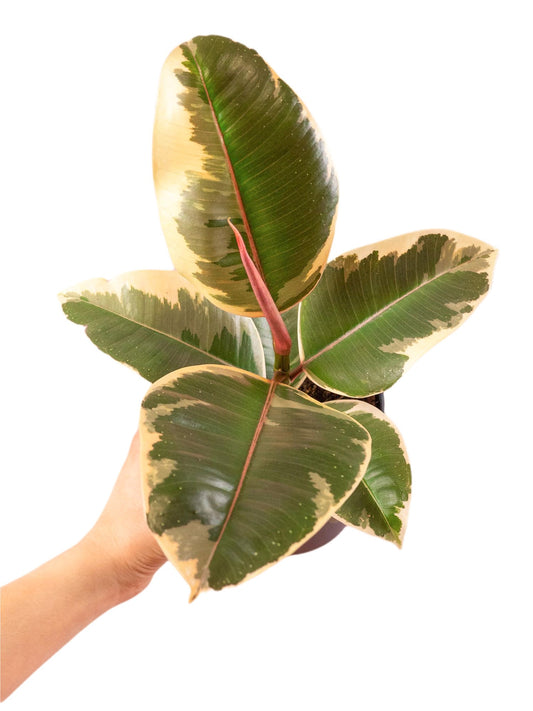
To care for a Ficus 'Tineke', place it in bright, indirect light near a window, water when the topsoil has dried, and keep it at around 18–27°C, away from drafts. This variegated rubber plant is a cultivar of Ficus elastica, recognizable by its large green leaves marbled with cream, which our product page also describes as having pale pink tints on the young leaves.
Here we detail what makes it unique: its variegation, how it differs from 'Belize' or 'Ruby', and its light requirements. For general care information applicable to all ficuses, see our complete Ficus care guide.
🌿 Why choose a Ficus 'Tineke'
The Ficus 'Tineke' offers the stature of a rubber plant with bright foliage that illuminates a living room corner. According to NC State Extension (the North Carolina State University Extension), this cultivar has leaves variegated with green and cream or pale yellow and can reach 13 feet, or about 4 m.
The species itself produces stiff, glossy leaves that can grow up to 17 inches long (about 43 cm) and 6 inches wide (about 15 cm). Indoors, the same source states that it usually grows to between 60 cm and 3 m, with pruning and staking as needed.
| Key feature | What it means for your home |
|---|---|
| Bright foliage | Green leaves marbled with cream that brighten up a plain interior |
| Large stature | Up to about 4 m for the cultivar according to NC State, easily kept in check with pruning |
| Thick, glossy leaves | Stiff foliage that wipes clean with a cloth and stays neat |
| Distinct growth | Each new leaf unfurls from a protective sheath, a spectacle in spring |
🔎 Ficus 'Tineke' at a glance
According to Plants of the World Online (POWO), the database of the Royal Botanic Gardens, Kew, the accepted name is Ficus elastica Roxb. ex Hornem., published in 1819, in the Moraceae family.
Its native range covers Assam, Bangladesh, the Eastern Himalayas, Nepal, Myanmar, Thailand, Laos, Vietnam, southern China, the Malay Peninsula, Sumatra, and Java: it is a tree of the tropical rainforest biome. In the wild, NC State Extension states that it can reach 50 to 100 feet, or about 15 to 30 m.
The name elastica refers to its milky sap, which was once used to produce rubber.
| Criterion | Verified detail |
|---|---|
| 🏷️ Botanical name | Ficus elastica 'Tineke' (species Ficus elastica Roxb. ex Hornem.) |
| 🧬 Family | Moraceae (Moraceae) |
| 🌳 Type | Tropical evergreen tree, grown as an indoor plant |
| 🌍 Origin | Tropical Asia, from the Eastern Himalayas to southern China, Sumatra, and Java |
| 🍃 Foliage | Large glossy leaves, green variegated with cream or pale yellow |
| 🌸 Flowering | Flowers hidden in small figs about 1.3 cm large, rare indoors |
| 📏 Size | About 60 cm to 3 m in a pot; up to about 4 m for 'Tineke' |
| ⚠️ Toxicity | Toxic to dogs, cats, and horses according to the ASPCA |
📋 Quick care sheet
Essential care guidelines at a glance.
| Parameter | Guideline |
|---|---|
| Light | Bright and indirect, without afternoon sun, at least about 1,100 to 2,200 lux |
| Watering | Regular without excess, topsoil dried out, saucer emptied |
| Substrate | Soil-based potting mix for green plants, well-draining, pot with drainage holes |
| Humidity | Tolerates ambient air; tray of wet pebbles near heating |
| Temperature | About 18 to 27°C, never below about 16°C |
| Repotting | In spring, when roots fill the pot, into a pot barely wider |
| Fertilizer | Green plant fertilizer during the growing season, nothing in winter |
| Toxicity | Toxic to animals, gloves recommended for pruning |
| Difficulty | Easy if there is enough light for variegation |
📍 Where to place a Ficus 'Tineke' to maintain its variegation
Place your Ficus 'Tineke' near a bright window, in bright indirect light: NC State Extension recommends bright indirect light or partial shade for the species indoors, with protection from the afternoon sun.
For indoor ficuses in general, including Ficus elastica, the University of Florida (UF/IFAS, Institute of Food and Agricultural Sciences) recommends 100 to 200 foot-candles, or about 1,100 to 2,200 lux, for well-acclimatized plants.
The cream areas of 'Tineke' are low in chlorophyll, the green pigment that captures light: aim for the upper end of this range rather than the minimum. Regarding heat, UF/IFAS recommends around 18 to 27°C (65 to 80°F) and a minimum of around 16°C (60°F) at all times.
☀️ Ideal: Near an east or west window, filtered bright light in the afternoon
🌥️ Acceptable: Bright room further from the window, supplemented by a grow light in winter
🚫 Avoid: Dark corner, scorching sun through the glass, radiator, cold draft
🪴 Repotting a Ficus 'Tineke' without damaging it
Repot your Ficus 'Tineke' in spring, when the roots fill the pot or grow out of the drainage holes. For plants grown indoors, NC State Extension recommends a soil-based potting mix and good drainage; the species also tolerates clay, loamy, or sandy soils outdoors.
Choose a pot with drainage holes that is barely wider than the old one, and heavy if the plant is large, as the wide leaves make it prone to tipping. If you have just received it, wait: UF/IFAS recommends not repotting a Ficus for at least four weeks after it has been installed.
| Step | The right approach |
|---|---|
| 1. Choose the time | Spring, when roots fill the pot, and the plant has been installed for at least 4 weeks |
| 2. Choose the pot | Pot with drainage holes, barely wider, heavy enough for a large plant |
| 3. Remove from the pot | Remove the root ball without pulling on the trunk, untangle roots that are circling |
| 4. Repot | Soil-based, well-draining potting mix, keep the root collar at the same level, stake if needed |
| 5. Water | Water thoroughly, allow to drain completely, return to the same bright place |
columns: 4
columns_mobile: 2
-
Ficus Elastica Tineke
Regular price From 8,95 €Regular price8,95 €From 7,16 € -

 Livraison offerte
Rubber Plant - Ficus Elastica Cloe - 19cm Pot - Height 65cm
Regular price From 64,95 €Regular price64,95 €From 51,96 €Livraison offerte -

 Sold out
Ficus elastica 'Abidjan'
Regular price 14,95 €Regular price19,95 €Sale price 14,95 €14,95 €11,96 €Sold out -



✂️ Ficus 'Tineke' care: watering, humidity, and fertilizer
Regarding watering, NC State Extension summarizes the rule for Ficus elastica: water regularly, without excess, and significantly reduce watering during dormancy, from autumn to the end of winter. Check that the topsoil has dried out before watering, water thoroughly, then empty the saucer.
Our indoor air suits it; near a heater, a tray of wet pebbles is more useful than misting (see our article on misting). Use a green plant fertilizer during the growing season, at the dosage on the label.
💧 Watering: Topsoil dry before watering, then empty the saucer
🔹 Dormancy: Significantly reduced watering from autumn to the end of winter
💧 Humidity: Tray of wet pebbles or group plants together, no misting
🌱 Fertilizer: Green plant fertilizer from spring to the end of summer
🧹 Cleaning: Wipe leaves with a damp cloth to capture light
🍂 Pruning a Ficus 'Tineke' and managing variegation that turns green
A branch that has turned green has more chlorophyll than variegated shoots: it often grows faster and, if left alone, may end up dominating the plant. Cut it at its base with clean pruning shears in spring, then increase the light if the new leaves remain pale and variegated.
The same pruning can be used to limit height or branch a plant that grows up a single stem, which NC State Extension describes as sparsely branched when young. Wear gloves: the milky sap flows abundantly when cut. NC State Extension places it in USDA zones 9a to 12b: it remains an indoor plant all year in France.
📅 Seasonal care calendar
| Season | Key action |
|---|---|
| 🌸 Spring | Prune a branch that has turned green, repot if needed, resume fertilizing |
| ☀️ Summer | Regular watering without excess, filtered bright light in the afternoon, wipe leaves |
| 🍂 Autumn | Space out then stop fertilizing, reduce watering, choose a winter spot before the nights get chilly |
| ❄️ Winter | Bright, consistent spot, at least 16°C, away from radiators, topsoil dry before watering |
🌱 Propagating a Ficus 'Tineke'
For Ficus elastica, NC State Extension mentions air layering, root cuttings, and sowing; air layering remains the safest technique on a thick stem. In spring, make a small incision in the stem below a leaf, wrap the wound in damp sphagnum moss then plastic film, and sever the air layer when roots are visible.
A top cutting taken with pruning shears can also root in a warm, bright place after allowing the latex to dry. A cutting reproduces the variegation of the original stem: choose a well-variegated stem. For the general details applicable to ficuses, see our Ficus guide.
🐛 Common problems: causes and solutions
Why are my Ficus 'Tineke' leaves turning brown or falling off?
For the species, NC State Extension links leaf drop to overwatering, temperature drops, and cold drafts; UF/IFAS reminds that ficuses must be kept above around 16°C at all times.
On a variegated cultivar, the cream areas, lacking chlorophyll, may brown first after a sunburn or cold snap. Regarding pests, NC State Extension lists mealybugs, scale insects, spider mites, and thrips; also see mealybugs.
| Symptom | Probable cause | Solution |
|---|---|---|
| Cream edges turning brown | ☀️ Direct afternoon sun through the glass | Filter the light with a sheer curtain or move the plant back |
| Yellow leaves then drop, damp soil | 💧 Overwatering | Let the soil surface dry, empty the saucer |
| Dark spots and drop after airing | ❄️ Cold snap, below around 16°C | Move away from openings and cold glass |
| New leaves almost green | ☀️ Too little light or branch that has turned green | Move closer to the window, cut the all-green branch |
| Clumps of cottony white, honeydew | 🐛 Mealybugs | Isolate, wipe the leaves, treat if the infestation persists |
| Dull leaves, fine webs | ⚠️ Spider mites | Shower the foliage, wipe the undersides of the leaves |


🌸 Our Ficus elastica varieties
The descriptions below follow those of NC State Extension for Ficus elastica cultivars. 'Belize' adds pink and red to the cream variegation, 'Red Ruby' mixes purple, red, and white with pink stems, while 'Tineke' remains in green, cream, and pale yellow tones; our product page adds pale pink on the young leaves, a tint not mentioned by NC State Extension. Find our rubber plants in our Ficus collection and among our colored plants.
| Variety | Its key feature |
|---|---|
| Ficus elastica 'Tineke' | Green leaves variegated with cream or pale yellow, up to about 4 m |
| Ficus elastica 'Belize' | Green leaves with cream, pink and red highlights, approximately 1.2 to 3 m tall |
| Ficus elastica 'Red Ruby' | Purple, red and white splashes, reddish-pink stems and veins, approximately up to 1.8 m tall |
| Ficus elastica 'Variegata' | Light green leaves edged in white or yellow |
| Ficus elastica 'Cloé' | Rubber plant with large, glossy green leaves and a more massive silhouette |
| Ficus elastica 'Abidjan' | Rubber plant with very dark foliage, creating a striking contrast with 'Tineke' |
🎨 Which plants to pair with your Ficus 'Tineke'
The light variegation of the Ficus 'Tineke' stands out next to dark or fine foliage. Pair it with the Ficus 'Alii' to contrast broad leaves with sword-shaped leaves, or with the Ficus 'Audrey' for a duo of large-growth ficuses.
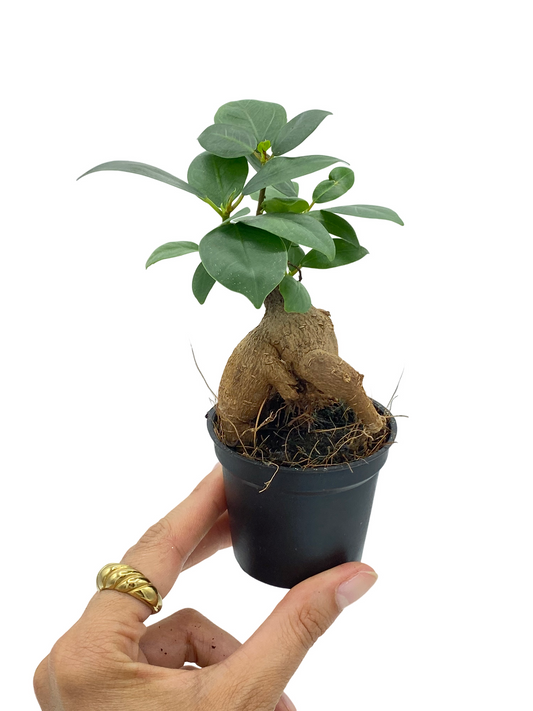
For a display of variegated foliage, the Monstera 'Thai Constellation' and the Croton share the same need for bright light; the Schefflera adds a palm-like layer, and the Ficus ginseng completes the coffee table.
In a low-light area, consider a grow light, and browse our large and medium plants; upon receiving a package, read our guide on acclimating a plant after buying it online.
⚠️ Is Ficus 'Tineke' toxic to cats and dogs?
Yes. The ASPCA (American Society for the Prevention of Cruelty to Animals) does not have a dedicated page for Ficus elastica: its "Weeping Fig" page, which covers Ficus in general (Ficus sp.) and lists the "Indian rubber plant" among its common names, classifies it as toxic to dogs, cats, and horses due to a proteolytic enzyme, ficin, and a psoralen, ficusin.
Contrary to what is sometimes reported, it is not calcium oxalate. NC State Extension also lists the species as problematic for cats, dogs, and horses. Keep it out of reach of pets and contact a veterinarian if ingested.
✅ Our expert tips for success
To keep a Ficus 'Tineke' well variegated, opt for bright indirect light, more than you would for an all-green rubber plant, watering without excess, reduced in winter, and a stable temperature of approximately 18 to 27°C, never below 16°C. Monitor the variegation: cut off any branch that turns entirely green, and pale leaves need more light.
To learn more about the genus, read our guide to Ficus varieties, discover our Ficus 'Tineke', and find its relatives in all our indoor plants.
I love the Ficus 'Tineke' because each new leaf emerges from its sheath with slightly different variegation. At my place, it has always kept its colors near a large window, and faded as soon as I moved it further back into the room. I wait for the potting mix to dry on the surface before watering, and I don't move it again once it has found its place. When a branch turns green, I cut it off without regret in the spring.

Laura Bruneau
Jardinière et autrice


