

Variegated Hibiscus (variegated Hibiscus rosa-sinensis): Care and Flowering

To care for a Hibiscus Variegata, give it the brightest spot in your home, keep its soil moist but not waterlogged, maintain a temperature of 18 to 24 °C, never below 7 to 10 °C at night, and prune it in late winter.
These guidelines come from the University of Minnesota’s indoor hibiscus guide and the RHS (Royal Horticultural Society) hibiscus growing guide.
Hibiscus Variegata is a trade name: it refers to a variegated hibiscus sold as a form of Hibiscus rosa-sinensis, the Chinese hibiscus, a tropical shrub unrelated to the hardy garden rose of Sharon. This guide answers the questions that come up most often: sun or shade, watering, flowering and buds dropping, pruning, summering outdoors, pests and toxicity.
For garden hibiscus, see instead which hibiscus to choose for the garden.
🌿 Hibiscus Variegata: which hibiscus is behind the name?
“Variegata” simply means variegated: this name does not refer to a specific cultivar, and several variegated hibiscus plants are sold under this label. Ours is sold as a variegated form of Hibiscus rosa-sinensis: in our production photos, it has green and cream-white variegated foliage and red flowers.
According to Plants of the World Online (POWO) from the Royal Botanic Gardens, Kew, the accepted name is Hibiscus × rosa-sinensis L., a cultivated hybrid resulting from crosses in the South Pacific, with no natural wild range.
These characteristics partly resemble those of the variegated cultivar 'Cooperi', which Singapore’s National Parks Board (NParks) describes as having leaves splashed with white, light green and pink, and red flowers about 10 cm across; the Montreal Botanical Garden describes it as having green foliage tinged with pink and cream, and scarlet flowers.
In the absence of a cultivar label, and because our photos do not show pink, we cannot say that this is the same cultivar. What we can say for certain is that it is a tropical, tender hibiscus for indoor growing.
| Benefit | What this means for you |
|---|---|
| Double appeal | Decorative variegated foliage all year round and 10 cm flowers from summer to autumn (RHS) |
| Manageable size | Eventually reaches 1 to 1.5 m tall and 0.5 to 1 m wide, according to the RHS; its size can be controlled by pruning |
| Repeat flowering | Each flower lasts one day (NC State), but buds keep appearing as long as there is enough light |
| Summer outdoors | It can spend the summer in the garden or on a balcony and be brought indoors before the nights turn chilly (RHS) |
🔎 Hibiscus Variegata at a glance
Here is an overview of Hibiscus Variegata, based on botanical sources for Hibiscus × rosa-sinensis and our own product information for details specific to this variety.
The RHS profile for Hibiscus × rosa-sinensis describes it as a compact evergreen shrub with glossy dark green leaves, rated H1B: it can spend the summer outdoors but requires a minimum temperature of 10 to 15 °C. Its simple, five-petalled flowers are about 10 cm across and emerge from the leaf axils from summer to autumn.
According to NC State Extension (North Carolina State University), each flower lasts just one day.
| Feature | Verified details |
|---|---|
| 🏷️ Botanical name | Sold as a variegated form of Hibiscus × rosa-sinensis L.; cultivar not specified (POWO for the species) |
| 🧬 Family | Malvaceae, like rose of Sharon (Hibiscus syriacus) and mallow |
| 🌳 Type | Tropical evergreen shrub, not hardy: H1B, minimum 10 to 15 °C (RHS) |
| 🌍 Origin | Cultigen derived from South Pacific hybrids, with no natural range (POWO) |
| 🍃 Foliage | Variegated green and cream-white in our photos and product information; glossy dark green in the species (RHS) |
| 🌸 Flowering | Simple flowers, 10 cm across, from summer to autumn (RHS), each lasting one day (NC State) |
| 📏 Size | 1 to 1.5 m tall and 0.5 to 1 m wide in 5 to 10 years (RHS) |
| ⚠️ Toxicity | No ASPCA profile for H. rosa-sinensis; the ASPCA “Hibiscus” profile (H. syriacus) lists it as non-toxic |
📋 Quick care guide
Essential growing guidelines at a glance.
| Factor | Guideline |
|---|---|
| Light | Very bright; at least 4 to 5 hours of direct light for flowering (Minnesota); bright, filtered light, sheltered from direct sun (RHS) |
| Watering | Keep soil moist, never waterlogged or so dry that the plant wilts; allow it to dry out a little more between waterings in winter (Minnesota) |
| Potting mix | Peat-free indoor plant potting mix or John Innes No. 2 potting mix (RHS), in a pot with drainage holes |
| Humidity | Average humidity and good indoor ventilation (RHS); avoid sudden fluctuations (Minnesota) |
| Temperature | Ideally 18 to 24 °C, around 13 °C minimum during the day (Minnesota); 7 to 10 °C minimum at night (RHS) |
| Repotting | In February or early March (RHS), into a pot only slightly larger |
| Fertilizer | Balanced liquid fertilizer in spring and summer: weekly according to the RHS, about once a month at half strength according to Minnesota; none in winter (RHS) |
| Pruning | In February or early March: shorten the previous year’s shoots (RHS); it tolerates hard pruning (Minnesota) |
| Difficulty | Moderate: easy to keep, more challenging to get flowering without plenty of light |
📍 Where to place a Hibiscus Variegata: light, sun or shade, indoors or outdoors
Sun or shade? For an indoor hibiscus, the answer is sun, or at least as much light as possible. The University of Minnesota says that hibiscus needs very bright light to flower well indoors, ideally by a west- or south-facing window where it gets at least 4 to 5 hours of direct light.
The RHS, on the other hand, recommends bright but filtered light, sheltered from direct sun, and considers a south-facing windowsill suitable in winter; the Smithsonian Gardens says hibiscus prefers full sun, and produces fewer and smaller flowers in partial shade.
Sources therefore differ on direct sun; our compromise is a south- or west-facing window without a sheer curtain in winter, with a light sheer curtain during the hottest hours of summer. Keep it away from radiators, draughts and fireplaces, the RHS warns.
☀️ Hibiscus light: South- or west-facing window, with at least 4 to 5 hours of direct light (Minnesota); use a light sheer curtain in midsummer, as the RHS prefers filtered light; in shade, it produces fewer flowers (Smithsonian)
🌡️ Warmth: Ideally 18 to 24 °C and at least 13 °C during the day (Minnesota); never below 7 to 10 °C at night (RHS)
🌳 Hibiscus Variegata outdoors: Move it outside after the last frost, first placing it on a porch and then in filtered light under a tree before exposing it to full sun (Minnesota); bring it indoors before temperatures drop below 12 °C (RHS)
🪴 Repotting Hibiscus Variegata: when, pot and potting mix
Repot Hibiscus Variegata in February or early March, just before new growth starts, as the RHS guide advises. It recommends a peat-free potting mix, ideally one formulated for indoor plants, or a John Innes No. 2 mix; our universal potting mix enriched with biostimulants is suitable.
Choose a pot with drainage holes that is only slightly wider than the old one: Iowa State University Extension points out that an oversized pot holds too much moist soil, which dries slowly. The RHS advises waiting six to eight weeks after repotting before resuming fertilizing.
If you have just received your plant, read our guide to repotting a plant after purchase.
| Step | What to do |
|---|---|
| 1. Choose the right time | February or early March, before new growth starts (RHS); combine with pruning |
| 2. Prepare the pot | Pot with drainage holes, only slightly wider than the old one; do not add a layer of pebbles at the bottom—the potting mix provides drainage |
| 3. Remove the plant | Tap the pot to loosen the root ball, then gently tease apart any circling roots |
| 4. Set it in place | Keep it at the same depth as before, using peat-free indoor plant potting mix lightly firmed around the root ball |
| 5. Water | Water until it drains through the holes (Minnesota), then empty the saucer; wait 6 to 8 weeks before fertilizing (RHS) |
columns: 4
columns_mobile: 2
-

 Sold out
-
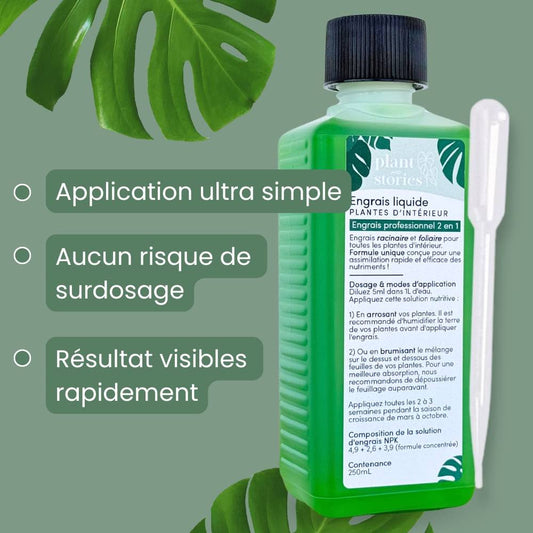
Fertilizer for All Indoor Plants - 250ml Liquid Fertilizer - Root and Foliar Fertilizer + Free Graduated Pipette!
Regular price 18,00 €Regular price20,00 €Sale price 18,00 €Sale -

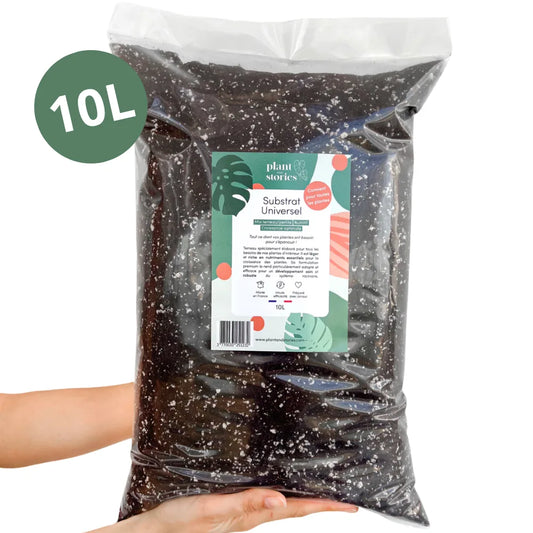
Universal Substrate enriched with Mycorrhizae and Bacillus - Premium Quality - Universal potting mix
Regular price From 9,50 €Regular price8,50 €Sale price From 9,50 € -

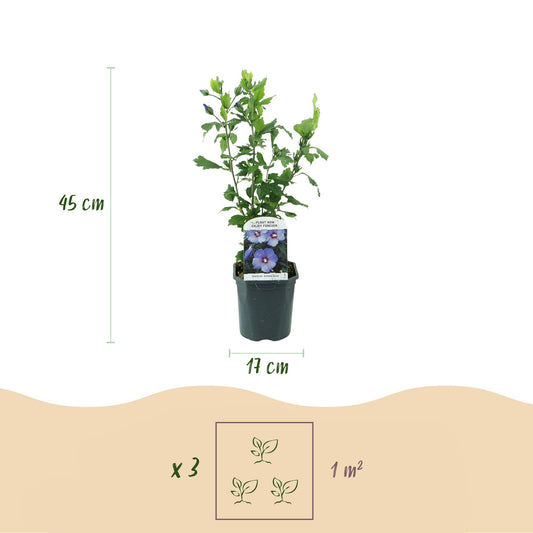
Hibiscus 'Blue Bird' (Hibiscus syriacus) - flowering shrub - 17 cm pot - Height 45 cm
Regular price From 44,95 €Regular price -

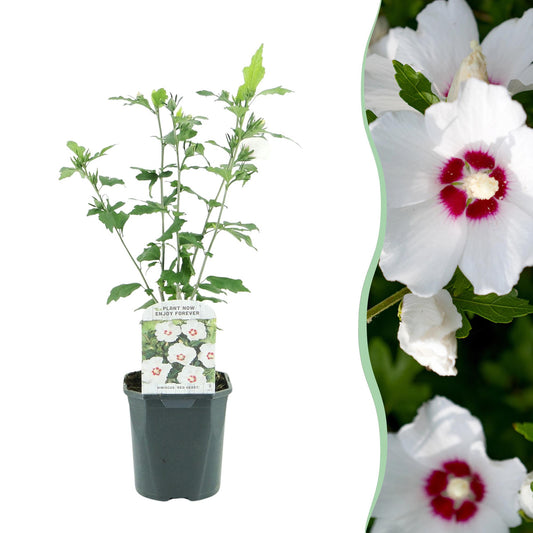
Hibiscus 'Red Heart' (Hibiscus syriacus) - flowering shrub - 17 cm pot - Height 45 cm
Regular price From 44,95 €Regular price




✂️ Caring for Hibiscus Variegata (like any red or white hibiscus): watering, fertilizer and variegation
Caring for Hibiscus Variegata is much the same as caring for any indoor hibiscus, with one extra consideration: keeping an eye on its variegation.
For watering, the University of Minnesota recommends keeping the soil relatively moist but never waterlogged, and never letting it dry out to the point that the plant wilts; water from above until it drains through the pot’s holes, then allow the soil to dry out a little more between waterings in winter.
Smithsonian Gardens confirms that hibiscus does not like to dry out and prefers an evenly moist root ball. Whether your hibiscus is variegated, red-flowered or white-flowered, these care practices for Hibiscus rosa-sinensis remain the same.
💧 Watering hibiscus: Check with your finger: water as soon as the surface dries, until water drains out, then empty the saucer; water a little less in winter (Minnesota)
🌱 Fertilizer: Use a balanced liquid fertilizer from spring through summer, such as our liquid fertilizer for indoor plants; the RHS recommends feeding weekly, while Minnesota recommends monthly at half strength indoors: start with the latter
🔹 Variegation: Remove any entirely green shoots as soon as they appear: the RHS explains that they grow more vigorously and eventually take over the plant
🔹 Spent flowers: Each flower lasts just one day (NC State): remove it as it fades to keep the plant tidy
🧹 Cleaning: Shower or wipe the foliage from time to time: Minnesota recommends this to help limit aphids and spider mites
🍂 Getting Hibiscus Variegata to flower: blooms, buds dropping and winter
Hibiscus flowers on new wood, notes Smithsonian Gardens: to get flowers, it therefore needs new shoots, light and warmth. The RHS says it flowers from summer to autumn.
If buds drop before opening, the University of Minnesota first points to the plant being too cold or too hot, followed by draughts, overwatering or underwatering, and insufficient light; Smithsonian Gardens adds that hibiscus sometimes drops a few buds for no serious reason.
In winter, the RHS warns that buds and leaves may turn yellow and drop as light levels fall: the plant then goes into a period of relative dormancy, which it tolerates well if you reduce watering. It recommends stopping fertilizing in winter.
📅 Seasonal care calendar
| Season | Key task |
|---|---|
| 🌸 Spring | Prune and repot in February or early March; resume fertilizing 6 to 8 weeks later; move it outdoors after the last frost, in stages |
| ☀️ Summer | Bright light, water as soon as the surface dries, fertilize regularly, remove spent flowers and watch for aphids |
| 🍂 Autumn | Bring it indoors before temperatures drop below 12 °C (RHS); reduce watering |
| ❄️ Winter | Place it by the brightest window, keep the soil a little drier, stop fertilizing and never let nighttime temperatures fall below 7 to 10 °C (RHS) |
🌱 Pruning and propagating Hibiscus Variegata
Prune in February or early March, according to the RHS: shorten the previous season’s shoots to maintain a framework that will carry new flowering shoots, cutting vigorous stems back to 4 to 7 cm from their base and removing thin, unproductive stems.
The University of Minnesota confirms that hibiscus tolerates hard pruning in late winter, noting that this also removes buds and delays flowering.
For propagation, the RHS recommends 7 to 10 cm softwood or semi-ripe cuttings taken from late spring to early summer and planted in a sandy, peat-free potting mix; with bottom heat of 24 to 27 °C and a humid atmosphere, roots appear in about two weeks. Take your cuttings from well-variegated shoots.
For the method, see our article on propagating in water or potting mix.
🐛 Common problems: causes and solutions
Most problems with Hibiscus Variegata are caused by its growing conditions, and pests are less common. The University of Minnesota links yellowing and leaf drop to sudden changes in soil moisture or temperature, or to draughts, and notes that yellowing can also indicate that the plant needs fertilizer.
As for pests, the RHS lists aphids, spider mites and greenhouse whitefly; Minnesota lists aphids and spider mites; Smithsonian Gardens also mentions thrips. The table below ranks symptoms from most common to more specific.
| Symptom | Likely cause | Solution |
|---|---|---|
| Buds falling before they open | ☀️ Too cold or too hot, drafts, irregular watering, insufficient light (Minnesota) | Keep it in a fixed, very bright spot, above 13 °C; water regularly when the soil feels dry |
| Yellow leaves falling off | 💧 Sudden changes in soil moisture or temperature, drafts; sometimes lack of fertilizer (Minnesota) | Keep it in a stable location, water regularly, and resume feeding in spring |
| Leaves and buds turning yellow in winter | ☀️ Insufficient light: relative dormancy (RHS) | Move it to the brightest window, reduce watering, and be patient until spring |
| Entirely green branch | ⚠️ Reversion: a non-variegated, more vigorous shoot (RHS) | Cut it back completely or down to the wood bearing variegated leaves |
| Small insects clustered on young shoots and buds | 🐛 Aphids, the main pest along with spider mites (Minnesota, RHS) | Shower the foliage, then use an insecticidal soap approved for hibiscus if needed (Minnesota) |
| Speckled leaves, fine webbing, small white flies | ⚠️ Spider mites or greenhouse whiteflies (RHS) | Shower the undersides of the leaves and isolate the plant; see our spider mite guide |
-

Our flowering outdoor shrubs: buddleias, dogwoods, deutzias, hibiscus, mock oranges and more...


🌸 Our variegated hibiscus varieties and their relatives
Several hibiscus varieties have variegated foliage or similar names, and they are not all grown in the same way. The first two are tropical Hibiscus rosa-sinensis; the last two are Hibiscus syriacus, a different, hardy species for the garden. For these garden hibiscus, see our Hibiscus syriacus (rose of Sharon) guide.
| Variety | What makes it special |
|---|---|
| Hibiscus Variegata | Our variegated hibiscus: green and cream-white foliage, with red flowers in our photos; sold as a form of H. rosa-sinensis, to be grown indoors |
| Hibiscus rosa-sinensis 'Cooperi' | A variegated cultivar described by NParks (Singapore): white, light green, and pink leaves, with red flowers about 10 cm across |
| Hibiscus × rosa-sinensis (green form) | The typical Chinese hibiscus: glossy dark green leaves and 10 cm flowers ranging from crimson to white, orange, and yellow (RHS) |
| Hibiscus tiliaceus 'Variegata' | A different species sold as variegated hibiscus; none of the sources we consulted describe it as an indoor plant, so we do not attribute any growing characteristics to it |
| Hibiscus syriacus 'Oiseau Bleu' | A hardy garden hibiscus, a different species from Chinese hibiscus, to be planted outdoors |
| Hibiscus syriacus 'Red Heart' | Another hardy rose of Sharon for the garden; do not confuse it with an indoor hibiscus |
🎨 Indoor or outdoor hibiscus: choose and pair it well
Hibiscus Variegata is an indoor hibiscus: the RHS rates it H1B, and Minnesota describes it as non-hardy, to be brought indoors before the first frost. If you are looking for an outdoor hibiscus to plant in the ground, you need an Hibiscus syriacus: our article on which hibiscus to choose for the garden compares hardy varieties.
Indoors, Hibiscus Variegata pairs well with other colorful foliage plants that like bright light, featured in our guide to indoor plants with colorful foliage. Place it at the front of the window and keep shade-loving plants behind it.
⚠️ Is Hibiscus Variegata toxic to cats and dogs?
The answer requires some nuance. The ASPCA’s “Hibiscus” entry (American Society for the Prevention of Cruelty to Animals) classifies hibiscus as non-toxic to dogs, cats, and horses, but it covers Hibiscus syriacus, the garden rose of Sharon, not Hibiscus rosa-sinensis, even though it lists “Rose of China” among its common names.
We could not find an ASPCA entry specifically for Chinese hibiscus. A veterinary guide by A. Knight (Colorado State University College of Veterinary Medicine) states that no toxins have been identified in the genus, but dogs that chew and eat the plant may experience excessive salivation, vomiting, and often bloody diarrhea, along with lethargy, loss of appetite, and dehydration.
As a precaution, keep your Hibiscus Variegata out of reach of pets that nibble on plants, and call your veterinarian if symptoms occur. For a home with a cat, see our list of non-toxic plants for cats.
✅ Our expert tips for success
Follow four simple steps to grow Hibiscus Variegata successfully. Give it the brightest window, facing south or west, with a sheer curtain in midsummer. Keep the soil moist but not waterlogged, and never let nighttime temperatures drop below 7 to 10 °C. Prune in February or early March, and remove any branches that have reverted to green to preserve the variegation.
Finally, once it has buds, do not move it: that is the key to seeing its flowers open.
I love Hibiscus Variegata as much for its foliage as for its flowers: even without buds, it remains decorative. My first recommendation is to give it the best window in the house, even if that means moving another plant. When someone tells me the buds are falling, I always ask whether it has been moved or exposed to a draft. And I don’t hesitate to cut off branches that are entirely green.

Laura Bruneau
Jardinière & autrice


