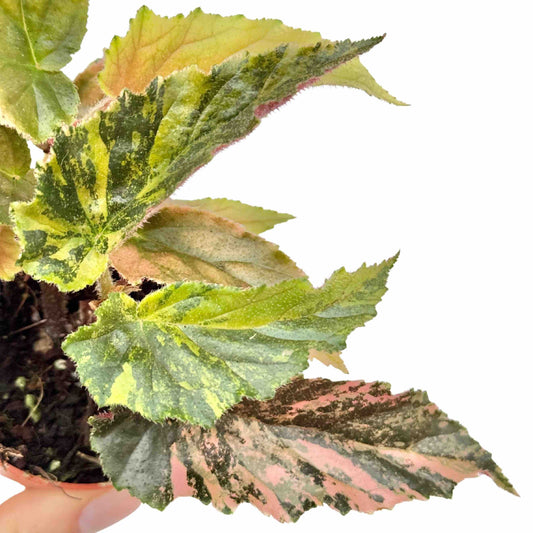
Colorful-Foliage Houseplants: The Guide

A colorful foliage houseplant is one whose leaves display pink, purple, red, or silvery hues thanks to pigments and variegation, rather than its flowers. The key to keeping these colors vibrant comes down to one word: light. Discover our selection in our collection of colorful plants. From pink Aglaonemas to striking dark foliage, these plants bring color without needing flowers, all year round; their vibrancy depends above all on light, which brings out or mutes their pigments, and on a few simple care tips that we explain here to help keep their colors vivid for the long term.
This guide explains where these colors come from, how to distinguish pigment from variegation, which varieties to choose for the palette you want, and how to care for these plants to preserve their vibrancy without exhausting them.
Where does foliage color come from?
A leaf’s color depends on the balance between three families of pigments: chlorophyll (green), carotenoids (yellow, orange), and anthocyanins (pink, red, purple, violet). When chlorophyll decreases or other pigments become more prominent, the leaf changes color. This interplay of pigments explains the diversity of foliage, from the soft pink of Stromanthe to the deep purple of Oxalis.
Anthocyanins are water-soluble pigments involved in a plant’s response to light, temperature, and stress. This explains why foliage color is not fixed: it varies with the age of the leaf, exposure, and temperature, but always within the limits allowed by the plant’s genetics.
| Pigment | Colors |
|---|---|
| Chlorophyll | Green |
| Carotenoids | Yellow, orange, cream |
| Anthocyanins | Pink, red, purple, violet |
Variegation or pigmentation: what’s the difference?
It’s important to distinguish between two mechanisms: variegation, where areas lack chlorophyll (often appearing white or cream), and pigmentation, where colored pigments overlay the green. This distinction makes all the difference to plant care. For more information, see variegation.
In a white variegated area, the absence of chlorophyll prevents the leaf from photosynthesizing: the plant grows more slowly and needs more light. In a pink or purple pigmented leaf, anthocyanins are often present alongside chlorophyll rather than replacing it, so the colored tissue still contributes some energy to the plant. In other words, a pigmented plant is generally more robust than a heavily white-variegated plant, all else being equal. This is a useful distinction when shopping: pink or purple foliage often requires fewer precautions than foliage with extensive white areas.
| Mechanism | Appearance | Effect |
|---|---|---|
| Variegation | White / cream areas | Less photosynthesis, more light needed |
| Pigmentation | Pink, red, purple | Colored tissue remains partially active |
The question I’m asked most often is, “Why is my plant losing its color?” Nine times out of ten, it’s due to a lack of light. I always place my colorful foliage near a bright window, but out of direct sunlight: enough light for the pigments to show, but not so much that it burns the leaf blade. That’s the balance I’ve been fine-tuning in my own collection for years.
The decisive role of light
Light is the number-one factor in color intensity: the right exposure stimulates anthocyanin production, while a spot that’s too dark causes foliage to fade. A study published on red-leaved Aglaonema found that suitable light intensity significantly increases the anthocyanin content of leaves, while too little light reduces it (National Library of Medicine, PMC).
However, beware: too much direct sunlight can burn and bleach the leaf blade. The goal is bright but indirect, filtered light that allows the pigments to show without damaging the leaf. In winter, a grow light can make up for the lack of daylight.
In practice, each species has its own threshold. Colorful Aglaonemas tolerate partial shade but lose their vibrancy below a certain light intensity; pink and purple foliage, rich in anthocyanins, needs more filtered light to stay vivid. That’s why the same plant can display brilliant colors near an east-facing window and fade in a dark hallway: genetics set the potential, but light brings it out.
columns: 4
columns_mobile: 2
-
-

 Sold out
-
-

 Sold out


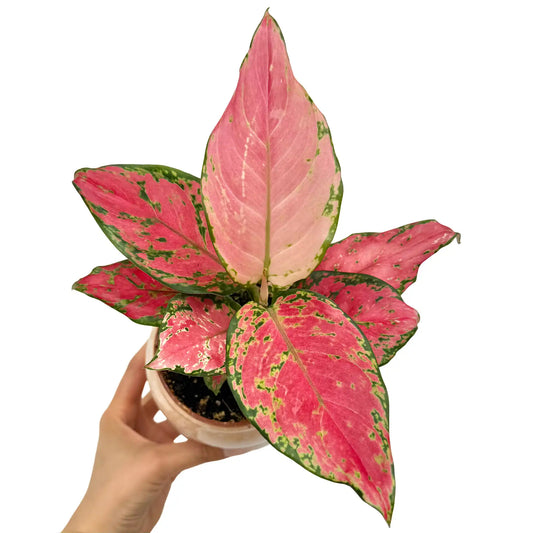

The best pink and purple plants
For a colorful home, a few reliable favorites stand out in different palettes. Pink hues come from anthocyanins, while dark foliage brings purples and bronzes, each with its own care requirements. Some, like Stromanthe Triostar, combine variegation and pigmentation on the same leaf, making them particularly striking but also a little more demanding when it comes to light.
| Variety | Dominant color | Good to know |
|---|---|---|
| Pink / red Aglaonema | Pink, coral, red | Stable color, tolerates partial shade |
| Calathea roseopicta | Pink on dark green | Painted patterns, high humidity |
| Stromanthe Triostar | Pink, cream, green | Variegation + pigment, bright filtered light |
| Oxalis triangularis | Deep purple | Leaves open during the day |
| Alocasia cuprea | Metallic bronze-red | Striking foliage, excellent drainage essential |
Dark foliage and pet-safe plants: other options
Beyond pink, two groups are especially appealing: dark, almost black foliage, and colorful plants that are safe for pets. They expand your color palette without compromising on safety.
For dark foliage, Alocasia cuprea and cultivars with purple-black pigmentation create a striking look. For pet safety, Calathea and Maranta offer spectacular patterns while being safe for pets, unlike Aglaonema and Alocasia, which are toxic if ingested.
These plants have specific needs. Calathea prefer humidity above 60% and temperatures of 18 to 30°C, never dropping below 15°C. Oxalis triangularis, meanwhile, prefers bright indirect light and temperatures of 18 to 24°C: above 27°C, it goes dormant and loses its leaves. The New York Botanical Garden recommends maintaining humidity above 50% during active growth and suggests using a hygrometer to monitor ambient humidity.
📋 Quick reference sheet (for experienced gardeners)
A quick overview of care guidelines common to colorful foliage plants.
| Factor | Guideline |
|---|---|
| Light | Bright indirect; no direct sunlight |
| Main pigment (pink/red) | Anthocyanins |
| Main pigment (yellow/orange) | Carotenoids |
| Humidity | High for Calathea / Maranta (>60%) |
| Growing medium | Well-draining, airy, never waterlogged |
| Water | Soft water for Marantaceae (sensitive to limescale) |
| Color maintenance | Dust leaves, provide consistent light |
| Toxicity | Varies: check by species |
Caring for colorful plants through the seasons
Foliage color changes with seasonal light, so support it all year round.
📅 Seasonal care calendar
| Season | Key task |
|---|---|
| 🌸 Spring | Growth resumes: more light brightens colors; resume fertilizing every 2 weeks |
| ☀️ Summer | Bright filtered light for intense colors, at 20 to 24°C, with no scorching sun |
| 🍂 Autumn | Colors deepen as light levels drop; reduce fertilizing |
| ❄️ Winter | Move closer to a window or add a grow light for 10 to 12 hours a day |


Diagnosis: fading colors or damaged leaves
Most color loss is caused by light or water. Here’s how to read the signs.
| Symptom | Likely cause and solution |
|---|---|
| Fading colors | Not enough light: move closer to a filtered-light window |
| Bleached or scorched leaves | Direct sunlight: filter it or move the plant |
| Brown, dry edges | Air too dry (Calathea): increase humidity |
| Dull, dusty leaves | Clean the leaf blade to restore light exposure |
To create the right environment, our range of potting mixes and growing media meets the specific needs of Marantaceae and colorful aroids.
Key figures by variety
Each colorful plant has its own temperature and humidity thresholds. This table summarizes verified guidelines for three reliable favorites.
| Variety | Temperature | Humidity |
|---|---|---|
| Calathea / Goeppertia | 18 to 30°C, never below 15°C | Ideally > 60% |
| Oxalis triangularis | 18 to 24°C, dormant above 27°C | 40 to 60% |
| Colorful Aglaonema | 18 to 27°C | Moderate to high |
Create a colorful home with Plant and Stories
Long-lasting colorful foliage depends on three essentials: bright filtered light, well-draining soil, and humidity suited to the species. Provide these conditions, and your plants will keep their vibrant pink, purple, and silvery hues all year round. Conversely, foliage that turns green or fades is almost always asking for more light, not showing a flaw in the plant: simply moving it closer to a filtered-light window is often enough to bring back its intensity within a few weeks.
To explore further, browse our rare plants and limited editions, carefully selected and shipped from France. With the right placement, light, and a few accessories, you can keep your foliage vibrant from spring through winter. Try combining several varieties with complementary hues to create a colorful, living display all year round, and rotate your plants toward the light for even growth and well-distributed color.

Laura Bruneau
Jardinière & autrice