Monstera “Obliqua Peru”: Care, Propagation, and True Identity

To successfully grow a Monstera “obliqua Peru,” give it bright, indirect light, water thoroughly then let the top of the potting mix dry out, keep it warm at around 16 to 29°C with high humidity, and provide a support pole: these are the guidelines NC State Extension (North Carolina State University) gives for Monstera adansonii and Monstera deliciosa, as there is no authoritative care sheet for “Peru.”
Before getting into care, one clarification is in order, as this is where most pages get it wrong: “obliqua Peru” is a trade name. No authoritative source confirms that the plant sold under this name is the botanical species Monstera obliqua, and the claim that it belongs to “Monstera karstenianum” is no more credible.
The basic growing guidelines shared across the genus are covered in our Monstera care guide, while the relative it is most often confused with is covered in our Monstera adansonii care sheet. This guide focuses on what is specific to this plant: its identity, differences, and particular needs.
🌿 What is a Monstera “obliqua Peru”?
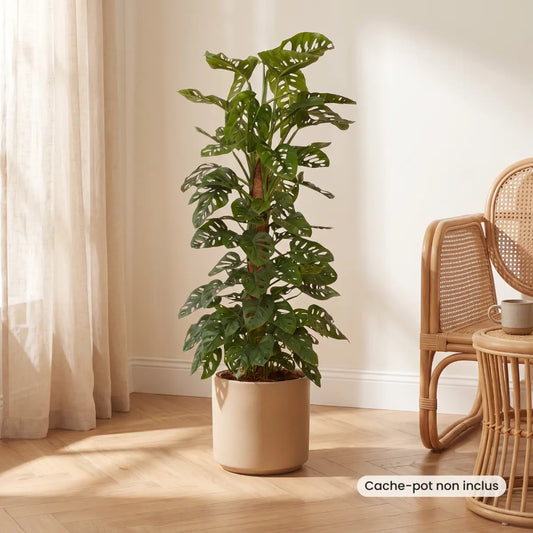
It is a small Monstera prized for its thick, deep-green, quilted foliage, with a pleated look between the veins, as it is sold under this name. Its name combines two things.
“Obliqua” refers to Monstera obliqua Miq., a species described in 1845 and accepted by Plants of the World Online (POWO), the Royal Botanic Gardens, Kew database.
“Peru” evokes Peru; POWO does include Peru in the natural range of M. obliqua, which adds to the confusion, but no botanical source links this commercial plant to a specific population. In the trade, it is also sold as Monstera sp. 'Peru' and Monstera karstenianum.
However, POWO states that Monstera karstenianum Nicolson, published in 1960, is a naked name (nomen nudum: a name published without a description) and lists it as a synonym of Philodendron opacum. The honest conclusion: we cannot give you a definite species name.
What we do know is that it is a climbing aroid in the genus Monstera, grown like its relatives.
| Benefit | What this means for you |
|---|---|
| Thick, quilted foliage | A rare texture among Monsteras that catches the eye up close and from afar |
| Compact size | It fits on a shelf, in a hanging planter, or on a small support pole, where a large Monstera would take over |
| Tougher leaves | Thick leaf blades that are less delicate to the touch than the very thin leaves of some Monsteras |
| An accessible collector's plant | Sold young in a small pot, individually or in a set, at a fraction of the price of true botanical rarities |
🔎 Monstera “obliqua Peru” at a glance
Here is an overview, distinguishing what has been verified from what has not. The names’ status comes from POWO (Kew), which accepts Monstera obliqua Miq. and Monstera adansonii Schott, but does not recognize Monstera karstenianum as a Monstera.
The growing guidelines come from NC State Extension's care sheets for Monstera adansonii and Monstera deliciosa: no authoritative care sheet specifically covers the “Peru” plant, and we note this each time.
| Feature | Verified details |
|---|---|
| 🏷️ Botanical name | Monstera sp. sold as “obliqua Peru”; exact species not established by an authoritative source |
| 🧬 Family | Araceae, like Philodendron and Epipremnum |
| 🌳 Type | Evergreen climbing vine with aerial roots, grown in a pot |
| 🌍 Origin | Trade name that evokes Peru; precise origin undocumented. M. obliqua Miq. occurs from Costa Rica to Bolivia and Brazil, including Peru (POWO) |
| 🍃 Foliage | Small, thick, deep-green leaves, quilted between the veins |
| 🌸 Flowers | Undocumented for this plant; extremely rare in indoor Monsteras |
| 📏 Size | Not documented by an authoritative source; sold young in a small pot (6 to 12 cm, depending on the seller) |
| ⚠️ Toxicity | Calcium oxalates in Monsteras (ASPCA, NC State): treat as toxic |
📋 Quick care guide
The essential growing guidelines, at a glance.
| Parameter | Guideline |
|---|---|
| Light | Bright and indirect; no direct sun, which burns the leaves |
| Watering | Water thoroughly, then let the top quarter to third of the potting mix dry out (NC State, Monstera deliciosa) |
| Potting mix | Airy, well-draining aroid mix that stays lightly moist without becoming waterlogged |
| Humidity | High: use a tray of damp pebbles or a humidifier, as NC State recommends |
| Temperature | About 16 to 29°C (60 to 85°F, NC State for M. deliciosa); never below about 10°C (50°F, NC State for M. adansonii) |
| Repotting | In spring, when roots emerge from the pot |
| Fertilizer | Diluted liquid fertilizer during the growing season; stop in winter |
| Toxicity | Toxic if ingested; sap can irritate the skin |
| Difficulty | Moderate: sensitive to dry air and overwatering |
📍 Where should you place a Monstera “obliqua Peru”?
Choose the brightest spot possible without direct sunlight. NC State Extension recommends bright, indirect light for Monstera adansonii and warns that direct sun burns the leaves; these guidelines also apply to “Peru,” whose foliage is similar. In too little light, a Monstera grows slowly and produces long stems with small leaves.
Its compact size makes it easy to place in a hanging planter near a window or on a high shelf, where it can trail before being guided onto a support pole. As for timing, set it up or move it in spring, when growth resumes.
☀️ Light: in front of an east- or west-facing window, or set back from a south-facing window filtered by a sheer curtain
🌡️ Conditions: a heated room, never below about 10°C (NC State guideline for M. adansonii), away from radiators and cold drafts
📅 Timing: set up, repot, and propagate in spring and summer, during active growth
🪴 Repotting and supporting a Monstera “obliqua Peru”
Like all Monsteras, it is a vine: NC State describes Monstera adansonii as a climber that clings with its aerial roots. In a pot, it needs a rich but very airy potting mix that retains a little moisture without ever staying waterlogged; NC State warns that excess water can cause root rot.
Our Aroid potting mix with mycorrhizae meets these needs. A small moss pole, described in our Monstera moss pole guide, provides the support and moisture its aerial roots seek. Don’t use an oversized pot: a small plant in a large volume of soil will stay wet for too long.
| Step | What to do |
|---|---|
| 1. Choose a pot | Use a pot with drainage holes, only slightly wider than the root ball and never much larger than the old one |
| 2. Prepare the potting mix | Use an aroid mix based on bark, fiber, and perlite, lightly moistened |
| 3. Add the support pole | Push a small moss pole into the bottom of the pot before adding the root ball |
| 4. Plant | Set the root ball at the same depth as before, with aerial roots facing the support pole |
| 5. Tie and water | Tie the stems loosely, water until it drains, then empty the saucer |
columns: 4
columns_mobile: 2
-

 Sold out
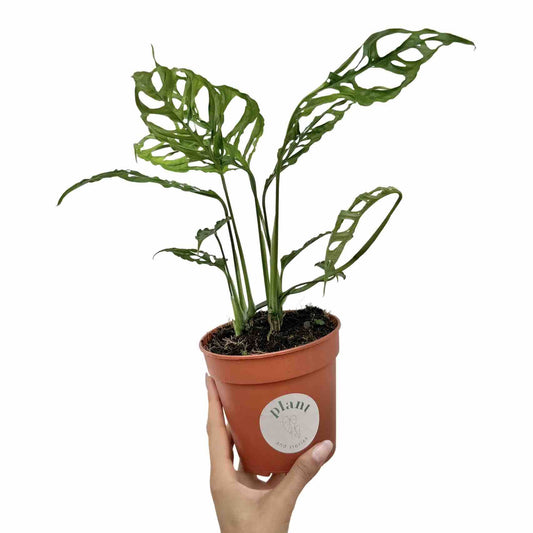
Monstera Obliqua Peru
Regular price From 8,95 €Regular price14,92 €Sale price From 8,95 €8,95 €From 7,16 €Sold out -
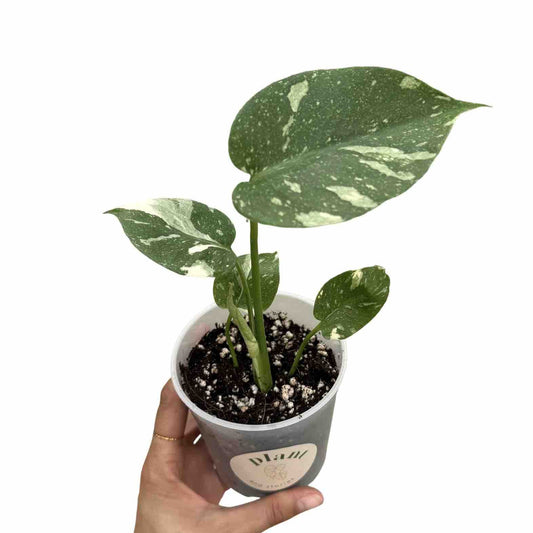
Monstera Thai Constellation
Regular price From 19,95 €Regular price24,95 €Sale price From 19,95 €19,95 €From 15,96 €Sale


✂️ Specific care for Monstera “obliqua Peru”
Day to day, care for it like a small Monstera, paying particular attention to two things: humidity and overwatering. Its thick leaves withstand handling better than thin leaves, but its roots are vulnerable to suffocation in heavy potting mix. For detailed basics, see our Monstera care guide.
💧 Watering: Water thoroughly, then wait until the top quarter to third of the potting mix is dry (NC State); water less often in winter
💧 Humidity: Keep humidity high with a humidifier, by grouping plants together, or with a tray of damp pebbles; do not mist
🌱 Fertilizer: Use diluted liquid fertilizer during active growth, preferably one for foliage plants; do not fertilize in winter
🪢 Support pole: Guide each new stem toward the pole and moisten the moss when it dries out
🧹 Cleaning: Wipe the leaves with a damp sponge, supporting the leaf blade, and inspect the undersides while you’re at it
🍂 Monstera “obliqua Peru” through the seasons
Its growth follows the light and warmth. In spring and summer, it produces new leaves: this is the time to water more often, fertilize, repot, and propagate. In fall, water less often and stop fertilizing. In winter, move it closer to the window and watch for dry air from heating, the main enemy of its foliage.
Keep it within the 60 to 85°F range, or about 16 to 29°C, recommended by NC State Extension for Monstera deliciosa.
📅 Seasonal care calendar
| Season | Key task |
|---|---|
| 🌸 Spring | Repot if needed, add a support pole, resume fertilizing, propagate |
| ☀️ Summer | Water when the top layer is dry, monitor humidity, fertilize during active growth |
| 🍂 Fall | Water less often, stop fertilizing, move away from cold windows at night |
| ❄️ Winter | Keep the mix just moist, do not fertilize, provide maximum light, maintain humidity around the pot |
🌱 Propagating a Monstera “obliqua Peru”
Stem cuttings are the easiest method: NC State recommends this for Monstera adansonii and also cites air layering for Monstera deliciosa. In spring or summer, take a cutting with at least one node, one leaf, and, if possible, an aerial root, using a clean tool.
Root it in damp sphagnum moss, water, or a light potting mix, in a warm spot with bright, indirect light.
For this type of small vine, sphagnum often gives the best results: our guide how to propagate successfully in sphagnum moss explains the method, while our comparison propagating in water or potting mix will help you choose. Repot once the new roots are well established. A cutting faithfully reproduces the mother plant, including its quilted foliage.
🐛 Common problems: causes and solutions
Most issues with “Peru” come from dry air, overly wet potting mix, or insufficient light. As for pests, check the undersides of the leaves: thrips are a common Monstera pest, covered in our guide to thrips on Monstera.
| Symptom | Likely cause | Solution |
|---|---|---|
| Yellow leaves, soft stem bases | 💧 Overwatering, suffocated roots | Let the top of the potting mix dry out, empty the saucer, and repot in an airy mix |
| Brown, dry leaf edges | ⚠️ Air is too dry, especially during the heating season | Increase humidity with a tray of damp pebbles or a humidifier |
| Long stems, small leaves spaced far apart | ☀️ Not enough light | Move it closer to a window or add a grow light |
| Scorched patches on the leaf blade | ☀️ Direct sunlight through a window | Filter the light with a sheer curtain or move the plant farther back |
| Leaves without holes | ⚠️ Normal appearance for the plant sold under this name, especially when young | Nothing to fix: its signature is quilted foliage, not fenestrations |
| Silvery spots, dull leaves | 🕷️ Thrips or spider mites, encouraged by dry air | Shower the foliage, isolate the plant, and treat the undersides of the leaves |


🌸 Monstera varieties not to confuse it with
The “Peru” is often confused with several Monstera varieties. Several French sales pages describe it as having highly fenestrated leaves, confusing this commercially sold plant with the botanical species Monstera obliqua. Here’s how to tell them apart, drawing on POWO’s entry for Monstera adansonii and our dedicated plant profiles. To compare the whole genus, see our Monstera variety comparison.
| Variety | What makes it special |
|---|---|
| Monstera obliqua Peru | Small, thick, puckered leaves; sold as a young plant in a small pot, individually or in a set |
| Monstera adansonii | Accepted species (Schott, 1830, according to POWO): heart-shaped, glossy leaves with oval holes, reaching about 45 cm (18 inches) in the wild; fast-growing according to NC State |
| Monstera obliqua Miq. (the true species) | Botanical species accepted by POWO, described in 1845: not to be confused with the plant sold under the name “obliqua Peru” |
| Monstera Esqueleto | Large, deeply fenestrated leaves with prominent skeletal veins: a plant of an entirely different size |
| Monstera adansonii variegata | The fenestrated cousin, variegated in white or cream and more demanding when it comes to light |
| Monstera Thai Constellation | A Monstera deliciosa cultivar with speckled cream variegation, ideal for a large statement plant in a collection |
🎨 Which plants pair well with Monstera “obliqua Peru”?
It shares its care needs with small tropical vines: bright indirect light, moderate watering, and high humidity. Create a collection shelf with a trailing Philodendron scandens, a Rhaphidophora tetrasperma with split leaves, or a Monstera adansonii to compare the two types of foliage side by side.
Grouping these plants helps maintain a more favorable local humidity level, a principle explained in our guide to increasing air humidity. Explore the whole family in our Monstera collection, browse our rare plants and hanging plants, or see all our indoor plants.
⚠️ Is Monstera “obliqua Peru” toxic to cats and dogs?
It should be considered toxic. No toxicity profile is available for the plant sold under this name, but all documented Monstera species are toxic.
The ASPCA (American Society for the Prevention of Cruelty to Animals) profile for Monstera deliciosa classifies it as toxic to dogs and cats because it contains insoluble calcium oxalates. Symptoms include mouth irritation, intense burning of the mouth, tongue, and lips, excessive drooling, vomiting, and difficulty swallowing.
NC State classifies Monstera adansonii as a low-severity poison for humans, cats, and dogs, and notes that its sap can irritate the skin: wear gloves when pruning it. Keep it out of reach and contact a veterinarian if it is ingested.
✅ Our expert tips for success
Keep three things in mind about Monstera “obliqua Peru.” First, its name is commercial: nothing supports identifying it as the botanical species Monstera obliqua, and “karstenianum” is not a Monstera name recognized by POWO. Second, its signature feature is small, thick, puckered foliage—not leaves full of holes.
Finally, grow it like other Monstera: bright indirect light, temperatures of about 16–29°C, high humidity, an airy substrate, and a support pole. With these basics in place, it’s a rewarding collector’s plant that takes up little space.
I love “Peru” because it doesn’t look like any other Monstera: its puckered leaves make you want to reach out and touch them. In my experience, disappointment almost always comes from expecting fenestrated leaves, when that’s simply not its style. Mine thrives on a bright shelf among other plants, with a small moss pole. Give it humidity around the pot and a little patience, and it will reward you.

Laura Bruneau
Jardinière et autrice