Philodendron melanochrysum: care, support pole and humidity

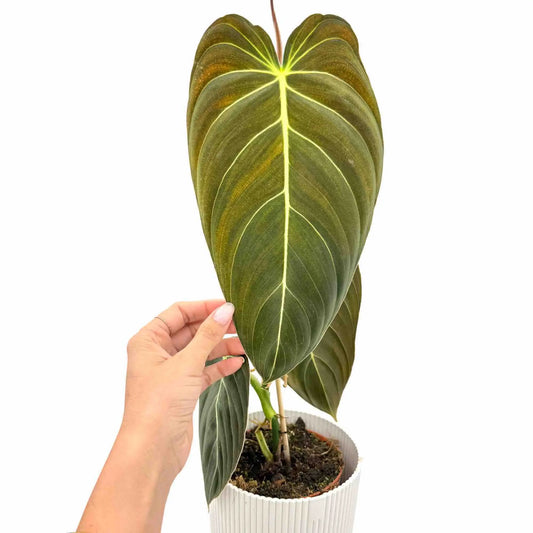
To care for a Philodendron melanochrysum, give it bright, filtered light, temperatures of at least 15 °C year-round, moderate watering in an airy potting mix, and a support to climb on. Philodendron melanochrysum, often called “melano” by collectors, is a climbing vine in the Araceae family, native to Colombia, with large, heart-shaped, velvety dark green leaves with coppery highlights.
Its care is similar to that of other climbing Philodendron, with two extra requirements: air that is not too dry and a support. For the basics that apply to the whole genus, read our Philodendron care guide; the full range is gathered in the Philodendron collection.
🌿 Philo melanochrysum: a climbing Philodendron from Colombia with velvety foliage
Philodendron melanochrysum Linden & André, described in 1873, is, according to Plants of the World Online, Kew’s database, a climbing plant from humid tropical habitats, native to Colombia. Its species name combines the Greek melas, meaning black, and chrysos, meaning gold: the RHS also calls it the black-gold philodendron.
In nature, like many Philodendron, it clings to tree trunks using its aerial roots: NC State Extension (North Carolina State University) notes that climbing Philodendron attach their aerial roots to a stake or trellis, and describes melanochrysum as a rare vine with large, velvety, deep green leaves and yellow veins.
This is the humid-tropical-vine habit you need to recreate at home: filtered light, mild conditions and a vertical support.
| Benefit | What it means for you |
|---|---|
| Rare velvety foliage | Large, velvety dark green leaves with coppery highlights and pale green veins (RHS) |
| Leaves that grow with the plant | With good support, it goes from small juvenile leaves to leaves measuring 25 to 75 cm (RHS) |
| A year-round houseplant | The RHS classifies it as H1A: it can be kept under cover year-round, above 15 °C |
| A plant that can be propagated from cuttings | Take a tip cutting or a bud cutting with its leaf, according to the RHS |
🔎 Philodendron melanochrysum at a glance
Here is the verified profile of Philodendron melanochrysum.
The RHS (Royal Horticultural Society) Philodendron melanochrysum profile describes large, heart-shaped leaves with a velvety texture, 25 to 75 cm long, dark green with coppery highlights and pale green veins, on a plant that reaches 2.5 to 4 m tall at maturity, which it achieves in 5 to 10 years.
Kew lists two synonyms, Philodendron andreanum and Philodendron grandidens, sometimes found in older books. NC State also notes that the genus includes more than 600 species, and that young and mature plants can look very different.
| Feature | Verified details |
|---|---|
| 🏷️ Botanical name | Philodendron melanochrysum Linden & André (Kew POWO) |
| 🧬 Family | Araceae |
| 🌳 Type | Evergreen vine that climbs using its aerial roots |
| 🌍 Origin | Colombia, humid tropical habitats (Kew POWO) |
| 🍃 Foliage | Heart-shaped, velvety leaves, 25 to 75 cm long, dark green with coppery highlights and pale green veins (RHS) |
| 🌸 Flowering | Arum-family inflorescence (spathe and spadix), rare indoors |
| 📏 Size | 2.5 to 4 m tall and 0.5 to 1 m wide at maturity, in 5 to 10 years (RHS) |
| ⚠️ Toxicity | Calcium oxalates: harmful if ingested (RHS, NC State); Philodendron are toxic to dogs and cats (ASPCA) |
📋 Quick care guide
Essential growing guidelines, all in one place.
| Factor | Guideline |
|---|---|
| Light | Bright but filtered (RHS); never direct sun, which scorches the leaves (NC State) |
| Watering | Moderately, checking by touch, and less when it is cooler (RHS); overwatering causes root rot (NC State) |
| Potting mix | Rich in humus and well-drained (RHS), airy with bark and perlite |
| Humidity | Preferably high (NC State): use a humidifier and group plants together; do not mist (Iowa State) |
| Temperature | At least 15 °C in winter (RHS); approximately 18 to 29 °C (65 to 85 °F, NC State) |
| Support | Essential: a tall, stable moss or coco-fiber pole |
| Repotting | In spring (NC State), into a pot only slightly larger |
| Fertilizer | Diluted liquid houseplant fertilizer in spring and summer |
| Toxicity | Calcium oxalates: keep out of reach of cats and dogs (ASPCA, NC State) |
| Difficulty | Moderate: easy if given warmth, a support and air that is not too dry |
📍 Where to place a Philodendron melanochrysum: light and temperature
Place your Philodendron melanochrysum near an east- or west-facing window, or set back from a south-facing window behind a sheer curtain, in a heated room. The RHS recommends bright but filtered light and a partially shaded south-, east- or west-facing position; NC State notes that Philodendron prefer bright indirect light and that direct sun can scorch their leaves.
As for temperature, the RHS requires a minimum of 15 °C in winter, while NC State puts the ideal range for Philodendron at 65 to 85 °F, or about 18 to 29 °C, and notes that they are very sensitive to cold. Avoid drafts and direct contact with a radiator.
🌅 East- or west-facing window: The ideal spot: plenty of light and brief, gentle sunshine. A sheer curtain is enough to filter the western sun in summer.
🌡️ Heated room: Never below 15 °C (RHS): no cold conservatory in winter and no icy windowsill.
🪟 Dark room: It will stretch and produce small leaves: move it closer to a window or supplement with a grow light.
🪴 Philodendron melanochrysum potting mix and repotting in 5 steps
The RHS recommends growing Philodendron melanochrysum in a potting mix rich in humus and well-drained; NC State recommends soil for Philodendron that is moist but well-drained and rich in organic matter, and warns that overwatering causes root rot.
In practice, this means a mix that retains a little moisture without ever becoming compacted: a base of potting mix for aroids, loosened with pine bark and perlite.
Our Monstera and aroid potting mix is designed for these climbing plants; to learn more, read our guide to aroid potting mix for collectors.
| Step | What to do |
|---|---|
| 1. Choose the right time | In spring (NC State), when the plant resumes growing |
| 2. Choose a pot | Only slightly larger than the old one, with drainage holes and heavy enough to support the pole |
| 3. Prepare the potting mix | Airy aroid mix, rich in humus and well-drained (RHS), loosened with bark and perlite |
| 4. Insert the support first | Push the pole into the bottom of the pot before adding the potting mix, then position the stem against it |
| 5. Water and drain | Water thoroughly, then empty the saucer: the roots must never sit in water |
columns: 4
columns_mobile: 2
-

 Sold out
Philodendron melanochrysum
Regular price 39,95 €Regular price39,95 €31,96 €Sold out -
Philodendron Melanochrysum 'Variegata'
Regular price 179,95 €Regular price179,95 €143,96 €Sold out -

 Sold out
Philodendron Gloriosum
Regular price From 9,95 €Regular price9,95 €From 7,96 €Sold out -
Monstera Soil - Enriched with Mycorrhiza and Bacillus - Araceae Substrate
Regular price From 9,50 €Regular price23,75 €Sale price From 9,50 €9,50 €From 7,60 €Sale -
Set of 2 stackable coconut fiber plant supports + 1m Velcro tape included - Support for climbing plants
Regular price 17,00 €Regular price20,00 €Sale price 17,00 €17,00 €13,60 €Sale



✂️ Philodendron melanochrysum care: watering, humidity, support and fertilizer
Once established, a Philodendron melanochrysum needs little attention, but care should be regular. Here are the five things to monitor, from most important to simplest.
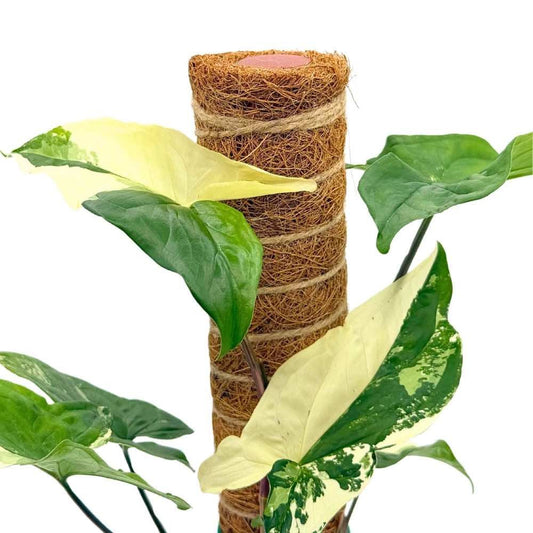
🪢 Support: This is the key step. Climbing Philodendron attach their aerial roots to a support (NC State). For Monstera, another climbing aroid, the RHS recommends a moss pole in its growing guide; the plant can root into it if the moss stays moist. See our moss pole guide or our stackable coco-fiber poles, which can be extended as the plant grows.
💧 Humidity: NC State says Philodendron prefer high humidity but adapt to the humidity in a home; a humidifier can help. Iowa State University Extension points out that misting is not an effective way to raise humidity: use a humidifier and group plants together instead. See our guide on how to increase air humidity.
💧 Watering: Water moderately when the top of the potting mix has dried, and less often when temperatures drop, as the RHS recommends. Never leave standing water in the saucer.
🌱 Fertilizer: Use diluted liquid houseplant fertilizer from spring until late summer; do not feed in winter, when growth slows.
🔹 Leaves: Do not rub the velvety leaves: dust them with a soft brush. Check the undersides; the RHS lists mealybugs and red spider mites among its pests.
🍂 Philodendron melanochrysum through the seasons
In spring and summer, Philodendron melanochrysum grows: this is the time to repot it, extend its support, secure new stems and feed the plant. The RHS classifies it as H1A, meaning it should be grown under cover year-round above 15 °C: do not put it outdoors in the garden, even in summer, except in a warm greenhouse.
In winter, keep it above 15 °C and water less. Penn State Extension notes that in winter, humidity in a heated home can easily fall below 30%, and that a humidifier helps, even if it does not achieve ideal levels: this is the season when its leaves are most likely to turn brown.
Our guide to dry air and heating in winter covers helpful care steps.
📅 Seasonal care calendar
| Season | Key task |
|---|---|
| 🌸 Spring | Repot if needed, resume fertilizing, extend the support |
| ☀️ Summer | Active growth: water according to the potting mix, use diluted fertilizer, secure new stems to the support |
| 🍂 Autumn | Water less often, gradually stop fertilizing, watch for pests |
| ❄️ Winter | At least 15 °C, reduce watering, use a humidifier if the air is dry, keep away from radiators |
🌱 Propagating Philodendron melanochrysum: method
The RHS recommends propagating Philodendron melanochrysum from a soft tip cutting or a bud cutting with its leaf. In spring, take a section of stem with at least one node, preferably with an aerial root, and cut it with a clean blade.
Root it in moist sphagnum moss in a warm spot with filtered light, as explained in our guide to propagating in sphagnum moss. Melanochrysum cuttings root slowly: expect to wait several weeks before new roots appear, though there is no guaranteed timeframe.
Pot it up in an airy potting mix once the roots are a few centimeters long, then immediately add a small support. Leaves on a young cutting are small: they will grow as the plant climbs.
🐛 Philodendron melanochrysum problems: causes and solutions
Problems with Philodendron melanochrysum show on its highly expressive leaves.
Juvenile and adult leaves look different, which often causes unnecessary concern: NC State notes that young and mature Philodendron can look very different, and the International Aroid Society describes how, in many climbing Philodendron, leaves gradually change from their juvenile to adult form as the plant climbs.
A plant that does not climb will therefore often keep producing small leaves. Here are the most common problems.
| Symptom | Likely cause | Solution |
|---|---|---|
| Leaves stay small | ☀️ Plant has no support, is still young, or gets too little light | Add a tall support, secure the stem against it, and move the plant closer to a window |
| Brown leaf edges or tips | ⚠️ Air is too dry, especially in winter near a radiator (Penn State) | Use a humidifier, group plants together, and move the plant away from the heat source |
| Dry brown spots in the middle of the leaves | ☀️ Scorching from direct sunlight (NC State) | Move the plant back or filter the light; scorched areas will not turn green again |
| Yellow leaves, waterlogged potting mix | 🍄 Overwatering and root rot (NC State) | Let the mix dry out, check the drainage, and repot in an airy potting mix |
| Long stems and widely spaced leaves | ☀️ Not enough light | Move the plant closer to an east- or west-facing window, or add a grow light |
| Fine webbing and dull, speckled leaves | ⚠️ Spider mites, noted by the RHS | Isolate the plant and treat it: see our spider mite guide |


🌸 Our velvety-leaved Philodendron varieties
Philodendron melanochrysum is one of the velvety-leaved Philodendrons sought after by collectors. Here are the varieties in our selection and what makes each one special.
| Variety | What makes it special |
|---|---|
| Philodendron melanochrysum | The standard form: a climbing vine with dark green velvety leaves and a coppery sheen (RHS), best grown on a support |
| Philodendron melanochrysum 'Variegata' | A variegated form with cream or pale yellow markings (product page): same care, slightly brighter light, but no direct sun |
| Philodendron gloriosum | Velvety leaves with white veins and a creeping, non-climbing growth habit (product page): no support needed, but it does need a wide pot |
| Other Philodendrons | Easy-care species in the genus, with similar needs, are covered in our general guide |
🎨 Which plants pair well with Philodendron melanochrysum?
Philodendron melanochrysum does well alongside plants that need the same filtered light and air that is not too dry: grouping plants together helps maintain some humidity around them, as the Iowa extension points out.
For example, place it near another velvety-leaved plant, Philodendron gloriosum, or a Calathea rufibarba with fuzzy leaves.
To understand why we do not recommend misting these leaves, read Misting: useful or not? For supports of all sizes, see our guide to supports for climbing plants.
If you see fine webbing under the leaves, see our spider mite guide.
⚠️ Is Philodendron melanochrysum toxic to cats and dogs?
Yes, it should be considered toxic.
To our knowledge, the ASPCA (American Society for the Prevention of Cruelty to Animals) does not have a dedicated entry for Philodendron melanochrysum. Its entry for Philodendron hederaceum (heartleaf philodendron) (listed as “Heartleaf Philodendron”), another species in the same genus, classifies it as toxic to dogs, cats, and horses (“Toxic to Dogs, Toxic to Cats, Toxic to Horses”) because of its insoluble calcium oxalates. We use this as the closest reference in the absence of an entry for the species itself.
Reported signs include mouth irritation, pain and swelling of the mouth, tongue, and lips, excessive drooling, vomiting, and difficulty swallowing. The RHS states that Philodendron melanochrysum is harmful if ingested and irritating to the skin and eyes, and recommends wearing gloves; NC State attributes Philodendron toxicity to calcium oxalate crystals.
Keep it out of reach of pets and children, and call your veterinarian if it is ingested. For a pet-safe plant, see our list of plants that are non-toxic to cats.
✅ Our expert tips for success
To grow Philodendron melanochrysum successfully, remember four key things: bright but filtered light, temperatures that never drop below 15 °C, moderate watering in an airy potting mix, and a support it can climb. Use a humidifier in winter rather than a mister, and give it time: its leaves grow larger as it climbs.
With the right conditions, it will become one of the most spectacular plants in an aroid collection.
When someone shows me a Philodendron melanochrysum with small leaves, I look at its support first, well before considering watering: almost always, the stem is trailing away from the support. I recommend securing it against a tall support and waiting for several new leaves before making a judgment. I also stress the importance of warmth: below 15 °C, it sulks, and a cold windowsill in winter is enough to damage its velvety leaves.

Laura Bruneau
Jardinière et autrice