

Rhaphidophora tetrasperma (Monstera minima): care and cultivation

To care for a Rhaphidophora tetrasperma, place it in bright, indirect light, water it when the top 2.5 cm of the potting mix is dry, keep it at 18–27°C with humidity close to 60%, and give it a support to climb.
These guidelines come from the profile at NC State Extension (North Carolina State University). This vine, often called mini monstera or Monstera minima, is popular for its deeply split leaves in a compact size. But be aware of the name: it is not a Monstera.
In this guide, we explain the difference, how to encourage deeply split leaves, how to propagate it from a node, and which species in the genus to choose.
🌿 Why Rhaphidophora tetrasperma is not a Monstera
This is the first question plant lovers ask, and it deserves a clear answer. Rhaphidophora tetrasperma belongs to the genus Rhaphidophora, described by Hasskarl in 1842, not the genus Monstera; the species itself was named by Hooker fils in 1893. Both genera belong to the same family, Araceae, which explains the resemblance between their leaves and aerial roots.
Plants of the World Online (POWO) by the Royal Botanic Gardens, Kew lists it as an accepted species native from Peninsular Thailand to Peninsular Malaysia. NC State explains that it is neither a true Monstera nor a Philodendron, and that its leaf splits appear earlier than those of Monstera deliciosa.
In practical terms, its leaves are much smaller (15 to 30 cm long) and its stems are thinner. If you're looking for the classic plant with giant leaves, see our Monstera care guide. If you want the split-leaf look in a small space, Rhaphidophora is the plant for you.
| Advantage | What it means for you |
|---|---|
| Split leaves from a young age | A tropical, split-leaf look without waiting years |
| Compact size | Leaves measuring 15 to 30 cm that fit in a living room or bedroom |
| Fast growth | A vine that quickly gains height when it gets enough light |
| Easy to propagate | A node with an aerial root is all you need to multiply the plant |
🔎 Rhaphidophora tetrasperma at a glance
Here is the verified profile of the species. The accepted name and origin come from POWO (Kew); the dimensions, climate, and toxicity information come from NC State Extension.
The genus Rhaphidophora contains 105 accepted species, distributed from tropical Africa to the western Pacific, according to the POWO genus profile.
| Feature | Verified details |
|---|---|
| 🏷️ Botanical name | Rhaphidophora tetrasperma Hook.f. (1893); common names: mini monstera, Monstera minima |
| 🧬 Family | Araceae, like Monstera, Philodendron, and Epipremnum |
| 🌳 Type | Perennial climbing vine with aerial roots and evergreen foliage |
| 🌍 Origin | Humid tropical forests of Peninsular Thailand and Peninsular Malaysia |
| 🍃 Foliage | Dark green, oval to lance-shaped, 15 to 30 cm long, deeply split and fenestrated when mature |
| 🌸 Flowering | Rare indoors: a white spadix surrounded by a cream spathe |
| 📏 Size | 0.6 to 4.5 m tall and 0.3 to 1.2 m wide, depending on the support |
| ⚠️ Toxicity | Calcium oxalate in all parts: irritant to cats, dogs, and humans |
📋 Quick care guide
Essential care guidelines, all in one place.
| Parameter | Guideline |
|---|---|
| Light | Bright and indirect; gentle morning sun is tolerated, but avoid direct midday sun |
| Watering | When the top 2.5 cm is dry; always empty the saucer |
| Potting mix | Rich in organic matter, airy, and well-draining, with an acidic to neutral pH |
| Humidity | Ideally around 60% |
| Temperature | 18 to 27°C, away from cold drafts |
| Repotting | In spring, when roots emerge from the pot |
| Fertilizer | Houseplant fertilizer in spring and summer, at the label rate; none in winter |
| Toxicity | Toxic if ingested (calcium oxalate); sap is irritating, so gloves are recommended |
| Difficulty | Easy if it gets enough light |
📍 Where to place Rhaphidophora tetrasperma and when to set it up
The right location is crucial: light determines the size and shape of the leaf splits. NC State recommends bright, indirect light and warns that overly strong direct sun can scorch the foliage. Set up or repot your plant in spring, when it starts growing again.
☀️ Exposure: near an east- or west-facing window, or 1 m from a south-facing window with a sheer curtain
🌡️ Environment: a room between 18 and 27°C, away from a radiator or a drafty exterior door in winter
📅 Timing: set up and repot in spring; in summer, it can go outside in light shade if nighttime temperatures stay above 18°C
🪴 Repotting and support: best practices
Rhaphidophora is a vine: in the wild, it climbs tree trunks using its aerial roots. NC State recommends providing a trellis, totem, or moss pole (see our moss pole guide).
This is also the key to large, split leaves: a stem that attaches and climbs will produce larger leaves than one that trails. Choose an airy potting mix for aroids, such as our Aroid potting mix with mycorrhizae.
| Step | What to do |
|---|---|
| 1. Choose the pot | Use a pot with drainage holes, only slightly larger than the root ball; an oversized pot retains water and causes root rot |
| 2. Prepare the potting mix | Use an aroid mix rich in organic matter and drainage materials (bark, perlite) |
| 3. Insert the support first | Push the support to the bottom of the pot before adding the root ball to avoid damaging the roots |
| 4. Position the plant | Place the aerial roots next to the support, then fill in without compacting the mix firmly |
| 5. Tie and water | Tie the stem loosely with a soft tie, water until it drains, and empty the saucer |
columns: 4
columns_mobile: 2
-

 Sold out
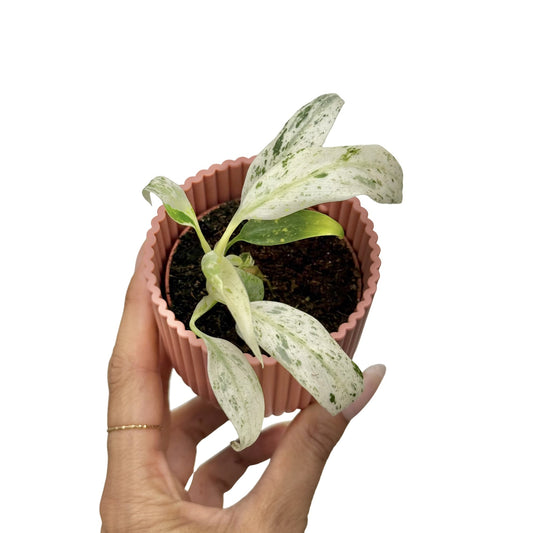
Rhaphidophora Tetrasperma Variegated
Regular price 59,95 €Regular price59,95 €47,96 €Sold out -
Rhaphidophora Puberula Variegata
Regular price 12,95 €Regular price14,95 €Sale price 12,95 €12,95 €10,36 €Sale -
Rhaphidophora Korthalsii Marble Aurea
Regular price 34,95 €Regular price39,95 €Sale price 34,95 €34,95 €27,96 €Sold out -


Monstera Minima with stake - Monstera Rhaphidophora tetrasperma - 19cm pot - Height 90cm
Regular price From 64,95 €Regular price64,95 €From 51,96 €Livraison offerte




✂️ Routine care for Rhaphidophora tetrasperma
Day to day, this plant needs little: light, careful watering, and a little humidity. Overwatering is the main cause of failure: NC State links yellow leaves to overwatering or insufficient light, and lists root rot among the diseases that can affect it.
💧 Watering: Check with your finger: if the top 2.5 cm is dry, water thoroughly; otherwise, wait
💧 Humidity: Aim for 60%: group plants together or use a humidifier, especially when the heating is on
🌱 Fertilizer: Apply houseplant fertilizer in spring and summer at the recommended rate; stop in winter
✂️ Pruning: Cut just above a node to encourage branching or limit height; keep the cuttings for propagation
🧹 Cleaning: Wipe the leaves with a damp sponge to help them absorb more light and spot pests
🍂 Rhaphidophora through the seasons
The plant's growth follows the light. In spring and summer, it grows quickly and uses more water and fertilizer. In fall and winter, growth slows: water less often and watch out for dry air from radiators, which encourages spider mites. Keep it above 18°C at all times, the lower limit of the range recommended by NC State.
📅 Seasonal care calendar
| Season | Key task |
|---|---|
| 🌸 Spring | Repot, install a support, resume fertilizing, propagate |
| ☀️ Summer | Water more often, monitor humidity, fertilize according to the label |
| 🍂 Fall | Water less often, apply the last fertilizer, bring the plant indoors if it was outside |
| ❄️ Winter | Water less, don't fertilize, provide maximum light, increase humidity |
🌱 Propagating Rhaphidophora tetrasperma from a node
NC State says the species can be propagated from stem cuttings, and it's very simple. Find a node—the point where a leaf joins the stem and an aerial root grows. Cut just below it with a clean tool, keeping one leaf and the small root attached.
Place the cutting in water, sphagnum moss, or directly in a light, moist potting mix, in a warm spot with indirect light. To choose a method, see our comparison of propagating in water or potting mix. A cutting without a node will never produce a new stem: this detail makes all the difference.
For a fuller pot, plant several rooted cuttings at the base of the parent plant.
🐛 Common problems: causes and solutions
Most problems are caused by watering or light. NC State lists spider mites, fungus gnats, and mealybugs as pests; thrips, which are common on aroids, are covered in our guide to thrips on houseplants.
| Symptom | Likely cause | Solution |
|---|---|---|
| Yellow leaves | 💧 Overwatering or insufficient light | Let the top 2.5 cm dry, empty the saucer, and move the plant closer to the window |
| Leaves that don't split | ☀️ Insufficient light, a young plant, or a stem without support | Provide more indirect light and a support; the next leaves will grow larger |
| Dry brown spots | ☀️ Excessively strong direct sun (scorching) | Move it away from the window or filter the light with a sheer curtain |
| Drooping leaves | ⚠️ Potting mix has stayed too dry for too long | Water thoroughly as soon as the top is dry, without waiting for the mix to dry out completely |
| Fine webs, dull leaves | 🕷️ Spider mites encouraged by dry air | Rinse the foliage and raise humidity to around 60% |
| Silvery spots, black dots | 🐛 Thrips | Isolate the plant, rinse it, and treat it according to our dedicated guide |
-

For quick results in the garden: fast-growing shrubs, hedges and climbers that...


🌸 Our Rhaphidophora varieties
Here are the forms of the genus that we grow or that you may find in stores, along with what makes each one special. According to POWO, they are all vines native to humid tropical forests.
| Variety | What makes it special |
|---|---|
| Rhaphidophora tetrasperma | The standard species, sold by us under the name Monstera minima with its support: dark green, split leaves |
| Rhaphidophora tetrasperma variegata | Cream variegation on a green background: slower-growing and requiring even more indirect light |
| Rhaphidophora puberula variegata | A species native to Assam and western and southern Malesia (Sumatra, Borneo, and the Malay Peninsula), with highly striking variegated foliage |
| Rhaphidophora korthalsii Marble Aurea | Yellow-marbled leaves; a species found from Peninsular Thailand to the western Pacific |
| Rhaphidophora hayi | A small vine from New Guinea and northern Queensland, with leaves that lie flat against its support |
| Rhaphidophora decursiva | A large vine from the Indian subcontinent to southern China, for fans of very large, deeply split leaves |
🎨 Which plants pair well with Rhaphidophora tetrasperma?
Rhaphidophora has the same needs as other aroid vines: indirect light, careful watering, and humidity. Create a jungle corner with a Monstera adansonii with fenestrated leaves, a trailing Pothos, and a climbing Philodendron. Rhaphidophora’s split leaves contrast beautifully with whole, rounded foliage.
To set up several climbing plants on supports, our guide to supports for climbing plants covers the options.
⚠️ Is Rhaphidophora tetrasperma toxic to cats and dogs?
Yes. According to NC State Extension, all parts of the plant contain calcium oxalate crystals. If ingested, they cause irritation of the mouth, excessive drooling, difficulty swallowing, and digestive upset in both animals and humans.
NC State classifies the severity as low, but also notes that the sap can cause contact dermatitis, so wear gloves when pruning. The University of Florida (UF/IFAS) describes the same mechanism in Monstera, a related aroid: needle-shaped crystals penetrate mucous membranes. The ASPCA does not have a dedicated page for this species.
Keep the plant out of reach and contact a veterinarian if your pet has chewed on it.
✅ Our expert tips for success
Keep three things in mind to grow Rhaphidophora tetrasperma successfully. First, plenty of indirect light: that’s what makes the leaves split. Next, water only when the top of the potting mix is dry, and aim for humidity of around 60%. Finally, provide a support as soon as you repot, so the vine can climb and produce its most beautiful leaves.
And remember, it’s not a Monstera: it’s a Rhaphidophora, just as spectacular in a more compact size.
Rhaphidophora tetrasperma is one of the vines I most often recommend to people who dream of deeply divided leaves but don’t have room for a large Monstera. What I’ve noticed at home is that the difference between an average plant and a stunning one almost always comes down to two things: light and a support. As soon as it can attach itself and climb toward the window, its appearance changes completely. And when a stem gets too long, I cut it just above a node and plant the cuttings at the base: the pot becomes bushier.

Laura Bruneau
Jardinière et autrice


