

Oxalis deppei (four-leaf clover): care, bulbs and dormancy

To care for Oxalis deppei, plant its bulbs in spring in well-draining soil, give it plenty of light, keep the soil barely moist, and let it rest when its leaves turn yellow: that's the secret to this four-leaf clover.
Its accepted botanical name is Oxalis tetraphylla; “Oxalis deppei,” sometimes spelled oxalys deppei, remains the name most commonly used by retailers and garden centers.
This guide covers this specific species; for purple oxalis with triangular leaves, see our Oxalis triangularis (purple oxalis) guide, and for variegated oxalis with yellow flowers, see our Oxalis Plum Crazy guide.
🌿 Oxalis deppei or Oxalis tetraphylla: why are there two names for a four-leaf clover?
Both names refer to the same plant, but only one is accepted by botanists.
According to its Oxalis deppei entry, Oxalis deppei Lodd. ex Sweet, published in 1831, is a synonym of Oxalis tetraphylla var. tetraphylla; the EPPO database (European and Mediterranean Plant Protection Organization) also recognizes Oxalis tetraphylla as the reference name and lists Oxalis deppei among the other scientific names.
EPPO gives “four-leaf clover” and “false four-leaf clover” as French common names, and good-luck plant, lucky clover, and iron cross as English names. The word tetraphylla means “four-leaved”: each leaf has four leaflets, whereas a true clover has only three.
According to Penn State Extension, the “lucky” four-leaf clover is originally a rarity of white clover (Trifolium repens), estimated at 1 or 2 for every 10,000 three-leaflet leaves, and its reputation for bringing good luck is documented in writing as early as the 17th century.
Oxalis deppei offers this symbol every time, which explains its popularity as a gift.
| Advantage | What it means for you |
|---|---|
| Four leaflets on every leaf | A lucky four-leaf clover without having to search the lawn for one |
| Bright pink flowers | A long flowering season from spring to early fall, according to the RHS |
| Compact, clumping habit | About 10 cm tall in flower for the species, according to the RHS: ideal in pots or borders |
| Hardiness rating H4 | More cold-hardy than purple oxalis (H3) or Oxalis vulcanicola (H2), according to the RHS, in well-drained soil |
🔎 Oxalis deppei at a glance
According to Plants of the World Online (POWO), the Royal Botanic Gardens, Kew's database, Oxalis tetraphylla Cav., published in 1795, is a tuberous geophyte from the subtropical biome, native to Mexico (central, Gulf, northeast, southeast, and southwest), Guatemala, El Salvador, and Panama; it has been introduced to several countries, including France and Great Britain.
Contrary to what is often said, it is therefore not native to South America.
In the RHS (Royal Horticultural Society) Oxalis tetraphylla profile, which lists Oxalis deppei as a synonym, it is described as a clump-forming bulbous perennial with clover-shaped leaves, each heart-shaped leaflet bearing a dark brown band near the base, and bright pink funnel-shaped flowers.
Descriptions vary between sources and selections: NC State and the University of Wisconsin instead describe four green leaflets with light-colored stripes along the veins.
| Feature | Verified details |
|---|---|
| 🏷️ Botanical name | Oxalis tetraphylla Cav. (1795); synonym Oxalis deppei Lodd. ex Sweet (POWO, EPPO, RHS) |
| 🧬 Family | Oxalidaceae |
| 🌳 Type | Clump-forming, deciduous bulbous perennial (RHS); tuberous geophyte (POWO) |
| 🌍 Native range | Mexico, Guatemala, El Salvador, and Panama (POWO) |
| 🍃 Foliage | Four heart-shaped leaflets, with a dark brown band at the base (RHS) |
| 🌸 Flowering | Bright pink funnel-shaped flowers, from spring to early fall (RHS) |
| 📏 Size | About 10 cm in flower for the species, 15 cm for 'Iron Cross' (RHS) |
| ⚠️ Toxicity | Oxalis genus toxic to dogs, cats, and horses (ASPCA) |
📋 Quick care guide
Essential growing guidelines at a glance.
| Factor | Guideline |
|---|---|
| Light | Full sun in a sheltered east-, south-, or west-facing spot (RHS); sunny window indoors (Wisconsin) |
| Watering | Keep soil barely moist, never wet (Wisconsin); well-drained soil (RHS) |
| Growing medium | Well-drained, low-fertility, sandy or loamy soil (RHS); well-drained soilless mix in pots (Wisconsin) |
| Humidity | Typical indoor humidity; sources consulted report no particular requirements |
| Temperature | Daytime temperatures no higher than about 24 °C (75 °F), with cooler nights (Wisconsin); H4, about -10 to -5 °C (RHS) |
| Planting | Bulbs just below the surface in pots (Wisconsin), about 5 cm deep (2 inches) for the genus (NC State) |
| Fertilizer | Monthly during active growth only (Wisconsin, NC State) |
| Toxicity | Toxic to dogs, cats, and horses (ASPCA) |
| Difficulty | Easy, as long as you observe its annual dormancy |
📍 Where to place Oxalis deppei: sun or shade, indoors or outdoors?
Choose sun over shade: Oxalis deppei grows equally well indoors and outdoors, but always needs light. The RHS recommends full sun in a sheltered east-, south-, or west-facing spot, and suggests it for courtyards, rock gardens, slopes, pots, hanging baskets, conservatories, and as a houseplant.
Indoors, University of Wisconsin–Madison horticulture extension recommends a sunny window and cool conditions, especially while flowering, with daytime temperatures no higher than about 24 °C (75 °F) and cooler nights of around 8 to 14 °C (15 to 25 °F lower).
Outdoors, its H4 rating (about -10 to -5 °C) means it can remain in well-drained garden soil where winter temperatures do not drop lower—which applies to much of France; in cold, wet regions, grow it in a pot instead.
☀️ Indoors: A sunny windowsill in a fairly cool room, away from radiators
🌤️ Outdoors: Rock garden, border, pot, or hanging basket in sheltered full sun, with well-drained soil
🚫 Avoid: A dark corner that causes leggy growth, and heavy, waterlogged soil in winter, which rots the bulbs
🪴 Planting Oxalis deppei bulbs: when, how deep, and in what growing medium?
Plant Oxalis deppei bulbs in spring, as growth begins, in a growing medium that never stays waterlogged.
For pots, the University of Wisconsin recommends placing them just below the surface of a well-drained soilless mix; NC State Extension's Oxalis genus profile (North Carolina State University) recommends burying rhizomes and stolons about 5 cm (2 inches) deep for the genus.
In the garden, the RHS recommends well-drained, fairly poor, sandy or loamy soil in a sunny, sheltered spot.
For the basics, our guide to planting bulbs and our article on planting bulbs in pots provide further guidance; our guide to the difference between potting soil and growing medium will help you choose the right mix.
| Step | What to do |
|---|---|
| 1. Choose the right time | In spring, when the bulbs show their first shoots, or as soon as you buy them |
| 2. Prepare the pot | Use a pot with drainage holes and a light, well-draining mix; don't add a layer of clay pebbles at the bottom |
| 3. Position the bulbs | Pointed end up, just below the surface in pots (Wisconsin) or about 5 cm deep outdoors (NC State) |
| 4. Water lightly | Water once to moisten the soil, then wait for the leaves to emerge before watering more |
| 5. Place in the light | Put it in a sunny window or sheltered full sun outdoors as soon as the first leaves appear |
columns: 4
columns_mobile: 2
-

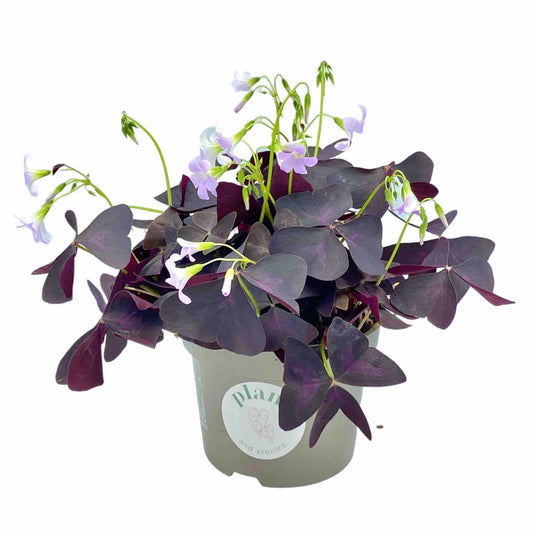 Sold out
-

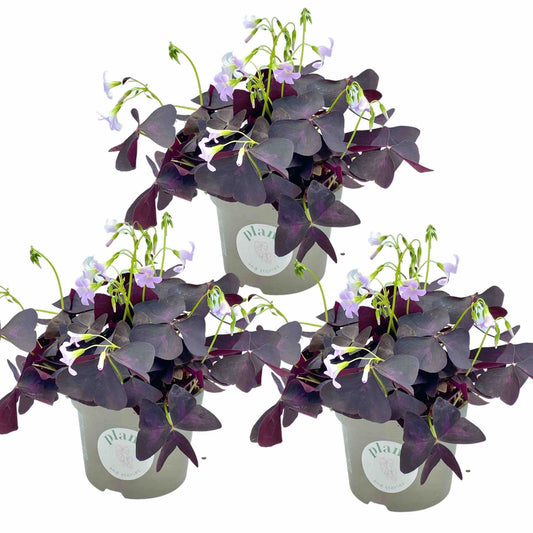 Sold out
Set of 3 Oxalis Triangularis
Regular price 29,99 €Regular price34,50 €Sale price 29,99 €Sold out -
Oxalis Trio | Oxalis Triangularis - Oxalis Plum Crazy - Oxalis Sunset Velvet
Regular price 31,05 €Regular price34,50 €Sale price 31,05 €Sold out -

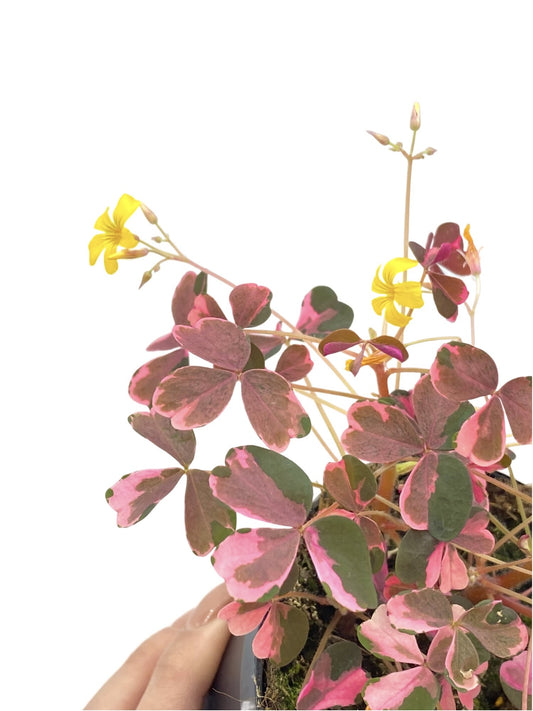 Sold out
-

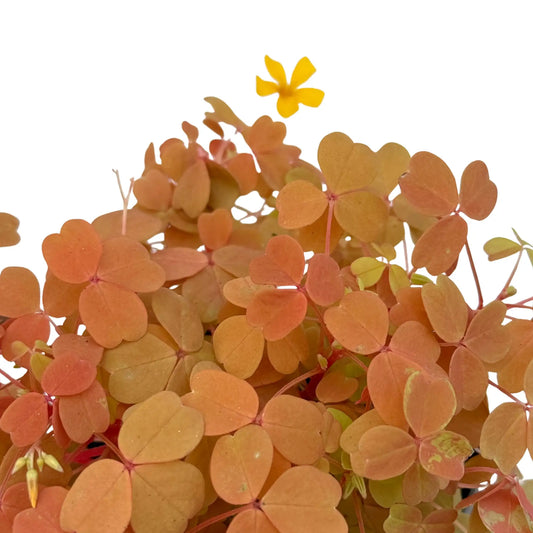 Sold out


✂️ Caring for Oxalis deppei indoors and outdoors: watering, fertilizer, and pruning
Caring for Oxalis deppei is simple while it's growing: provide light, keep the soil barely moist, and give it a little fertilizer. The University of Wisconsin recommends keeping Oxalis soil barely moist but never wet; most tolerate slight drying between waterings, so check with your finger rather than following a schedule.
Outdoors, the RHS notes in its 'Iron Cross' cultivar profile that this cultivar is drought-tolerant: once established in the ground, it generally needs watering only during prolonged dry spells. The University of Wisconsin and NC State recommend monthly fertilizer only during active growth. The RHS does not require any pruning.
There's no need to mist the foliage: see our article about misting.
💧 Watering: Water when the top of the growing medium has dried; empty the saucer; don't water during dormancy
🌱 Fertilizer: Once a month during active growth, never during dormancy
🔹 Faded leaves: Remove them when dry, without pulling on the bulbs
🔹 Flowers: Let them be: flowering continues from spring to early fall
👀 Watch for: Aphids and whiteflies indoors (Wisconsin), slugs and snails outdoors (RHS)
🍂 Dormancy and winter: caring for Oxalis deppei when its leaves disappear
An Oxalis deppei that turns yellow and loses its leaves isn't necessarily dead: it's a deciduous bulbous perennial that needs a rest.
The University of Wisconsin explains that these Oxalis often decline after a few months, sometimes in summer, because they grow from small bulbs: stop watering, let the foliage dry out, remove it, then keep the pot in a cool, dark place for 2 to 3 months before bringing it back into the light.
NC State observes that new shoots appear within 1 to 3 months and notes that lifted bulbs can be stored at around 2 to 5 °C (35 to 41 °F) in peat or vermiculite.
Outdoors, the bulbs can stay in well-drained soil over winter thanks to their H4 rating; also see what to do with bulbs after flowering.
📅 Seasonal care calendar
| Season | Key task |
|---|---|
| 🌸 Spring | Plant or restart the bulbs, return them to the light, begin light watering, and fertilize monthly |
| ☀️ Summer | Bright pink flowers; water regularly but lightly; provide sheltered full sun or a sunny window |
| 🍂 Fall | Flowering ends in early fall; as foliage turns yellow, reduce watering and then stop |
| ❄️ Winter | Dormancy: keep the pot cool, dry, and dark, or leave the bulbs in well-drained soil (H4) |
🌱 Propagating Oxalis deppei: dividing the bulbs
Oxalis deppei is mainly propagated by dividing the bulbs. The University of Wisconsin recommends dividing the many small bulbs during dormancy: they separate easily and can be replanted in small groups. The RHS also mentions seed propagation, which is slower.
When repotting in spring, lift the clump, separate the healthy, firm bulbs, discard any that are soft, and replant the rest in fresh, well-draining mix.
🐛 Common problems: causes and solutions
Problems with Oxalis deppei are mostly caused by overwatering, insufficient light, or misunderstanding its dormancy.
For the genus, NC State lists aphids, leaf miners, spider mites, and whiteflies, as well as mildew, leaf spot, and rust, and notes that overwatering causes root rot, with soft stems and yellow leaves; the RHS reports slugs, snails, and rust on the species.
If the bulbs become soft, read our root rot guide.
| Symptom | Likely cause | Solution |
|---|---|---|
| All the leaves turn yellow together after flowering | ⚠️ Normal dormancy (Wisconsin) | Stop watering, let the plant dry out, and keep it cool and dark for 2 to 3 months |
| Soft stems, yellow leaves, waterlogged soil | 🍄 Excess water, root rot (NC State) | Remove from the pot, discard the soft bulbs, and replant the healthy ones in dry, well-draining mix |
| Drooping or wilted leaves during active growth | 💧 Too little water or air that is too dry (NC State) | Water when the top of the soil is dry; move away from the radiator |
| Long stems and sparse foliage | ☀️ Not enough light | Place in gentle full sun or near a sunny window |
| Orange pustules on the undersides of leaves | 🍄 Rust (RHS, NC State) | Remove affected leaves, improve air circulation, avoid wetting the foliage |
| Sticky leaves, tiny insects | 🐛 Aphids or whiteflies (Wisconsin) | Rinse the foliage with lukewarm water, isolate the plant |


🌿 Our picks for further reading
To continue reading or find another oxalis to give as a gift, here are our resources on its closest relatives.
| Our pick | Why choose it |
|---|---|
| Oxalis triangularis: care, dormancy, and growing outdoors | A guide to purple oxalis, another bulbous species, for comparing dormancy, watering, and growing outdoors |
| Potted Oxalis triangularis | Also take a look if you're looking for a gift oxalis with purple foliage: another species, Oxalis triangularis |
| Set of 3 Oxalis triangularis | Also take a look: three purple shamrocks (Oxalis triangularis) to fill a planter |
| Oxalis trio (triangularis, Plum Crazy, Sunset Velvet) | Also take a look: three oxalis colors together, without Oxalis deppei |
🎨 Oxalis deppei or purple oxalis: what are the differences and how can you pair them?
Purple oxalis is a different species, Oxalis triangularis: its leaves have three purple triangular leaflets and its flowers are white to pale pink, while Oxalis deppei has four green leaflets marked with brown and bright pink flowers. Care for Oxalis triangularis indoors, including its own dormancy period, is covered in our dedicated guide.
Oxalis vulcanicola, such as Oxalis Sunset Velvet, are different again: they have yellow flowers and a much lower H2 hardiness rating.
In the garden, Oxalis deppei pairs well in borders or rock gardens with low-growing plants that enjoy full sun; in a pot, it makes a lovely gift when paired with our plant gift ideas.
⚠️ Is Oxalis deppei edible or toxic to cats and dogs?
Keep it out of reach of pets. The ASPCA (American Society for the Prevention of Cruelty to Animals) Good Luck Plant page (other names listed: Shamrock Plant, Sorrel) covers the genus Oxalis (Oxalis spp.): it classifies it as toxic to dogs, cats, and horses due to soluble calcium oxalates.
It notes that all parts of the plant may be toxic, that serious effects are generally limited to ingestion of large quantities, that it may cause colic in horses, and that kidney failure is possible if large amounts are consumed. Is oxalis edible? We do not recommend using it for food.
For the genus, NC State says that small amounts of raw leaves, flowers, seeds, or roots are not dangerous and have a sour taste, while also noting that these plants are toxic if ingested and should be kept out of reach of children and pets; Penn State notes that all Oxalis species contain oxalic acid.
No reliable source we consulted addresses the edibility of Oxalis tetraphylla specifically: we do not provide any advice on consuming it. For a home with pets, see our list of non-toxic plants for cats and our plants that are safe for dogs.
✅ Our expert tips for success
A thriving Oxalis deppei follows its natural cycle: plant the bulbs in spring in well-draining soil, provide plenty of light, keep the soil barely moist, and feed monthly while it is growing; then give it a proper rest in a cool, dry place when the foliage turns yellow.
Remember its accepted name, Oxalis tetraphylla, to find the right growing guides, and its H4 hardiness rating, which means it can stay outdoors in well-drained soil. Keep it out of reach of pets and do not eat it.
The four-leaf clover is the plant I'm given most often at the start of the year, and the one people are quickest to think has died. I grow it by a sunny window in a cool room, and let it take a nap when it turns yellow: keep the pot dry, put it in the shade, and be patient. When the little leaves reappear, I know the lucky charm has kept its promise. My advice: never throw away an oxalis pot that looks empty.

Laura Bruneau
Jardinière & autrice


