

Oxalis triangularis (purple shamrock): care, dormancy and outdoors

To care for an Oxalis triangularis, place it near a bright window, water when the surface of the potting soil has dried out, and let it rest when its leaves wilt: this is a normal cycle, not a sign that the plant is dying. This plant with purple leaves is also known as purple shamrock, purple oxalis, triangular oxalis, or butterfly plant.
It is easy to recognize by its three triangular leaflets, which open during the day and close at night. For related species, see our Oxalis deppei profile and our Oxalis vulcanicola profile.
🌿 Why do Oxalis triangularis leaves close at night?
Oxalis triangularis leaves fold up every evening because it is a nyctinastic plant: according to the University of Wisconsin–Madison horticultural extension, its leaflets close at night or in cloudy weather, then reopen in the light. NC State adds that the flowers follow the same rhythm.
This is neither a lack of water nor a disease. The folded leaflets resemble butterfly wings, which is where its nickname butterfly plant comes from. However, leaves that remain closed and droop in broad daylight indicate a problem, which we cover below.
| Benefit | What it means for you |
|---|---|
| Purple triangular foliage | A rare dark touch of color among houseplants, without having to wait for flowers |
| Daily leaf movement | A living display in the morning and evening, enjoyed by children and collectors alike |
| Compact size | 15 to 30 cm tall in flower according to the RHS: a windowsill is all it needs |
| Underground storage organs | The plant regrows after its rest period or a spell of dryness, and is easy to divide |
🔎 Oxalis triangularis at a glance
According to Plants of the World Online (POWO), the database of the Royal Botanic Gardens, Kew, the accepted name is Oxalis triangularis A.St.-Hil., published in 1825; Oxalis regnellii Miq., a name still widely used in garden centers, is a synonym.
The species is native to Peru, Bolivia, Brazil, Paraguay, and northern Argentina, where it grows in seasonally dry tropical regions; POWO describes it as a tuberous geophyte, meaning a plant that spends the unfavorable season underground.
As for cultivation, the RHS (Royal Horticultural Society) Oxalis triangularis profile describes it as a bulbous clump-forming perennial, while North Carolina State University Extension (NC State Extension) describes it as a rhizomatous perennial: two terms for its small underground organs, commonly called bulbs.
| Feature | Verified details |
|---|---|
| 🏷️ Botanical name | Oxalis triangularis A.St.-Hil. (1825); synonym Oxalis regnellii Miq. (POWO) |
| 🧬 Family | Oxalidaceae |
| 🌳 Type | Perennial with underground organs (a tuberous geophyte according to POWO, rhizomatous according to NC State) |
| 🌍 Native range | Peru, Bolivia, Brazil, Paraguay, northern Argentina (POWO) |
| 🍃 Foliage | Three dark purple to green triangular leaflets that close at night (NC State) |
| 🌸 Flowers | White to pale pink flowers with 5 petals, from early summer to fall (NC State) |
| 📏 Size | 15 to 30 cm tall in flower (RHS); 15 to 45 cm tall and 30 to 60 cm wide (NC State) |
| ⚠️ Toxicity | Oxalis genus is toxic to dogs, cats, and horses (ASPCA); leaves are edible in moderation (NC State) |
📋 Quick care guide
Key care details, all in one place.
| Parameter | Guideline |
|---|---|
| Light | Bright window indoors (Wisconsin); sheltered partial shade outdoors (RHS) |
| Watering | When the surface has dried out (NC State); keep potting soil barely moist, never waterlogged |
| Potting mix | Light, free-draining potting mix with a loam or sand base (RHS, NC State) |
| Humidity | Normal household air; no misting needed |
| Temperature | Up to around 24 °C (75 °F) during the day, with cooler nights (Wisconsin) |
| Repotting | At the end of its rest period, before growth resumes (Wisconsin) |
| Fertilizer | Monthly during active growth only (Wisconsin) |
| Toxicity | Toxic to dogs, cats, and horses (ASPCA) |
| Difficulty | Easy, as long as you allow for its annual rest period |
📍 Where to place Oxalis triangularis: indoors or outdoors?
Indoors, place your Oxalis triangularis near a very bright window: the University of Wisconsin recommends a sunny window where the temperature does not exceed around 24 °C (75 °F) during the day, with cooler nights of 15 to 25 °F (about 8 to 14 °C cooler than during the day).
The more light it gets, the more compact the clump will stay; avoid a scorching midday window in summer. Outdoors, the RHS recommends partial shade, or sun in a sheltered spot facing south, east, or west.
Its hardiness rating of H3 (-5 to 1 °C) means it can be grown in the ground only in mild regions; NC State lists it for USDA zones 8a to 11b, where it rests in winter and regrows in spring. Elsewhere, move it outdoors in its pot during the warm season and bring it inside before the first frost.
☀️ Indoors: Bright east- or west-facing windowsill, a fairly cool room, away from radiators
🌤️ Outdoors: Pot on a sheltered, partially shaded patio or balcony, from the end of frost season to early fall
🚫 Avoid: A dark corner (stretched stems, dull color), a saucer full of water, planting in the ground in a region with cold winters
🪴 Planting Oxalis triangularis bulbs and repotting: what potting mix should you use?
Oxalis triangularis likes a light potting mix that retains a little moisture without staying waterlogged. The RHS recommends well-drained, sandy or humus-rich soil and, for growing under cover, a mix of equal parts loam, leaf mold, and grit.
NC State, in its profile of the Oxalis genus, recommends planting the rhizomes about 5 cm deep; for container growing, the University of Wisconsin places them just below the surface of a well-drained mix. Repot at the end of the rest period, before moving the plant back into the light, as recommended by the University of Wisconsin.
For potting mix, see our article on the difference between potting soil and growing medium and our guide to when to repot a plant after purchase.
| Step | What to do |
|---|---|
| 1. Choose the right time | At the end of the rest period, when the first shoots appear, or when the pot is crowded with bulbs |
| 2. Prepare the pot | Use a pot with drainage holes, only slightly wider than the previous one, and light, free-draining potting mix; no layer of clay pebbles at the bottom |
| 3. Plant the bulbs | Just below the surface (Wisconsin) to about 5 cm deep (NC State), in small groups |
| 4. Water | Water once to settle the mix, then wait until the surface dries before watering again |
| 5. Move it back | Place it back near the bright window; leaves will emerge within a few weeks |
columns: 4
columns_mobile: 2
-

 Sold out
-
-
-
-
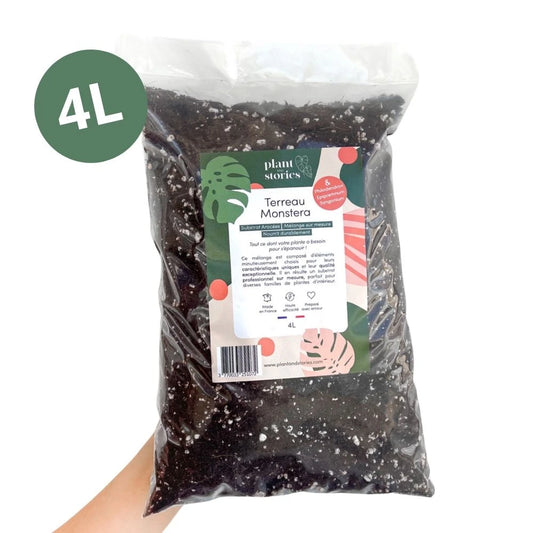
Monstera Soil - Enriched with Mycorrhiza and Bacillus - Araceae Substrate
Regular price From 9,50 €Regular price23,75 €Sale price From 9,50 €Sale -
Fertilizer for All Indoor Plants - 250ml Liquid Fertilizer - Root and Foliar Fertilizer + Free Graduated Pipette!
Regular price 18,00 €Regular price20,00 €Sale price 18,00 €Sale





✂️ Caring for Oxalis triangularis: watering, fertilizer, and flowering
Watering Oxalis triangularis is simple: NC State recommends letting the surface dry out between waterings, while the University of Wisconsin advises keeping the potting mix barely moist, never wet. According to Penn State Master Gardeners, overwatering can cause root rot. Check the soil with your finger rather than watering by the calendar.
For fertilizer, the University of Wisconsin recommends feeding monthly only during active growth, never during the rest period. According to NC State, flowering lasts from early summer to fall, with blooms ranging from white to pale pink.
💧 Watering: When the surface of the potting mix is dry; empty the saucer after watering
🌱 Fertilizer: Once a month during growth, at a light dose; none during the rest period
🔹 Spent flowers and leaves: Remove at the base to keep the clump tidy
🔹 Rotation: Turn the pot a quarter turn from time to time for an even clump
👀 Keep an eye out for: Aphids and whiteflies indoors, slugs and snails outdoors
🍂 Winter or summer dormancy in purple oxalis: what to do when it loses its leaves
When your Oxalis triangularis suddenly turns yellow and droops, it is probably entering dormancy. NC State explains that it can go dormant in fall or when conditions become too hot or too dry, so its rest period does not necessarily occur in winter.
The University of Wisconsin then recommends stopping watering, letting the leaves dry before removing them, and placing the pot in a cool, dark spot; purple-leaved types need only about one month of rest, compared with 2 to 3 months for other Oxalis. When the first shoots appear, move it back into the light and resume watering.
📅 Seasonal care calendar
| Season | Key task |
|---|---|
| 🌸 Spring | At the end of dormancy or in full growth: repot if needed, resume watering and monthly feeding |
| ☀️ Summer | White to pale pink flowers, regular watering; can be moved outdoors to partial shade, may go dormant in extreme heat |
| 🍂 Fall | Bring indoors before frost, stop feeding; dormancy is common, stop watering as soon as the leaves wilt |
| ❄️ Winter | Keep the pot cool and in the dark during dormancy, then move it back to the window as soon as the first shoots appear |
🌱 Propagating Oxalis triangularis by dividing the bulbs
The most reliable method is division. The University of Wisconsin says Oxalis plants are easy to propagate during dormancy by separating their small bulbs; the RHS also mentions sowing seeds. Remove the root ball from the pot, gently separate clusters of bulbs, then replant them in small groups at a shallow depth in fresh potting mix. Remove any soft or blackened bulbs as you go.
🐛 Common problems: causes and solutions
The main threats to Oxalis triangularis are overwatering and insufficient light. NC State reports no serious insect or disease problems for the species, but notes that the genus can be affected by rust, powdery mildew, leaf spots, and root rot caused by overwatering; the RHS mentions rust and, outdoors, slugs and snails.
If the bulbs are soft, see our root rot guide.
| Symptom | Likely cause | Solution |
|---|---|---|
| All the leaves turn yellow and droop at once | ☀️ Entering dormancy (fall, heat, or drought) | Stop watering, remove dry leaves, and keep the pot cool and dark for about a month |
| Yellow leaves, waterlogged potting mix, soft bulbs | 🍄 Overwatering, root rot | Remove the plant from its pot, discard affected bulbs, and repot in dry, free-draining potting mix |
| Very long, limp stems and dull color | ☀️ Insufficient light | Move it closer to a window; trim stretched stems back to the base |
| Leaves closed in broad daylight, dry potting mix | ⚠️ Thirst | Water thoroughly, then empty the saucer |
| Orange pustules on the undersides of leaves | 🍄 Rust (RHS, NC State) | Remove affected leaves, improve airflow, and avoid wetting the foliage |
| Tiny white flies or colonies on new shoots | 🐛 Whiteflies or aphids (Wisconsin) | Rinse the foliage with lukewarm water, remove pests by hand, and isolate the plant |


🌸 Our Oxalis varieties
Oxalis triangularis comes in several cultivars: NC State mentions 'Atropurpurea', 'Charmed Wine', 'Ebony', 'Fanny', 'Francis', and 'Mijke', among others. Here are the Oxalis plants in our Oxalis collection. Please note that 'Plum Crazy' and 'Sunset Velvet' are not purple shamrocks: the RHS classifies them as Oxalis vulcanicola (synonym Oxalis spiralis subsp. vulcanicola), with yellow flowers and an H2 hardiness rating (1 to 5 °C), making them more cold-sensitive than Oxalis triangularis.
| Variety | What makes it special |
|---|---|
| Oxalis triangularis | The classic species, with purple foliage and pale flowers, offered in a 12 cm pot |
| Set of 3 Oxalis triangularis | Three pots of the same purple shamrock, perfect for filling a planter or giving as a gift |
| Oxalis Trio (triangularis, Plum Crazy, Sunset Velvet) | A trio for comparing three foliage colors and two Oxalis species |
| Oxalis vulcanicola 'Plum Crazy' | Oxalis vulcanicola according to the RHS, with pinkish-purple foliage: see our Oxalis 'Plum Crazy' care guide for its needs |
| Oxalis vulcanicola sold under the name Sunset Velvet | Oxalis vulcanicola sold under the name “Sunset Velvet,” with foliage in shades ranging from orange to magenta according to the RHS; see our Oxalis vulcanicola guide |
🎨 What plants pair well with purple oxalis?
Purple oxalis creates a beautiful contrast with Oxalis varieties that have lighter foliage: our Oxalis deppei guide features a species with green foliage and a dark center, while our Oxalis vulcanicola guide features a species with coppery tones. Outdoors, the RHS recommends it for patios, rock gardens, containers, and hanging baskets, in sheltered partial shade.
If you live with a pet, choose safe plant companions: our list of plants that are non-toxic to cats and our selection of plants that are safe for dogs can help.
⚠️ Is Oxalis triangularis edible or toxic to cats?
For pets, the ASPCA (American Society for the Prevention of Cruelty to Animals) Shamrock Plant profile, which covers the Oxalis genus (Oxalis spp.), including Oxalis triangularis, classifies these plants as toxic to dogs, cats, and horses due to soluble calcium oxalates; it lists kidney failure (rare in dogs and cats), tremors, and salivation as possible signs.
Keep it out of your cat's reach.
Is Oxalis edible? NC State says the leaves and flowers are edible but should be consumed in moderation: all parts have toxic potential, though serious effects are generally limited to the ingestion of large quantities.
Its genus profile notes that the name Oxalis comes from a Greek word meaning “sour” and describes the plants' sour, lemony flavor. Plants sold for ornamental purposes are not grown as edible crops.
✅ Our expert tips for success
Growing Oxalis triangularis successfully comes down to four things: a bright window, watering only once the surface has dried, monthly feeding during growth, and allowing it a month of rest without panicking. Outdoors, grow it in a pot in partial shade and bring it inside before frost; the RHS considers it hardy only down to -5°C at best.
Keep it out of pets' reach and divide the bulbs when the pot becomes crowded.
An Oxalis triangularis that suddenly wilts isn't necessarily lost: it's resting. I like recommending it to beginners precisely because it teaches you to observe: it closes when the light fades and clearly signals when it needs water. My one piece of real advice is to resist the urge to water a plant that has just wilted: let it sleep, and it will grow back. If you have a curious cat, place it up high.

Laura Bruneau
Jardinière & autrice


