Cacti and Succulents: The Complete Guide to Growing Them Successfully

Cacti and succulents are often confused, and it's almost understandable: both store water and both hate too much attention. But they are not exactly the same plants, nor do they have the same needs. If you are looking for a family that forgives forgetfulness without ever letting you down, you are in the right place.
Our cacti and succulents are grown in France and selected for their ease of care as much as for their graphic look.
Cacti and succulents: what are the differences?
All cacti are succulents. But not all succulents are cacti. The difference lies in a technical detail: cacti have areoles, those little dots from which spines or hairs grow. Other succulents, such as Echeveria or Sedum, store water in their thick leaves without having these structures.
In practice, it doesn't change much in terms of care. Both families share the same general principles: plenty of light, little water, and fast-draining soil.
Easy varieties to get started with
For a first purchase, it is best to aim for sure bets among our easy-care cacti and succulents.
columns: 4
columns_mobile: 2
-

 Livraison offerte Sale
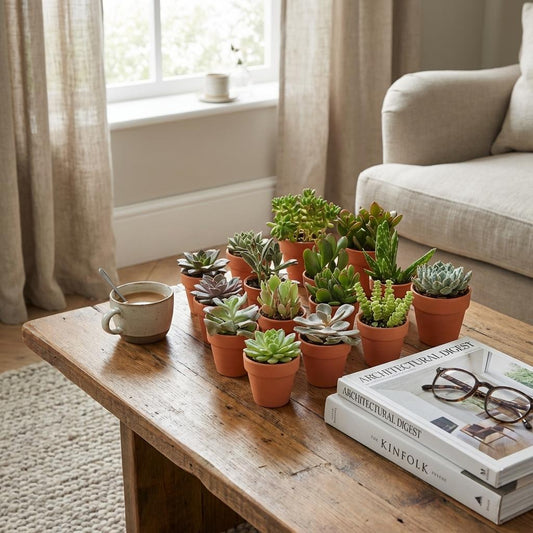
Set of 18 Mini Succulents with Terracotta Pots - Surprise Mix - 8cm Pot - Height 5-10cm
Regular price 64,95 €Regular price69,95 €Sale price 64,95 €64,95 €51,96 €Livraison offerte Sale -

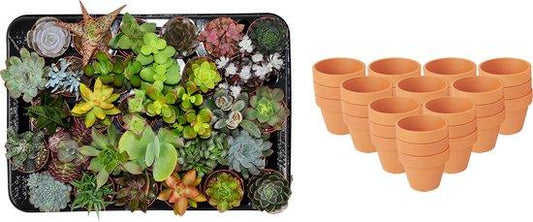
Set of 30 Mini Succulents with Terracotta Pots - Surprise Mix - 8cm Pot - Height 5-10cm
Regular price 104,95 €Regular price104,95 €83,96 €Livraison offerte -

 Livraison offerte Sale
Set of 18 Mixed Succulents - 5cm Pot - Height 5-10cm
Regular price 49,95 €Regular price59,95 €Sale price 49,95 €49,95 €39,96 €Livraison offerte Sale -

 Livraison offerte Sale
Set of 30 Mini Succulents - Surprise Mix - 5cm Pot - Height 5-10cm
Regular price 64,95 €Regular price84,95 €Sale price 64,95 €64,95 €51,96 €Livraison offerte Sale


- Echeveria, with its fleshy rosettes, easily forgives forgetfulness.
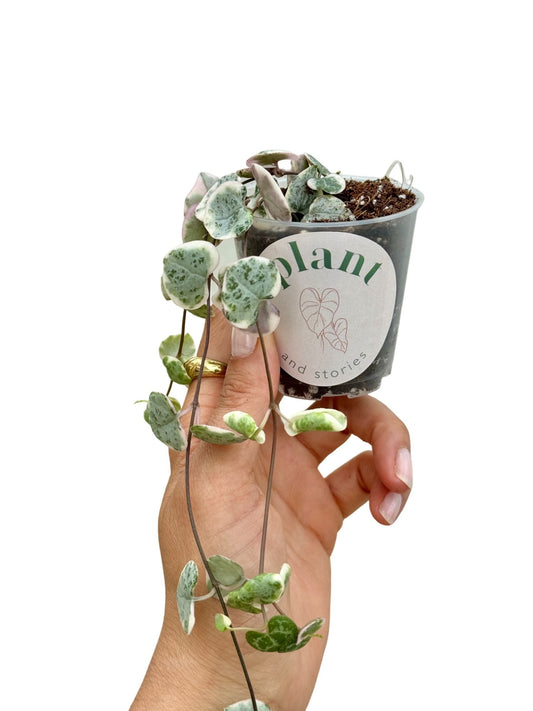
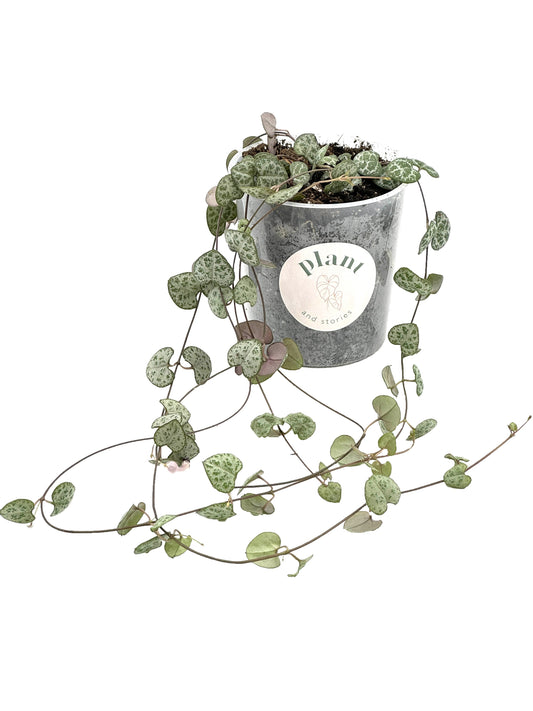
- Sedum morganianum, nicknamed donkey tail, trails beautifully without asking for much.
And on the cactus side, Opuntia or Mammillaria remain indestructible, even for the most distracted beginners.
Light, the key to success
Without enough light, a cactus literally etiolates: it stretches out, becomes pale, and loses its compact shape. It needs a very bright exposure, ideally several hours of direct sunlight every day. A south-facing window remains the best location, far ahead of a poorly exposed office corner.
Watering: the #1 mistake to avoid
The classic mistake is to water a cactus like any other houseplant. Result: root rot, and a plant that does not recover. The rule is simple, almost brutal: let the soil dry out completely between waterings, and water thoroughly, without leaving water to stagnate in the saucer.
In winter, watering is drastically reduced, sometimes to once a month. Cacti enter a dormant period, and too much water at this time is the leading cause of rot.
Fast-draining soil and repotting
For this family, the universal soil enriched with biostimulants can work if it is lightened with coarse sand or pumice. Repotting is done in spring, and only if the roots are really overflowing from the current pot.
Pests and diseases: what really affects cacti
Mealybugs remain the number one concern for cacti and succulents.
They often nestle in hard-to-reach corners, between the spines or at the base of the rosettes, and easily go unnoticed at first. A cotton swab soaked in 70-proof alcohol allows you to remove them one by one at the first signs, before a colony settles in permanently.
Spider mites, on the other hand, take advantage of the dry air from heating in winter to proliferate. A fine veil on the spines or a slight diffuse yellowing of the tissue should alert you. Good ventilation of the room and regular checking of the foliage are generally enough to avoid a real infestation.
But the real enemy of cacti is not a pest, it is too much water. The resulting rot is identified by a soft, almost spongy base, sometimes accompanied by an unpleasant odor. When this is the case, you must act quickly: remove the plant from the pot, cut out the entire affected area with a clean tool, let it scar over in the open air for a few days, then repot in dry soil.
Why is my cactus etiolating (and how to react)?
An etiolated cactus is a plant that stretches out abnormally, loses its original compact shape, and becomes pale, almost light green. It is an unambiguous signal: the plant is desperately looking for more light.
The only real remedy is to move it closer to a more generous light source, ideally a south-facing window.
However, be careful not to suddenly expose an etiolated plant to intense sun: a gradual transition over one to two weeks avoids burns on tissue that is not yet accustomed to it.


Making babies: propagating your succulents
Many succulents multiply from a simple detached leaf, left to dry for a few days before being placed on dry soil. There is no need to water right away: roots often appear before you have even added a drop of water.
If your home lacks light to grow these cuttings properly, a grow light helps a lot. And to build a real collection overall, our easy-care plants perfectly complement a shelf of cacti and succulents. All our plants remain rated 9.9/10 from 2,697 reviews, grown in France as always.
A cactus rarely dies from neglect, much more often from too much attention. The number one mistake is to water it like any other houseplant. My advice: let the soil dry out completely, then water thoroughly, without ever leaving water to stagnate in the saucer. In winter, during its dormant period, drastically reduce watering. And if your cactus stretches out while turning pale, gradually move it closer to a very bright window: it is asking for light, not water.

Laura Bruneau
Jardinière et autrice