

Orchid Varieties: The Different Genera and How to Choose the Right One for You

The easiest orchid varieties to grow at home are Phalaenopsis, Paphiopedilum, Cattleya and, in a cool room, Cymbidium. They all belong to the Orchidaceae family, which includes nearly 30,000 known species, according to the MNHN (National Museum of Natural History).
This guide introduces the main types of indoor orchids, outlining each one’s light requirements, temperatures according to the American Orchid Society, flowering habits and difficulty level. It will help you choose the right one for you, then point you to our care guides and our collection of orchids (Orchidaceae).
🌟 What is an orchid? The Orchidaceae family at a glance
An orchid is a flowering plant in the Orchidaceae family, one of the largest in the plant kingdom, with nearly 30,000 known species and new discoveries every year, according to the MNHN. The POWO (Plants of the World Online), the botanical database of the Royal Botanic Gardens, Kew, lists 691 accepted genera.
Its flower is distinguished by its labellum, a highly modified floral part, and its column (or gynostemium), which combines the male and female organs, according to the botany department at the University of Hawaiʻi at Mānoa. The same source explains that orchids can be terrestrial, epiphytic (growing on other plants) or saprophytic.
The museum notes that 95% of orchids are tropical and subtropical, and that selective breeding has produced tens of thousands of horticultural varieties. So when we talk about orchid varieties in stores, we are mainly referring to cultivated genera and hybrids, not wild species.
| At a glance | What you need to know |
|---|---|
| A huge family | Nearly 30,000 known species (MNHN) and 691 accepted genera (POWO) |
| Mostly tropical | 95% of species are tropical and subtropical (MNHN), which explains their popularity as houseplants |
| Thousands of hybrids | Tens of thousands of varieties developed through selective breeding (MNHN) |
| Long-lasting flowers | Cattleya, Phalaenopsis and Cymbidium stay in bloom for a long time, according to the museum |
📊 The main types of indoor orchids: a comparison
The main types of indoor orchids differ chiefly in their light requirements and the temperatures they need at night. This table compares ten common genera. Temperatures are taken from the American Orchid Society’s culture sheets and converted to °C; flowering information comes from the Missouri Botanical Garden and Clemson University. Difficulty ratings reflect our expert opinion on growing them in an apartment.
| Genus | Light | Night and day temperatures | Flowering | Difficulty and who it's for |
|---|---|---|---|---|
| Phalaenopsis (moth orchid) | Bright light, no direct sun; an east-facing window is ideal (Missouri Botanical Garden) | Nights above 16 °C, days at 24–29 °C (AOS (American Orchid Society)) | In winter, flowers last for months (MBG) | Easy: the first choice, even for beginners |
| Cambria and Oncidium (dancing lady orchid) | 1 to 5 hours of sun per day (AOS) | Nights at 13–16 °C, days at 27–29 °C (AOS) | Branched spikes of small flowers, often yellow and brown (MBG) | Intermediate: for a bright room with slightly cooler nights |
| Dendrobium | Bright light, no midday sun (Clemson University Extension) | Nights at 13–18 °C, days at 21–29 °C (AOS) | Fall and winter, flowers last 3 to 4 weeks (Clemson) | Intermediate: the nobile type needs a drier rest period in late fall |
| Cattleya | Twice as much light as a Phalaenopsis (Clemson) | Day-to-night temperature difference of 5.5 to 8.3 °C (AOS) | Once a year (Clemson), with fragrant flowers that last about a month (MBG) | Intermediate: for a very bright window |
| Paphiopedilum (lady's slipper orchid) | Moderate light, 2 to 3 hours of filtered sun (AOS) | Nights at 16–18 °C for mottled leaves, 10–16 °C for green leaves (MBG) | One large slipper-shaped flower, striped or spotted | Easy to intermediate: for a less brightly lit room |
| Vanda | 50 to 100% of full sunlight in a greenhouse (AOS) | Nights at 13–22 °C, days at 21–35 °C (AOS) | Large flowers; can be grown without a growing medium (AOS) | Demanding: for a greenhouse, conservatory or collector |
| Cymbidium | Lots of light, 4 or more hours of direct sun (AOS) | Nights at 10–14 °C in fall to encourage flowering (AOS) | Long-lasting flowers, good as cut flowers (MBG) | Easy in cool conditions, difficult in a heated living room |
| Miltoniopsis (pansy orchid) | East-, north- or west-facing window, 1 to 5 hours of sun (AOS) | Nights at 13–22 °C, days at 21–29 °C (AOS) | Large, flat, colorful flowers | Demanding: needs at least 70% humidity (AOS) |
| Zygopetalum | Fairly bright light, no direct sun (MBG) | Nights about 5 to 6 °C cooler than days (MBG) | Late fall to early spring, very fragrant (MBG) | Intermediate: for those who love fragrance |
| jewel orchid (Ludisia) | Medium light, good air circulation (MBG) | Warm, humid conditions year-round (MBG) | Small white flowers on a spike; grown for its foliage | Easy: a foliage orchid |
📋 Quick facts
Common guidelines for indoor orchids, according to the MNHN, POWO, AOS, RHS and ASPCA.
| At a glance | The rule |
|---|---|
| Family | Orchidaceae |
| Species | Nearly 30,000 known species (MNHN) |
| Genera | 691 accepted genera (POWO) |
| Origin | 95% of species are tropical and subtropical (MNHN) |
| Light | Bright, filtered light for most; never harsh midday sun |
| Night temperatures | 10 to 22 °C depending on the genus, with a nighttime drop that helps trigger flowering (AOS) |
| Air humidity | 30 to 80% depending on the genus, 50 to 80% for Phalaenopsis (AOS) |
| Growing medium | Bark-based mix, never all-purpose potting soil (RHS) |
| Watering | Soak when the growing medium is dry to the touch, without leaving the roots in water |
| Toxicity | Phalaenopsis, Oncidium flexuosum and Cattleya trianaei are listed as non-toxic to dogs, cats and horses (ASPCA) |
How to choose an orchid in 6 steps
To choose an orchid, start with the room it will live in, not the flower: check the light from the window and the nighttime temperature, then choose a genus that will thrive there, and finally pick a color. Next, check the plant’s condition, whether in store or when your delivery arrives. A healthy orchid will bounce back quickly, while a tired plant can demand months of patience.
| Step | What to do |
|---|---|
| 1. Check the light | East- or west-facing window for a Phalaenopsis or Paphiopedilum; a very bright south-facing window for a Cattleya, which needs more than 4 hours of direct sunlight indoors (AOS) |
| 2. Note the nighttime temperature | Living room heated year-round: Phalaenopsis; cool room or frost-free conservatory: Cymbidium or Dendrobium |
| 3. Choose the genus, then the color | Read the label: the genus name tells you how to grow the plant; its color does not affect its needs |
| 4. Inspect the leaves | They should be firm and glossy, with no soft spots or deep creases; an orchid with yellow leaves often indicates overwatering |
| 5. Check the roots | In a clear pot, they should be firm, green or silvery, never brown and mushy |
| 6. Choose one with some unopened buds | A flower spike with a few open flowers and more buds to come will give you the longest flowering period |
columns: 4
columns_mobile: 2
-

 Livraison offerte
White Phalaenopsis Orchid (Phalaenopsis amabilis) – 9 cm pot
Regular price From 44,95 €Regular price -

 Livraison offerte
Red Phalaenopsis orchid 'Congo' (Phalaenopsis) – 9 cm pot
Regular price From 44,95 €Regular price -

 Livraison offerte
Pink Phalaenopsis orchid 'Niagara Falls' (Phalaenopsis) – 12 cm pot
Regular price From 49,95 €Regular price -

 Livraison offerte
Orange Phalaenopsis orchid 'Spider' (Phalaenopsis) – 9 cm pot
Regular price 44,95 €Regular price -
Fragrant orange Phalaenopsis orchid 'Fragrance' (Phalaenopsis) – 9 cm pot
Regular price 44,95 €Regular price -

 Livraison offerte
Surprise box of 4 Phalaenopsis orchids – 12 cm pot
Regular price 164,95 €Regular price -
Premium Orchid Potting Soil, Orchid Substrate, Potting Soil for All Orchids 4L
Regular price 11,99 €Regular price10,95 €Sale price 11,99 € -
Orchid Fertilizer - Phalaenopsis Fertilizer - 250ml Liquid Fertilizer - Root and Foliar Fertilizer + Free Graduated Pipette!
Regular price 18,00 €Regular price20,00 €Sale price 18,00 €Sale



🧭 Which orchid should you choose for your home?
The right type of orchid depends first on the room it will live in: light, nighttime warmth and air humidity. Here are our recommendations, based on AOS and Missouri Botanical Garden culture sheets.
For everyday advice on where to place an orchid in your home, our orchid care guide covers placement and lighting.
| Your situation | The orchid that will thrive there |
|---|---|
| Bright living room, east- or west-facing window | Phalaenopsis: Clemson University describes it as one of the most adaptable orchids for indoor light |
| A somewhat dimmer room | Paphiopedilum, which prefers lower light according to the Missouri Botanical Garden, or Phalaenopsis |
| Very bright south-facing window | Cattleya, Dendrobium or Cambria, with midday sun filtered out |
| Cool conservatory or lightly heated bedroom | Cymbidium; bring it indoors when nighttime temperatures fall to 4.4 °C, according to the AOS |
| Bright, humid bathroom | Miltoniopsis, which needs at least 70% humidity (AOS); also see how to increase air humidity |
| You love fragrant flowers | Zygopetalum, with its very fragrant flowers, or Cattleya, which is fragrant too (MBG) |
| You prefer foliage | The jewel orchid (Ludisia), grown for its veined leaves |
| Cat or dog at home | Phalaenopsis, listed as non-toxic to dogs, cats and horses by the ASPCA (American Society for the Prevention of Cruelty to Animals); see our list of non-toxic plants for cats and our pet-friendly plants |
📐 Which orchids are easiest to grow?
The easiest orchids to grow are Phalaenopsis, Paphiopedilum, Cattleya and, in a cool room, Cymbidium. The University of Wisconsin Extension ranks Cattleya, Paphiopedilum and Phalaenopsis among the best indoor orchids. The MNHN lists Cattleya, Phalaenopsis and Cymbidium as easy-to-grow orchids whose flowers stay in bloom for a long time.
Phalaenopsis is the easiest choice for an apartment: according to Clemson, it does well in low light, at 1,500 to 1,700 foot-candles (about 16,000 to 18,000 lux), with nights of at least 18 °C (16 °C minimum according to the AOS)—the typical temperature of a heated home. Its flowers stay fresh for several months.
Our Phalaenopsis guide covers how to grow it and encourage it to flower again. By contrast, the University of Wisconsin considers Dendrobium and Oncidium more difficult to grow indoors. Start with a Phalaenopsis, then expand your collection once you have watering figured out.
📐 Rare orchids: what “rare” really means
In botanical terms, a rare orchid is a species threatened in the wild; in a garden center, the word usually refers to an uncommon variety, which is an entirely different thing.
All orchid species are listed under CITES, and they make up the vast majority of listed species, according to a document from the IUCN (International Union for Conservation of Nature) Orchid Specialist Group presented to CITES (the Convention on International Trade in Endangered Species). The entire Paphiopedilum genus is even listed in Appendix I, the strictest category. However, Phalaenopsis hybrids propagated in cultivation and labeled for retail sale, like ours, are exempt from CITES formalities.
The same document cites the case of Paphiopedilum canhii, which lost 99.5% of its population to commercial harvesting shortly after its discovery. It also reports 347 orchid species collected from the wild and sold in Thailand. The MNHN (French National Museum of Natural History) notes that CITES regulates the collection, possession, sale, import, and export of specimens.
So, if you're looking for an unusual orchid, choose plants that have been cultivated, with a clear genus or hybrid name, and never a plant collected from the wild.
📐 Hardy garden orchids
A few orchids can be grown outdoors in the garden: the easiest is Bletilla striata, which the RHS (Royal Horticultural Society) rates H4, hardy from -10 to -5°C. It forms clumps 10 to 50 cm tall and bears fragrant pink flowers in spring and early summer, in partial shade and moist but well-drained soil.
According to the RHS page on outdoor orchids, Dactylorhiza hybrids produce pink or purple flower spikes, thrive in moist soil, and cannot tolerate drought; Cypripediums, or lady's slippers, and most hardy orchids prefer freely draining soil.
These hardy orchids die back in winter and flower again from late spring to midsummer. The RHS notes that they are sensitive to waterlogged soil in winter and drought in summer.
🗓️ Orchid blooming calendar
An orchid won't flower continuously all year round, but by combining several genera, you can enjoy blooms almost year-round. Phalaenopsis blooms mainly in winter, and its flowers last for months, according to the Missouri Botanical Garden.
Dendrobium blooms in fall and winter, according to Clemson; Zygopetalum from late fall to early spring; and most Cattleya in winter and early spring. To keep your plants in good shape during the cold season, see our guide to houseplants in winter.
📅 Seasonal care calendar
| Season | Key task |
|---|---|
| 🌸 Spring | Repot orchids that have finished flowering in a bark-based mix; resume fertilizing when new growth appears |
| ☀️ Summer | Move Cymbidium outdoors in partial shade; water by touch when the potting mix is dry, paying closer attention in hot weather |
| 🍂 Fall | Cooler nights to trigger flower spikes on Phalaenopsis and Cymbidium; reduce watering for resting Dendrobium nobile |
| ❄️ Winter | Phalaenopsis, Zygopetalum, and Dendrobium in full bloom; keep orchids away from radiators and cold windows |
🐛 Mistakes to avoid when choosing an orchid
The most common mistakes come from choosing a genus that doesn't suit the room, rather than from a lack of care. Here's how to avoid them.
| Mistake | Why it's a problem | Solution |
|---|---|---|
| Choosing by color alone | Color tells you nothing about the plant's needs | Choose the genus first, then the color |
| Keeping a Cymbidium in a heated living room | It needs fall nights of 10 to 14°C to flower (AOS) | Keep it in a cool conservatory or move it outdoors in summer |
| Placing a Vanda in front of a north-facing window | In a greenhouse, it needs 50 to 100% of full-sun light (AOS) | Choose a Phalaenopsis or Paphiopedilum for this room |
| Repotting in all-purpose potting soil | The RHS recommends a bark-based mix for indoor orchids | Use a specialist orchid potting mix and repot an orchid |
| Watering on a fixed schedule | The roots will rot if they sit in water | Water by touch when the potting mix is dry, and water an orchid by soaking |
| Buying an orchid collected from the wild | All species are listed under CITES | Choose cultivated plants with clear labels |


🌿 Our orchids and further reading
Our orchid range currently focuses on Phalaenopsis, the easiest genus, available in many colors and shapes. Each guide below covers a specific task or genus.
| Our selection | Why choose it |
|---|---|
| Phalaenopsis orchid | The ideal genus for beginners: our white Phalaenopsis (amabilis-type hybrid), the red 'Congo', the pink 'Niagara Falls', the orange 'Spider' with its narrow petals, or the fragrant orange 'Fragrance' |
| By color | Our white, pink, purple, yellow, or orange orchids, or a surprise box of 4 orchids |
| Orchid care | Light, temperature, watering, and reblooming: the complete guide |
| Watering an orchid | The soak method, guided by touch |
| Repotting an orchid | When and how to repot, using our premium orchid potting mix or our maritime pine bark |
| Getting an orchid to bloom again | Encourage a new flower spike with our specialist liquid orchid fertilizer and our fertilizers and care products |
| Jewel orchid | Ludisia, Macodes, and Anoectochilus: orchids grown for their foliage |
| Orchid symbolism | What the language of flowers says, color by color, before you give one as a gift |
🔑 How to recognize the main orchid genera at a glance
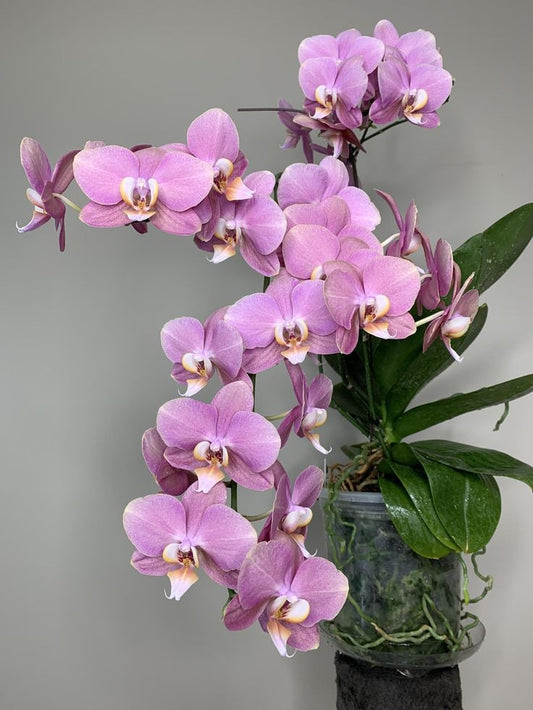
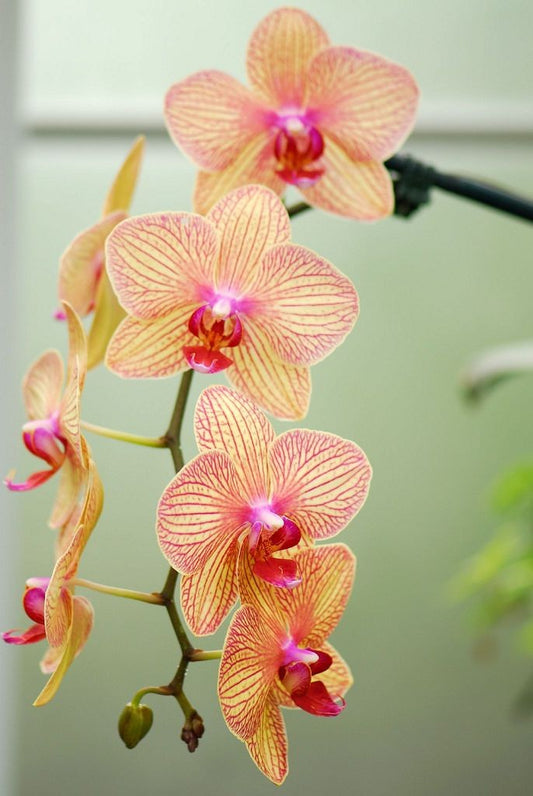
You can recognize the main orchid genera by their flowers and growth habit, without being a botanist. Phalaenopsis has broad leaves at the base and flat, butterfly-shaped flowers arranged along an arching flower spike.
Cambria and Oncidium have pseudobulbs—swollen structures at the base of the leaves that store water—and many small flowers, often less than 2.5 cm across, according to the Missouri Botanical Garden. Dendrobium grows on upright canes, Paphiopedilum is distinguished by its slipper-shaped flower, and Vanda by its long aerial roots.
Cymbidium forms long, strap-shaped leaves and tall spikes of waxy flowers. Good to know: Cambria is not a natural genus; the EPPO (European and Mediterranean Plant Protection Organization) database describes it as a name for intergeneric hybrids involving, among others, Oncidium, Odontoglossum, Miltonia, Cochlioda, and Brassia.
✅ Our tips for choosing the right orchid
To choose the right orchid, remember one simple rule: choose the genus first, based on your light levels and nighttime temperatures, then choose the color. Start with a Phalaenopsis, add a Paphiopedilum for a less bright room or a Cymbidium for a cool conservatory, and leave Vanda and Miltoniopsis for very bright or humid interiors.
If you're giving one as a gift, our guide to choosing a plant to give and our page on the meaning of orchids and their colors will help. You can also explore all our flowering houseplants and our orchid collection.
For a first orchid, I always recommend a Phalaenopsis: it's very forgiving and rewards you with months of flowers. I find that you learn more by observing a single plant than by buying five at once. Then, try a Paphiopedilum: its slipper-shaped flower is always a surprise, and it thrives where other orchids don't get enough light.

Laura Bruneau
Jardinière & autrice


