

Jewel orchids (Ludisia, Macodes, Anoectochilus): care

To care for a jewel orchid, place it in gentle light out of direct sun, keep its potting mix moist but never waterlogged using low-mineral water, maintain a temperature of 20 to 22 °C and high humidity, especially for Macodes and Anoectochilus.
The name jewel orchid does not refer to a single species but to a group of three main genera: Ludisia, Macodes and Anoectochilus. Unlike Phalaenopsis, these are terrestrial orchids: they grow on the floor of damp tropical forests, spreading by means of a fleshy stem called a rhizome. They are grown for their foliage, which looks embroidered with threads of gold, silver or copper.
If you're looking for care tips for a classic flowering orchid, our orchid care guide is a better fit; here, everything revolves around the leaves.
🌿 Why choose a jewel orchid?
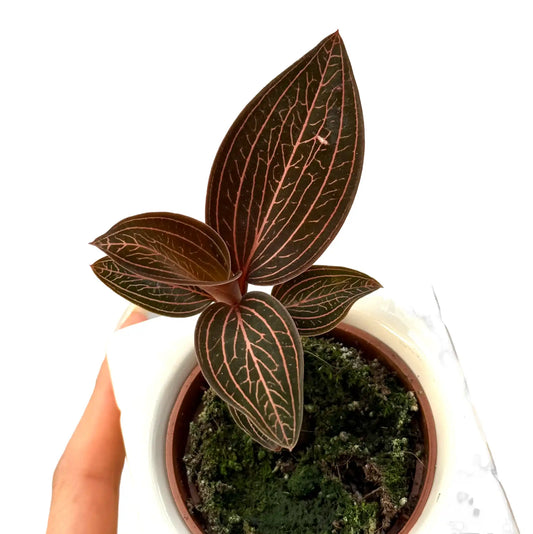
Jewel orchids tick a rare box: they are orchids grown for their foliage all year round, rather than for a bloom that lasts a few weeks. Their velvety leaves, threaded with a network of luminous veins, catch the light like precious fabric.
The three genera also offer a natural progression for collectors: start with Ludisia, which is hardy and vigorous, then move on to Macodes and Anoectochilus, which are more delicate and make the jewels of a terrarium. Their small size makes them easy to accommodate, even in a modest apartment.
| Benefit | What it means for your home |
|---|---|
| Spectacular foliage all year round | Golden, silver or pinkish veins add decorative appeal without relying on flowering |
| Compact size | 10 to 50 cm tall according to the RHS: a shelf or terrarium is all you need |
| Tolerates gentle light | Thrives near a north-facing window, where many plants become leggy |
| Easy to propagate from cuttings | A piece of stem placed on sphagnum moss will root within a few weeks |
🔎 Jewel orchid facts
According to Plants of the World Online (POWO), Kew Gardens' botanical database, the genus Ludisia comprises just 2 species, including Ludisia discolor, native from southern China to Sumatra and the Philippines.
The genus Macodes comprises 11 species, and Macodes petola grows from the southernmost Nansei-shotō archipelago (Japan) to the Thai Peninsula and western and central Malesia (Malaysia, Indonesia and the Philippines). The genus Anoectochilus is the largest, with 51 species ranging from tropical and subtropical Asia to the Pacific.
All belong to the Orchidaceae family and the Goodyerinae subtribe, and POWO describes them as rhizomatous geophytes of the humid tropical biome. The RHS (Royal Horticultural Society) classifies Ludisia discolor as H1a: to be grown under glass all year round, above 15 °C.
| Criteria | Verified details |
|---|---|
| 🏷️ Botanical name | Ludisia discolor, Macodes petola, Anoectochilus spp. (3 genera) |
| 🧬 Family | Orchidaceae, Goodyerinae subtribe |
| 🌳 Type | Evergreen terrestrial orchid with a creeping rhizome |
| 🌍 Origin | Tropical and subtropical Asia, from southern China to Malesia, extending to the Pacific for Anoectochilus (POWO) |
| 🍃 Foliage | Velvety, dark green to purplish brown, with gold, silver, red or pink veins |
| 🌸 Flowering | Upright spike of 20 to 30 small white flowers with yellow centers, lasting 2 to 3 weeks (SNHF) |
| 📏 Size | 10 to 50 cm tall and wide (Ludisia, RHS) |
| ⚠️ Toxicity | Ludisia is non-toxic to dogs, cats and horses (ASPCA); no published data for Macodes and Anoectochilus |
📋 Quick care guide
Essential growing guidelines, all at a glance.
| Care factor | Guideline |
|---|---|
| Light | Gentle and indirect; north-facing exposure or filtered east-facing window, never direct sun |
| Watering | Keep the potting mix moist; let the surface dry between waterings, and use rainwater or demineralized water |
| Potting mix | Airy but moisture-retentive mix: fine bark, potting soil, sphagnum moss and charcoal |
| Humidity | Ideally 75 to 80% (SNHF); Ludisia tolerates indoor air, Macodes and Anoectochilus do not |
| Temperature | 20 to 22 °C all year round; 18 °C minimum recommended (SNHF), never below 15 °C (RHS) |
| Repotting | In spring, in a wide, shallow pot, with the rhizome resting on the surface |
| Fertilizer | Diluted orchid fertilizer, every other watering in spring and summer |
| Toxicity | Ludisia is non-toxic (ASPCA); use caution with the other genera |
| Difficulty | Ludisia is easy; Macodes and Anoectochilus are demanding and ideally suited to terrariums |
📍 Where should you place a jewel orchid at home?
Place your jewel orchid in a warm, bright room, away from direct sunlight: in their native forest understory, these orchids live in the shade of trees. The RHS recommends a partially shaded spot, typically near a north-facing window.
The best location also depends on the genus: Ludisia does very well on a shelf or desk, while Macodes or Anoectochilus will benefit much more from a terrarium, display case or bright bathroom.
☀️ Light: Gentle, indirect light; direct sunlight will fade and burn the velvety leaves.
🌡️ Warmth: 20 to 22 °C according to the SNHF (Société nationale d'horticulture de France), which sets the minimum at 18 °C; keep away from drafts and radiators.
💦 Humidity: A heated home often has humidity of around 30 to 40% (see our guide to increasing humidity): enough for Ludisia, too dry for Macodes.
🪴 What pot and potting mix should you use for a jewel orchid?
A jewel orchid should not be grown in bark alone like a Phalaenopsis: it is a terrestrial orchid whose roots like to stay moist.
The SNHF recommends a mix of 60% fine pine bark, 30% horticultural potting soil and 10% charcoal, while the RHS suggests houseplant potting soil or medium-grade bark with a little sphagnum moss. Choose a wide, shallow pot, as the rhizome spreads across the surface rather than growing deep.
Repot in spring, when the mix has compacted or the plant is growing beyond the pot.
| Step | What to do |
|---|---|
| 1. Choose a pot | Wide, shallow and with drainage holes; a bowl or low planter will work |
| 2. Prepare the mix | Fine bark, potting soil and charcoal, with a little sphagnum moss to retain moisture |
| 3. Gently remove the plant | Free the rhizome without breaking the fleshy stems, and remove the old potting mix |
| 4. Lay the rhizome down | Place it flat on the surface, with the roots in the mix, without burying it |
| 5. Water and position | Water with low-mineral water, then return the plant to gentle light and humid air |
columns: 4
columns_mobile: 2
-

 Sold out
-
-

 Sold out
-
Anoectochilus roxburghii x Ludisia discolor - Spiderman
Regular price 12,95 €Regular price19,95 €Sale price 12,95 €Sold out


✂️ Everyday care: watering, humidity and fertilizer
Caring for a jewel orchid is all about balance: the potting mix should never stay dry for long, but it should never be waterlogged either. According to NC State Extension, waterlogged potting mix quickly causes roots and stems to rot. Air humidity is the other key, especially for the more delicate genera.
💧 Watering: Water when the surface dries, at the base of the plant, without wetting the velvety leaves; empty the saucer.
💧 Water: Use room-temperature rainwater, demineralized water or filtered water; limescale leaves marks on the leaves and potting mix.
💧 Humidity: Aim for 75 to 80% for Macodes and Anoectochilus (terrarium or display case); group plants together for Ludisia.
🌱 Fertilizer: Half-strength orchid fertilizer, every other watering from spring to the end of summer.
🧹 Cleaning: Remove damaged leaves and gently dust with a brush rather than a damp cloth.
🍂 Jewel orchids through the seasons
Jewel orchids do not have a true dormant period, but their growth slows as the light fades. From spring through summer, they produce new leaves: this is the time to repot, take cuttings and feed.
The upright spike of 20 to 30 small white flowers lasts 2 to 3 weeks; the SNHF places flowering in spring or early summer, though the timing varies with growing conditions. In winter, space out waterings a little, stop fertilizing and watch out for dry air from the heating.
📅 Seasonal care calendar
| Season | Key task |
|---|---|
| 🌸 Spring | Repot, take cuttings and resume diluted fertilizer. |
| ☀️ Summer | Leaf growth: water regularly, maintain high humidity and avoid direct sunlight. |
| 🍂 Fall | Water a little less often; give the last application of fertilizer at the end of summer. |
| ❄️ Winter | Keep above 15 °C, stop fertilizing and humidify the air despite the heating. |
🌱 How do you propagate a jewel orchid?
Jewel orchids are very easy to propagate from cuttings because their fleshy stems produce roots at each node. The RHS recommends laying stem sections on moist sphagnum moss until roots appear, after about 6 weeks, then potting them in a standard mix after 6 months.
Cut a section with 2 to 3 nodes, let the cut end dry for a few hours, then lay it on live sphagnum moss in a closed container. The SNHF notes that a glass of water also works for Ludisia. Dividing the clump when repotting is still the safest method.
🐛 Common problems: causes and solutions
Jewel orchids show what they need through their leaves and stems. Here are the most common problems, according to the RHS and NC State Extension, and how to fix them.
| Symptom | Likely cause | Solution |
|---|---|---|
| Stem soft and black at the base | 🍄 Rot: waterlogged potting mix | Cut above the healthy part, take a cutting and make the mix lighter |
| Leaves curling, dry edges | ⚠️ Air is too dry | Move to a terrarium or increase humidity, and move away from the radiator |
| Leaves faded or brown | ☀️ Too much direct sunlight | Move to a spot with gentle, indirect light |
| Stems growing long, dull veins | ☀️ Not enough light | Move closer to a bright window without direct sunlight |
| White, cottony clusters in leaf axils | 🐛 Mealybugs | Remove with a cotton swab dipped in alcohol and isolate the plant |
| Speckled leaves, fine webbing | 🕷️ Spider mites | Shower the foliage, increase humidity and treat |


🌸 Our jewel orchid varieties
Here are the jewel orchids we offer, listed from easiest to most demanding; each name links to the plant in our store, and you can find the whole family in our orchid collection.
| Variety | What makes it special |
|---|---|
| Ludisia discolor | The easiest: velvety purplish-brown leaves with red or gold veins; thrives indoors |
| Macodes petola | Dark green leaves with a network of bright golden veins; a terrarium is recommended |
| Anoectochilus chapaensis | Species native to southern Yunnan and northern Indochina according to POWO; grow in a terrarium |
| Anoectochilus roxburghii x Ludisia 'Spiderman' | Intergeneric hybrid (Ludisia × Anoectochilus), to be grown in humid conditions |
| Ludisia discolor 'Alba' | A sought-after cultivated form among collectors; grow it just like the type species |
| Ludisia discolor var. dawsoniana | Form with large, pink-veined leaves; POWO lists it as a synonym of Ludisia discolor |
🎨 Which plants pair well with a jewel orchid?
In a terrarium, jewel orchids pair well with plants that enjoy the same humidity and gentle light. Mosses, small ferns and Fittonia, which also thrives in high humidity, create a cohesive woodland scene; our guide to terrariums and humidity explains how to manage condensation.
On a shelf, a Ludisia makes a lovely companion for a Calathea makoyana: both prefer bright shade and humid air.
⚠️ Are jewel orchids toxic to cats and dogs?
No, not Ludisia: the ASPCA (American Society for the Prevention of Cruelty to Animals) lists the jewel orchid (under its former name, Haemaria discolor) as non-toxic to dogs, cats and horses, and NC State Extension says the same of Ludisia discolor.
However, we found no published data on the toxicity of Macodes or Anoectochilus. As a precaution, keep them out of reach of pets and young children; a closed terrarium takes care of that, too.
✅ Our expert tips for success
Success with a jewel orchid mostly comes down to choosing the right genus for your home. Start with Ludisia discolor if you're a beginner: it tolerates average indoor humidity and the occasional missed watering. Save Macodes and Anoectochilus for a terrarium or display case, where humidity stays stable. In every case, remember the three rules: gentle light, a moist but well-drained substrate, and low-mineral water.
And to explore the world of plant collectors further, check out our guide to rare houseplants.
I like to recommend Ludisia as a first jewel orchid: it grows, it's easy to propagate, and it teaches you how to read a foliage plant. Once you've learned its rhythm, growing Macodes petola in a terrarium becomes a real pleasure, with those golden veins lighting up as soon as a ray of light touches them. My advice: don't try to make it bloom—just enjoy watching it grow.

Laura Bruneau
Jardinière & autrice


