Terrarium plants: which ones should you choose, closed or open?

The best plants for a terrarium are low, dense, slow-growing plants, chosen according to the type of container: tropical plants that thrive in humid air (Fittonia, Peperomia, Pilea, Hypoestes, small ferns) for a closed terrarium, succulents and cacti only for an open terrarium. This guide helps you make this choice, plant by plant, with a large comparison table, and then build your terrarium step by step.
It does not cover adjusting humidity, which is already detailed in our guide to condensation in terrariums: read it once your plants are installed. Each plant mentioned links to its complete care sheet for more information.
🌟 Why the choice of plants determines the success of a terrarium
A successful terrarium depends first on the plants you put in it, much more than on the container. Under glass, the space is fixed: a plant that grows too quickly will touch the wall, suffocate its neighbors, and have to be removed. The RHS points out that many classic houseplants, even when young, become too vigorous for a terrarium over time.
The University of Missouri Extension recommends choosing low, dense plants and not mixing species with very different light and temperature requirements. Choosing well therefore means bringing together compatible, small, and patient plants.
| Benefit | What it means |
|---|---|
| Plants that stay small | Less pruning, no plant to remove after a few months, a stable display |
| Identical needs | The same humidity and light for all: no plant will decline in favor of another |
| Almost no watering in a closed terrarium | The RHS says only a few times a year, in small amounts |
| A display suited to the room | The right type of terrarium for your light: bright office, shelf, bathroom |
📊 Which plant for which terrarium? The large comparison
Here are the most common terrarium plants, classified by container type, with their adult size and growth rate. The dimensions come from the NC State Extension (North Carolina State University), converted from inches to centimeters and rounded; the RHS lists Peperomia, Fittonia, Hypoestes, Pilea, small ferns, Cryptanthus, and Selaginella kraussiana as closed terrarium plants.
For the plants we have care sheets for, the link will take you to their complete guide.
| Plant | Terrarium type | Adult size | Growth | Light | Toxicity to dogs and cats |
|---|---|---|---|---|---|
| Fittonia (Fittonia albivenis) | Closed, humid | About 8 to 20 cm tall, spreading 15 to 45 cm (NC State) | Slow | Bright to medium, no direct sun | Non-toxic (NC State) |
| Peperomia prostrata | Closed or open, humid | 23 to 30 cm, trailing stems about 30 cm (NC State) | Slow | Light shade to partial shade | Non-toxic (NC State) |
| Pilea involucrata | Closed, humid | About 8 to 30 cm (NC State) | Compact growth, pinch the stems | Bright and indirect, humid air | Non-toxic (NC State) |
| Pilea peperomioides | Open, large container, young plant | About 20 to 30 cm (NC State) | Fast | Bright and indirect | Non-toxic (NC State) |
| Cryptanthus bivittatus | Closed or open, humid | Leaves about 8 to 15 cm (NC State) | Slow; "a first choice for a terrarium" according to NC State | Filtered light | Non-toxic (NC State) |
| Selaginella kraussiana | Closed, humid | 5 to 10 cm tall, spreading 30 to 45 cm (NC State) | Fast | Shade to partial shade | Non-toxic (NC State) |
| Soleirolia soleirolii | Closed, humid, with caution | 8 to 15 cm tall, spreads extensively (NC State) | Fast, invasive | Light shade | Non-toxic (NC State) |
| Hypoestes (Hypoestes phyllostachya) | Open, humid or large closed | 30 to 60 cm possible (NC State); our pots stay around 20 to 30 cm if pinched | Fairly fast, pinch often to stay compact | Bright and filtered | Non-toxic (ASPCA, see the care sheet) |
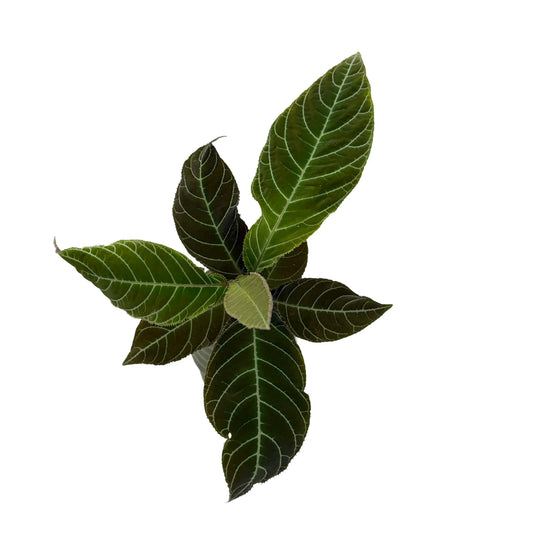
| Macodes petola (jewel orchids) | Closed, humid | Small creeping orchid | Stays low, creeping stem | Soft, no direct sun | No published data (see the care sheet) |
| coffee plant (Coffea arabica) | Young plant only, large container, temporary | About 1.2 to 1.8 m indoors at maturity (NC State) | Medium (NC State): repot as soon as it approaches the glass | Bright, with a little light shade (NC State) | Coffee and caffeine are toxic to dogs and cats (ASPCA, see the care sheet) |
| Tillandsia (Tillandsia) | Open and well-ventilated only, never closed | Depending on the species: prefer small ones like T. ionantha | Slow | Bright, no scorching sun | Not documented by the ASPCA (see the care sheet) |
| Succulents and cacti (cactus and succulent guide) | Open desert type only | Choose dwarf species | Depending on the species | Maximum light | Varies by species (Crassula is toxic) |
📋 Quick technical sheet
Common guidelines for any plant terrarium, before choosing the species.
| Guideline | The rule |
|---|---|
| Container type | Closed for tropical plants, open for succulents and dry air plants (UF IFAS) |
| Plant size | Low, dense, slow; check adult height and spread (RHS) |
| Number of plants | Container large enough for at least 2 plants (UF IFAS) |
| Light | Bright and indirect for at least 6 hours a day, north or east window (RHS) |
| Temperature | Nights around 18 °C (65 °F), days about 5 to 6 °C warmer (University of Missouri) |
| Drainage layer | 1.3 to 3.8 cm of gravel at the bottom (UF IFAS) |
| Substrate | Sterilized potting mix over about 1/5 of the container height (UF IFAS) |
| Watering | Closed: a few times a year, in small amounts (RHS) |
| Fertilizer | None for at least 1 year after planting (University of Missouri) |
| Maintenance | Remove dead leaves and faded parts without delay (RHS) |
How to make a terrarium step by step
To make a terrarium, choose a clear glass container, place a reserve of washed gravel, a thin layer of charcoal for the closed version, and suitable potting mix, then plant from largest to smallest, cover with moss, and barely water before closing. The University of Florida Extension (UF IFAS) recommends 1.3 to 3.8 cm of gravel, charcoal for closed terrariums, and sterilized potting mix filling about 1/5 of the container.
The RHS recommends washed gravel at the bottom and potting mix mixed with a draining material, in a ratio of about 4 to 1.
Warning: a jar has no hole, so this layer does not drain anything outside; it serves as a reserve where excess water accumulates away from the roots (read our article on drainage in a container without a hole). The main thing remains very measured watering. In an open desert terrarium, replace the humic potting mix with a very mineral cactus substrate.
🧰 The equipment needed to make a terrarium
A clear glass container, ideally about 30 cm wide and high according to the RHS, with a glass lid for the closed version. Then washed gravel, horticultural charcoal, potting mix, and moss: the University of Illinois estimates that these layers occupy about a quarter of the volume.
For tools: a long pair of tweezers or chopsticks and a spray bottle (RHS), a clean brush to clean the leaves (University of Illinois); for a narrow neck, a spoon attached to a stem (RHS).
| Step | The right action |
|---|---|
| 1. Choose the container | Closed for tropical plants, open for succulents and cacti; clear and clean glass |
| 2. Place the water reserve | Washed gravel at the bottom (RHS), from 1.3 cm minimum to 3.8 cm in a large container (UF IFAS): a reserve for excess water, not drainage outside |
| 3. Add the charcoal | About 0.6 cm (1/4 inch) of horticultural charcoal in a closed terrarium (Mississippi State University): it prevents a sour smell (UF IFAS) and helps eliminate potentially toxic byproducts (University of Missouri) |
| 4. Insulate and fill | A veil or moss so the potting mix does not sink, then about 1/5 substrate (UF IFAS) |
| 5. Plant from largest to smallest | Place the tallest plant first, then the ground covers, without touching the wall |
| 6. Cover and decorate | Moss or live sphagnum moss on the surface (RHS), stones, wood; for desert type, dry gravel |
| 7. Water very little | Spray along the wall (RHS), without soaking: the added water is no longer removed (Mississippi State University) |
| 8. Let breathe before closing | Lid open for about 24 hours, then alternate 24 hours closed and 24 hours open until condensation no longer accumulates (Mississippi State University); then, light condensation indicates the right water level (RHS) |
The assembly takes one session; it is the balancing that requires patience. The Mississippi State University Extension considers the system balanced when almost no more condensation forms after these cycles.
🔀 The variants: closed, open, desert, in a bottle
| Variant | What changes during assembly |
|---|---|
| Closed terrarium | Lid, charcoal, tropical plants; no flowering plants, whose care requires opening (RHS) |
| Open humid terrarium | Same assembly without a lid; more frequent watering (University of Illinois) |
| Desert terrarium | Mineral substrate for cacti, dry gravel, never a lid (RHS, Mississippi State University) |
| Bottle terrarium | Wide neck or demijohn (RHS), layers poured with a paper funnel (Mississippi State University) |
| Old aquarium | Good container (RHS), to be closed with a glass lid |
columns: 4
columns_mobile: 2
-
-
-

 Sold out
-
-

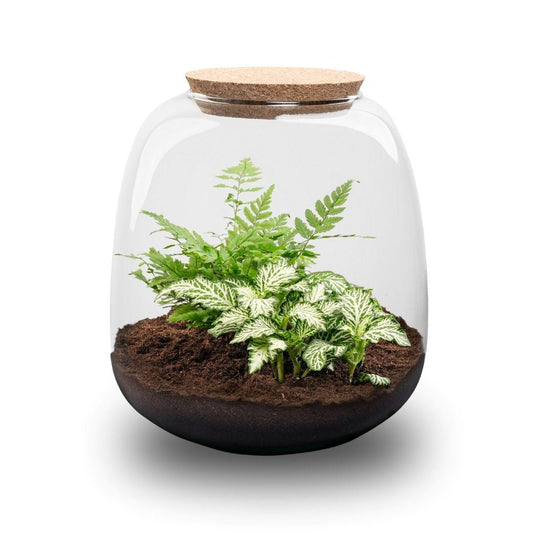
Closed terrarium kit with Fittonia and fern, small glass jar with cork lid, Ø 19 cm, height 20 cm
Regular price 64,95 €Regular price



🧭 Which terrarium according to your room and your light?
The right choice depends first on the light of the room, then on the space and the time you want to devote to it. A closed terrarium requires bright but indirect light; a desert terrarium, on the contrary, demands maximum light, which makes it a project for a very bright room. Here are our answers to the most frequent situations.
| Your situation | Our advice |
|---|---|
| Bright office, north or east window | Closed terrarium: Fittonia, Peperomia prostrata, Pilea involucrata, small ferns |
| Very bright room, south window | Open desert terrarium: succulents and dwarf cacti, jar never closed |
| Dark room, far from windows | No terrarium without light: add a horticultural LED lamp above the jar |
| Bright bathroom | Open humid terrarium or plants from our bathroom collection |
| Beginner who wants hassle-free | Closed terrarium with 2 or 3 slow plants (Fittonia, Cryptanthus) and very little water |
| Collector | Closed top terrarium for jewel orchids like Macodes petola |
| Curious pets at home | Non-toxic plants (Fittonia, Peperomia, Pilea according to NC State) and closed container; see our list of non-toxic plants for cats |
| Wanting Tillandsia in glass | Open and well-ventilated container only (RHS), never a closed jar; see the Tillandsia guide |
🫙 Closed, open, or desert terrarium: what difference for the plants?
The difference lies in the humidity of the air: a closed terrarium recycles its water and remains very humid, an open terrarium dries out faster. According to the University of Florida (UF IFAS) extension, the closed terrarium is better suited to tropical plants and the open terrarium is ideal for succulents and plants that like it dry.
The RHS (Royal Horticultural Society) confirms that succulents are particularly suited to open terrariums. So never put a cactus under glass: the saturated air causes their water-filled tissues to rot. Between the two, the humid open terrarium (wide-neck jar) accommodates Peperomia, Hypoestes, or Cryptanthus, with slightly more frequent watering.
Tillandsia are a special case: the RHS guide on air plants insists on a well-ventilated location and complete drying between two waterings, rot coming from stagnant water combined with confined air. They will therefore go in an open and ventilated container, never under glass.
📏 Adult size and growth rate: the forgotten criterion
The most important criterion is the adult size, because a plant sold in a few-centimeter pot can outgrow your jar in one season. The RHS asks to check the final height and spread on the label.
The NC State Extension warns, for example, that Soleirolia (Helxine) can live in a terrarium but eventually crowds out the other plants; in the ground, its forgotten fragments even grow back after pulling out.
Selaginella kraussiana also grows quickly, while Fittonia and Cryptanthus are classified as slow-growing. The Pilea peperomioides, fast-growing and 20 to 30 cm at maturity, is kept for a large open container.
Same logic for the coffee plant: sold as a small terrarium plant, it reaches about 1.2 to 1.8 m indoors according to the NC State Extension; it only stays under glass long enough to be young, then joins a real pot.
☀️ Terrarium plant without light: is it possible?
No: no plant lives without light, even in a terrarium. The RHS recommends bright indirect light for at least 6 hours a day, ideally near a north or east window, sheltered from the summer sun and heat sources.
The University of Missouri extension places shade-tolerant plants at a maximum of 10 feet from a clear window, or about 3 m. Beyond that, or in a room without a window, horticultural lighting becomes essential. Direct sunlight is the opposite excess: under glass, it overheats the air and burns the leaves.
🗓️ The terrarium through the seasons
A plant terrarium lives at the pace of light: it grows from spring to late summer and slows down in winter. Spring is the best time to arrange a jar or replace a plant that has become too large. In summer, the main risk is overheating if the sun reaches the glass.
In fall and winter, the light decreases: the RHS then allows a south or west window, without sticking the terrarium to a radiator, and the waterings are spaced out even more. The University of Missouri advises not to add fertilizer for at least 1 year after planting.
📅 Care calendar by season
| Season | Key action |
|---|---|
| 🌸 Spring | Arrange or redo the terrarium, trim the plants that touch the wall, remove the faded leaves. |
| ☀️ Summer | Move away from direct sunlight, monitor overheating and persistent condensation. |
| 🍂 Fall | Move closer to the window (south or west possible in winter according to the RHS), space out waterings, no fertilization. |
| ❄️ Winter | Maximum light without radiator heat, almost zero watering in closed. |
⏳ How long does a terrarium last?
A plant terrarium has no fixed end date, but its composition remains decorative for one to two years at most: this is the usual display duration indicated by the State University of Mississippi. To prolong it, trim what touches the glass and replace the plant that has become too large.
The system itself can last much longer: the University of Missouri recalls that Dr. Nathaniel Ward, the originator of Ward's cases in the 19th century, saw a young fern and a grass grow for four years in a closed bottle, without adding water or opening the lid.
🐛 The most common mistakes with terrarium plants
Most failures come from a bad plant choice or an excess of water, much more than a lack of care. The RHS links yellowing leaves to overwatering and rot to excessive condensation. Here are the mistakes we see most often, and how to avoid them.
| Mistake | Why it's a problem | The solution |
|---|---|---|
| Put a cactus or succulent under glass | Saturated air rots the fleshy tissues | Reserve succulents and cacti for the open terrarium (RHS, UF IFAS) |
| Choose a vigorous houseplant | It touches the wall and suffocates the others in a few months | Check the adult size, prefer slow and dwarf species |
| Mix sun plants and shade plants | One part of the plants will necessarily wither | Gather identical needs (University of Missouri) |
| Water like a classic pot | Stagnant water at the bottom of a jar without a hole, asphyxiated roots | Water very little, read the condensation (terrarium condensation guide) |
| Place the terrarium in the sun | Greenhouse effect, burned leaves | Bright indirect light, north or east window (RHS) |
| Leave dead leaves | They rot and promote mold | Remove them without delay (RHS) |
| Put fertilizer in from planting | Too fast growth in a fixed space | No fertilizer for at least 1 year (University of Missouri) |


🌿 Our plant guides to arrange your terrarium
Each plant below has a complete care guide: light, watering, substrate, propagation, and toxicity. Start with slow and tolerant plants, then add the collector species.
You will find other humid air plants in our bathroom plant collection, all our Peperomia, our rare plants and all our indoor plants.
| Our selection | Why choose it |
|---|---|
| Fittonia | The closed terrarium plant par excellence: low, slow, veined foliage, non-toxic |
| Peperomia | Small creeping species like Peperomia prostrata, slow and non-toxic |
| jewel orchids | The jewel of the closed terrarium: Macodes petola and its golden veins, which demands high humidity |
| Hypoestes | Pink, red, or white speckled foliage; pinch often to stay compact |
| Pilea peperomioides | The Pilea peperomioides stays young, in a large open container: it grows fast |
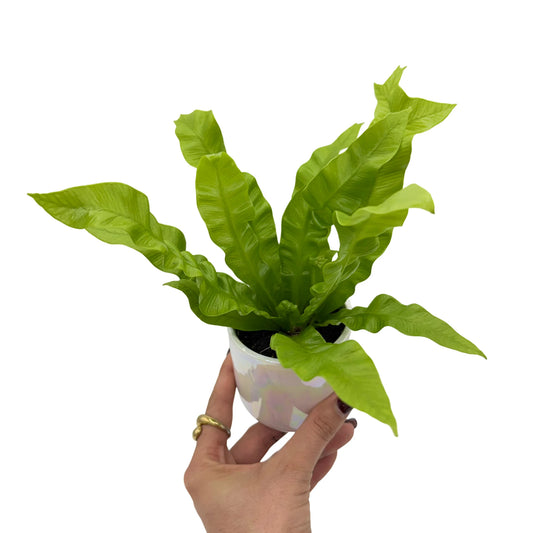
| Boston Fern | The type reaches 0.5 to 1 m (RHS), too large for a jar; for a terrarium, the RHS cites the compact cultivar 'Fluffy Ruffles' and other small ferns like Pellaea rotundifolia |
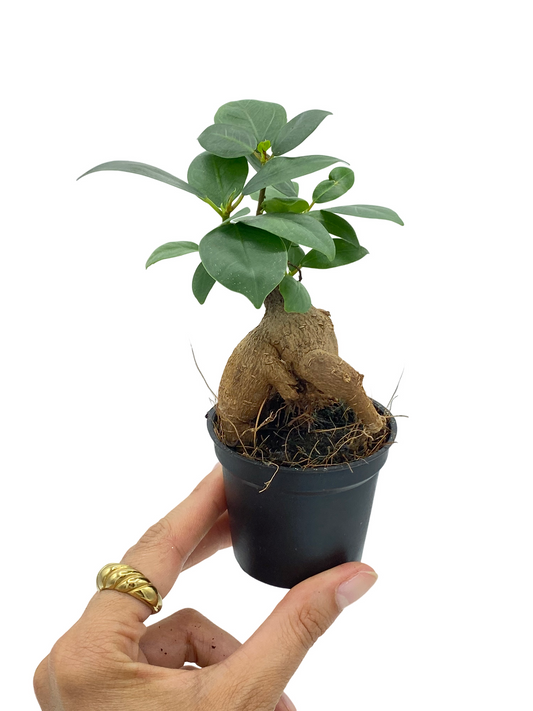
| Ficus ginseng | The Ficus ginseng bonsai for a large open and very bright terrarium; milky sap (NC State), keep out of reach of animals for safety |
| Crassula | Succulent for open desert terrarium only; toxic to dogs and cats |
| cactus and succulent guide | All species to arrange a desert open terrarium, in full light |
| coffee plant | Young terrarium plant, especially in a kit: move to a pot when it grows, because it reaches 1.2 to 1.8 m indoors (NC State) |
🔑 DIY terrarium kits: a good way to start?
Yes, a terrarium kit avoids the most common mistake: combining incompatible or too large plants for the container. Our kits gather the container, the layers (water reserve, activated charcoal, potting soil, moss), plants adapted to the format, and a building plan, with the tools according to the version.
It suits beginners and makes an original gift idea: the University of Illinois presents the terrarium as a family project and a unique gift for the holidays. Find all our terrarium kits to arrange, and the jars alone among our terrarium containers.
| Your desire | The kit that answers it |
|---|---|
| A first closed terrarium | Closed Fittonia and fern kit, small jar with cork stopper |
| A living Christmas gift | Christmas Fittonia and heather kit, whose decoration is removed after the holidays, or Christmas mini fir kit |
| An ambient light in the evening | Calathea and Fittonia light kit: LED ambient stopper, not a grow lamp |
| A bonsai under glass | Ficus ginseng bonsai kit ; milky sap (NC State), keep out of reach of animals as a precaution |
| Choose your own plants | DIY kit without plants: jar, substrate and tools, plants and moss to add |
| Rebuild a terrarium | Terrarium refill and terrarium accessories |
✅ The right choice in summary
To succeed with a terrarium, first choose the type of container according to your light, then plants with identical needs, low and slow-growing. Closed: Fittonia, small Peperomia, Pilea involucrata, Cryptanthus, jewel orchids, small ferns. Open desert-style: succulents and dwarf cacti, never under a bell jar.
Build simple layers, water very little, and rely on condensation thanks to our terrarium condensation guide.
My first terrarium was a kitchen jar with a Fittonia and a little moss: it is still the combination I recommend for beginners. The mistake I see most often is the pretty plant bought on a whim that touches the glass three months later. Always look at the adult size before the color of the leaves, and leave air between the plants: a terrarium is composed with patience.

Laura Bruneau
Jardinière & autrice