Carnivorous plants: choosing and growing them according to their habitat

To keep a carnivorous plant alive, grow it as it would grow in its native environment: bog-dwelling carnivorous plants (Sarracenia, Venus flytraps, and temperate sundews) need full sun outdoors, rainwater, and a cool winter, while tropical Nepenthes thrive indoors in warm, humid conditions. Failure is almost always due to tap water, enriched potting soil, or spending winter in a living room.
This guide categorizes carnivorous plants by growing environment, compares seven plants using sourced data, and debunks myths about mosquitoes and giant plants. The outdoor growing of Sarracenia has its own detailed page, and our Nepenthes 'Gaya' illustrates the tropical family.
🌟 Why a carnivorous plant needs neither fertilizer nor meat
A carnivorous plant is a plant that captures and digests small animals, especially insects, to supplement the nutrients that its poor, waterlogged soil does not provide: it therefore needs neither fertilizer nor meat provided by you.
According to the RHS (Royal Horticultural Society) carnivorous plant growing guide, most come from nutrient-poor environments and require no fertilization. The RHS page on carnivorous plants states that they die in garden soil, ordinary potting soil, or with any fertilizer.
The RHS Venus flytrap page adds that its traps do not digest inanimate objects like meat or cheese: digestion only continues if they detect the movement of a living prey.
| Feature | What it means |
|---|---|
| Urns | Urn- or trumpet-shaped leaves where prey fall: Sarracenia, Nepenthes (RHS) |
| Snap traps | In the Venus flytrap, small hairs trigger the closure of the trap, often in a tenth of a second (RHS) |
| Sticky leaves | Sticky leaves or pads that trap insects: Drosera, Pinguicula (RHS) |
| Cups | Rounded cup traps, another form mentioned by the RHS alongside trumpet urns |
| Flowers | The Venus flytrap bears white flowers in spring on a stem approximately 10 to 30 cm long (NC State) |
📊 Carnivorous plants compared by growing environment
Carnivorous plants are divided into three growing environments: temperate bog plants to grow outdoors, tropical indoor plants, and small carnivorous plants for bright indoor spaces. The RHS hardiness scale ranges from H1 (under a heated shelter) to H7 (very hardy); H3 means hardy in coastal and mild regions, with a minimum of -5 to 1 °C.
| Carnivorous plant | Environment | Light | Winter | Hardiness | Watering in season |
|---|---|---|---|---|---|
| Sarracenia purpurea | Temperate bog, outdoors | Full sun, south or west exposure (RHS) | Cool rest, slightly drier, loses leaves (RHS) | H6, -20 to -15 °C (RHS) | Pot in a saucer of rainwater |
| Sarracenia leucophylla and hybrids | Temperate bog, outdoors in mild regions | Full sun, shelter from cold wind (RHS) | Cool rest, slightly drier (RHS) | H3, -5 to 1 °C; up to 0.5 to 1 m tall (RHS) | Pot in a saucer of rainwater |
| Venus flytrap (Dionaea muscipula) | Temperate bog, outdoors or on a full-south windowsill | Full sun, 6 hours or more of direct sun according to NC State Extension (North Carolina State University) | Deciduous foliage in winter (NC State); cool rest outdoors, or above 10 °C if overwintered indoors (RHS) | USDA zones 7 to 10 (NC State); H3 for the 'Akai Ryu' cultivar (RHS) | Roots always wet, saucer of rainwater |
| Drosera capensis | Bright indoor space or outdoors in summer | Full sun, south exposure (RHS) | Under shelter in frost regions; flowers from spring to autumn (RHS) | H3, -5 to 1 °C (RHS) | Saucer of rainwater at all times (RHS) |
| Mexican Pinguicula (e.g., P. gigantea) | Bright indoor space | South window or supplemental lighting in winter (University of Illinois Extension) | Sheltered indoors in winter (University of Illinois) | Outdoors in USDA zones 7 to 10 only (Illinois), i.e., down to -17.8 °C at coldest | Water through the saucer to avoid wetting the leaves |
| Lowland Nepenthes | Tropical, warm indoors | Bright light, 2 to 6 hours of direct sun at most (NC State) | No dormancy: 21 to 35 °C (NC State) | USDA zones 10 to 13: never frost (NC State) | Moist but well-drained substrate, never sitting in water |
| Highland Nepenthes | Tropical, indoors with cool nights | Bright light, without scorching sun | 24 to 29 °C during the day, around 16 °C at night (NC State) | Never frost (NC State) | Moist but well-drained substrate, very humid air |
📋 Quick fact sheet
Common guidelines for all carnivorous plants, according to the RHS and NC State.
| Feature | The rule |
|---|---|
| Water | Rainwater, otherwise distilled water; tap water accumulates minerals in the substrate (RHS) |
| If using tap water | Boil and cool as a temporary measure, and replace the substrate every six months (RHS) |
| Substrate | Never regular soil or potting mix: special carnivorous plant mix, poor and acidic (RHS) |
| Peat-free mix | 75% sustainably grown sphagnum moss and 25% 4 mm sifted pine bark, or 100% chopped dried sphagnum moss (RHS) |
| Fertilizer | None: the plant feeds on the insects it captures (RHS) |
| Tray method | In season, place the pot in 2.5 to 5 cm of water for bog carnivorous plants (RHS) |
| Light | Full sun outdoors for temperate plants; behind glass, beware of summer sun burning the leaves (RHS) |
| Repotting | Not before a year in the purchased pot, then into a slightly larger pot when the roots fill it (RHS) |
How to grow a carnivorous plant in 6 steps
To successfully grow a carnivorous plant, first identify its environment, then provide the water, substrate, and light of that environment, and respect its winter.
| Step | The right action |
|---|---|
| 1. Identify the environment | Temperate bog, tropical, or small indoor carnivorous plant: everything else follows |
| 2. Provide water | Collect rainwater, or buy distilled water; never hard water |
| 3. Choose the pot | Plastic pot with drainage holes; the University of Illinois advises against porous terracotta, which dries out too quickly |
| 4. Place it in the right spot | Full sun outdoors for Sarracenia and Venus flytraps, bright filtered light for Nepenthes |
| 5. Water from below | Saucer filled with rainwater in season for bog plants; just moist substrate for Nepenthes |
| 6. Prepare for winter | Cool rest and pot out of water for temperate plants; constant warmth and light for Nepenthes |
columns: 4
columns_mobile: 2
-
 Livraison offerte
Nepenthes 'Gaya' - Nepenthes, carnivorous plant - 12cm pot - Height 17cm
Regular price 44,95 €Regular price -
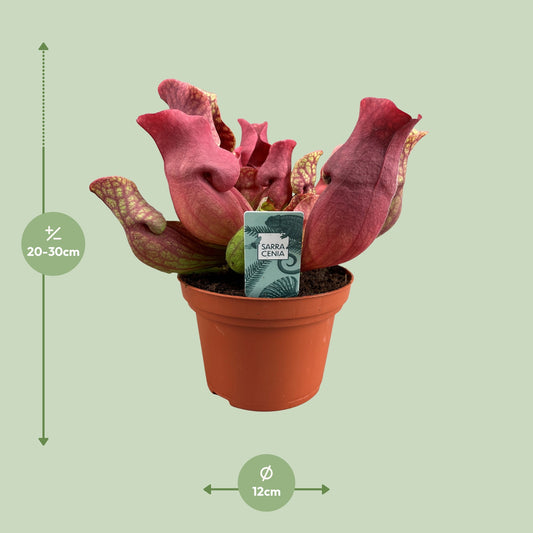
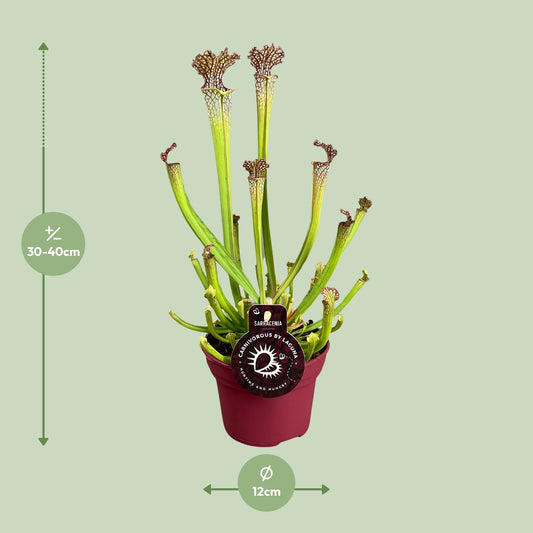
Sarracenia × farnhamii - Sarracenia, carnivorous plant - 12 cm pot - Height 40 cm
Regular price From 44,95 €Regular price -

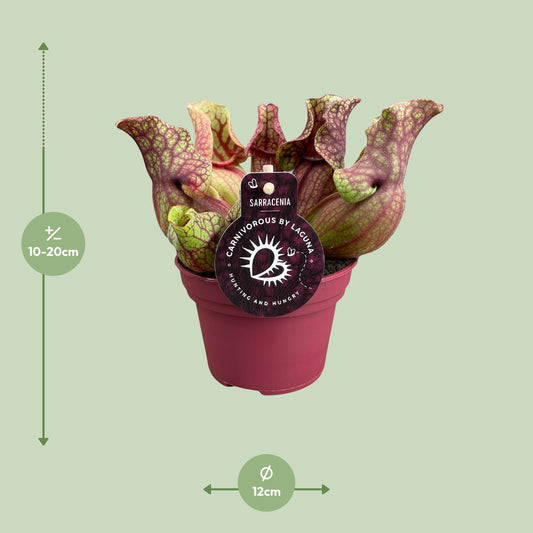
Sarracenia purpurea subsp. venosa - Purple pitcher plant, carnivorous plant - 12cm pot - Height 20cm
Regular price 44,95 €Regular price -

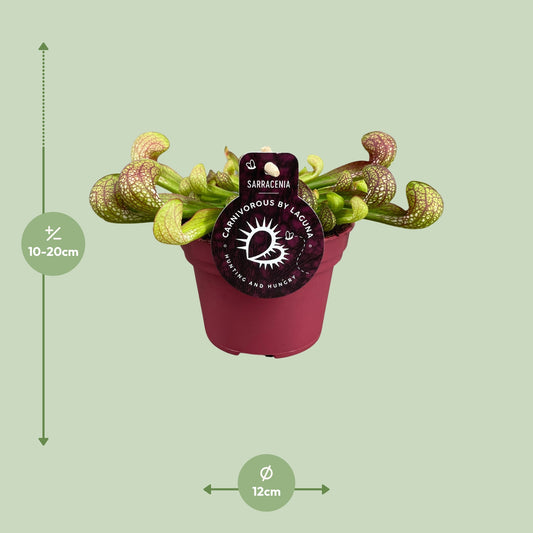
Sarracenia psittacina - Parrot's beak, carnivorous plant - 12 cm pot - Height 13 cm
Regular price 44,95 €Regular price -

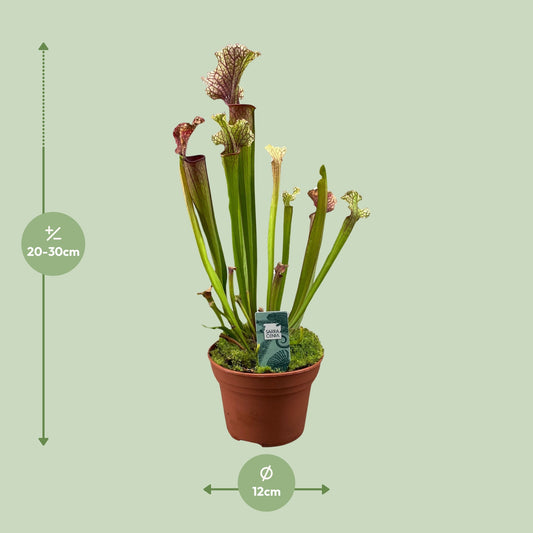
Sarracenia 'Judith Hindle' - Hybrid Sarracenia, carnivorous plant - 12 cm pot - Height 30 cm
Regular price 44,95 €Regular price -

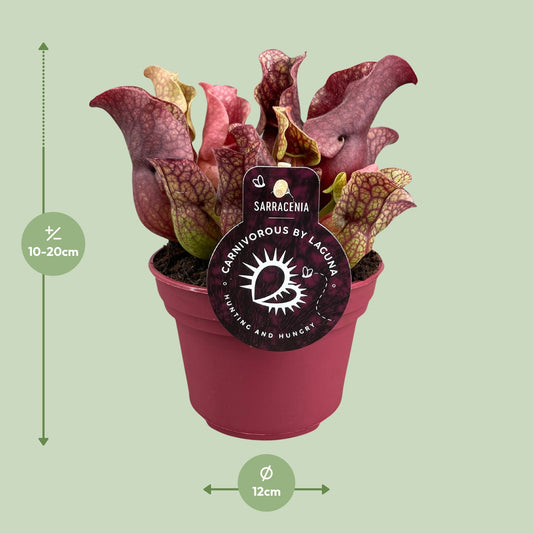
Hybrid Sarracenia with red pitchers - Red Sarracenia, carnivorous plant - 12 cm pot - Height 20 cm
Regular price 44,95 €Regular price -
Live sphagnum moss - Sphagnum moss for plants - Sphagnum moss - Live sphagnum moss for plants
Regular price 9,50 €Regular price8,50 €Sale price 9,50 € -
Horticultural Perlite - Perlite for plants
Regular price From 8,50 €Regular price8,50 €Sale price From 8,50 €




🧭 Which carnivorous plant to choose for your situation?
The right carnivorous plant depends first on where you can grow it: a balcony or garden in full sun is suitable for bog carnivorous plants like Sarracenia, a warm, bright, humid interior for Nepenthes, and a south windowsill for small succulents and Drosera capensis.
| Your situation | The right carnivorous plant |
|---|---|
| South-facing balcony or patio | Sarracenia and Venus flytrap, with the pot sitting in rainwater from one of our saucers |
| Garden | Sarracenia purpurea, the hardiest (H6), in a pot or small bog |
| Heated and bright apartment | Nepenthes in bright light, without direct sun through the glass, ideally in hanging pots (RHS) |
| South windowsill | Drosera capensis and Mexican Pinguicula, which stay small |
| Dark room | No carnivorous plant without a grow light above the plants |
| Terrarium | Nepenthes or Pinguicula in a large, ventilated, and lit container; never Sarracenia or Venus flytrap, which need sun and a cold winter; see our plants for closed or open terrariums |
📐 Temperate bog carnivorous plants: outdoors all year
Temperate bog carnivorous plants can be grown outdoors all year, in full sun, with the pot in rainwater in season, and a cool winter rest; the Venus flytrap, more sensitive to cold, requires a little more care in winter. The RHS considers Sarracenia, Drosera, and Pinguicula hardy enough to be happy outdoors all year in a sunny spot, and recommends a bell during severe cold.
For the Venus flytrap, NC State considers it hardy in USDA zones 7 to 10 (zone 7: minimums of -17.8 to -12.2 °C) and growable in colder areas with winter protection; the RHS, which grows it indoors, recommends a cooler rest but above 10 °C.
The Venus flytrap is native to an area of approximately 110 km (70 miles) around Wilmington, North Carolina, according to NC State.
For Sarracenia, our Sarracenia (sarracenie) page details varieties, dormancy, and division; for overwintering in a pot, see how to protect plants from frost.
📐 Nepenthes: tropical indoor carnivorous plants
Nepenthes are tropical indoor vines with hanging urns, which grow all year without dormancy and require warmth, bright light without direct sun, and high humidity: it is the carnivorous plant best suited to a heated and bright apartment, provided the air is humidified. NC State counts 197 species, originating from the Seychelles, Madagascar, and tropical Asia to the western Pacific.
The urns often measure 10 to 20 cm; in air that is too dry, they develop poorly or dry out, NC State warns. Water with rainwater without leaving the pot soaking, and remove old urns when they begin to fade, as the RHS recommends.
For lasting humidity, group the plants or use a humidifier: follow our guide to increase air humidity. Most Nepenthes sold are hybrids propagated in culture, according to NC State.
📐 Pinguicula and Drosera capensis: small windowsill carnivorous plants
Succulents (Pinguicula) and Drosera capensis are the easiest small carnivorous plants to keep indoors, on a very bright windowsill. The University of Illinois recommends a mix of two parts peat, one part sand, and one part perlite, with watering through the saucer.
It considers the succulent effective against small insects like fungus gnats or thrips, not against larger insects. The genus Drosera counts at least 250 species according to NC State.
📐 Flies, mosquitoes, giant plant: myths
No, a carnivorous plant does not rid a house of its flies or mosquitoes: it captures a few prey, not a population. NC State reminds that flies only represent about 5% of the Venus flytrap's prey, especially ants, beetles, and spiders, and that digestion takes about 10 days.
Against fungus gnats, a fungus gnat trap is much more effective. As for the "giant carnivorous plant", these are Nepenthes: NC State cites Nepenthes rajah urns of about 30 cm, and Nepenthes gracilis vines of 1.8 to 6 m.
The RHS indicates that some tropical Nepenthes trap frogs, birds, or small rodents in the wild.
🗓️ The calendar of a carnivorous plant
A temperate carnivorous plant grows and hunts from spring to autumn, then rests in the cold in winter; a Nepenthes keeps the same pace all year round, in the warmth. The dionaea flowers in May and June according to NC State, and the Sarracenia purpurea in spring according to the RHS.
📅 Care calendar by season
| Season | Key action |
|---|---|
| 🌸 Spring | Resumption: repotting if the roots fill the pot, return of the saucer of rainwater, cutting of urns and dry leaves |
| ☀️ Summer | Full sun outdoors for temperate ones, saucer always filled; Nepenthes sheltered from the midday sun, humid air |
| 🍂 Autumn | Sarracenia urns turn brown: it's normal; reduction of water, pot removed from the saucer before the cold |
| ❄️ Winter | Rest in the cool and in the light for temperate ones, just moist substrate; Nepenthes in the warmth, never near a radiator |
🐛 The mistakes that kill a carnivorous plant
The mistakes that kill the most carnivorous plants are tap water, enriched potting soil, lack of light and winter in the warmth for temperate species. Here is how to avoid them.
| Mistake | Why it's a problem | The solution |
|---|---|---|
| Watering with tap water | Minerals accumulate in the substrate; hard water can kill the plant (RHS, NC State) | Rainwater or distilled water only |
| Planting in potting soil | Soil and potting soil are too rich (RHS) | Poor and acidic mixture, or peat-free sphagnum |
| Giving fertilizer or meat | Useless, and meat is not digested (RHS) | Let the plant hunt on its own |
| Triggering the dionaea traps | A trap closes at most three times before dying (RHS dionaea sheet) | Do not touch the sensitive hairs, do not play |
| Leaving a temperate one in the living room in winter | The RHS advises against the warm room in winter: the dionaea needs a rest in the cool | Rest outdoors or in a cold and bright room |
| Putting a Nepenthes in the saucer | The substrate must remain moist but drained (NC State) | Water without leaving the pot soaking |
| Letting the substrate dry | Bog carnivores hate to dry out (RHS) | Monitor the saucer, especially for pots outdoors |


🌿 Our carnivorous plants and what is needed to grow them
Here are our two carnivorous plants, one for each major environment, and the necessary for their substrate.
| Our selection | Why choose it |
|---|---|
| Sarracenia (sarracenie) | The bog carnivore to grow outdoors: our Sarracenia in a 12 cm pot, in several varieties and hybrids |
| Nepenthes 'Gaya' | The tropical indoor carnivore: our Nepenthes 'Gaya' in a 12 cm pot, hybrid with hanging urns |
| Living sphagnum | The peat-free substrate recommended by the RHS: our living sphagnum, or the pack of 3 bags; see our living sphagnum guide |
| Perlite | To lighten a peat or sphagnum mixture: our horticultural perlite |
| terrariums | Containers for a bright tropical composition, with our guide for managing the humidity and condensation of a terrarium |
| outdoor plants | To compose a sunny balcony around your Sarracenia |
| rare plants | Other collector plants for curiosity lovers |
🔑 Peat, protected species and responsible purchasing
Always buy a carnivorous plant from cultivation, never taken from nature, and never plant it in a natural wetland: several genera are regulated by international trade, some species are threatened, and an introduced carnivore can invade a fragile peat bog.
CITES (Convention on International Trade in Endangered Species of Wild Fauna and Flora) regulates the trade of the genera Dionaea, Nepenthes and Sarracenia, listed in its Appendix II according to the CITES carnivorous plant checklist published by Kew in 2001.
This list also places in Appendix I, at its publication date, Nepenthes rajah, Nepenthes khasiana, Sarracenia oreophila, Sarracenia jonesii and Sarracenia alabamensis subsp. alabamensis; check the current status on the CITES Species+ database before any purchase of a botanical species.
Sarracenia purpurea, introduced to France and elsewhere in Europe, became invasive in an English peat bog, hence Kew (Royal Botanic Gardens, Kew) removed it.
In France, the round-leaved sundew (Drosera rotundifolia), a plant of acidic peat marshes, is listed on a national protection list according to the INPN (National Inventory of Natural Heritage, MNHN).
Finally, the RHS tested six substrates for Sarracenia: the peat-free mixtures based on sphagnum clearly outperformed peat, and it reminds that protecting peat bogs can make them carbon sinks.
🔑 Carnivorous plants and animals: are they toxic?
The dionaea is not toxic to animals: the ASPCA (American Society for the Prevention of Cruelty to Animals) classifies it as "Non-Toxic to Dogs, Non-Toxic to Cats, Non-Toxic to Horses". We did not find an ASPCA sheet for Sarracenia or Nepenthes; NC State indicates Nepenthes are non-toxic to cats and dogs.
To go further, consult our list of non-toxic plants for cat.
✅ Our tips to succeed with your carnivorous plant
To succeed with your carnivorous plant, respect its environment: Sarracenia and dionaea outdoors in the sun with a cool winter, Nepenthes in the warmth and humidity, small succulents on a bright ledge.
Rainwater, poor substrate and zero fertilizer are good for all, as for the ericaceous plants, other lovers of acidic soil. Find our Nepenthes among our indoor plants and our Sarracenia among our outdoor plants.
I often advise starting with a Sarracenia on a sunny balcony rather than a dionaea on a living room ledge: it's the carnivore that forgives the most, provided you have rainwater. For indoors, a hybrid Nepenthes seems to me the most reasonable choice. And I think you have to learn to love the winter of these plants: urns that turn brown in autumn are not a failure, it's their pace.

Laura Bruneau
Jardinière & autrice