

Sarracenia (Sarracenia): growing it outdoors year-round

Sarracenia, or the sarracenia, is a perennial carnivorous plant native to North American bogs that can be grown outdoors year-round: in full sun, with rainwater in the saucer, in nutrient-poor, unfertilized soil, and with a cold winter dormancy.
According to NC State Extension (North Carolina State University), the genus comprises 8 to 11 species, found mainly in the southeastern United States, and up to 22 natural hybrids. This guide explains how to plant it in a pot or bog, how to ensure successful dormancy, what level of hardiness to expect from each species, and what it really does with hornets.
For other carnivorous plants, see our carnivorous plant guide.
🌟 Why grow a sarracenia in the garden
Whether on a balcony or in the garden, a sarracenia offers spectacular colorful pitchers, stunning spring flowers, and a plant that catches its own insects. The RHS (Royal Horticultural Society) ranks sarracenia among the hardy carnivorous plants, happy outdoors year-round in a sunny spot.
Its pitchers are passive traps: the UC Davis Botanical Conservatory explains that they attract insects with nectar, then cause them to slip down smooth walls and past downward-pointing hairs into the liquid at the bottom. In return, it requires three strict conditions: sun, pure water, and cold winters.
| Strength | What that means |
|---|---|
| Hardy outdoor plant | S. purpurea is rated H6 by the RHS: hardy throughout the United Kingdom and northern Europe, down to -20 to -15°C |
| Maintenance-free trap | It catches flies and other insects on its own: no fertilizer or hand-feeding required (NC State) |
| Spring flowers | Umbel-like flowers, up to 5 cm in S. purpurea and about 10 cm in S. flava (RHS) |
| Pollinator-friendly | Its flowers provide nectar and attract bees and other pollinators (NC State) |
📊 Sarracenia species and their hybrids compared
Cultivated sarracenia are distinguished mainly by the shape of their pitchers and their hardiness, which ranges from very hardy to merely tolerant of light frosts. The data comes from the RHS, NC State, and the Missouri Botanical Garden.
On the RHS scale, H6 means a minimum of -20 to -15°C and H3 a minimum of -5 to 1°C: protect from hard frosts.
| Species | Pitchers and growth habit | Flowers | Hardiness | Who it's for, the little extra |
|---|---|---|---|---|
| Sarracenia purpurea | Plant 23 to 46 cm tall, squat pitchers 7.5 to 20 cm long in a rosette (NC State), open to the sky: they collect rainwater where insects drown (the Missouri Botanical Garden) | Purple, up to 5 cm, in spring, well above the pitchers (the RHS Sarracenia purpurea fact sheet); May to June (Missouri) | H6, -20 to -15°C (RHS); zones 4a to 9b (NC State) | The hardiest: ideal in cold regions and for beginners |
| S. purpurea subsp. venosa (Venosa) | Rosette of squat, veined pitchers | Dark purple, on stems about 80 cm long (RHS) | H3, -5 to 1°C (RHS) | Compact, but more tender than the type: shelter in case of hard frosts |
| Sarracenia flava | Upright trumpet-shaped pitchers, yellowish-green, 51 to 76 cm, purple throat spot (NC State) | Yellow, 7.5 to 15 cm, musk-scented, March to April in North Carolina (NC State) | H3 on its fact sheet (RHS), which lists it down to 90 cm | Large silhouette; flat winter leaves shaped like iris leaves |
| Sarracenia leucophylla | Upright pitchers 51 to 91 cm tall, white tops veined with purple, two flushes: in spring and then, more profuse, in late summer (NC State) | Red to burgundy, 5 to 7.5 cm, in April and May (NC State) | H3, -5 to 1°C (RHS) | The most decorative in late summer; place sheltered from the wind |
| Sarracenia psittacina (Psittacina) | Ground-hugging pitchers about 20 cm long, balloon-shaped hood with white windows (NC State) | Dark red to purple, about 5 cm, from March to June, before the pitchers (NC State) | H3, -5 to 1°C (RHS) | The parrot sarracenia: tiny, perfect in a small pot or along a border |
| Hybrids (Farnhamii, Judith Hindle, Maroon…) | Pitchers of very varied shapes and colors depending on the parents | Depending on the parents | Variable: the RHS recommends growing S. purpurea hybrids outdoors | The decorative choice; check the parents to estimate hardiness |
📋 Quick fact sheet
Sarracenia growing guidelines, according to the RHS, NC State, the U.S. Botanic Garden, and the Missouri Botanical Garden.
| Feature | The rule |
|---|---|
| Family | Sarraceniaceae; 8 to 11 species according to NC State and UC Davis |
| Origin | North American bogs and marshes, especially the southeastern United States (NC State) |
| Light | Full sun, 6 hours or more of direct sun during the growing season (NC State) |
| Water | Rain, melted snow, or distilled water; never tap water or mineral water (the U.S. Botanic Garden (USBG)) |
| Watering during the growing season | Pot in a saucer with 2.5 to 5 cm of water, never allowing it to dry out (RHS) |
| Watering in winter | Moist rather than waterlogged substrate, draining off excess water (RHS) |
| Substrate | 3 parts peat to 1 part clean sand (USBG), or peat-free: 75% sphagnum and 25% fine pine bark (RHS) |
| Fertilizer | Never: the RHS states that they die with any fertilizer |
| Winter | Cold dormancy essential, from autumn to spring (NC State, Missouri) |
| Propagation | Division of rhizome offsets, or sowing after cold stratification (NC State) |
How to plant a sarracenia outdoors in 6 steps
To plant a sarracenia outdoors, choose the sunniest spot, a pot with drainage holes in a saucer of rainwater, and a nutrient-poor substrate, then let it live according to the seasons. The carnivorous plant growing guide from the RHS recommends planting hardy species outdoors in spring, when they are actively growing.
| Step | The right action |
|---|---|
| 1. Choose the location | Full south or west, like sun-loving plants, at least 6 hours of direct sun (NC State), sheltered from strong winds for large species (RHS) |
| 2. Prepare the substrate | Blond peat or sphagnum with non-calcareous sand or perlite; never potting mix or garden soil |
| 3. Use a plastic pot with drainage holes | It retains moisture; the RHS recommends a pot just slightly larger than the root ball |
| 4. Place the pot in a tray | 2.5 to 5 cm of rainwater in the saucer during the growing season (RHS) |
| 5. Water with pure water | Top up the tray with rainwater or distilled water, never tap water |
| 6. Leave it outdoors in winter | It goes into cold dormancy; do not bring it into a heated room |
columns: 4
columns_mobile: 2
-
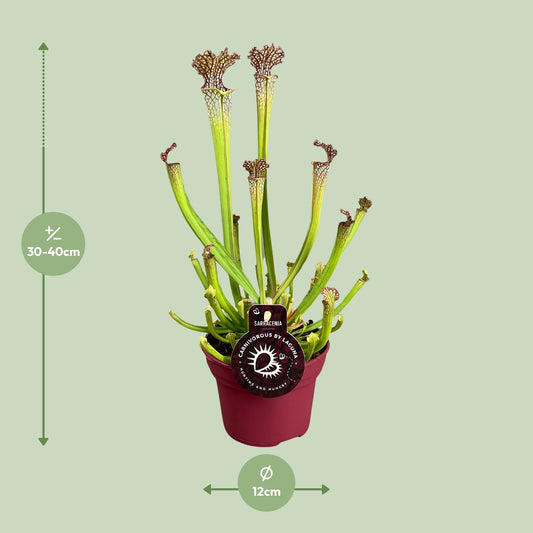
Sarracenia × farnhamii - Sarracenia, carnivorous plant - 12 cm pot - Height 40 cm
Regular price From 44,95 €Regular price -

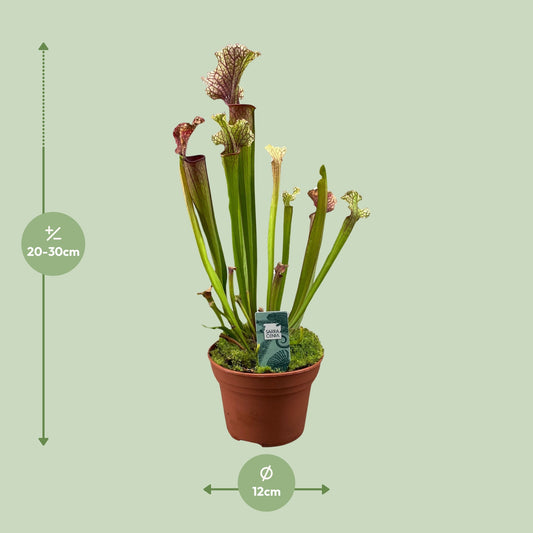
Sarracenia 'Judith Hindle' - Hybrid Sarracenia, carnivorous plant - 12 cm pot - Height 30 cm
Regular price 44,95 €Regular price -

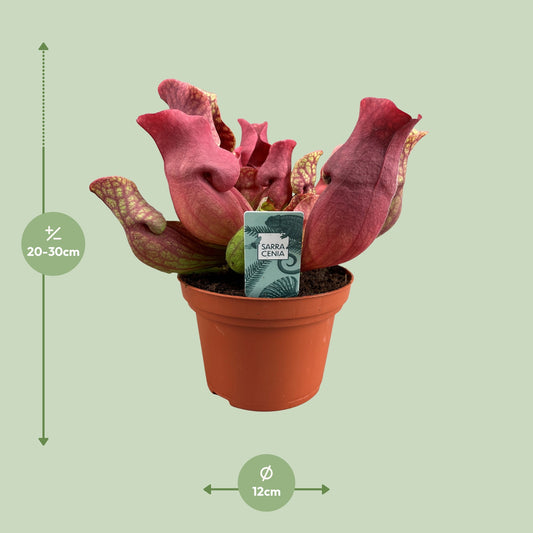
Sarracenia 'Maroon' - Maroon pitcher plant, carnivorous plant - 12 cm pot - Height 23 cm
Regular price 44,95 €Regular price -

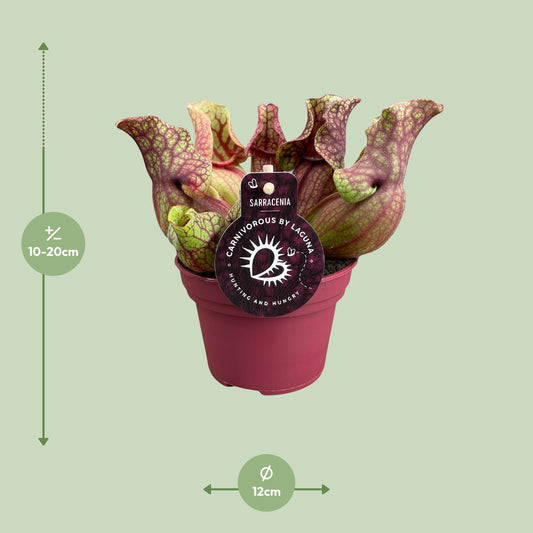
Sarracenia purpurea subsp. venosa - Purple pitcher plant, carnivorous plant - 12cm pot - Height 20cm
Regular price 44,95 €Regular price -

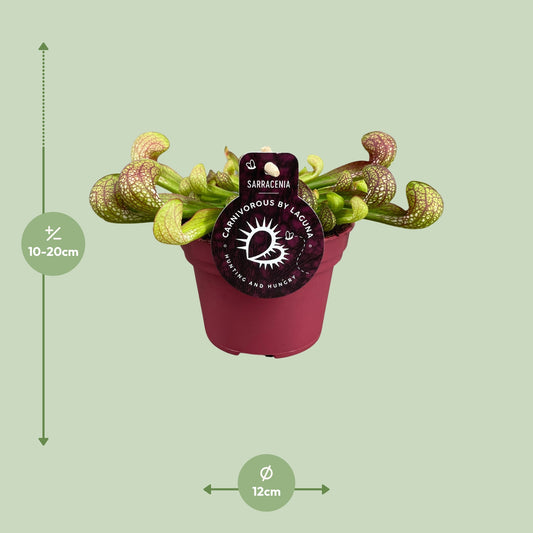
Sarracenia psittacina - Parrot's beak, carnivorous plant - 12 cm pot - Height 13 cm
Regular price 44,95 €Regular price -

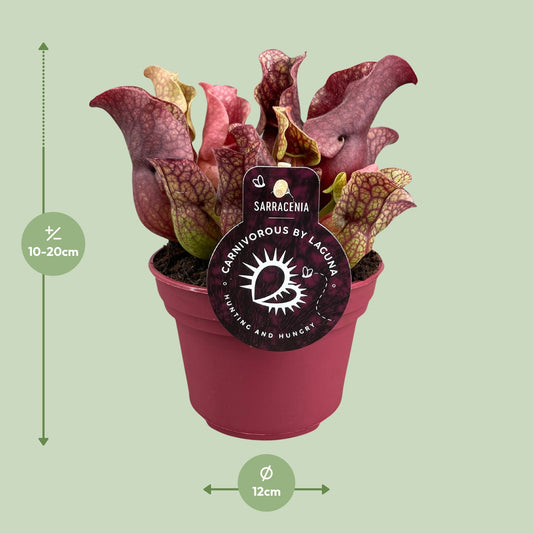
Hybrid Sarracenia with red pitchers - Red Sarracenia, carnivorous plant - 12 cm pot - Height 20 cm
Regular price 44,95 €Regular price -

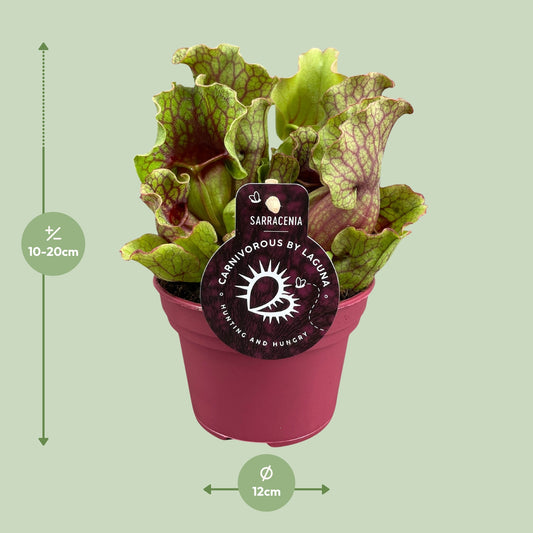
Green urn hybrid Sarracenia - Green Sarracenia, carnivorous plant - 12cm pot - Height 20cm
Regular price 44,95 €Regular price -
Live sphagnum moss - Sphagnum moss for plants - Sphagnum moss - Live sphagnum moss for plants
Regular price 9,50 €Regular price8,50 €Sale price 9,50 €



🧭 In a pot, in a bog, or by the edge of a pond: what setup?
The best setup depends on your space and your climate: a pot on a tray for a balcony, a garden bog for a collection, a shallow pond edge if you have one. Let's be honest: indoors is only suitable for a short period, on the brightest windowsill.
| Your situation | The right method |
|---|---|
| South-facing balcony or terrace | Pot with drainage holes in a tray of rainwater, among your plants for balcony and terrace |
| Garden bog | Pit lined with a perforated butyl liner, filled with nutrient-poor, moist substrate (RHS) |
| Pond edge | Pot placed in the shallow margin of a pond, as recommended by the RHS |
| Region with harsh winters | S. purpurea and its hybrids; pot buried up to the rim in a sheltered place (Missouri), bell in case of hard frost (RHS) |
| Mild or coastal climate | S. flava, S. leucophylla, Venosa and Psittacina, to be protected only from hard frosts |
| Windowsill | Only for a few weeks, on the brightest windowsill, shade during hot hours: the RHS warns that leaves can burn behind the glass |
| No sunny outdoor space | Prefer a tropical indoor carnivorous plant like Nepenthes |
📐 Winter dormancy: the rest that makes sarracenia last
A sarracenia needs a true cold dormancy every winter: this is what allows it to grow vigorously again in spring. NC State specifies that Sarracenia flava goes into dormancy from autumn to spring and that it needs cold winter temperatures for this.
The Missouri Botanical Garden explains that this need for a cold winter is the reason why S. purpurea often fails as an indoor plant. UC Davis adds that dormancy, triggered by the decrease in light and temperatures, begins in late autumn and lasts 3 to 5 months: a heated and lit room deprives it of this signal.
During dormancy, the RHS recommends keeping the substrate moist rather than waterlogged and draining off excess water. Our product sheet recommends dormancy between 0 and 10°C, outdoors sheltered or in a cold and bright room. The pitchers that turn brown in autumn are normal: only cut off dead tissue, as recommended by NC State and Missouri.
For hard frosts, follow the steps in our guide to protect your plants from frost.
📐 Sarracenia and Asian hornets: what science really says
A sarracenia catches insects, including Asian hornets, but it does not allow for fighting them. A French team (Marie-Anne Wycke, Romaric Perrocheau and Eric Darrouzet) tested two hybrids, 'Juthatip Soper' and 'Evendine', during the 2015 and 2016 seasons.
Published in 2018 in the journal Rethinking Ecology, the study concludes that the plants mainly trapped flies, attracted few hornets, and are not selective. The authors believe that they are not suitable for mass trapping and point research toward pheromone-based baits. So grow your sarracenia for its beauty and curiosity, not as a hornet trap.
📐 When sarracenia flowers and how to enjoy the flowers
Sarracenia flowers in spring, often before or during the emergence of the first pitchers, with solitary and drooping flowers in an inverted umbel shape. The RHS describes purple flowers 5 cm long in S. purpurea, held well above the pitchers.
NC State notes that S. psittacina flowers from March to June, before the formation of the first pitcher, and that the yellow flowers of S. flava give off a musk scent. A young plant does not necessarily flower: the RHS estimates 2 to 5 years for a S. purpurea to reach its adult size, and 5 to 10 years for S. flava.
If you want to sow, know that the seeds need a period of cold before germinating (NC State).
📐 Sarracenia: a danger to animals? Toxicity and protection
The ASPCA (American Society for the Prevention of Cruelty to Animals) does not publish a sheet for sarracenia and NC State does not mention any toxicity: we cannot therefore conclude on its danger to animals.
For its cousin from the same family, Darlingtonia californica, the ASPCA states "Non-Toxic to Dogs, Non-Toxic to Cats, Non-Toxic to Horses". Its wild populations are, however, threatened: always buy cultivated plants.
On its S. flava sheet, NC State estimates that 97.5% of the habitats of sarracenia in the southeastern United States have been destroyed, that some species are threatened, and that S. purpurea is protected in the wild.
According to POWO (Plants of the World Online, Kew), S. purpurea has become naturalized in bogs in Ireland, after planting, and in Switzerland: never plant it in a natural wetland.
CITES (Convention on International Trade in Endangered Species of Wild Fauna and Flora) also regulates its trade: the CITES list of carnivorous plants published by Kew in 2001 lists the genus in Appendix II, and S. oreophila, S. jonesii and S. alabamensis subsp. alabamensis in Appendix I at its publication.
🗓️ Caring for a sarracenia throughout the seasons
A sarracenia lives according to the seasons: flowering and new pitchers in spring, full growth in summer, entering dormancy in autumn, and cold rest in winter. NC State recommends waiting until spring, just before the appearance of the flowers, to remove the browned foliage.
📅 Seasonal Care Calendar
| Season | Key Action |
|---|---|
| 🌸 Spring | Remove dry pitchers just before flowering, repot or divide if the clump is overflowing, flowering, restart the rainwater tray |
| ☀️ Summer | Full sun, 2.5 to 5 cm of rainwater in the saucer, monitor for aphids and mealybugs on young shoots (RHS) |
| 🍂 Autumn | Growth slows, pitchers turn brown: this is the start of dormancy, leave the plant outside |
| ❄️ Winter | Cold rest, just moist substrate and empty saucer; pot buried or covered during hard frosts |
🐛 The Mistakes That Kill a Sarracenia
The mistakes that kill a Sarracenia are almost always the same: hard water, overly rich substrate, and a warm winter. Here is how to avoid them.
| Mistake | Why It's a Problem | The Solution |
|---|---|---|
| Watering with Tap Water | The chemicals in tap water, especially hard water, can be toxic to it (RHS) | Rainwater, melted snow, or distilled water (USBG): install a rain barrel and see how to collect and use rainwater |
| Planting in Potting Soil or Garden Soil | Too rich: the RHS states that it dies from it | Peat or sphagnum with sand or perlite, without fertilizer |
| Fertilizing | Fertilizers can burn it (NC State) | Add nothing: it feeds on the insects it catches |
| Feeding It Meat | Carnivorous plants do not digest complex proteins (USBG) | Let it hunt on its own outside |
| Wintering in a Heated Living Room | Without cold or reduced light, there is no dormancy (UC Davis, Missouri) | Outside in shelter or in a cold, bright room |
| Leaving the Tray Full in Winter | Contrary to RHS advice: moist substrate, not waterlogged | Empty the saucer and discard excess water |
| Cutting Still-Green Pitchers | They are still feeding the plant | Only cut dead tissue (NC State, Missouri) |


🌿 Our Sarracenia and Everything You Need to Succeed
Our Sarracenia is grown outdoors, and the substrates below allow you to create the lean mix it requires.
| Our Selection | Why Choose It |
|---|---|
| Sarracenia, 7 Varieties | Sarracenia in a 12 cm pot: Farnhamii (40 cm, or in a set of 2), Judith Hindle (30 cm), Maroon (23 cm), Venosa (20 cm), Psittacina (13 cm), red-pitcher hybrid and green-pitcher hybrid (20 cm). Venosa is the most cold-sensitive subspecies (H3): protect it from hard frosts |
| Live Sphagnum | The basis of the RHS peat-free mix: our live sphagnum, also available in a pack of 3 bags; see our live sphagnum guide |
| Perlite | Our horticultural perlite lightens and aerates the peat or sphagnum mix |
| Pine Bark | Our maritime pine bark for top dressing: the RHS recommends pine bark to retain moisture in outdoor pots |
| An Indoor Carnivorous Plant | For a room with no outdoor access, our Nepenthes 'Gaya', featured in our carnivorous plant guide |
| outdoor plants | All our garden plants, including our full sun plants, our balcony and patio plants, and our rare plants |
🔑 Repotting and Dividing a Sarracenia
Repot a Sarracenia when the roots fill the pot, into a container just slightly larger, just before spring growth resumes. The RHS states that a potted plant does not need to be repotted before a year or more.
This is also the time to divide: the RHS mentions dividing large clumps, rhizome cuttings, and sowing, while NC State recommends dividing rhizome offsets. If you have had to use tap water, the RHS recommends replacing the substrate every six months.
These plants share a preference for acidic soil with ericaceous plants, but require an even leaner mix: never use enriched ericaceous soil.
✅ Our Tips for Growing a Successful Sarracenia
To grow a successful Sarracenia, grow it outdoors in full sun, in a pot placed on a rainwater tray, with a lean, unfertilized substrate. Let it experience winter cold, choose the species according to your climate, and protect flava, leucophylla, Venosa, and Psittacina from hard frosts. Find it again with our outdoor plants.
For me, Sarracenia is the most beautiful introduction to carnivorous plants, on one condition: treat it as an outdoor plant. I always recommend starting with a hardy hybrid or a purpurea, on a well-exposed balcony, with a large rainwater tray. And I emphasize winter: it is the cold that creates the beauty of the pitchers the following spring.

Laura Bruneau
Jardinière & autrice


