

Fittonia (Fittonia albivenis): care, watering, and terrariums

To care for a Fittonia, place it in bright light but out of direct sun, keep its potting mix just moist without ever waterlogging it, maintain a temperature above 17°C, and provide humid air, ideally under glass. Fittonia, whose botanical name is Fittonia albivenis, is the mosaic plant with white, pink or red veins that you find in almost every terrarium.
You may also see it written as fitonia, fitonnia or phytonia. This guide revisits our advice, checking each point against the RHS (Royal Horticultural Society), NC State Extension and Kew. If you’re putting together a jar, our guide to plants for closed or open terrariums complements this page.
🌿 Fittonia, the terrarium’s star mosaic plant
Fittonia gets its nickname, mosaic plant, from the network of pale veins crisscrossing its green leaves; English speakers call it a nerve plant. Its success in terrariums comes down to three traits: it stays low, grows slowly and needs humid air. The RHS considers humid air essential and lists the bathroom or terrarium as suitable locations.
Mississippi State University Extension lists it among the plants suited to both open and closed terrariums.
That’s why it features in most of our terrarium kits, starting with the closed terrarium kit with Fittonia and fern, a 19 cm-diameter jar sealed with a cork stopper.
| Benefit | What it means for you |
|---|---|
| Striking foliage | White, pink or red veins on green foliage (NC State): a pattern you can see from across the room, even on a small plant |
| Compact size | Up to about 20 cm tall according to NC State: it fits on a desk or at the back of a jar |
| Made for terrariums | It likes the humid air retained by glass (RHS) and grows slowly, without taking over the arrangement |
| Pet-safe | The ASPCA lists it as non-toxic to dogs and cats, a real plus in a shared room |
🔎 Fittonia at a glance
Here is the verified profile of Fittonia. According to Plants of the World Online, Kew’s database, the accepted name is Fittonia albivenis (Lindl. ex Veitch) Brummitt: Fittonia verschaffeltii and Fittonia argyroneura, still common on plant labels, are just synonyms.
So the Fittonia verschaffeltii at your garden centre is the same species and needs the same care. Information on its growth habit, size and flowering comes from NC State Extension (North Carolina State University), which describes it as an evergreen creeping perennial from the tropical forests of South America; albivenis means “white-veined.”
| Feature | Verified details |
|---|---|
| 🏷️ Botanical name | Fittonia albivenis (Lindl. ex Veitch) Brummitt; synonyms F. verschaffeltii and F. argyroneura (Kew) |
| 🧬 Family | Acanthaceae |
| 🌳 Type | Small evergreen creeping perennial, a subshrub from humid forests, grown indoors |
| 🌍 Native range | Bolivia, northern Brazil, Colombia, Ecuador, Peru and Venezuela (Kew POWO) |
| 🍃 Foliage | Elliptical (RHS), green, with white, pink or red veins depending on the form (NC State) |
| 🌸 Flowers | Small spikes of cream-white flowers hidden by bracts, in July and August; rare indoors (NC State) |
| 📏 Size | Up to 8 inches (about 20 cm) tall, with a spread of about 45 cm (NC State) |
| ⚠️ Toxicity | Non-toxic to dogs, cats and horses (ASPCA, Nerve Plant) |
📋 Quick care facts
Essential growing guidelines, all in one place.
| Care factor | Guideline |
|---|---|
| Light | Bright, indirect light; tolerates artificial light well (NC State); never direct sun |
| Watering | Keep the potting mix just moist, never waterlogged; barely moist in winter (RHS) |
| Potting mix | Peat-free houseplant potting mix that retains moisture (RHS); shallow pot with drainage holes |
| Humidity | Humid air is essential according to the RHS: terrarium, bright bathroom or grouped plants |
| Temperature | Above 17°C (RHS); greenhouse or indoors year-round, H1A rating requiring temperatures above 15°C |
| Repotting | Shallow roots mean a small pot is enough (NC State); repot in spring if the plant outgrows it |
| Fertilizer | Balanced liquid fertilizer once a month during the growing season (RHS) |
| Toxicity | Non-toxic to dogs and cats (ASPCA) |
| Difficulty | Easy if the air is humid; sensitive to dry air, drafts and overwatering |
📍 Where to place a Fittonia: light, temperature, indoors or outdoors
Place your Fittonia in a bright room, near a window but out of direct sunlight. The RHS recommends a bright position without direct sun, which burns the leaves, and a temperature that stays above 17°C, away from cold drafts.
NC State Extension recommends bright to medium light and notes that the plant grows well under artificial lighting, which is useful for a desk or a terrarium fitted with an LED lid. Fittonia indoors or outdoors?
In France, it is an indoor plant all year round: the RHS rates its forms H1A, meaning they should be grown under cover above 15°C, and NC State considers it hardy only in USDA zones 11 and 12, which have tropical climates.
☀️ Ideal location: Near an east- or west-facing window, or set back from a south-facing window behind a sheer curtain; it does very well in a bright bathroom.
📅 When to move it: In spring, when growth resumes; in winter, keep it away from cold windows and radiators that dry out the air.
🏡 Fittonia outdoors? No, except in a tropical climate: below 15°C (the RHS H1A threshold), it suffers. Even in summer, a balcony exposes it to dry air and wind.
🪴 Fittonia in a terrarium or pot: how to plant it
Fittonia grows in both pots and terrariums; in either case, the potting mix should stay moist but never waterlogged. For potted plants, the RHS recommends peat-free houseplant potting mix that retains moisture, in a shallow container, and NC State notes that its shallow roots do well in a small pot.
For a closed terrarium, Penn State Extension (Pennsylvania State University) recommends a low-fertility potting mix with a handful of charcoal, kept out of direct sun, and notes that a layer of pebbles is no longer considered useful for drainage.
To understand condensation, read our guide to terrarium humidity and condensation.
| Step | What to do |
|---|---|
| 1. Choose a container | A clear jar with a lid for a closed terrarium, an open bottle for more ventilation, or a small pot with drainage holes |
| 2. Prepare the potting mix | Mix a little charcoal into low-fertility potting mix (Penn State), moisten it slightly and add enough to match the height of the largest root ball |
| 3. Plant | Place taller plants at the back and the low-growing Fittonia at the front, leaving space by the sides of the container (University of Vermont) |
| 4. Water sparingly | Water sparingly, a spoonful at a time (University of Vermont): it’s easy to add more, but hard to remove it |
| 5. Close and observe | A light film of condensation that clears is normal; if water streams down the glass, open the terrarium for a day or two (Penn State) |
columns: 4
columns_mobile: 2
-

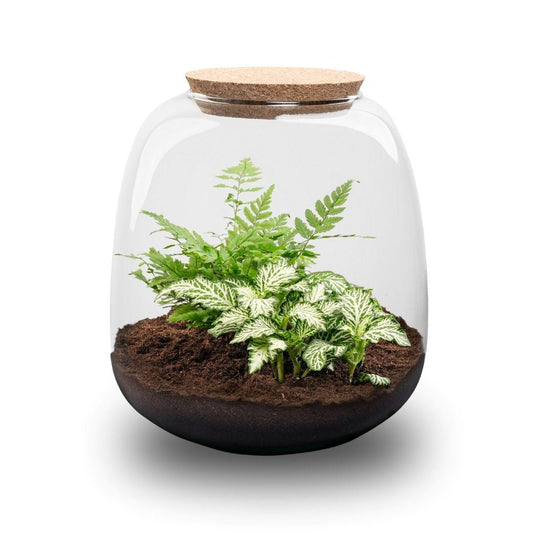
Closed terrarium kit with Fittonia and fern, small glass jar with cork lid, Ø 19 cm, height 20 cm
Regular price 64,95 €Regular price -

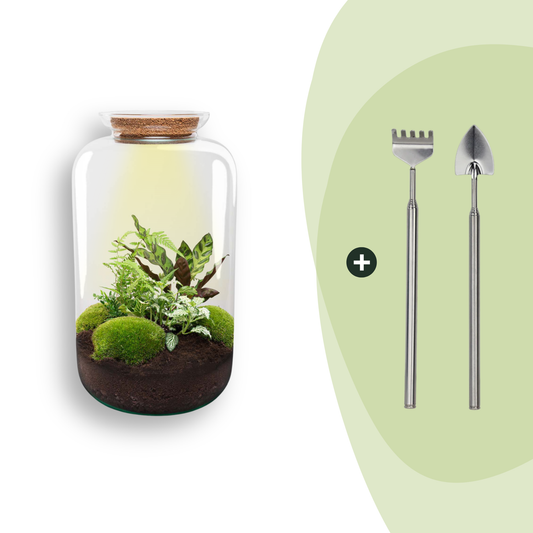
Tall illuminated terrarium kit for Calathea, Fittonia and Asparagus, 43 cm, with or without tools
Regular price From 109,95 €Regular price -


Ficus Ginseng Bonsai and Red Fittonia Terrarium Kit, 25 cm Ø Globe Jar, with or without tools
Regular price From 99,95 €Regular price -

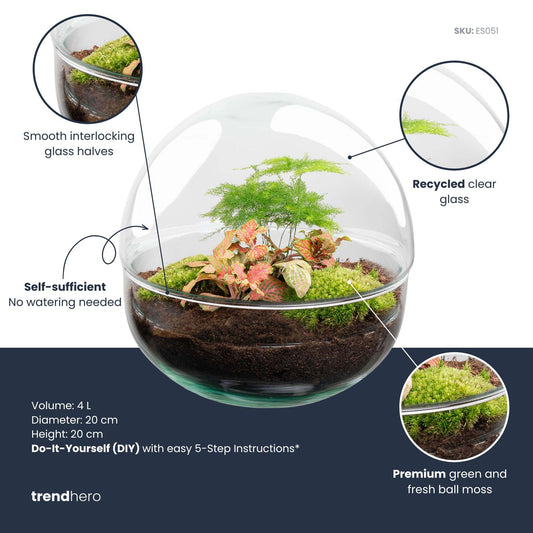
Glass sphere terrarium kit, Ø 20 cm, with Fittonia and Asparagus, with or without tools
Regular price From 89,95 €Regular price -

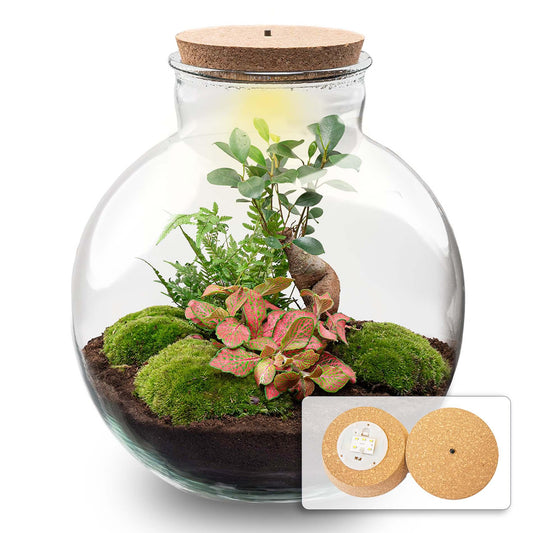
Large Ficus Ginseng bonsai and Fittonia terrarium kit, Ø 31 cm jar, with tools or LED stopper
Regular price From 104,95 €Regular price -

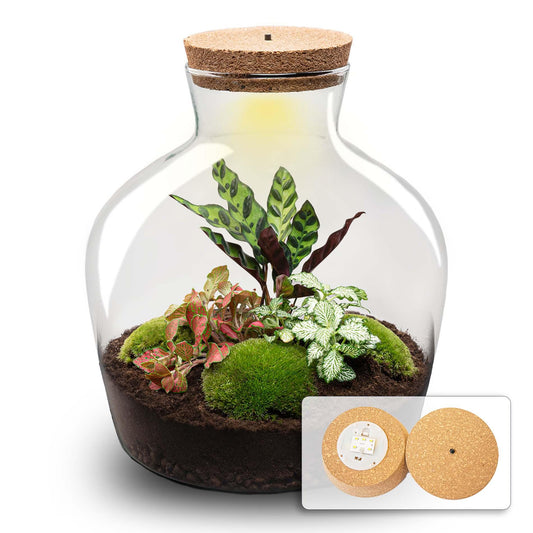
Large illuminated Calathea and Fittonia terrarium kit, 29 cm diameter jar with LED stopper, with or without tools
Regular price From 104,95 €Regular price -

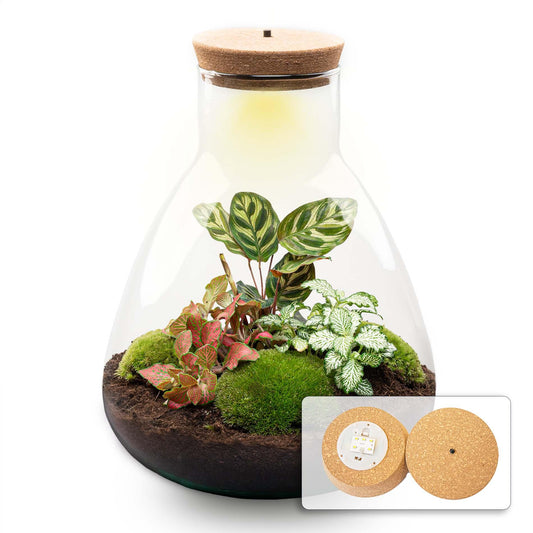
Luminous Calathea and Fittonia terrarium kit, Erlenmeyer flask with LED stopper, 30 cm high
Regular price From 104,95 €Regular price -


Illuminated bonsai Ficus Ginseng and Fittonia terrarium kit, glass bottle with LED cork, 25 cm high
Regular price 79,95 €Regular price


✂️ Fittonia care: watering, humidity, fertilizer and pruning
Caring for Fittonia indoors, a tropical understory plant, is all about balance: potting mix that stays slightly moist, humid air, but never standing water. The RHS sums up watering this way: keep the potting mix moist without waterlogging it.
Fittonia is known for its fainting effect: when it needs water, it droops dramatically, then perks up after a thorough watering, as the RHS and NC State explain. This is a useful signal, but don’t let it happen repeatedly: every bout of wilting stresses the plant. Conversely, NC State links overwatering to root rot and yellowing leaves.
💧 Watering: Feel the potting mix: when the surface dries out, water until the whole root ball is moist, then empty the saucer. In a pot, you’ll need to water more often than in a closed terrarium, where water circulates in a short cycle.
🔹 Wilting plant: Leaves and stems suddenly droop while the potting mix is dry: water thoroughly and the plant will generally perk up quickly (RHS). If the mix is moist but the plant is limp, suspect root problems instead.
💧 Humidity without misting: Opt for a terrarium, a bright bathroom or a group of plants placed on a tray of moist pebbles. NC State also notes that overly saturated air can make leaves wilt: air out a jar if water is running down the glass.
🌱 Fertilizer: For a potted Fittonia, apply balanced liquid fertilizer once a month during the growing season (RHS). In a closed terrarium, Penn State recommends waiting a year before adding any, then using a quarter-strength dose.
✂️ Pruning and pinching: Pinch the stem tips to keep the plant bushy (NC State), and cut back stems that touch the glass or become leggy, cutting just above a node. You can also pinch off flower buds to keep the plant compact.
🍂 Fittonia through the seasons
Growth resumes in spring: this is the time to repot if needed, resume fertilizing potted plants, pinch back the stems and take cuttings. In summer, pay particular attention to watering and direct sun, which is even more dangerous behind terrarium glass, where heat builds up, according to Mississippi State.
Fittonia also flowers in summer: small cream-white flower spikes appear in July and August, according to NC State, but are rare indoors. In autumn and winter, the RHS recommends keeping the potting mix barely moist; dry air from the heating becomes the main concern. Should you mist it?
Our article on misting: useful or not? explains why we prefer other solutions.
📅 Seasonal care calendar
| Season | Key task |
|---|---|
| 🌸 Spring | Repot if needed, resume monthly feeding, pinch back and take cuttings |
| ☀️ Summer | Keep the potting mix just moist, avoid all direct sun; discreet flowers in July and August |
| 🍂 Autumn | Water less often, stop fertilizing and keep it in a bright spot away from drafts |
| ❄️ Winter | Keep above 17°C (RHS), potting mix barely moist and air humid, away from the radiator |
🌱 Propagating Fittonia: stem cuttings or layering
Fittonia is easy to propagate from cuttings, and spring is a good time to do it. The RHS profile for the Argyroneura Group recommends taking tip cuttings with 3 or 4 pairs of leaves in spring, or layering in spring and summer.
NC State notes that creeping stems root on their own when they touch the potting mix: this natural layering makes it possible to take a stem that already has roots. Cut the cutting just below a node, remove the bottom pair of leaves, then plant it in a small pot of moist potting mix, away from dry air, under a cloche or directly in the terrarium.
To choose between water and potting mix, see our guide to propagating in water or potting mix.
🐛 Fittonia problems: wilting plants, dry leaves
A Fittonia that wilts is usually short of water, while dry leaves are most often caused by dry air. NC State describes leaves curling and falling in dry air or drafts, sunscorch from direct sunlight, leaf spots and root rot from overwatering.
The RHS lists glasshouse red spider mite, mealybugs and grey mould, while NC State adds scale insects and slugs. In terrariums, Penn State notes that diseases tend to take hold in the first few weeks: promptly remove any affected parts.
| Symptom | Likely cause | Solution |
|---|---|---|
| Entire plant collapsed, potting mix dry | ⚠️ Thirst: the fainting effect (RHS, NC State) | Water thoroughly; it will generally perk up quickly. Check the potting mix more often |
| Limp plant, yellow leaves, potting mix wet | 🍄 Overwatering, root rot (NC State) | Let it dry out, empty the saucer and repot in fresh potting mix if the roots are brown |
| Curled leaves that fall off | ⚠️ Dry air or drafts (NC State) | Move it away from radiators and windows, group it with other plants or move it to a terrarium |
| Scorched patches, dull colours | ☀️ Direct sun, intensified behind glass | Move the plant or jar out of direct sunlight |
| Grey fuzz on leaves, water running down the glass | 🍄 Gray mold, listed by the RHS among Fittonia diseases | Remove affected leaves and open the terrarium for a day or two |
| Fine webs, cottony clusters | 🐛 Spider mites or mealybugs (RHS) | Isolate the plant, wipe off or remove the pests, and check the undersides of the leaves |


🌸 Fittonia varieties: red, pink, white, green and mini
Commercial Fittonias are forms of the same species, grouped by the RHS according to vein color: the Argyroneura Group for silver veins and the Verschaffeltii Group for red veins, as in the cultivar 'Forest Flame'. They are all grown in the same way. Trade names (Pink, Skeleton, Mix, Lime) are given as they are sold. For a small jar, choose a mini Fittonia: NC State recommends dwarf forms for terrariums.
| Variety | Its appeal |
|---|---|
| Red Fittonia (Verschaffeltii Group) | Dark olive-green leaves with a dense network of bright red veins; 'Forest Flame' grows up to 10 cm tall (RHS). Red Fittonia, also sold as red fittonia, needs the same care as the species |
| White Fittonia (Argyroneura Group) | Bright green leaves with fine silver veins (RHS), described as white or cream depending on the label; albivenis means “white-veined” (NC State) |
| Pink Fittonia (Pink, Pink Forest Flame) | Pink veins, one of the three colors described by NC State; it needs the same care and humid air as other forms |
| Green Fittonia 'Lime' | Trade name for a form with lighter foliage, sold alongside a classic Fittonia in our large 31 cm jar |
| Fittonia 'Ruby' | Trade name, paired with a Fittonia albivenis and a Calathea in our large 29 cm lighted jar; needs the same care as the species |
| Fittonia mix (red and white) | Pairing a red Fittonia with a white one, as in our 30 cm Erlenmeyer jar, creates the most striking mosaic effect; 'Skeleton' is another common trade name |
🎨 Which plants pair well with Fittonia in a terrarium?
Pair Fittonia with plants that share its preference for humidity and filtered light.
Calathea adds height, the polka dot plant (Hypoestes), listed among terrarium plants by University of Vermont Extension, extends the colorful effect, while Asparagus lightens the arrangement, as in our 20 cm glass sphere.
For a scene with a miniature tree, see our Ficus ginseng guide and the open 3-liter bottle terrarium, which is airier than a closed jar.
Without a terrarium, a bright bathroom will do: see our selection of plants for a windowless bathroom and our tips for increasing air humidity.
⚠️ Is Fittonia toxic to cats and dogs?
No. The ASPCA (American Society for the Prevention of Cruelty to Animals) classifies the Nerve Plant, Fittonia verschaffeltii, as non-toxic to dogs, cats and horses. Kew lists this name as a synonym of Fittonia albivenis, so the ASPCA page does indeed refer to our species. NC State Extension also lists it as non-toxic.
Non-toxic does not mean edible: it is best to keep your cat from making a meal of it, and a closed terrarium offers the best protection. To create a pet-safe room, see our list of non-toxic plants for cats.
✅ Our expert tips for success
To grow Fittonia successfully, give it what the tropical forest floor provides: filtered light, soil that stays just moist, temperatures above 17°C and, above all, humid air. If it wilts, water it without panicking; if the leaf edges dry out, the air is what needs adjusting.
A terrarium is the easiest way to maintain humidity, as with our terrarium kits: all you have to do is keep an eye on condensation.
Fittonia is the plant we place in most of our jars because it becomes much easier to care for once it is under glass. In a pot, its wilting can be alarming; in our jars, we see it much less often. My advice: pair a red Fittonia with a white one—the contrast between the veins gives the arrangement all its charm.

Laura Bruneau
Jardinière & autrice


